
The National Electric Fly-In
by T.J. Rohyans
I had just returned from my second year attending the Joe Nall Giant Scale Fly-In and was busy editing photos from the trip when the phone rang. It was Jay Smith, assistant editor of Model Aviation, asking me if I wanted to attend the 2010 National Electric Fly-In (NEFI), to be held June 25–27, and cover it for the magazine. He told me that he couldn't because he was the event CD.
My first thought was, "Sure!" Then I realized that I had used all the vacation time I had until July. "I'll have to think about it and get back to ya," I told Jay. Lucky for me, the young lady I work with was willing to trade some days so I could attend the fly-in. I called Jay back and told him I would be there.
I was excited to go to NEFI when the time came. I grew up in New Haven, Indiana, but I haven't called Indiana home since 1989 and had been back only twice in the last 10 years—both times in the winter. I called my parents, my sister, and my aunt, who all live less than a three-hour drive from Muncie, and I invited them to bring the grandkids. I was doing my part to help them catch the aeromodeling bug.
I had been to AMA Headquarters only once, not long after it had opened in the mid-1990s, and, again, it was wintertime, so there wasn't much to see. My, how things have changed—for the better! The first thing I noticed as I pulled in on Thursday evening was the beautiful AMA Headquarters building. It is separate from the National Model Aviation Museum, unlike the last time I visited. The next thing that struck me was how big and beautiful the International Aeromodeling Center property is—more than 1,000 acres of lush, thick grass, dotted with the few necessary buildings, parking areas, CL pads (including a fenced area for Speed events), and the little house on the hill that serves as Event Headquarters during the Nats. Site 3, where NEFI was to be held, was in the middle of it all.
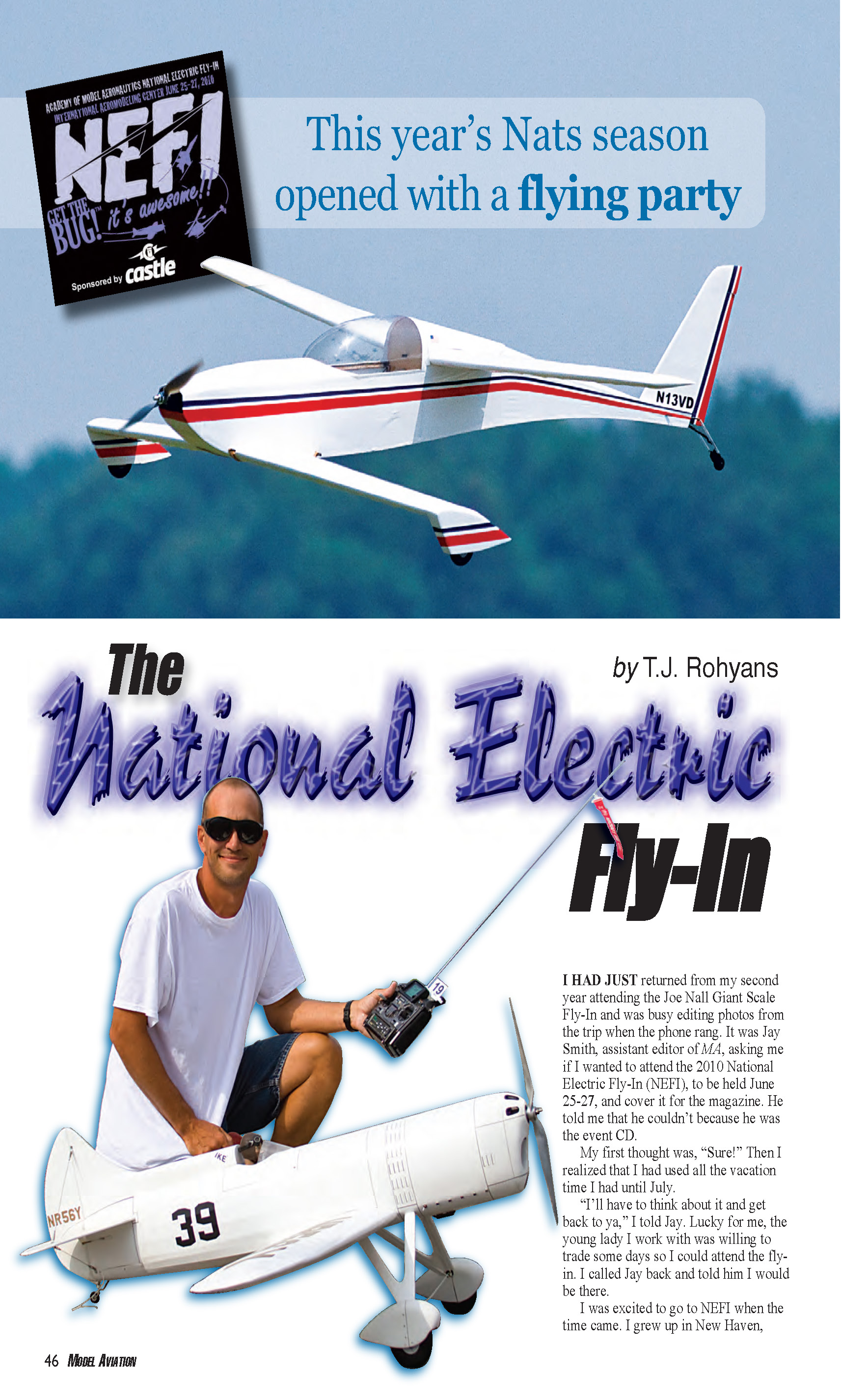
Sandy Frank of the Munsee Skychiefs conceived NEFI four years ago to bring electric-power RC pilots and hobbyists together for a weekend of casual flying and fun. This year the AMA was handed the reins, and it ran with it. CD Jay Smith, co-CD Michael Ramsey, and other AMA staffers and volunteers put forth a great deal of effort to make this a premier event for aeromodelers.
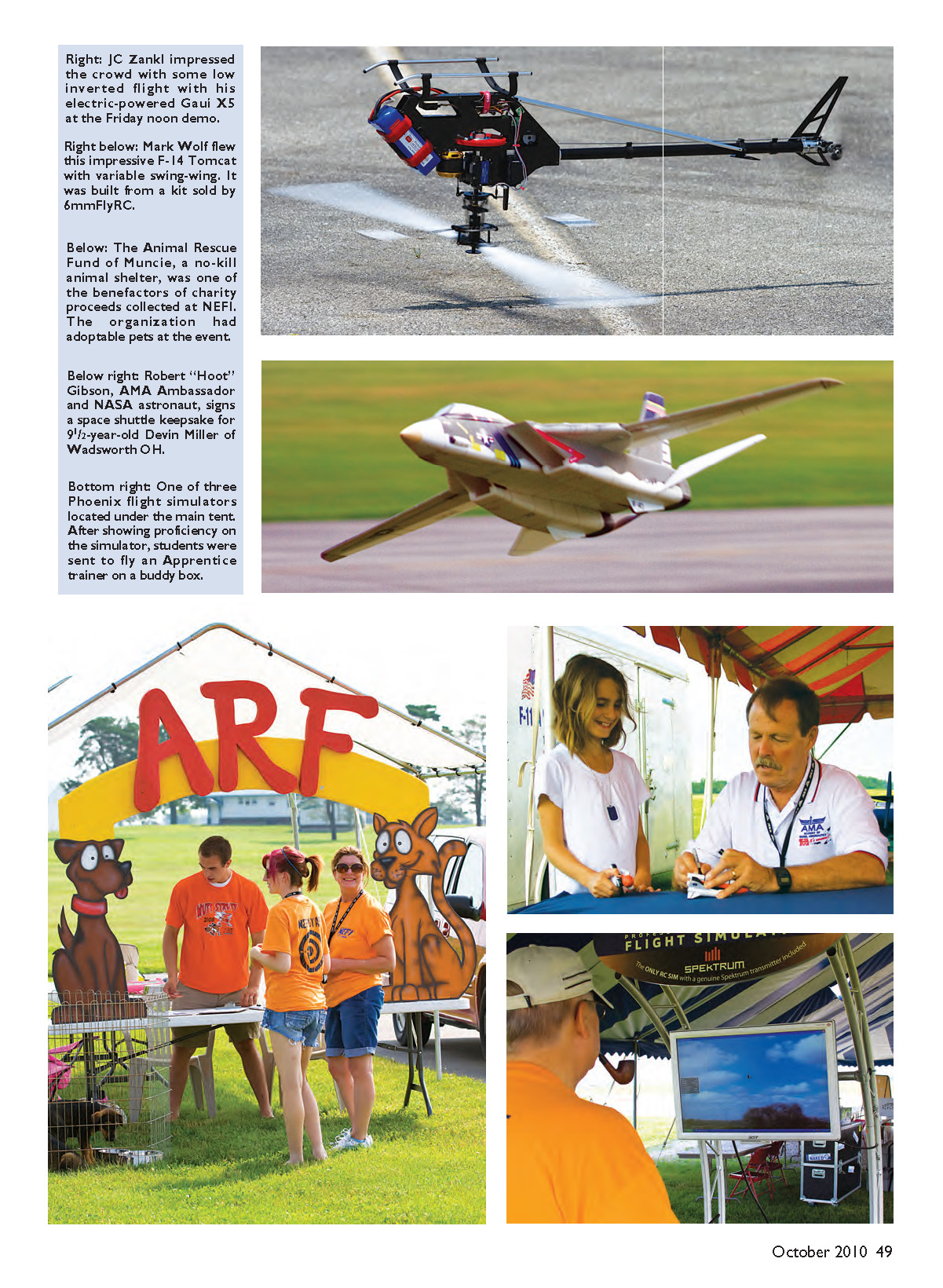
This year's NEFI was also a charity event for two great causes: the Animal Rescue Fund (A.R.F.) of Muncie and the AMA's own museum. Take the hint here; if you want to get in good with your community, hold an event to benefit a local charity. A.R.F. is a no-kill animal rescue association that provides shelter, medical care, love, and hope to abandoned, abused, or neglected animals until they are placed in permanent homes. This group makes every effort, through public awareness, education, and community involvement, to prevent animal cruelty, suffering, neglect, and overpopulation, and to eliminate euthanasia as a form of "animal control." A.R.F. relies on donations of time, money, and supplies to continue its efforts.
A great deal had changed since my first, and only, visit to the National Model Aviation Museum, which also benefited from NEFI. The facility's exhibits cover aeromodeling from the early days of simple hand-launched gliders to today's miniature turbine-powered jets and large models that NASA uses for research and development. Several aircraft on display mark the beginnings of some of the technology we take for granted today.
At the field, tents were up at Site 3 for pilot registration, vendors, flight training, spectators, and a special guest. The paved crosswind runway was a treat for many, and grass-field areas were available (groomed and ungroomed) for those who preferred a softer surface. AMA's first Ambassador—Robert "Hoot" Gibson—was on-site all weekend to meet and greet, sign autographs, and participate in daily flying, which included the full-contact combat event. Vendors' row featured everything a modeler could want or need for the weekend. There were motors, batteries, propellers, LEDs, kits (the flying kind). Many of the companies donated items to the raffle that went on throughout the weekend and participated in the noontime demos on Friday and Saturday.
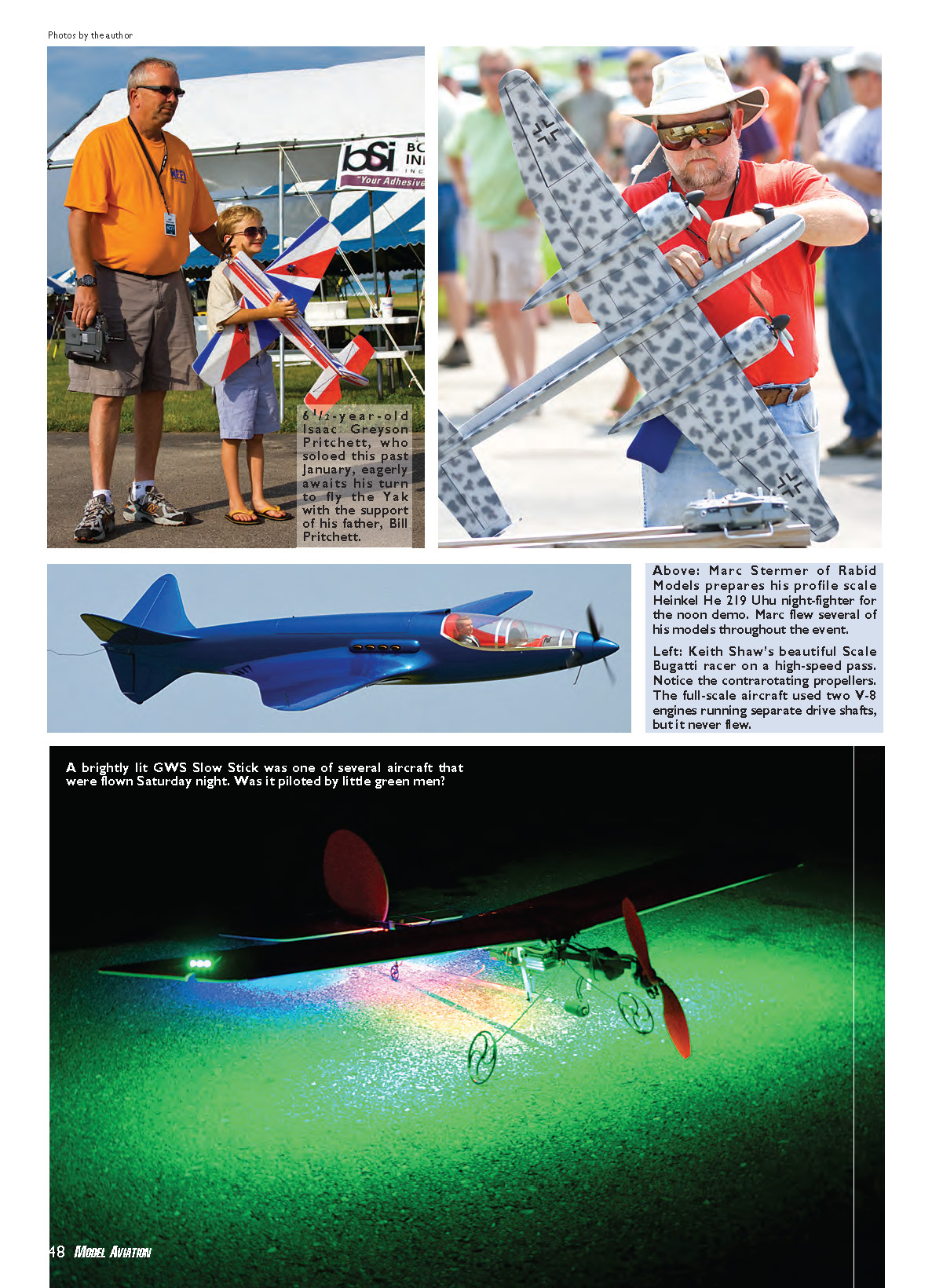
One vendor who caught my eye was Marc Stermer of Rabid Models and his profile-scale warbird foamies. Many of those designs were of World War II–era aircraft, and they looked as realistic up close (which is surprising for a flat foamie) as they did in the air.
I think the best thing I saw was the "Flight Experience" center under the main tent, where three Phoenix flight simulators ran all weekend. They were available for the uninitiated (and experienced modelers) to learn what flying models is all about. Volunteers who staffed the simulators spent time with the participants until they were proficient enough to make a few circuits without crashing. At that point, the beginners would have their hands stamped and be sent to a separate flightline, where they were paired with an instructor. Then they got to fly a real model (the E-flite Apprentice 15E) on a buddy box.
I saw people at the simulators and on buddy boxes all weekend. That's a great way to help people "catch the bug."
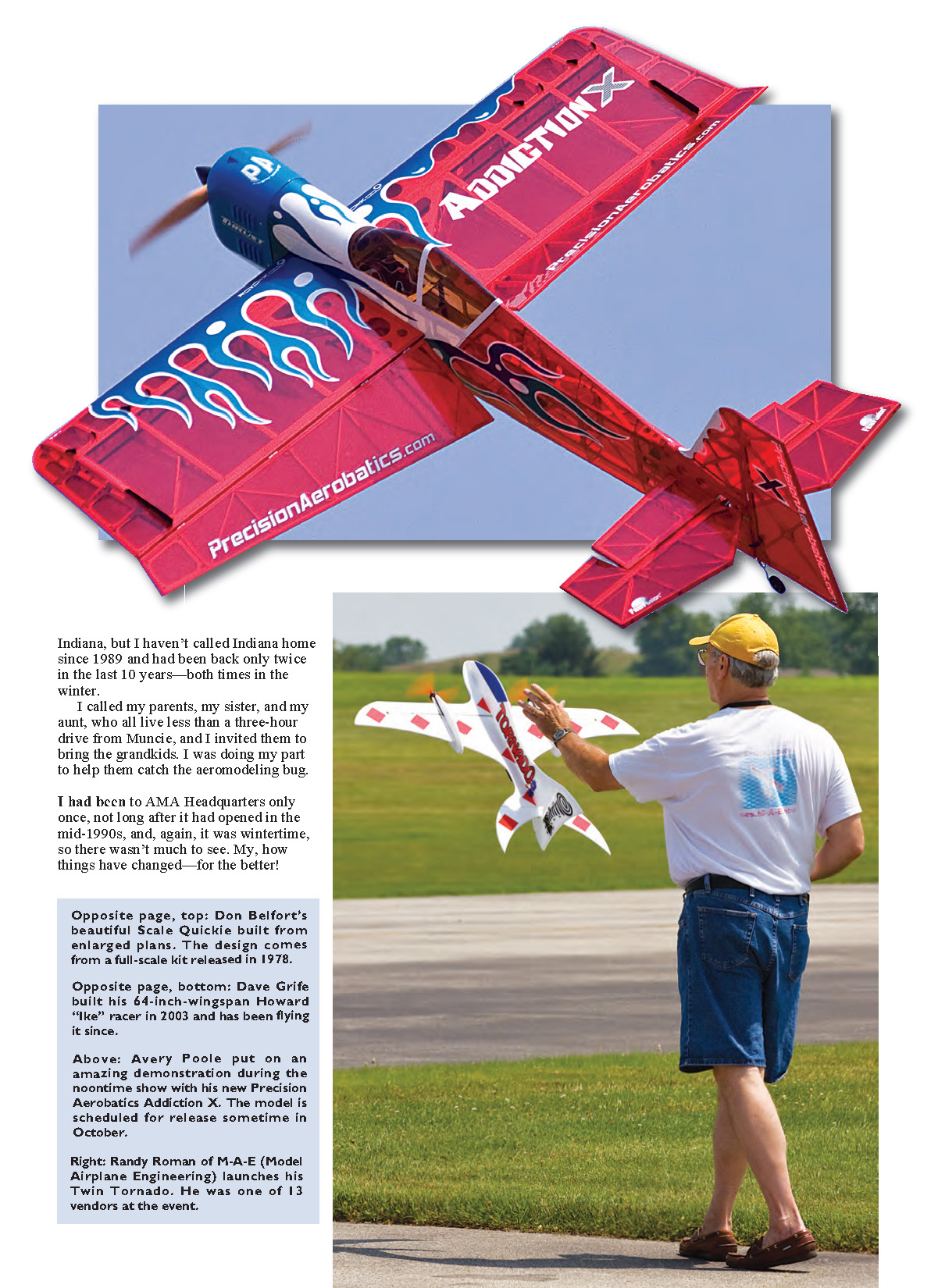
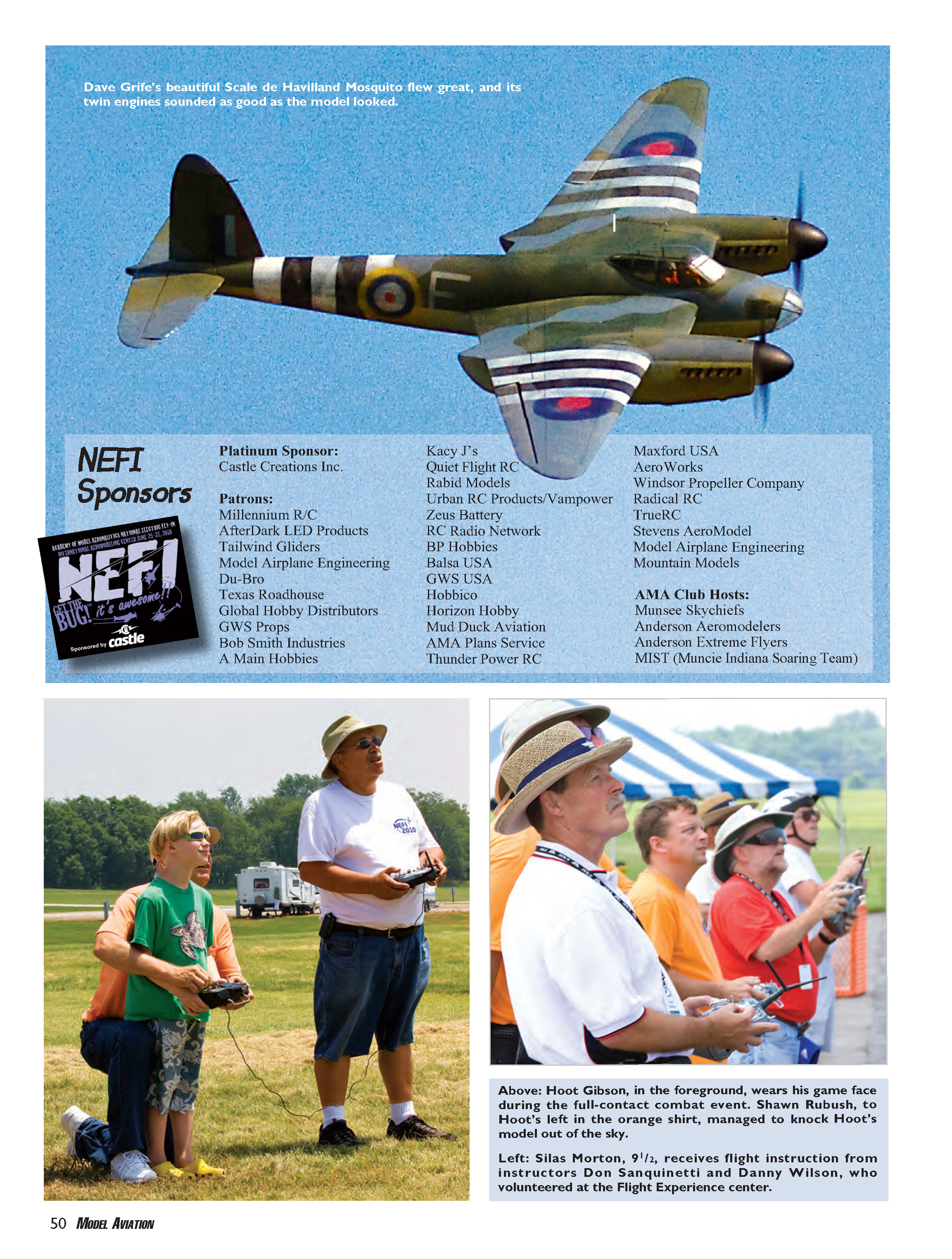
Open flying was the norm. There were daily noontime demos by Avery Poole with Precision Aerobatics, Marc Stermer of Rabid Models, and Bill Stevens of Stevens Aeromodel. Keith Shaw flew his beautiful Bugatti racer, and Dave Grife had his de Havilland Mosquito and "Ike" racer.
A few special events had also been planned. There was a ParkZone Radian sailplane contest on Friday and Saturday, in which six to eight participants took part over a small hill at Site 5. I was hoping to fly in one of those, but I missed both while photographing the events at Site 3.
On Saturday there were two additional contests, one of which was Warbird Pylon Racing. Most entrants flew ParkZone models that were (supposed to be) limited to 1350 mAh batteries.
Then there was "The Main Event": full-contact combat with the AMA Ambassador. Five-time space shuttle commander, former fighter pilot, and active RC modeler Robert "Hoot" Gibson flew an airplane that was donated by GWS Props and customized with graphics by Fast Grafix.
It was a foregone conclusion that Hoot would be the main target during the competition; even he knew it. What surprised many, including himself, was that he managed to keep his model in the air almost to the end. Perhaps that was because of his superior skill as a Miramar TOPGUN alum, or maybe it was the fact that there was a breeze and depth perception is nearly impossible when flying RC airplanes. It was most likely his superior skill.
In the end, the winner was the guy whose aircraft had enough battery capacity to stay airborne. Everyone else's slowly lost power and fell out of the sky.
Also making appearances during the weekend were the Muncie Police Department and Ball State University Police K-9 Units, demonstrating how their dogs are trained to search for illegal contraband and take down fleeing criminals using their strong jaws. (Note to self: Don't become a criminal.)
On Saturday evening all pilots and volunteers were treated to an all-you-can-eat pizza and breadsticks dinner that the AMA provided. That was followed by a slideshow presentation by Hoot, chronicling his life as an aeromodeler and how it coincided with his career as a naval aviator and space shuttle commander.
At one point during his talk, Hoot recalled having to learn Russian for a trip to Space Station Mir. To his surprise, and the amusement of many, one of the modelers at the presentation understood Hoot's Russian. He admitted that it was rusty. That was an entertaining story. Hoot is a great role model for younger generations to admire.
Just because the sun went down didn't mean that the action stopped at NEFI. When the moon (a full moon, by the way) began to rise, night-flying began. AfterDark LED Products donated a lighting kit as a prize for the fan-voted favorite model at the night-fly. (Maybe the winner should have had the airplane with the fewest lights.) Resourceful pilots who didn't have lights on their aircraft used vehicle headlights to illuminate an area in which they could fly.
On Sunday morning a few pilots were out and about getting in some flights, but most were breaking down their camps and preparing for the drive home. For me, that was a long drive back to Mobile, Alabama.
The weekend had turned out great, despite a stronger wind than was hoped for on Saturday. And there was a threat of rain that, thankfully, never materialized.
The official count was 88 registered pilots for this edition of NEFI, and I predict that next year will see double that amount, if not more. I had so much fun that I'm already looking forward to it. I hope to see you at the next NEFI, which is scheduled for June 10–12, 2011.
T.J. Rohyans [email protected]
Sources:
- National Electric Fly-In — www.modelaircraft.org/events/NEFI.aspx
- RCGroups NEFI thread — www.rcgroups.com/forums/showthread.php?t=1228598&page=28#post15448217
Transcribed from original scans by AI. Minor OCR errors may remain.

