
Nats '09
by Jay Smith
A national competition with an international flair
A benefit of our hobby is the great people we meet along the way. Some live near us and we get to see them regularly, while we see others only at fun‑flys or various competitions. In either setting, it is enjoyable to be around people who share our appreciation of aeromodeling, and it is a great way to learn and grow in the hobby.
Those great people include Ron Morgan—director/manager of the Nationals—who celebrated his 50th Nats this year, and his wife, Jane. Others are Al Williamson, Brenda Schuette, Phil Sullivan, and Wayne Yeager, who spend upward of six weeks working days, nights, and weekends to make this event happen.
Add to that all the time spent together before and after the Nats in planning meetings, and you might understand the strong bond that is formed. The same goes for the members of each AMA SIG, since every four or so days of the more‑than‑month‑long event brings a new group of friends.
A bonus of the Nats is that even though it is a national competition, it draws international competitors. This provides American participants the opportunity to interact with distant neighbors and see and hear how the hobby is for those who live outside the U.S.
This year was the 83rd National Aeromodeling Championships. It spanned May 27–31 inside East Tennessee State University’s Mini‑Dome in Johnson City, Tennessee, and June 29–August 2 in Muncie, Indiana, at the International Aeromodeling Center (IAC). In 40 days, 1,022 competitors competed in 154 events that encompassed many facets of CL, Indoor and Outdoor FF, and RC.
The weather this year was some of the best we could have asked for, with little rain and much cooler temperatures than normal in Muncie. The only complaints resulted from a few windy days and the occasional rain shower.
FF (Free Flight)
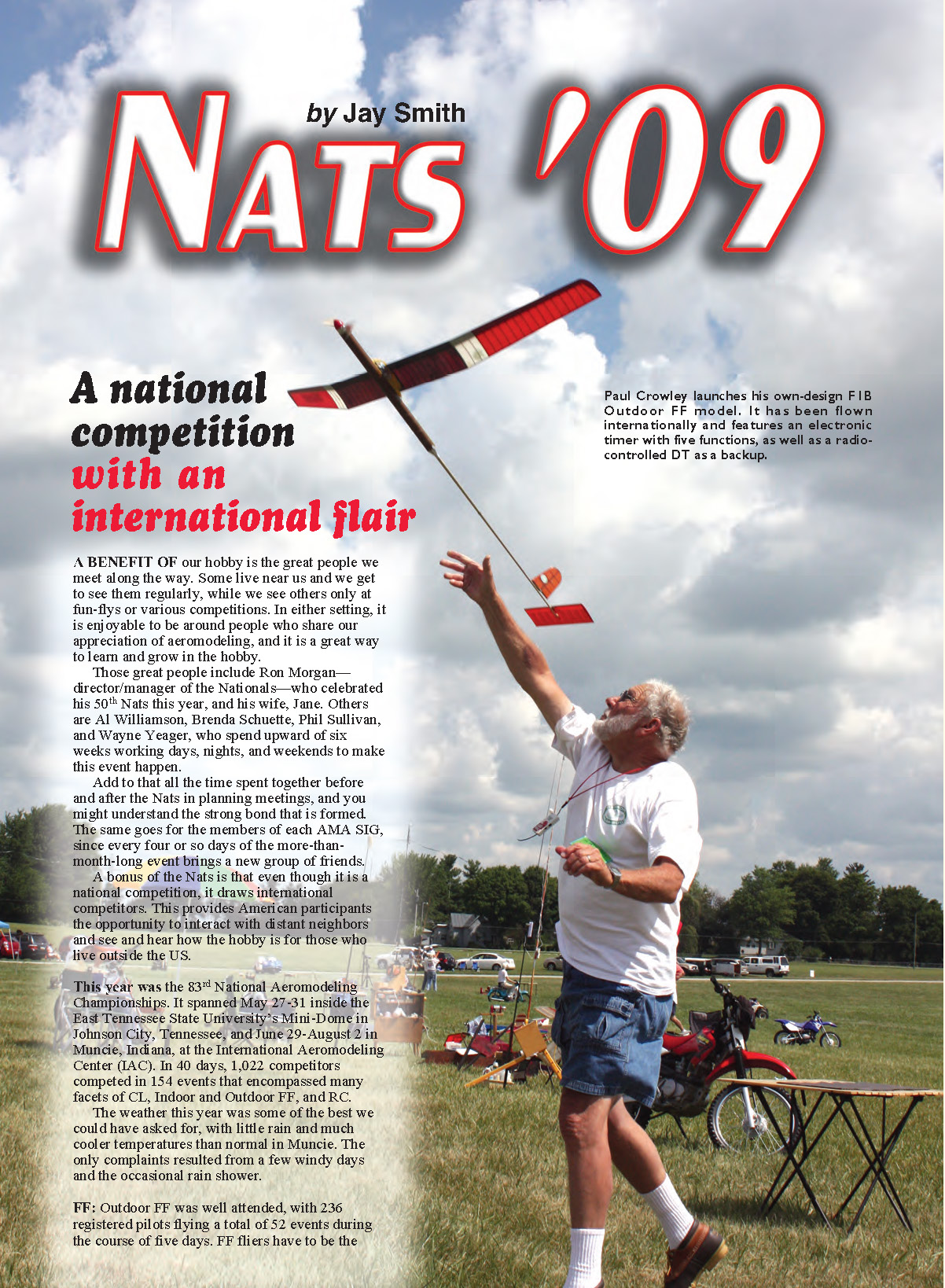
Outdoor FF was well attended, with 236 registered pilots flying a total of 52 events during the course of five days. FF fliers have to be the most mobile bunch at the competition. Methods of model retrieval include on foot, bikes, motorcycles, golf carts, and convertible vehicles on occasion. At times, it seems like retrieval is half the fun of the competition—if the aircraft can be easily retrieved.
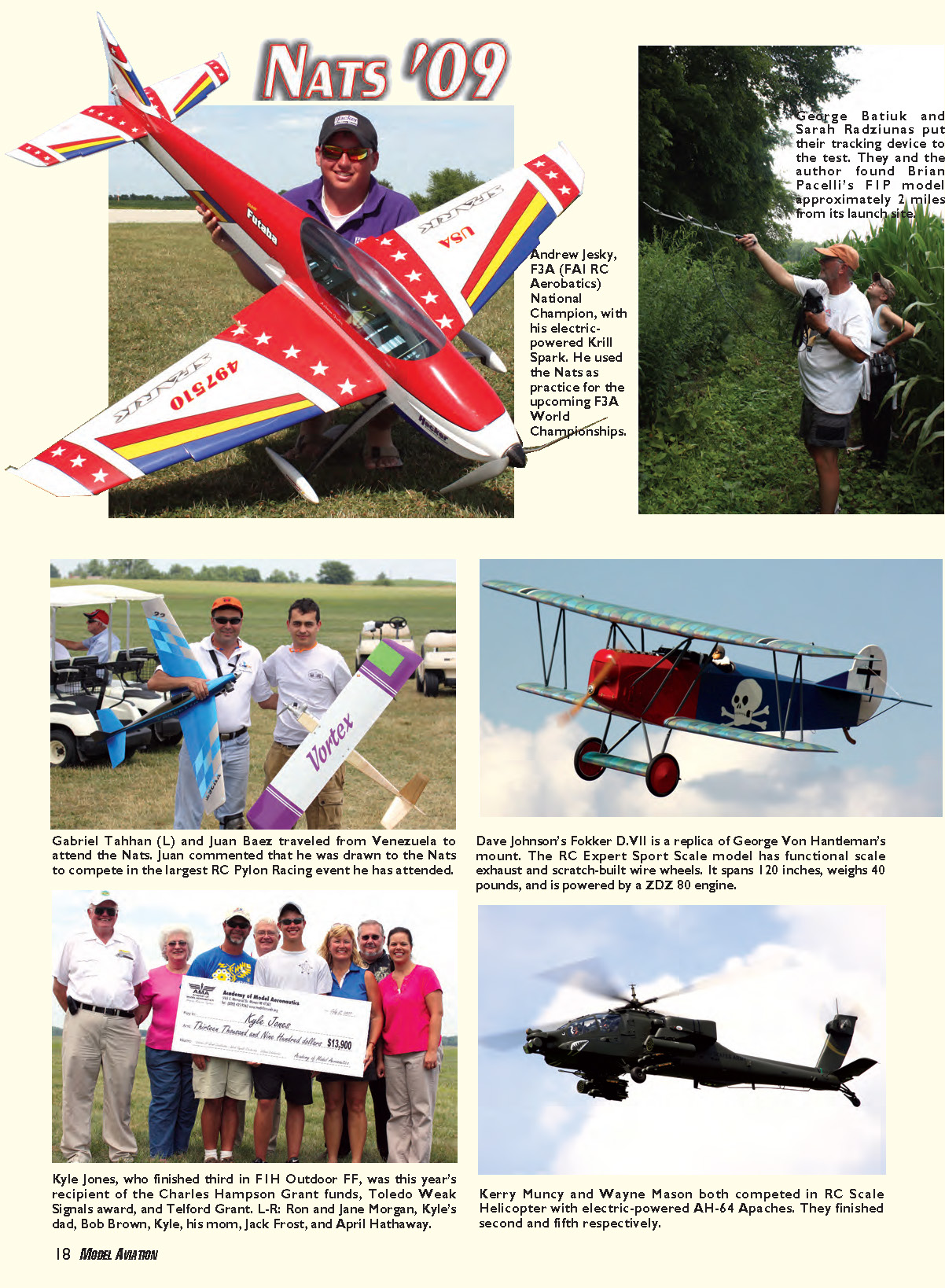
I had the opportunity to go off‑site to help find Brian Pacelli's F1P model, which he was fond of and eager to get back. I was accompanied by veteran FF competitors Sarah Radziunas and George Batiuk. The airplane had a tracking device, and we followed the receiver's reassuring beeps as we made our way roughly two miles from the launch site. We disembarked the vehicle and ventured into a cornfield that was surrounded by thick tree cover and foliage.
With the tracker's help, I spotted a glimmer of the red aircraft high in one of the trees. We marked the location and headed back to let Brian know that we had found his aircraft. Later, he recovered his model with a small monetary incentive to the local tree climber.
RC Soaring and RC Electric
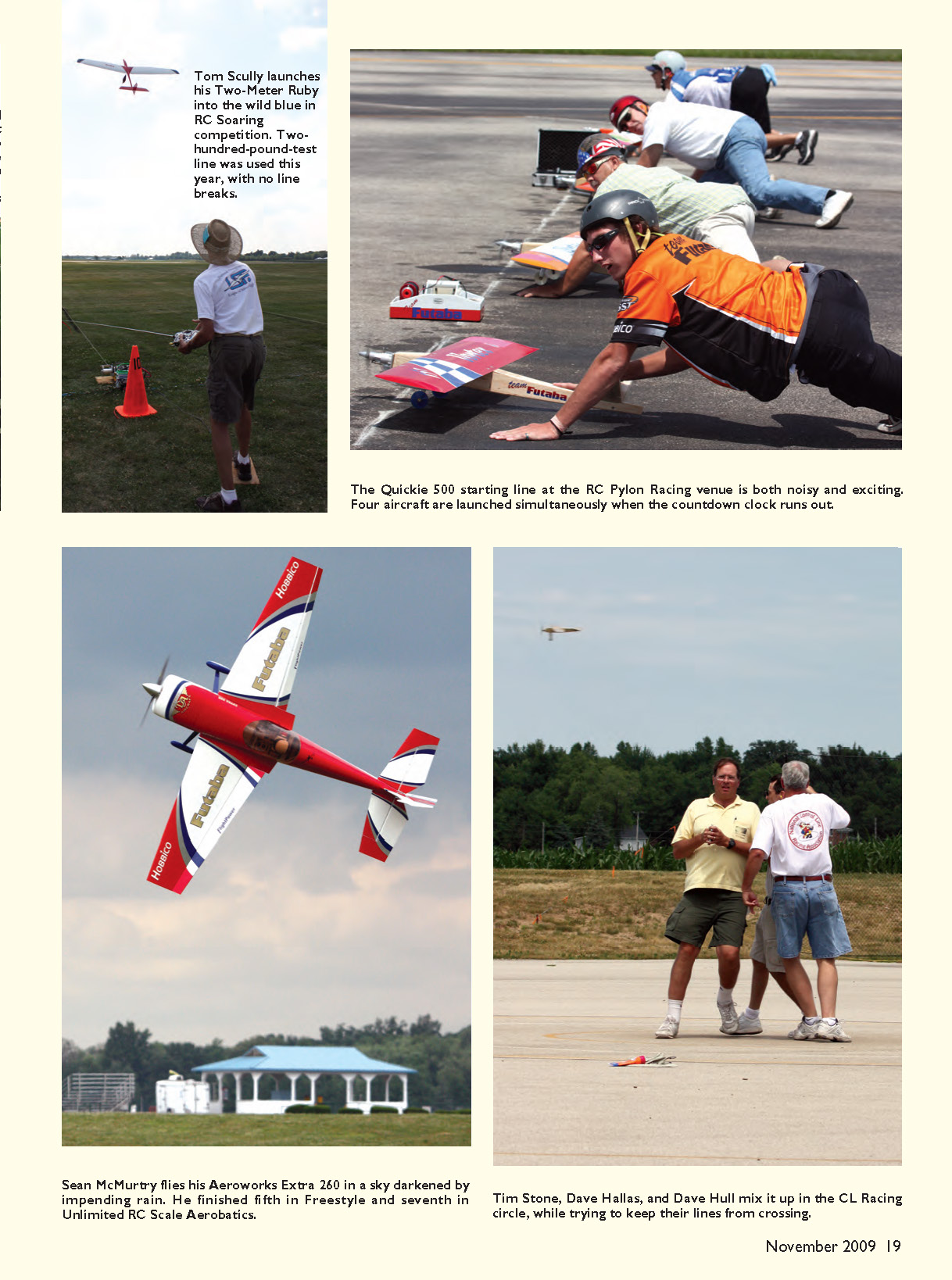
This was the first year of fully integrated RC Soaring events under the direction of the Soaring SIG: the League of Silent Flight (LSF). Soaring and Electric combined for a total of 168 registered pilots flying 12 official events during the course of 12 days.
In Soaring, the Unlimited class had the highest pilot count, followed by RES (Rudder‑Elevator‑Spoiler). This year, 290‑pound‑test line was used for RES and Unlimited, while 200‑pound‑test was used for Nostalgia and Two‑Meter. The line change proved to be good; during the course of the competition, there were roughly 1,800 launches with no line breaks.
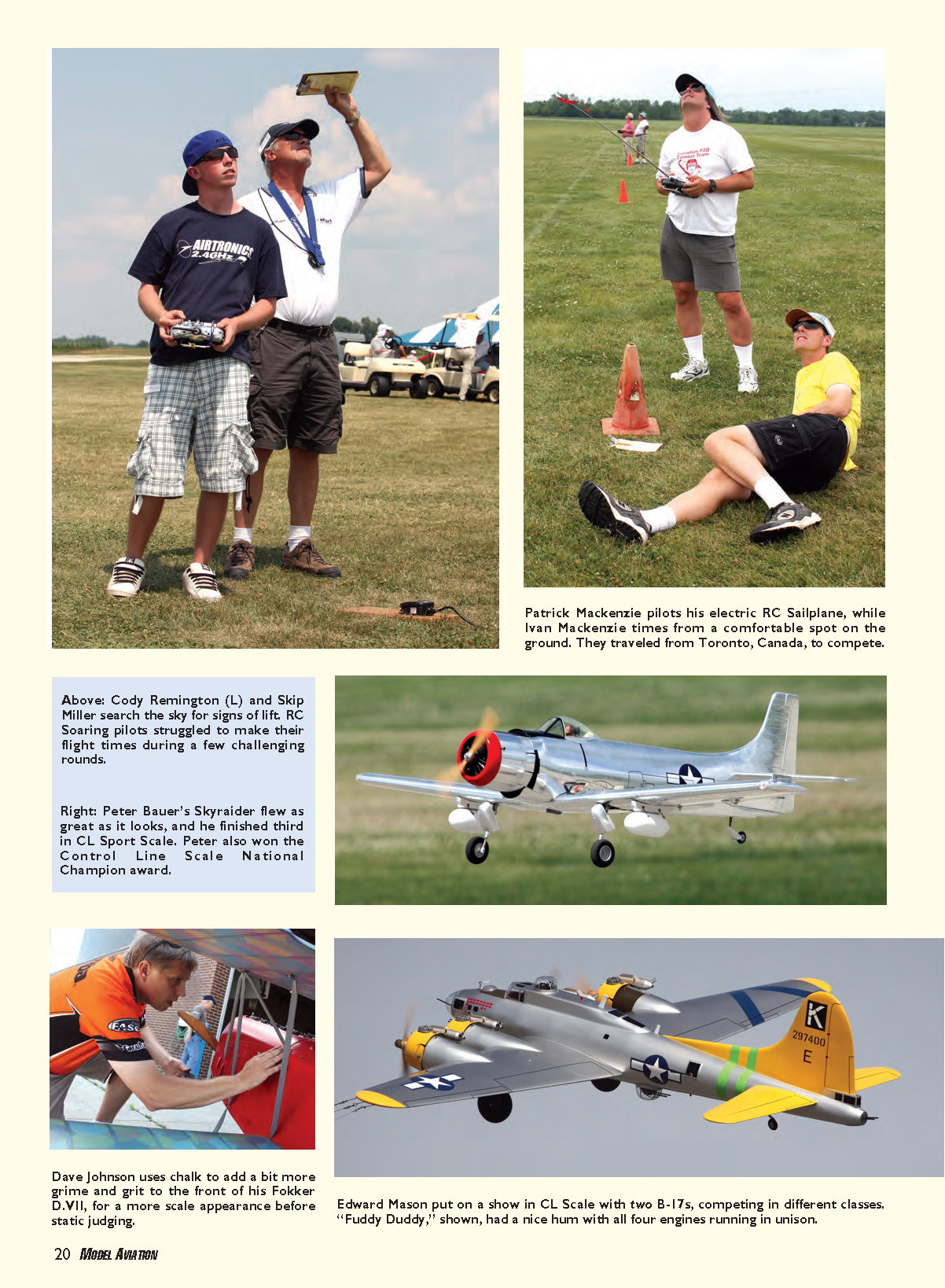
LSF Soaring Event Director Tom Kallevang noticed the proliferation of 2.4 GHz digital spread spectrum (DSS) radios. Overall, Soaring had about 30% of the registered pilots flying on 2.4 GHz. Moving to DSS radios opens up the competition even further, allowing anyone to compete against anyone else and doing away with the "protection" of those registered to fly on the same channel.
In RC Electric, event director Mike McGowan had a few observations. Electric Soaring was an exercise in transitioning the Electric events to true man‑on‑man Soaring events. With electric Soaring, it is possible to launch a group simultaneously; no flier gains advantage by being the last to launch.
In winch launch with large groups, the last person to launch has a full minute and numerous airplanes in front of him or her to analyze the air. So the "luck" of the draw for launch position often affects the outcome. The Electric Soaring groups were launched at the same time this year, which meant that they were all on approach and landing simultaneously if they were on time. That worked well, and lessons were learned to improve the field setup next year.
This year, the FAI‑style landing tape was introduced. It worked wonderfully and will probably be incorporated in following years.
Electric Soaring is still fairly new and is constantly evolving, thanks to advancements in technology. However, several current sailplanes require an electric‑conversion nose cone. "Electric sailplanes are still basically regular sailplanes flying with 12 or more ounces of ballast with a big drag device stuck on the nose!" said competitor Bob Burson.
RC Combat
This is a crowd‑pleaser at the Nats, providing spectators with the chance to see aerial dogfighting re‑created with the help of streamers that each aircraft carries. Pilots try to get "cuts" on their competition's streamers to gain points while trying to avoid midair collisions. Fliers put tacky material, such as Tanglefoot, on the wing leading edge to assist in snagging any streamers that make contact.
Slow Survivable Combat (SSC) was recognized as an official event for the first time this year. SSC limits engine sizes and model weights to make the class inexpensive and the aircraft durable and easily repairable. Combat pilots have been flying SSC unofficially with hopes that it would become a recognized event, and 23 pilots participated this year. There are expectations that the class will continue to grow.
Brian Gilkey, well known at the Combat Nats and who swept the competition the last two years, saw his reign come to an end in 2009. He was beaten by his younger brother, Eric Gilkey, in the Limited B class by 188 points.
The other big news in Combat is that the O.S. 25FX engine is being discontinued. It has been a popular choice for the .25B, 26B, Open B, and Limited B classes. Its replacement—the O.S. 25AX—has not been as good a fit for this application and has Combat pilots scouring the Internet and hobby stores for backup power plants.
RC Scale Aerobatics
Phil Vance and his team put on a successful event that drew 79 pilots. Contestants had to deal with unusual temperature changes and high winds, with gusts pushing upward of 30 mph.
Riley Kissenberth attended his first Nats and won the Sportsman class and the highly sought‑after Bennett Cup. First awarded in 2002, the Bennett Cup is given to the Nats Scale Aerobatics competitor who amasses the highest average maneuver score.
Jason Noll, another outstanding flier and last year’s Bennett Cup winner, walked away with first place in both Unlimited and Freestyle categories.
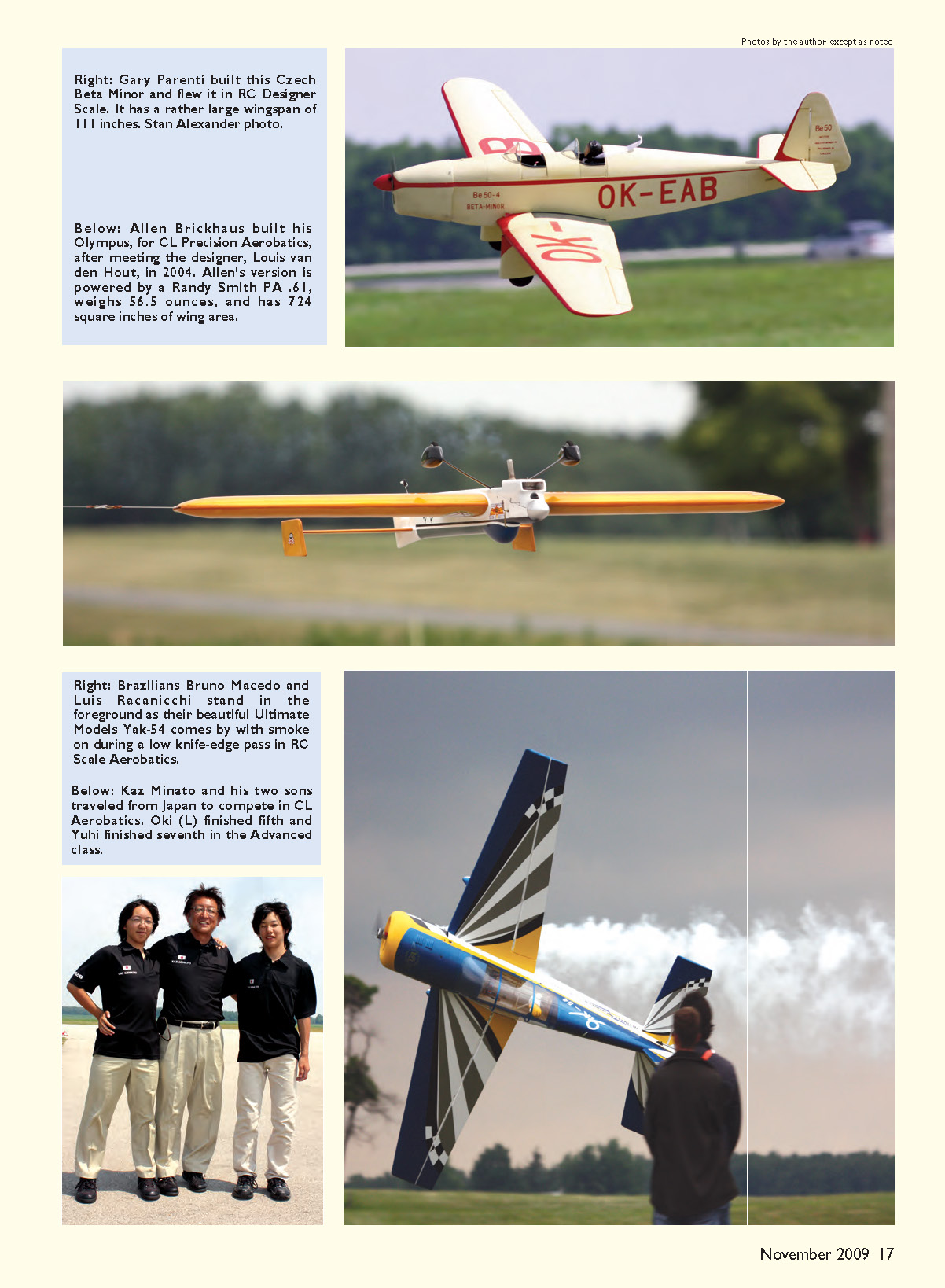
Bruno Macedo and Luis Racanicchi, both of Brazil, also attended the Scale Aerobatics Nats for the first time. Luis put on quite a show during the Freestyle competition, flying a beautiful Yak‑54 from Ultimate Models.
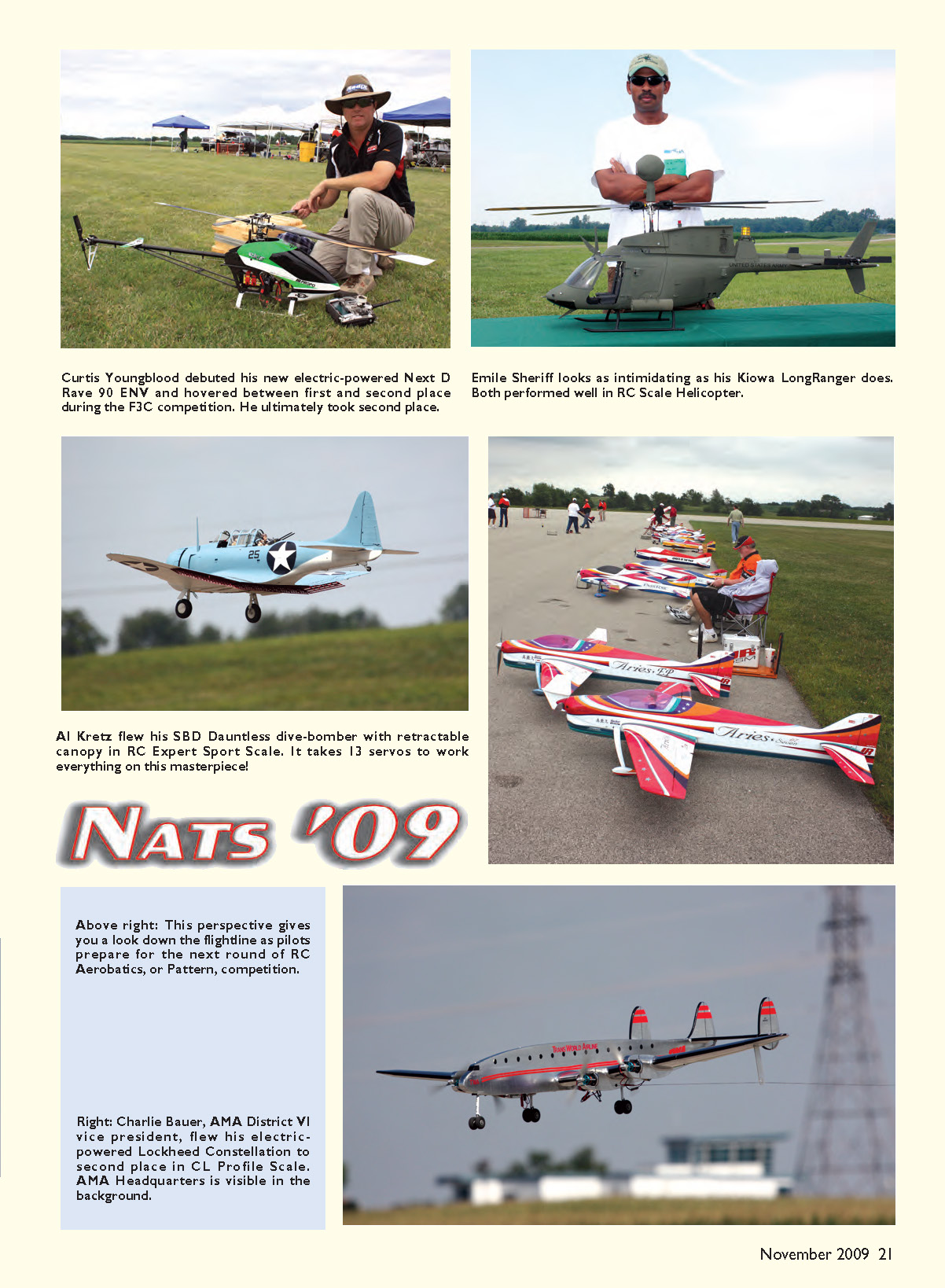
RC Aerobatics (Pattern)
This event was missing some competitors because top pilots such as Quique Somenzini and Jason Shulman were focusing their efforts on practicing for the F3A World Championships that took place in Pombal, Portugal, in August. However, there were still 111 pilots.
In his sixth year as Pattern manager, Dave Guerin and his staff did a nice job of maintaining three separate flightlines for four classes: Intermediate, Advanced, FAI F3A, and Masters.
Electric‑powered models continued to dominate as the propulsion of choice for the majority of pilots. A quick look at the charging stations showed a large diversity in battery packs in the lower classes, while the upper classes competed with major‑name‑brand packs. This year’s F3A winner, Andrew Jesky, flew a Hacker‑motor‑powered Spark by Krill Model.
Scale
Both RC and CL Scale bring out a large number of spectators who want to see these beautiful handcrafted masterpieces on display and in the air. There are no “hangar queens” at the Scale Nats!
RC pilots had to contend with a rolling crosswind during part of the competition, causing even the most experienced fliers to have difficulty getting a good landing.
Dennis Crooks walked away as the RC Scale National Champion, garnering an amazing 191.875 points flying his P‑38 in Expert Sport Scale. Dave Johnson was close behind, with a 191.125 score. This was his Fokker D.VII’s first Nats appearance. Dave competed with three WWI aircraft, keeping him busy throughout the competition.
In CL, the competition was close in Sport Scale between Allen Goff flying a WACO and John Brodak with his Shoestring racer. In the end, Allen won by a small margin.
The CL Scale National Champion award was given to Peter Bauer. The National Association of Scale Aeromodelers presents this award to the competitor with the highest total score (three flights and static) in the Sport Scale class.
RC Helicopter
The F3C Helicopter World Championship was scheduled to take place immediately following the Nats. This meant that the helicopter Nats was being viewed as a test run for the judges and staff. Craig Bradley, the helicopter event director, had three major events on his plate: the Nats, the World Championship, and the IRCHA (International Radio Controlled Helicopter Association) Jamboree.
Electric‑powered helicopters continue to gain momentum in the competition; however, this year’s winner, Scott Gray, was flying his tried‑and‑true O.S. .91‑powered JR Sylphide in a Stacy fuselage. Scott has been using this setup for approximately three years, and he thought that being comfortable with his machine helped him in the competition.
Scott was followed closely in the standings by Curtis Youngblood, debuting his Next D Rave 90 ENV electric. Curtis is no stranger to winning the Helicopter Nats, having done so numerous times.
In Scale Helicopter, Len Mount’s arrival was eagerly awaited; people wanted to see what new competition model he would unveil after a successful three‑year run with his Scout. Len had planned to debut his extremely aerobatic Red Bull Bo 105 CBS helicopter and intended to fly it just as Chuck Aaron flies the full‑scale version—to the extreme.
However, the Bo 105 was damaged because of a turbine backfire. So Len—who had pondered selling the Scout—pulled it out of retirement and flew it to his fourth Nats win.
RC Pylon Racing
Pete Bergstrom stepped up as event director, since Gary Freeman Jr., Randy Bridge, and Travis Flynn were absent supporting the 2009 F3D (FAI Pylon Racing) World Championships.
The Quickie 500 (Q‑500) event started with nearly 60 pilots at the beginning. Heading into the finals, 14 pilots and two wild cards were left in contention for the championship.
In the end, it came down to an amazing flyoff between Dave Norman and Fred Burgdorff. The two fought it out wingtip to wingtip until the 10th lap, when Fred cut Pylon One, allowing Dave to become the National Champion.
The excitement didn't end when determining the Quarter 40 (Q‑40) champion. As in Q‑500, a flyoff was required to establish the winner. A.J. Seaholm and Roy Andrassy squared off with the title in their sights. Disaster struck for Roy during the fourth lap, as his model's wing let loose around Pylon One. A.J. flew on to his first RC Pylon Racing National Championship.
CL (Control Line)
This year the circles were full of activity, as 181 registered participants flew in Precision Aerobatics, Racing, Combat, Navy Carrier, and Speed. Several participants came from other countries, including Japan, Brazil, and Canada.
Having flown RC Combat, I am amazed to watch CL Combat. As if trying to cut your competitor's streamer without a spectacular midair is not enough, CL presents the added challenge of keeping the wires from tangling.
This year, the win came down to Don McKay and Don Spoka. In their final match together, they had the only midair of the event. When the balsa settled, Don McKay had become the winner. This was his first Nats, and he's probably happy he attended.
CL Combat pilots aren't the only ones who have to deal with crossed lines. CL Racing fliers have some fancy footwork of their own. Winning at Racing requires more than being a good pilot. While a flier focuses on flying, the pitman has a big responsibility. That person has to catch the aircraft once the engine stops, refuel it, restart it by hand, and repeat as many times as is necessary to finish the race.
This year's Nats drew competitors from across our nation, from Florida to Maine to California and almost everywhere in between. Some showed up for competition and others for fellowship, but all were given the chance to immerse themselves in the model aviation experience.
I also had the opportunity to spend time with guests who traveled to the event from outside our country. They were amazed by our facilities at the IAC, as well as the large number of competitors that the contest attracts.
Venezuela's Juan Baez, who competed in Pylon, told me that in his home country, Pylon competitions are few and far between and do not draw a large number of competitors. I also learned that CL competition is almost nonexistent in some European countries.
If you have never visited the facilities in Muncie or attended the Nats, consider adding it to your to‑do list. Pictures and articles can't fully convey what it is like to see aeromodeling at its best, with all of the SIGs represented.
For even more coverage, check out NatsNews, our daily newsletter, which features talented reporters' pictures and stories of events as they happen throughout the competition. Every issue is available online to view or print.
— Jay Smith [email protected]
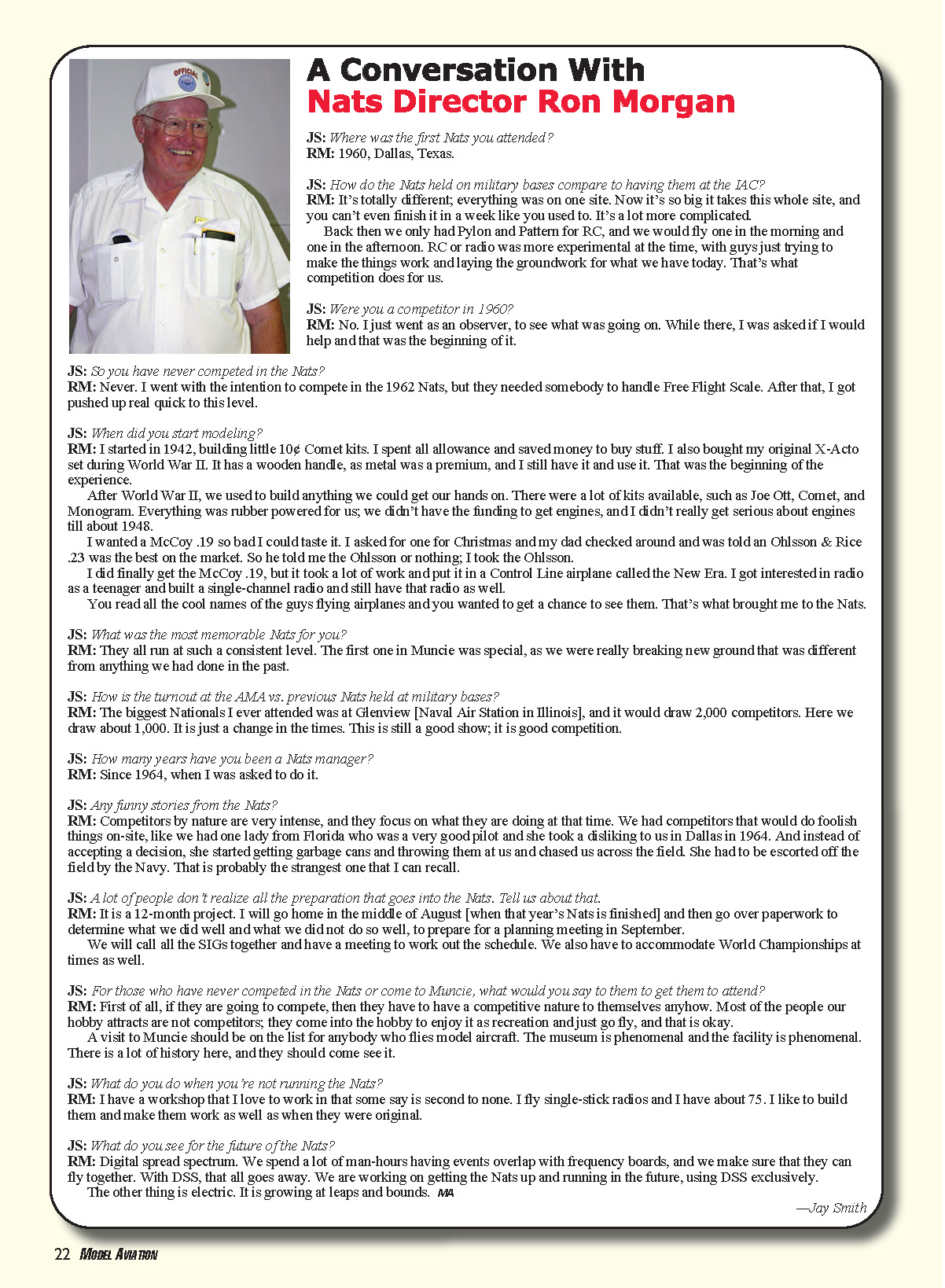
A Conversation With Nats Director Ron Morgan
JS: Where was the first Nats you attended? RM: 1960, Dallas, Texas.
JS: How do the Nats held on military bases compare to having them at the IAC? RM: It's totally different; everything was on one site. Now it's so big it takes this whole site, and you can't even finish it in a week like you used to. It's a lot more complicated. Back then we only had Pylon and Pattern for RC, and we would fly one in the morning and one in the afternoon. RC or radio was more experimental at the time, with guys just trying to make the things work and laying the groundwork for what we have today. That's what competition does for us.
JS: Were you a competitor in 1960? RM: No. I just went as an observer, to see what was going on. While there, I was asked if I would help and that was the beginning of it.
JS: So you have never competed in the Nats? RM: Never. I went with the intention to compete in the 1962 Nats, but they needed somebody to handle Free Flight Scale. After that, I got pushed up real quick to this level.
JS: When did you start modeling? RM: I started in 1942, building little 10‑cent Comet kits. I spent all allowance and saved money to buy stuff. I also bought my original X‑Acto set during World War II. It has a wooden handle, as metal was a premium, and I still have it and use it. That was the beginning of the experience.
After World War II, we used to build anything we could get our hands on. There were a lot of kits available, such as Joe Ott, Comet, and Monogram. Everything was rubber powered for us; we didn't have the funding to get engines, and I didn't really get serious about engines till about 1948.
I wanted a McCoy .19 so bad I could taste it. I asked for one for Christmas and my dad checked around and was told an Ohlsson & Rice .23 was the best on the market. So he told me the Ohlsson or nothing; I took the Ohlsson. I did finally get the McCoy .19, but it took a lot of work and put it in a Control Line airplane called the New Era. I got interested in radio as a teenager and built a single‑channel radio and still have that radio as well.
You read all the cool names of the guys flying airplanes and you wanted to get a chance to see them. That's what brought me to the Nats.
JS: What was the most memorable Nats for you? RM: They all run at such a consistent level. The first one in Muncie was special, as we were really breaking new ground that was different from anything we had done in the past.
JS: How is the turnout at the AMA vs. previous Nats held at military bases? RM: The biggest Nationals I ever attended was at Glenview [Naval Air Station in Illinois], and it would draw 2,000 competitors. Here we draw about 1,000. It is just a change in the times. This is still a good show; it is good competition.
JS: How many years have you been a Nats manager? RM: Since 1964, when I was asked to do it.
JS: Any funny stories from the Nats? RM: Competitors by nature are very intense, and they focus on what they are doing at that time. We had competitors that would do foolish things on‑site, like we had one lady from Florida who was a very good pilot and she took a disliking to us in Dallas in 1964. And instead of accepting a decision, she started getting garbage cans and throwing them at us and chased us across the field. She had to be escorted off the field by the Navy. That is probably the strangest one that I can recall.
JS: A lot of people don't realize all the preparation that goes into the Nats. Tell us about that. RM: It is a 12‑month project. I will go home in the middle of August (when that year's Nats is finished) and then go over paperwork to determine what we did well and what we did not do so well, to prepare for a planning meeting in September. We will call all the SIGs together and have a meeting to work out the schedule. We also have to accommodate World Championships at times as well.
JS: For those who have never competed in the Nats or come to Muncie, what would you say to them to get them to attend? RM: First of all, if they are going to compete, then they have to have a competitive nature to themselves anyhow. Most of the people our hobby attracts are not competitors; they come into the hobby to enjoy it as recreation and just go fly, and that is okay. A visit to Muncie should be on the list for anybody who flies model aircraft. The museum is phenomenal and the facility is phenomenal. There is a lot of history here, and they should see it.
JS: What do you do when you're not running the Nats? RM: I have a workshop that I love to work in that some say is second to none. I fly single‑stick radios and I have about 75. I like to build them and make them work as well as when they were original.
JS: What do you see for the future of the Nats? RM: Digital spread spectrum. We spend a lot of man‑hours having events overlap with frequency boards, and we make sure that they can fly together. With DSS, that all goes away. We are working on getting the Nats up and running in the future, using DSS exclusively. The other thing is electric. It is growing at leaps and bounds.
Sources
- NatsNews: www.modelaircraft.org/events/nats/natsnews.aspx
- AMA Nats information: (765) 287‑1256, ext. 224, 252, or 293
- AMA Nats page: www.modelaircraft.org/events/nats.aspx
Transcribed from original scans by AI. Minor OCR errors may remain.

