


Nats 2008: Summer Camp for Big Kids
by Jay Smith
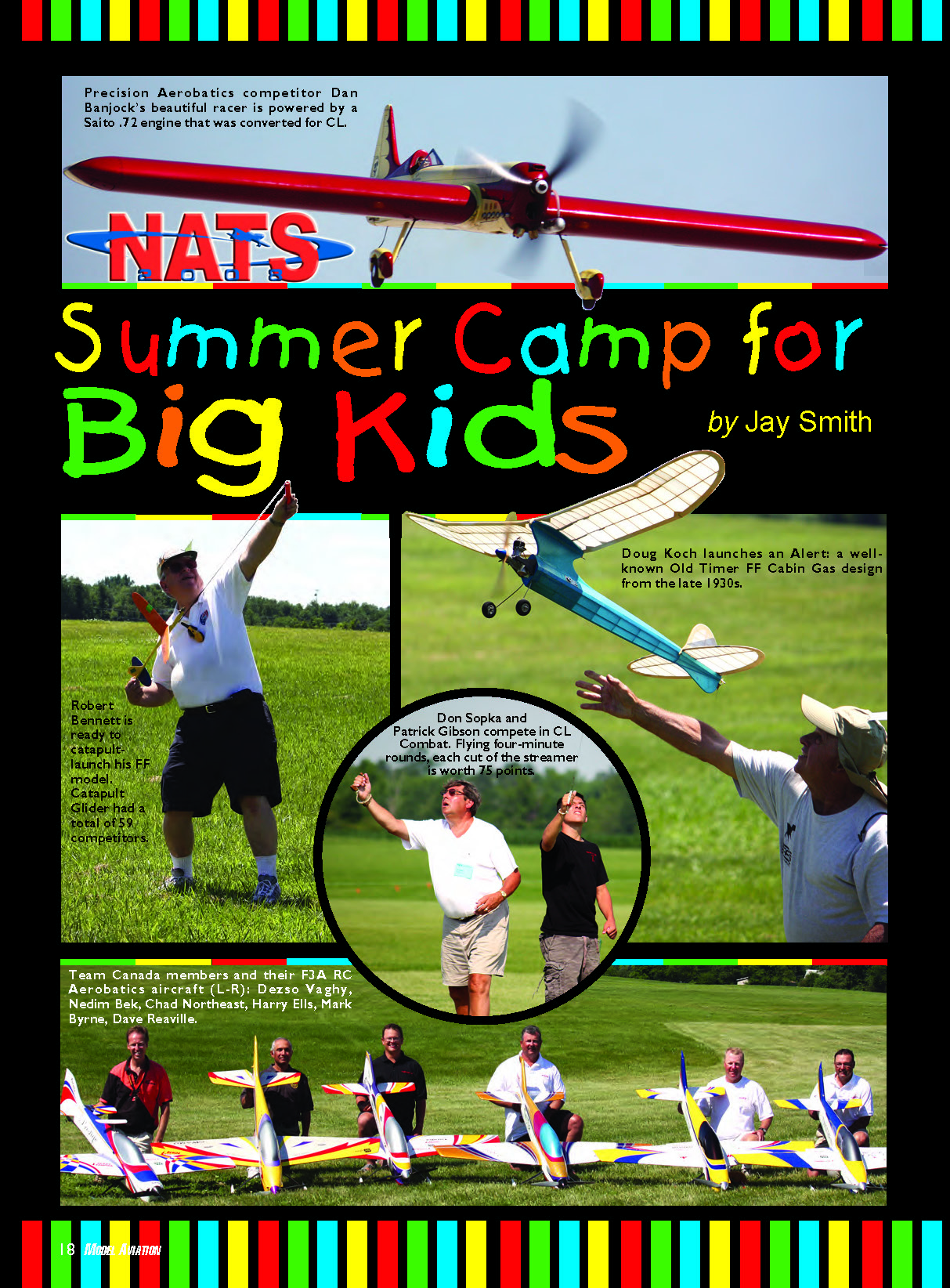
Precision Aerobatics competitor Dan Banjock's beautiful racer is powered by a Saito .72 engine that was converted for CL.
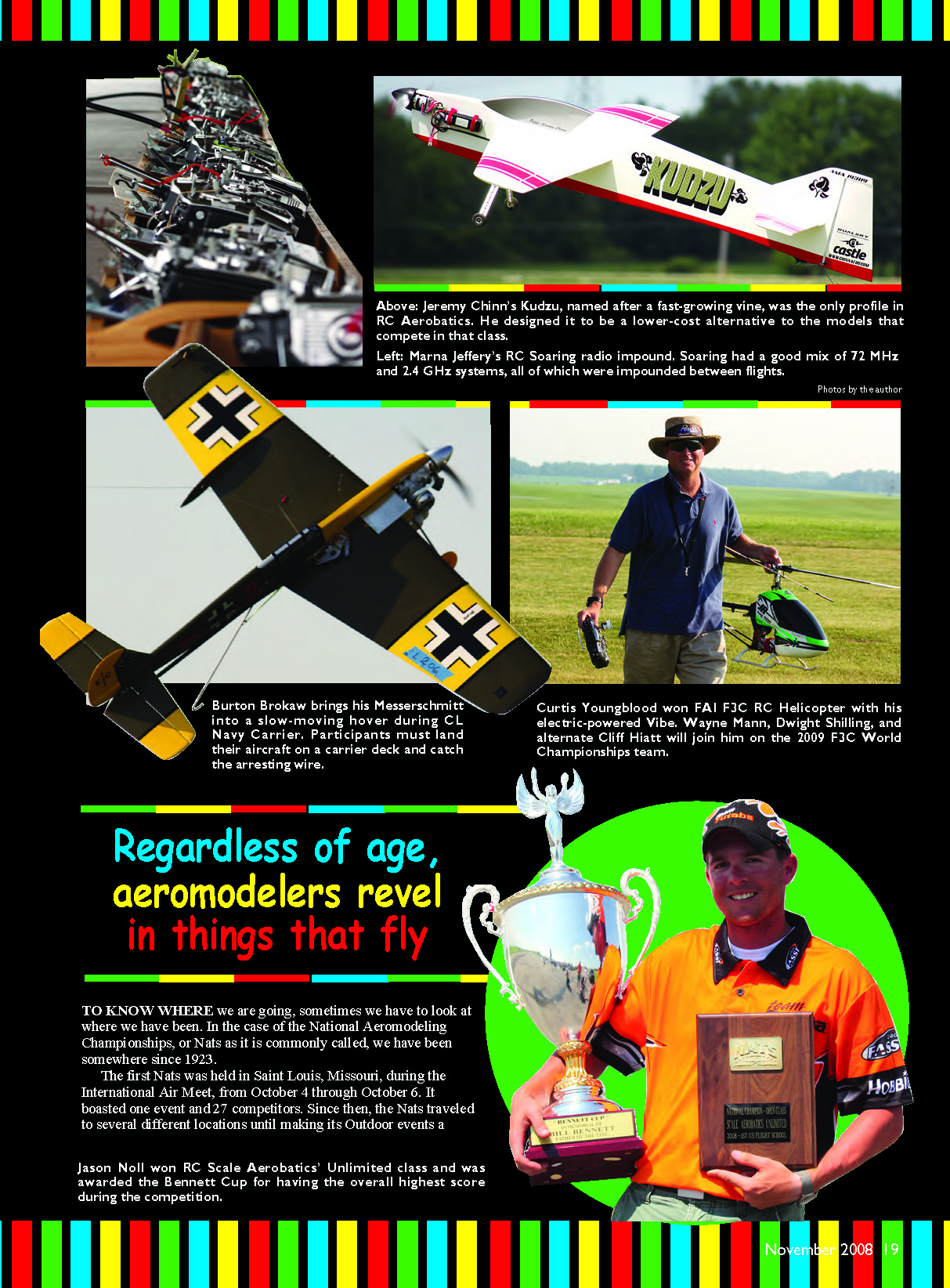
Robert Bennett is ready to catapult-launch his FF model. Catapult Glider had a total of 59 competitors.
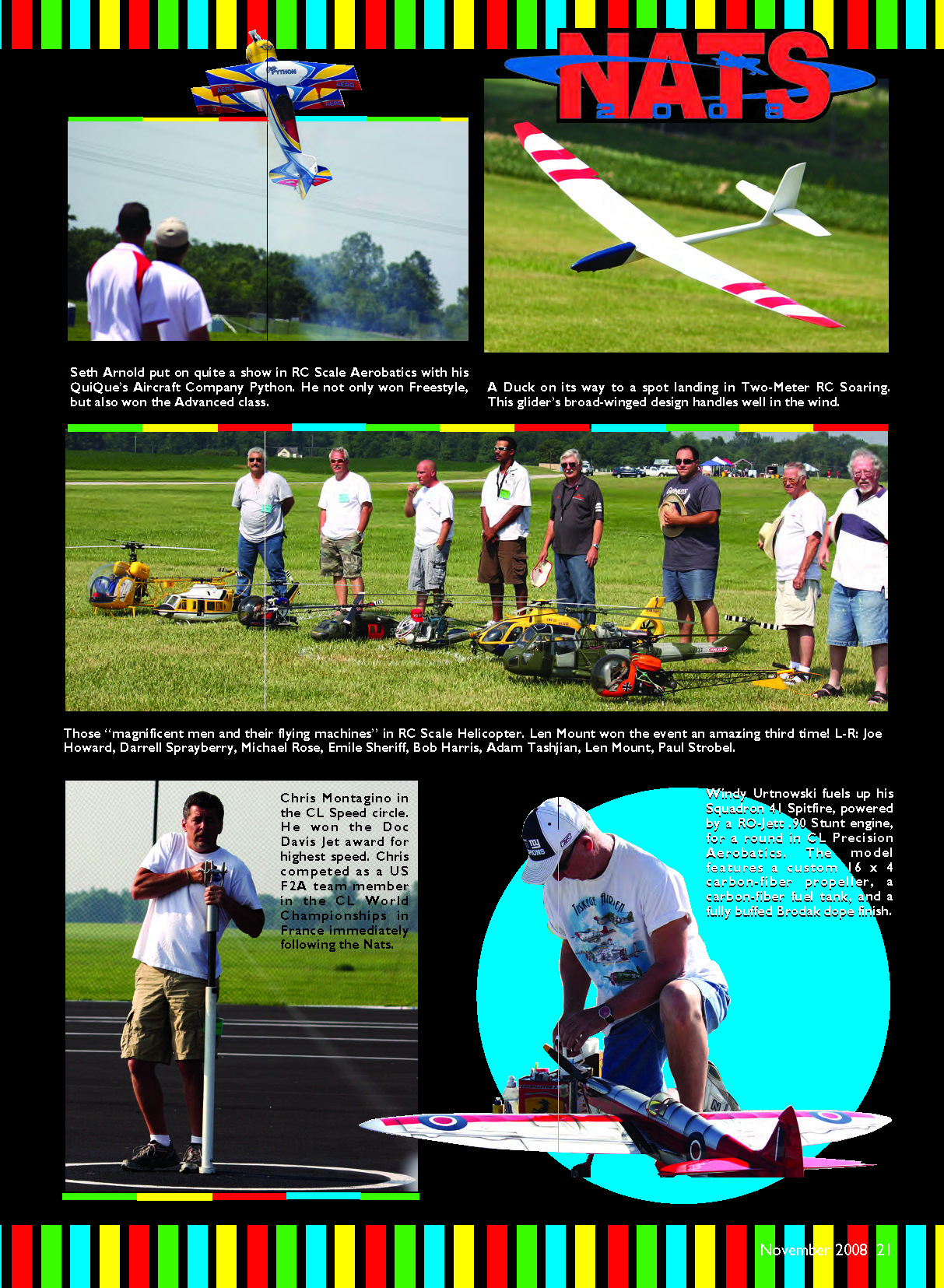
Don Sopka and Patrick Gibson compete in CL Combat. Flying four-minute rounds, each cut of the streamer is worth 75 points.
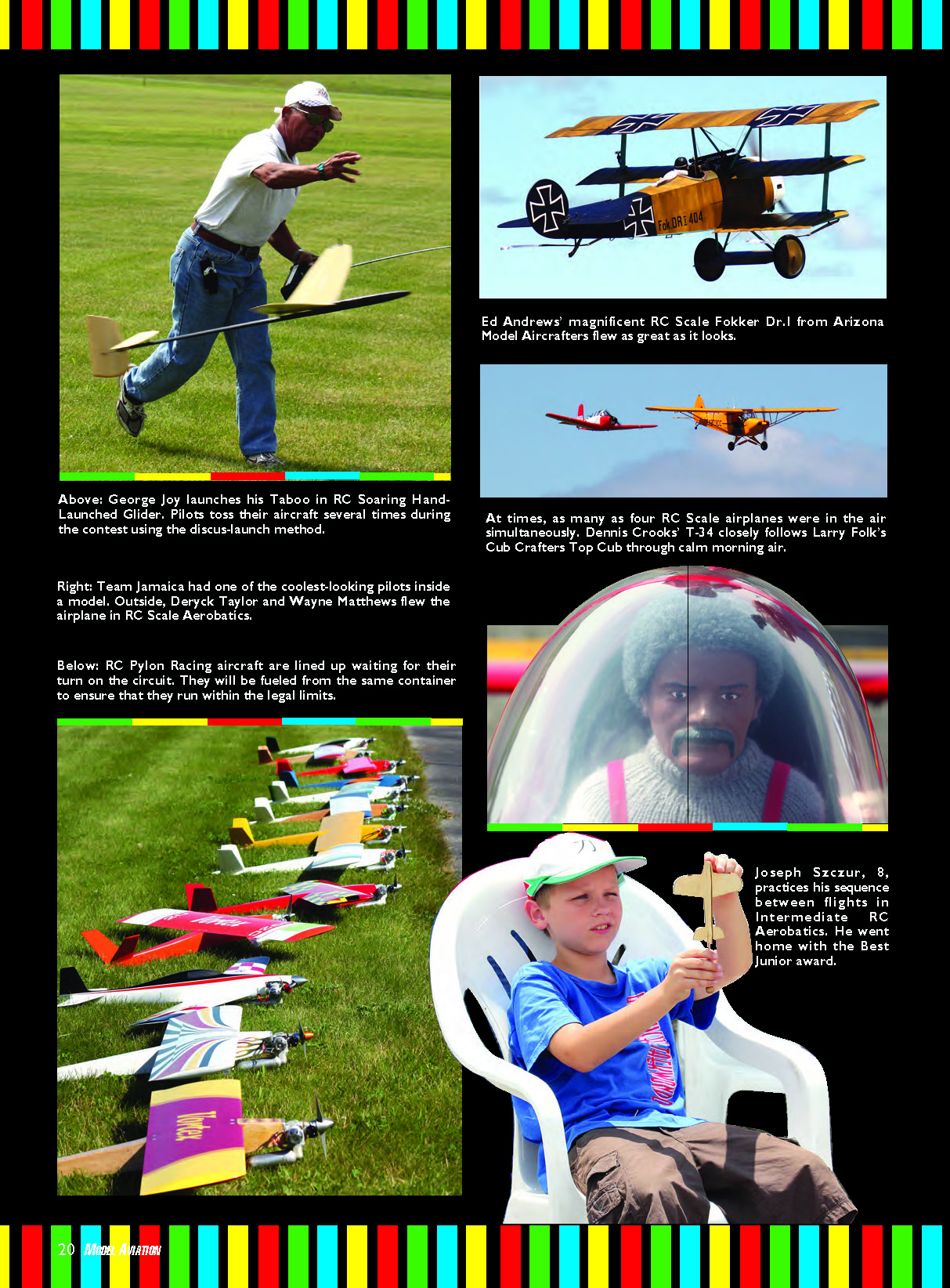
Doug Koch launches an Alert: a well-known Old Timer FF Cabin Gas design from the late 1930s.
Team Canada members and their F3A RC Aerobatics aircraft (L–R): Dezso Vaghy, Nedim Bek, Chad Northeast, Harry Ells, Mark Byrne, Dave Reaville.
Regardless of age, aeromodelers revel in things that fly
TO KNOW WHERE we are going, sometimes we have to look at where we have been. In the case of the National Aeromodeling Championships, or Nats as it is commonly called, we have been somewhere since 1923.
The first Nats was held in Saint Louis, Missouri, during the International Air Meet, from October 4 through October 6. It boasted one event and 27 competitors. Since then, the Nats traveled to several different locations until making its Outdoor events a
Jason Noll won RC Scale Aerobatics’ Unlimited class and was awarded the Bennett Cup for having the overall highest score during the competition.
attending the Nats for the first time.
I made it a point to ask as many people as I could what the attraction is. I didn't only ask pilots, but I also queried CDs and volunteers. The answers varied slightly, but the words "friends" and "people" were spoken more than any other.
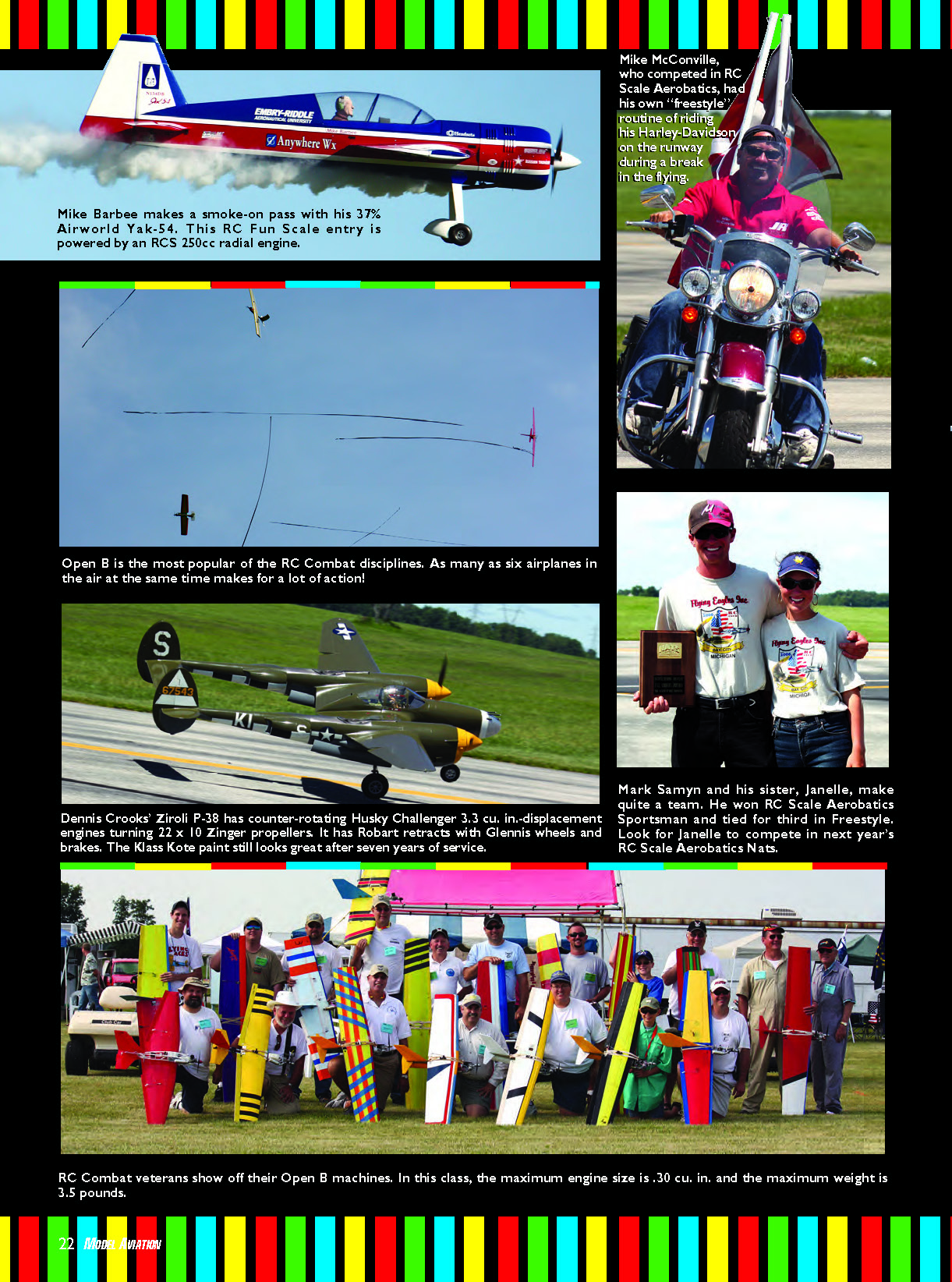
Mark Samyn was one of the "people" who had quite a story to tell about how he came to compete at the Nats for the first time, in RC Scale Aerobatics. He got interested in aviation when he started reading Aviation History magazine at age 15. Through a letter to the editor for back issues, Mark came into contact with Paul of Pennsylvania, who began sending him RC magazines.
By the time Christmas rolled around the next year, Mark was hooked and Paul gave him the surprise of his life: a new, ready-to-fly trainer. With Paul's help, Mark quickly moved up to more advanced models. As his flying excelled, people took interest, and Tom, a fellow club member, not only encouraged Mark to compete, but also helped him assemble a 50cc-size competition aircraft.
Mark's first competition was in Jackson, Michigan, with his sister, Janelle, as his caller. He went home with first place in Basic. On his next outing in Hamilton, Ohio, he took third in Sportsman.
With a great deal of encouragement, Mark decided to compete in RC Scale Aerobatics at the Nats. He spent the next two weeks practicing. Although he was busy getting ready for the competition, he got to see his sister solo using the same trainer he had used to get started in flying.
Mark went on to win in Sportsman and tied for third place in Freestyle. If that wasn't enough big news, Janelle plans to compete in next year's Nats.
There were electric-powered aircraft in most of this year's Nats events. The ease of use, reliability, and decreasing battery cost has motivated many competitors to cross over to this quiet power source.
Craig Buttery, a Broward County, Florida, sheriff, was one of the pilots who used electric power to compete in SSC, or RC Slow Survivable Combat. He employed a brushless motor, 4S 2500 battery, and a 45-amp speed control. Craig found that even in Combat, the electric system held up well and lasted just long enough to keep him in the fight.
In the CL Aerobatics circle, Walter Brownell flew a twin bomber powered by two 480 outrunner motors and two 25-amp ESCs on a 4S 4270 mAh battery. He had no problem getting his time in and performing the required maneuvers with his setup, and he had the speed controls set to slowly spool up and then back down at a set time. The two motors made a satisfying hum; there is just something about the sound of twins!
The RC Aerobatics (Pattern) competition was second to Electric Soaring in the number of aircraft powered by electric motors. The big electric power plants in the elegant Pattern airplanes were fed by 10S batteries and were not lacking in power for the Known or Unknown sequences that were thrown at the pilots.
Dan Landis commented that he switched to electric for Pattern competition three years ago and has found that his airframe and servos last longer with the decrease in vibration that electric power offers. He is also more confident knowing that his motor will run during the entire flight.
Danny Craig was one of the younger pilots at this year’s Nats, competing for the first time in the contest; he flew in RC Novice Fun Scale. This 13-year-old had a Hangar 9 Miss America P-51 that he and his father assembled and detailed for the competition.
After static judging, Danny was practicing with his model and was involved in a midair with a larger Pitts that John Boyko was flying. Danny’s Miss America was destroyed.
No sooner had what was left of the P-51 been recovered than a fellow competitor stepped up and loaned Danny a Cermark Pitts S-2B. With only four practice flights on the new airplane before the competition started, Danny went on to win both Novice Fun Scale and Best Junior.
Danny’s story showcases not only his skill as a pilot, but also the caliber of the competitors who attend the Nats who are willing to jump in and lend a hand—or an aircraft. I witnessed other cases of loaned models and parts, and I even saw fellow pilots working on competitors’ aircraft to keep them from missing a round.
That generosity spilled over into all of the disciplines. If anything could make you proud to be a part of our hobby, this is it. The camaraderie of pilots at the national level showcases our hobby at its best.
Another big part of this contest is NatsNews. This daily newsletter is put together to cover the previous day’s competition and report the events in a more timely and in-depth manner than could ever be done in this article—or a whole magazine, for that matter.
NatsNews pulls together talented reporters, and each one covers the event that encompasses his or her aeromodeling passion. All the pictures and text are then put in the talented hands of its editor, Liz Helms, who does a great job of preparing the publication for daily distribution.
Every issue of NatsNews is available online; more pictures and coverage are just a mouse click away.
A feature in this year’s NatsNews was “Meet the CD,” which offered the readers a chance to learn about some of the people who make the Nats happen. Most of the people who are involved with the Nats are volunteers, and they freely give their time, which is donated many months before the competition.
One of those volunteers is Nats Director Ron Morgan. He has attended the Nats an amazing 49 times. He has enough stories to fill a book, which I am trying to convince him to write after he completes his 50th Nats. This year the National Free Flight Society presented Ron and his wife, Jane, with an award in recognition of their support.
FF this year reminded one competitor of Woodstock, with tents and off-road vehicles covering the majority of the site. More than 200 fliers competed in all types of Outdoor FF categories. It was a sight to behold; models littered the sky and all-terrain vehicles littered the ground, with their riders on a mission to ferry their aircraft back to the flying line.
If a person was in the right place on the field, he or she could hear the roar of the finely tuned engines or the serene calm of aircraft after DT, looking for a soft landing. The wind and the trees claimed some of the models, but the majority made it back to be set aloft again.
Never having experienced FF to this extent, I was left with a mental note. The next time I am told FF is dead, I will invite that person to the Nats to see that it is alive and well.
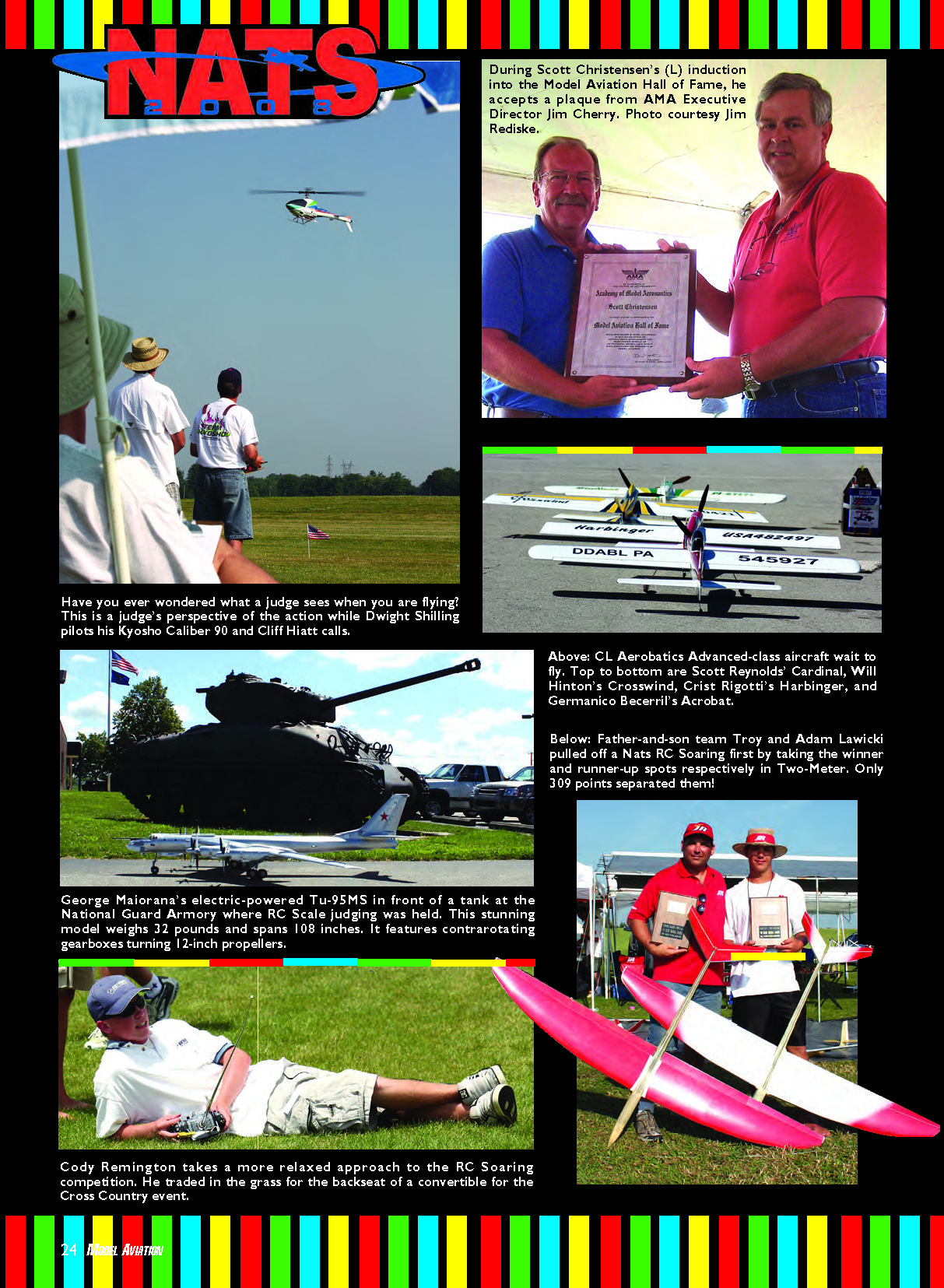
Scott Christensen was inducted into AMA’s Model Aviation Hall of Fame while he was competing in RC Scale with his Cessna 195. Scott has been involved with model aviation since 1948 and has been designing model aircraft since 1967.
He has designed and worked for Airtronics, Top Flite, Cox, and Sig. You may be familiar with one of his most popular designs: the Rascal series. He has also been involved in RC Soaring and is one of the founding members (number 001) of the LSF.
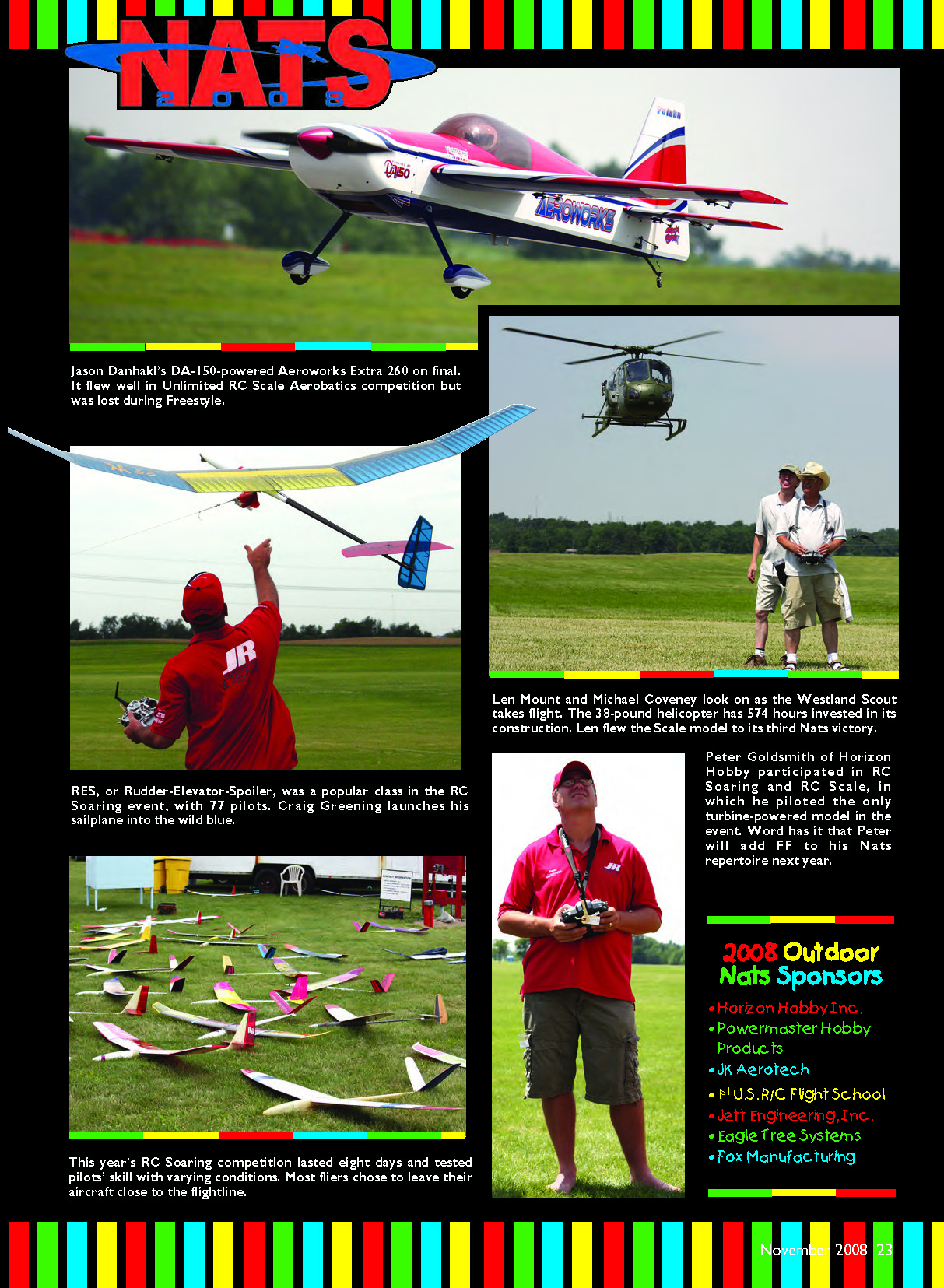
The LSF enjoyed 12 days of Soaring at the Nats, four of which were electric. Some of the events changed in the way the models were set aloft, be it via hand launch, winch launch, or electric power, but in the end it came down to reading the air, finding the lift, and avoiding the sink. Luck and a good landing didn’t hurt either.
Nine teams, two days, and a 15.92-mile course was the setting for this year’s Cross Country Soaring event. I had the opportunity to ride shotgun in Skip Miller’s team’s convertible. Rick Lederman drove as Skip and Cody Remington handled the flying duties from the backseat. It was an exciting experience that I won’t soon forget.
I assisted the trio by providing an extra set of eyes on the ground and in the air. A team has to contend with obeying the traffic laws and with momentarily losing sight of the airplane because of obstructions along the route. Skip and his team took first place, logging a total of 63.4 miles!
The 2008 Nats was a great experience. I learned more about the different disciplines that make up our hobby. Having a love for anything that takes flight made it easy to appreciate everything the Nats had to offer.
Don’t think you have to compete to find the value in attending the Nats. The freely shared combined knowledge and experience alone is worth the trip. You have the chance to learn about the different segments of our hobby and the commonalities that can be applied wherever your individual interest lies.
Most important is the people; they are what make this hobby great. The camaraderie and sportsmanship I experienced and observed at the Nats were as amazing as the skill of the pilots and their aircraft.
The Nats, as is the AMA, is here for everyone who has an interest in aviation. Having been there, I find myself looking forward to next year. It will be another summer camp for big kids! MA
Jay Smith [email protected]
Transcribed from original scans by AI. Minor OCR errors may remain.

