

New Life for Fox Valley Aero Club
by Darryl Hedges
The Fox Valley Aero Club (FVAC) is located approximately 40 miles west of Chicago in Saint Charles, Illinois. Since it was founded in 1929, the club has enjoyed steady growth and amiable relations with the community. Most people would consider it to be a typical AMA club.
But in 2003 and 2004 the FVAC felt the full force of a series of events that had been building for a number of years. It resulted in the club’s losing its flying field and being forced to either finance and construct a new field in a short period of time or simply fade into the history books.
The FVAC’s experience is one that other clubs across the country are facing more and more often as local communities wrestle with the need to enlarge their tax base through new-home construction and expansion. In the process, any available open land surrounding these communities is being annexed for the greater good of the public, which often outweighs the needs of the few—such as RC fliers.
Background
Founded in 1929 as the Flying Fools, the club began its existence in the days when model aviation consisted primarily of hand-launching free-flight gliders and rubber-band-powered airplanes. In those days members flew their models at a variety of informal field locations scattered throughout the area. In 1979 the Flying Fools changed its name to the Fox Valley Aero Club.
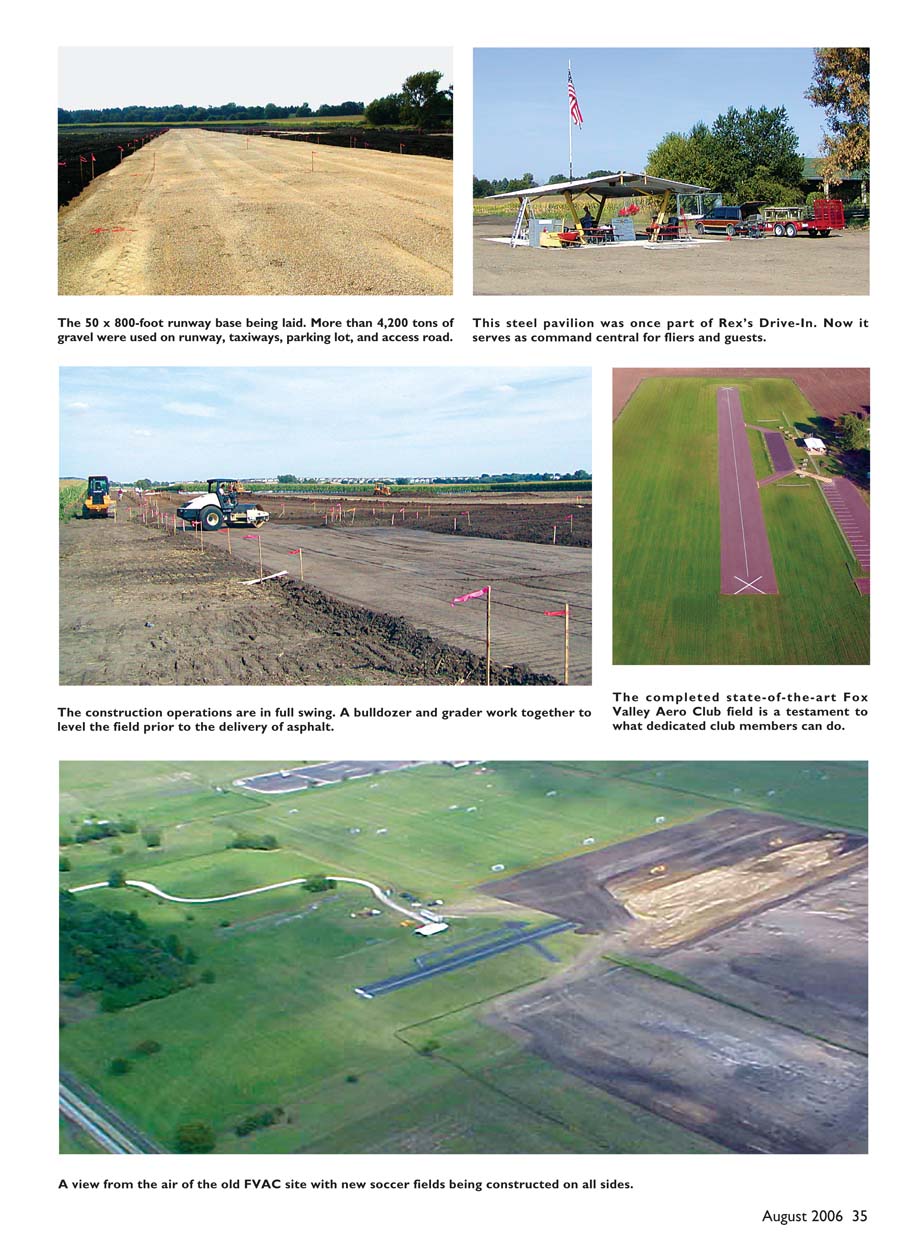
Working in cooperation with the city of Saint Charles and the Saint Charles Park District, the FVAC was able to secure a 15-acre “permanent” site for an RC flying field—part of 365 acres of land that had recently been acquired by the Park District from the Illinois Department of Corrections. A local drive-in restaurant donated a steel pavilion that served as the main gathering area and provided shelter from inclement weather.
As the years passed, the FVAC and the surrounding communities continued to grow. During that time several of the club’s key members continued building relationships with local government and Park District leaders in the hopes of protecting the group from the relentless expansion and growth that was taking place. Those efforts would eventually help the FVAC find a new home—but it would be years later.
Soccer Is King
When the FVAC opened its old field, it was surrounded on three sides by farmland and sat adjacent to the Saint Charles youth center, a state of Illinois correctional facility that houses approximately 500 wayward young men.
Over the years, housing started coming out west with a vengeance. When you have houses, you have kids. When you have kids, you have soccer fields. Soccer is king.
A guest who was visiting the club crashed his model on a soccer field during half-time of a game. That's all it took to set things in motion.
Although the club worked feverishly with the Park District to severely restrict the hours when the field could be in operation—by limiting flying to between 8 a.m. and 3 p.m.—the Park District soon notified the club that it would be closing the flying field to make room for more soccer and football fields.
The clock began running. The club had one year and a $5,000 donation from the Park District to find and build a new field elsewhere.
Dealing With Disaster
Where do you start when you get the word that your current field is about to be acquired by the local community?
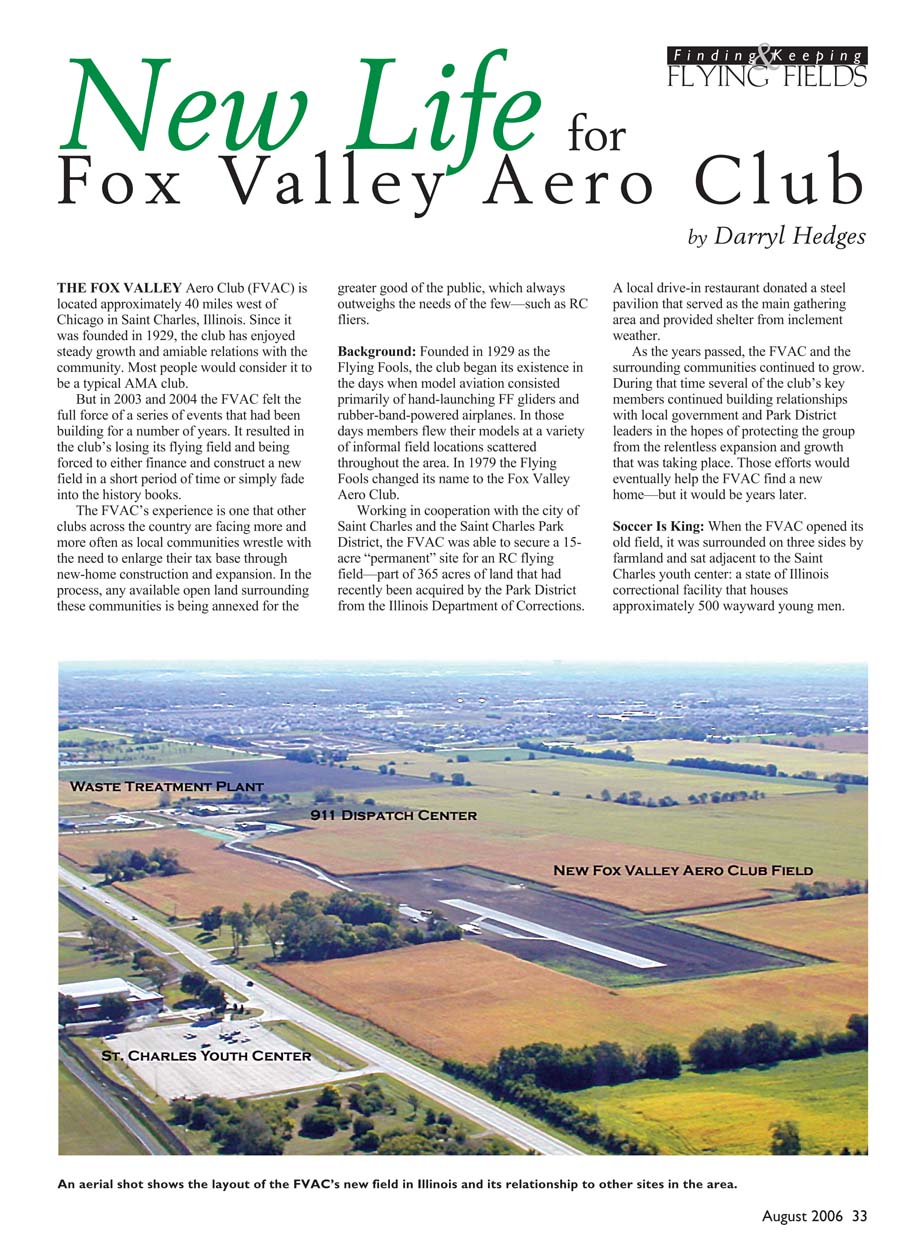
The Park District suggested that we begin our search for a new home by talking with the city of Saint Charles to determine whether or not the city owned any open land that would be suitable for a new field. After many meetings with city and county officials, a 10-acre site was identified. It was located adjacent to a city waste-processing facility and the Tri-County 911 Emergency Dispatch Center.
The good news was that the site was actually part of a larger piece of land that was technically located in a floodplain, so no new homes could be built on it. The Illinois Department of Corrections owned the property, and it was leased to a local farmer for growing crops.
The bad news was that the site had no direct access road and was being farmed. In addition, the land was straddling the boundaries between Saint Charles and its neighboring community to the south: the city of Geneva.
At the city's suggestion, the club hired an architect to draw plans based on the new location. The club originally wanted to have the field built facing north to minimize the effects of the sun during early morning and winter hours. That would have placed the field on the Geneva side of the property.
When Geneva realized that an RC field would be on its property, it nixed the idea because of concerns about liability, even though the club was going to be covered by AMA's liability insurance. So the field was turned around and oriented on the Saint Charles side of the property facing south. That simple change in plans cost the club $3,500 in wasted architectural drawings.
A Budget for a New Field
For a number of years the FVAC had made it a practice to take a portion of all revenue generated by events or dues and deposit it in a fund for the eventual construction of a new field.
When the time finally came, the club had approximately $60,000 in the bank. Everyone thought that was going to be more than enough to construct the new field. But as it turned out, the new-field construction fund was approximately $130,000 short of the mark.
The club initially solicited a bid from a reputable construction company in the area to build the field. The bid was to include the installation of a 50 x 800-foot asphalt runway to accommodate jets and large-scale aircraft and provide plenty of room for our trainers; the removal of any existing trees; the installation of a storm sewer to control water runoff; the construction of a paved access road to the property; and final grading of the land and seeding.
The contractor’s price was an eye-popping $255,137! The contractor estimated that all work could be completed within a six-week timeframe.
Faced with this staggering construction estimate, the FVAC asked the architectural firm that had drawn the plans for the new field to submit an alternate budgetary estimate. It came back with a figure of $191,278: a savings of roughly $63,000, but still well above what the club had anticipated.
At this point the group was faced with a decision to either find a way to raise a lot of money quickly or find a way to cut costs by having club members do most of the manual labor. The club chose the latter while devoting major efforts to figuring out how to raise the remainder.
Members Are a Club’s Greatest Resource
One of the FVAC members was a heavy-equipment operator by trade and volunteered to head up the project. Through his efforts and those of a core of dedicated club members, the new-field construction project moved forward.
The first thing that had to be done before construction could begin was to have a “field tile survey” completed to locate water-runoff subsystems. The existing blueprints had to be revised and the field tiles relocated as part of the construction process.
On July 14, 2004, at a preconstruction meeting with the Saint Charles engineering department, the club submitted its “financial guarantee” and “escrow agreement.” The city required these to ensure completion of the project.
That afternoon club members began cutting down weeds and removing brush at the new field. A week later a professional tree service began removing trees and grinding stumps. Before any earth-moving could be done, club members erected more than 2,800 linear feet of silt fencing during one of many regularly scheduled “work parties.”
For construction to proceed at the accelerated pace needed to finish the field before the end of 2004, the club arranged to have city inspections done on an almost daily basis. On July 30, 2004, full-scale grading of the property began with donated and rented bulldozers. To save money club members were taught how to check the grade for proper elevations.
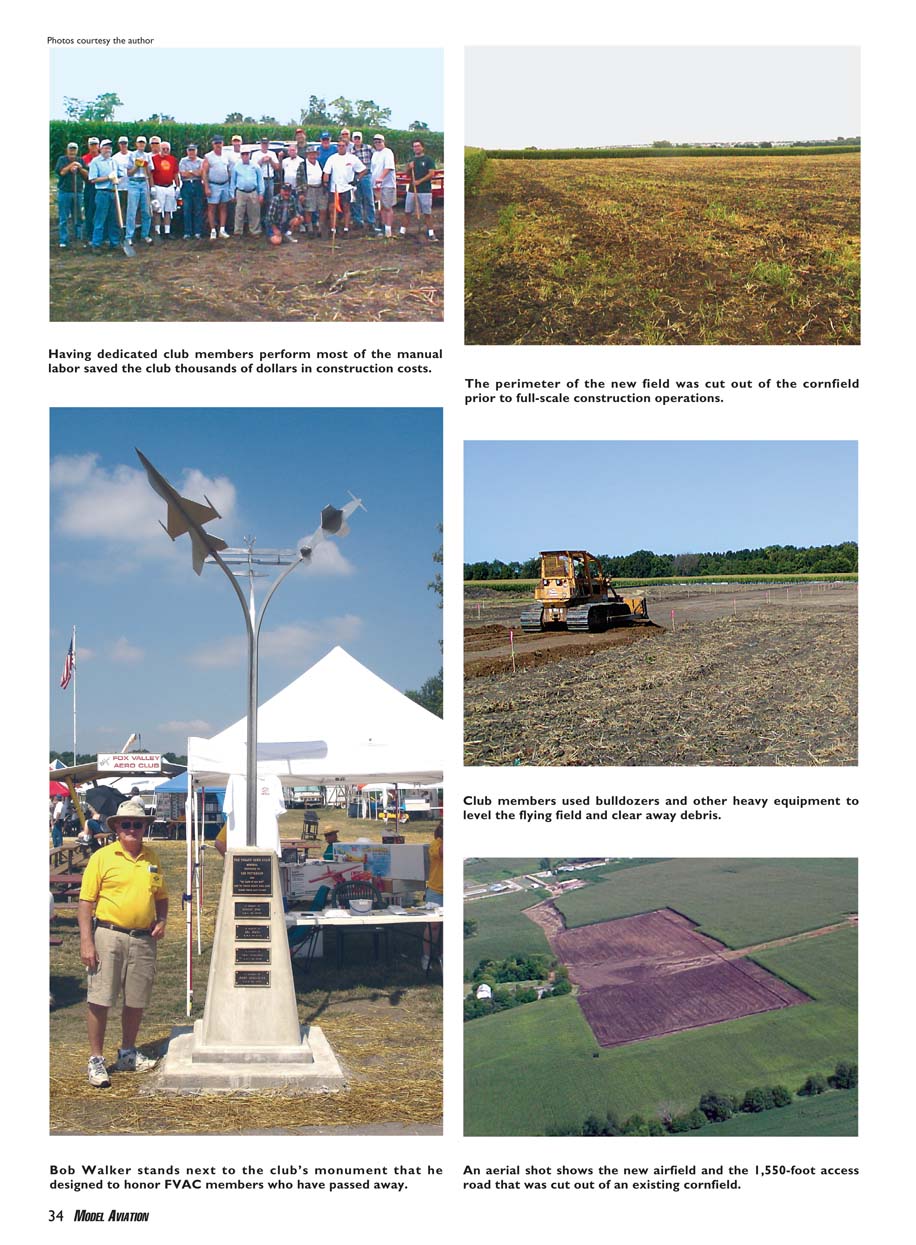
The perimeter of the new field was cut out of the cornfield prior to full-scale construction operations. Having dedicated club members perform most of the manual labor saved the club thousands of dollars in construction costs. Club members used bulldozers and other heavy equipment to level the flying field and clear away debris.
In the next several months activity at the new field reached a fever pitch. A host of subprojects went on simultaneously: construction of an asphalt runway and taxiway; construction of a 1,550-foot access road and parking lot; striping on the runway and parking lot; construction of a concrete pad for the steel pavilion brought from the old field; and installation of a flag pole and spectator bleachers. The field passed its final inspection on October 31, 2004.
Additional amenities were installed in the spring of 2005, such as a chain-link fence separating the active field area from the parking lot and spectator areas, eight pilot stations along the flightline, tennis nets donated by the local high school to act as safety netting along the flightline, a number of new wooden work tables, a monument honoring past members who had passed away, and electric power at the pavilion.
Creatively Financing the Future
While all this activity was taking place, the FVAC’s board members were trying to devise a way to pay for everything without having to mortgage their homes. Using the club’s $60,000 new-field fund and the $5,000 donated by the Park District as a starting point, the club was faced with the task of having to raise roughly $125,000 in an extremely short period of time. Following is how it was done.
- The board of directors approved levying an assessment of $300 per club member to be used for construction of the new field. At that time the club had roughly 200 members. If all members had agreed to pay the assessment, that would have raised approximately $60,000. In actuality, 55 members chose to drop out of the club without paying the assessment.
When the project was finally finished, it was estimated that the assessment paid by existing members and new-member initiation fees contributed roughly $73,000 to the fund.
- Several long-standing club members agreed to secure a four-year unsecured loan from a local bank for the projected $50,000 shortfall. Shortly after the loan went into effect, the adjustable interest rate on the loan went up, and the loan holders were faced with paying approximately $400 per month in interest on the loan. A better solution was needed immediately.
- One of the club’s members came up with the idea of a unique “lottery.” The club purchased a large glass fishbowl and filled it with 50 wooden golf balls numbered 1 through 50. Each ball was worth $1,000. Members were encouraged to purchase one or more balls at their discretion.
In effect they were loaning the club $1,000 for each ball they purchased—interest free. The intention was for the FVAC to begin repaying the “loans” as soon as it was back on its feet financially. The board promised members that it would begin drawing balls from the jar as quickly as possible.
As it turned out, all 50 balls were purchased within days. Some members bought one and others more than one. One member purchased 34 balls. True to its word, the club began drawing balls for repayment in late 2005. As of February 2006, only 14 balls remained unpaid.
Lessons to Be Learned
What advice would the FVAC have for your club?
- Start saving for your future field now. Begin setting aside monies now for that new field in the future. Land prices continue to skyrocket.
Figure that a new field will conservatively cost a minimum of $100,000. Depending on the amenities you provide and the initial cost of the land, your final cost could easily be two or three times that amount. It would not be out of the question to take your initial projected budget amount and double it.
- Start looking for a new field now. Have members keep their eyes open for potential flying-field locations. Work with your local community’s planning and building departments to determine where future housing development and growth is likely to occur. Identify unused or unwanted land and determine if it could be converted for use as a flying field.
Consider buying available farm property immediately if possible. Finance the purchase over an extended period of time. Buy far more land than you think you will actually need.
In the end the FVAC negotiated a 10-year lease with the city of Saint Charles for the 9.5 acres that it currently occupies, with an option for a second 10-year period. The club pays a reasonable $805 per year.
- Ask for help. Maintaining and nurturing your club’s relationship with the local community and government agencies is critical to its survival.
Enlist the help of various government agencies at the local, county, and state levels. Identify people in the government who can be your allies and who can get things done on your behalf, such as the mayor, city councilmen, city attorneys, and local park-district officials. Even your state senator or representative can intercede on your behalf if needed. The Illinois Department of Corrections was a major player in our drama.
- Give back to the community. Look for ways your club can demonstrate its goodwill and enhance its role as a “good neighbor” with the local park district and other community organizations.
Approach them with a “What can we do for you?” attitude. Give back to the community you live in. Car washes, fund-raising events, and charity drives are proven ways of supporting other groups in the community.
- Get kids involved with your club.
Sponsor a “Kids’ Day” each year to train kids how to fly. Work with your local Boy Scout and Girl Scout organizations, Civil Air Patrol groups, and church and fraternal organizations to get kids involved in the sport.
Every child has one or two parents, which can be your greatest allies in fending off hostile attacks from outside sources. Parents are always looking for new activities they can enjoy with their kids. Joining the local RC club is just one of the ways they can have fun together!
- Publicize your events. Get the word out about who you are and what your club has to offer people.
Get the local television stations and newspapers to cover club-sponsored events. Hold open houses and training classes for newcomers to the sport. Work with other clubs to sponsor swap meets and outings. Educate the public about the joys of flying RC models.
I hope your club will not have to cope with the types of events the FVAC did in 2003 and 2004. Preparing now for that inevitable day in the future when progress brushes your club aside to make room for more soccer fields or a new shopping center will make your life much easier.
Darryl Hedges 1578 Hunting Hound Ln. Bartlett, IL 60103
Transcribed from original scans by AI. Minor OCR errors may remain.

