
A New Look at Vintage Aerobatics
By Duane Wilson
I wrote an introductory article, published in the May 2006 MA, about two AMA SIGs dedicated to the history of RC modeling, one of which is the Senior Pattern Association (SPA). This group was one of the "best-kept secrets" within aeromodeling, and I hoped to introduce—or reintroduce—modelers to the joys and challenges of competitive aerobatic flying using vintage aircraft from the "good, old days" of RC Aerobatics, or Pattern.
The SPA uses pre-1976 designs primarily because many consider the 1965–1975 era to be the "golden age" of Pattern—when it was king and competition flourished. During much of that period all competitors (even at the national and world level) flew airplanes with wire landing gear, standard engines, and other equipment that was commonly available to all modelers at the time.
As technology advanced it became essential to use increasingly complex and expensive airplanes, engines, tuned pipes, and retractable landing gear to remain competitive at the highest levels. As a guiding principle since 1991, the SPA was purposely designed to limit technology, thus creating an atmosphere of evenly matched airplanes. This shifts the focus back to flying skill and the fun of competition within the average modeler’s budget.
Anyone who is starting at SPA’s Novice level (i.e., most people) may compete with any AMA-legal airplane—whatever you have. The idea is to encourage newcomers to compete—not to compel them to build and fly vintage aircraft without trying the experience first. Only at the Sportsman and Expert levels are SPA-legal designs required.
The response to the first article was positive and personally gratifying, with tremendous interest generated in vintage aerobatic competition. Some newcomers have even flown to or driven long distances to see an SPA contest. In the months since that article was published—and after Eric Henderson included a follow-up review of the SPA in his July 2006 MA RC Aerobatics column—the SPA’s membership increased more than 35% and two new regional chapters were formed. The Pacific Northwest group is centered in Oregon and the Northeast chapter is headquartered in New Jersey.
Because of the great response and to answer questions commonly posed to the SPA, I’ll pick up where the first article left off and delve a little deeper into SPA competition. I’ll include a general look at precision Aerobatics and a detailed review of airplane, engine, and other equipment preferences to better prepare the newcomer for that first contest.
The Novice, Experienced, and "Retired" Pattern Pilot
There is much diversity among SPA members. Some have years of experience and fly in SPA and AMA events, while most new Novice-class competitors are just making the jump from sport-flying to competition. Many SPA competitors are experienced former Pattern pilots who, for any number of reasons, did not continue in traditional AMA competition. They had that high-performance Pattern model in storage or were using it for fun-flying—sort of like taking a racecar out on the interstate.
Pattern airplanes are primarily designed to compete, and SPA competition is the perfect way to re-experience the contest challenge without a huge financial investment. These "retired" pilots have had their interest in competition rekindled and are rediscovering the fun they once had. Once the competition bug bites, you tend to stay bitten.
Links to AMA Competition
AMA Pattern can have a steep learning curve at first for newcomers. The SPA can be an inexpensive way to test the waters and limit the investment before entering AMA Pattern. Since it’s common for SPA pilots to also fly AMA Pattern, it's a great way to network and learn about competition.
Why do many AMA competitors also fly in the SPA? Typical reasons are the more relaxed atmosphere, a different type of airplane to compete with, flying Pattern "just for fun," and the unmatched camaraderie.
The SPA places the primary emphasis on simple competition without performance-enhancing accessories. Therefore, tuned pipes are prohibited and retractable landing gear must be kept down. Skeptics who compete despite their misgivings about flying without that equipment often enjoy themselves as much as with it.
A fledgling organization called the Ballistic Pattern Association (BPA) is being organized for retract-and-tuned-pipe diehards. As the name implies, this group deals primarily with later vintage aircraft for which those components are required.
The Pattern Model
Unlike trainers and many sport models that are designed with an extra measure of hands-off stability, Pattern airplanes are designed to go exactly where you point them and hold that heading with no corrections—while flying a beautiful aerobatic maneuver or heading straight into the ground; that depends on you. These models are not particularly hard to fly (in some ways they are easier), but you must stay ahead of them all the way.
An equally important ingredient for success in Aerobatics is a well-trimmed aircraft, to avoid having to make unnecessary corrections and battle the airplane through each maneuver. I can't overemphasize the importance of careful trimming by a knowledgeable person—either you or an expert.
Don't hesitate to ask someone to evaluate your aircraft's trim and balance (CG and lateral). The process may take several flights, but it is well worth the effort. A detailed description of the trimming process is beyond the scope of this discussion, but the information is available in magazine articles, on Internet forums, or from the experienced Pattern pilot at your field.
The SPA Model
RC Pattern pioneer Ed Kazmirski was quoted as stating that winning a contest is "... a combination of 65% pilot and 35% airplane ..." Some have placed the pilot skill factor even higher.
An expert pilot can do amazing things with a so-so airplane, but what about the rest of us? For any pilot, regardless of skill, 35% is still 35%, and in tight competition the choice of airplane can make an important difference in the outcome.
In SPA contests the emphasis is on competition with vintage aircraft—not precise duplications of the original designs. The goal is the same as it always has been in Pattern: to be as competitive as possible according to the current rules.
Since the current SPA pattern contains maneuvers up to the 1976 cutoff date, small deviations from the original model planform are allowed to improve flight characteristics and save weight, which improves vertical performance. You will see an evolution from standard tricycle gear to tail-draggers because there is less "K factor" emphasis on taxiing and takeoff.
The most important thing to keep in mind is that regardless of changes, the airplane must still closely resemble the original.
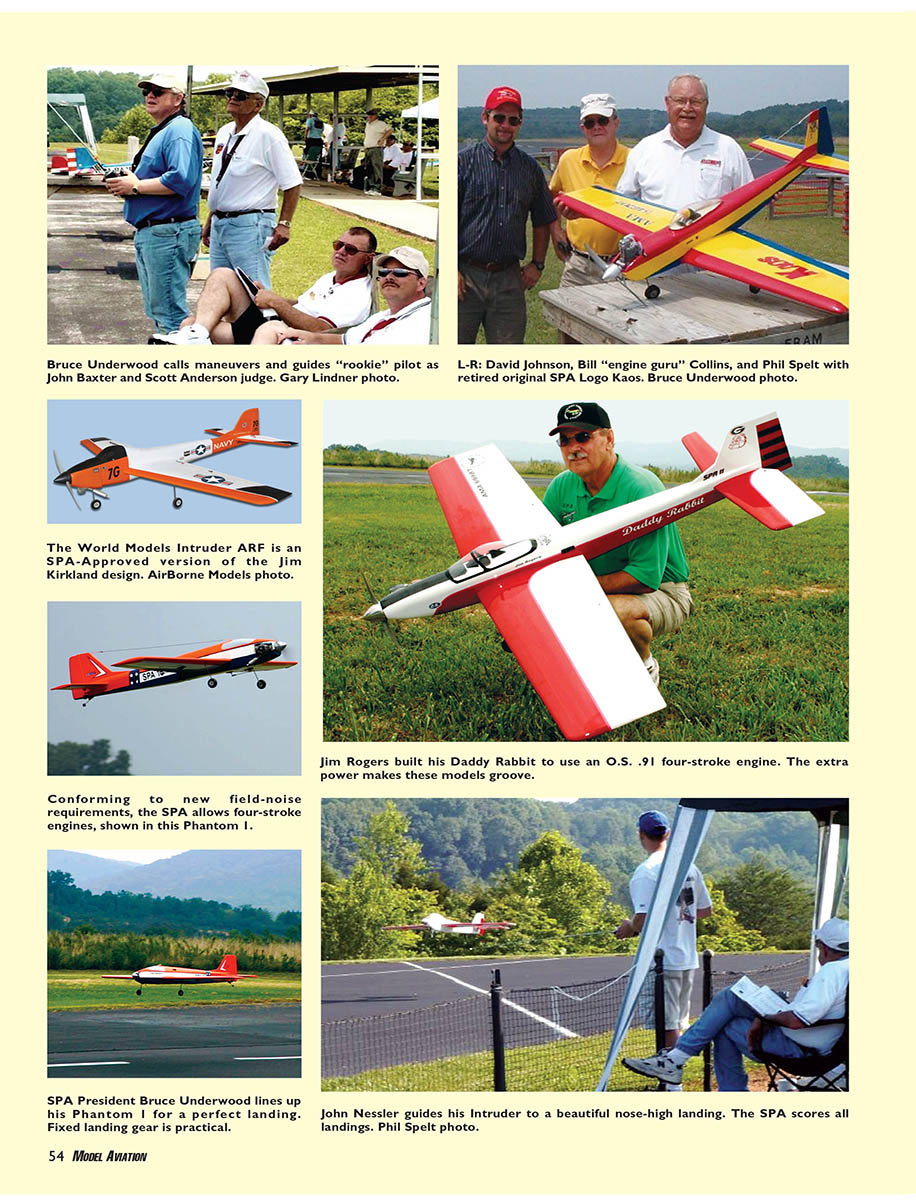
Other than landing gear, the most noticeable departure from the original model has been the allowance of four-stroke engines since the late 1990s because of today's noise restrictions. The four-stroke is now predominant because its performance rivals that of a two-stroke .61 with a tuned pipe, but two-stroke lovers will be happy to know that with recent improvements it is becoming common to see both engine types at most contests.
Choosing a Model
Airplane choice is noncritical for the Novice. It becomes more important as you advance through Sportsman to Expert, where maneuvers are more demanding and require more vertical performance. Although it's not recommended, I have seen high-wing trainers win Novice because the pilots were skilled in takeoffs, general flying, and landings.
Most competitors gravitate toward the best airplane, engine, propeller, fuel, etc., after competing in just a few contests by networking with others. For your first few meets it's best to concentrate on practicing and flying well with what you have. The rest will evolve naturally.
The early 1960s Pattern designs (originally designed to fly on reeds, before proportional radios) are great sport models but are seldom considered competitive enough for general SPA competition. The Taurus, Kaos, and Kwik Fli series are great for Pattern trainers, use in Novice, or use in Antique Class (a special, less commonly held event for pre-1967 designs).
Novice ARFs
Since Novice class allows any AMA-legal aircraft, most competitors opt for an aerobatic airplane they already have or one of the excellent Pattern trainer ARFs available as a way to experience competition without spending time scratch-building or on vintage kits. The most important thing at this stage is to fly an aerobatic model with which you are comfortable.
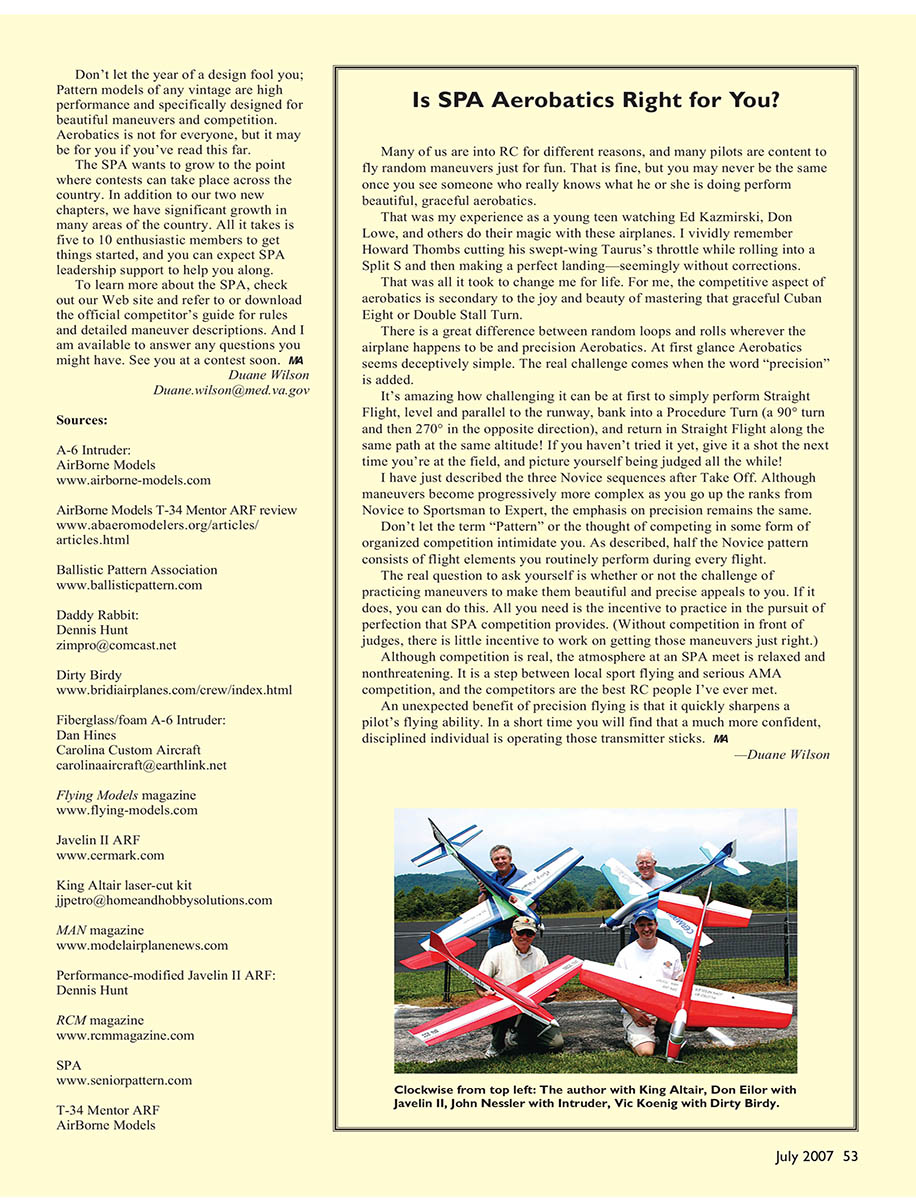
Many suitable airplanes are available from a wide variety of manufacturers, but two ARFs are worth special mention: Airborne Models' T-34 Mentor and the Cermark Javelin II. I've had great success with both and have seen them used repeatedly at SPA contests.
One of these designs has tricycle landing gear and the other is a tail-dragger. Both fly like they are on rails, but best of all, both are inexpensive and perform excellently. Neither model is SPA-legal, but it doesn't matter in Novice. Both will get you practicing in a hurry.
I used the T-34 as my Pattern trainer. It flies well on a .46–.50 two-stroke or .40–.72 four-stroke engine. Of all the aerobatic models I've flown, this is the easiest to "walk in" on landing approaches for perfect nose-high touchdowns on the main wheels of its tricycle landing gear. That is an important consideration if you are not used to flying a tail-dragger.
I was impressed enough with the T-34 to write a review for my local club's website. Eric Henderson's excellent review of the model appeared in the July 2002 MA RC Aerobatics column. Eric covered simple modifications to the standard airplane's vertical fin and control surfaces to improve performance. Read that column thoroughly if you are interested in the T-34. For $129.99, it is a great bargain. It has a wingspan of 58 inches.
The Javelin is a sharp little tail-dragger that is fast becoming the "go-to" design for SPA Novice competition. Several competitors fly it. It will perform the Novice pattern with ease, is graceful and smooth, and tracks wonderfully through maneuvers with its long tail moment.
The Javelin is the closest thing to the full-size SPA-legal airplanes. Dennis Hunt at Zimpro Marketing produces a performance-modified version. The Cermark version's suggested retail price is $169.95. It has a wingspan of 58 inches. The performance-modified version sells for $189.95 and also spans 58 inches.
All of the following (in the next section) are available as kits, short kits, Almost Ready-to-Cover (ARC) versions, or ARFs. You can't go wrong with any of them. These models have proven themselves in Pattern history and continue to do so at each SPA contest.
SPA-Legal Models
You can find a comprehensive list of SPA-legal designs on the SPA website. All were designed and flown prior to January 1, 1976, and can be used for all competition levels.
If you are familiar with Pattern's golden era, one or more of the model names may immediately interest you. If you are a younger or newer competitor, the choices might just look like a long list of names. Where do you find descriptions and pictures of these airplanes?
The designs featured in Radio Control Modeler (RCM) magazine throughout the years are located in a catalog for quick reference. Model Airplane News (MAN) magazine has its own plans service, as does Flying Models magazine. Also consider joining the SPA Discussion List, where you can ask for information about a particular design.
For those who don't have a preference, here are five of the most popular designs at SPA contests and the reasons for their fame. If you bring one of these to a meet, you will feel at home and know you have a good performer.
Daddy Rabbit
Jim Whitley won the 1966 Nats with this no-nonsense, functional design. Part of the reason it was featured on the cover of the May 2006 MA is that it is the acknowledged frontrunner when it comes to overall performance.
Dennis Hunt at Zimpro Marketing expertly produces this design as an ARC and several short-kit options. "The Rabbit," as it is usually called, has good vertical performance on a .91 four-stroke engine and will fly fast for rolling maneuvers, yet it is forgiving and capable of slowing nicely for those desirable soft landings.
As is common with rabbits in general, they are everywhere at SPA meets—and for good reason. Contact Dennis for information about the ARC he offers. It sells for $485.
Dirty Birdy
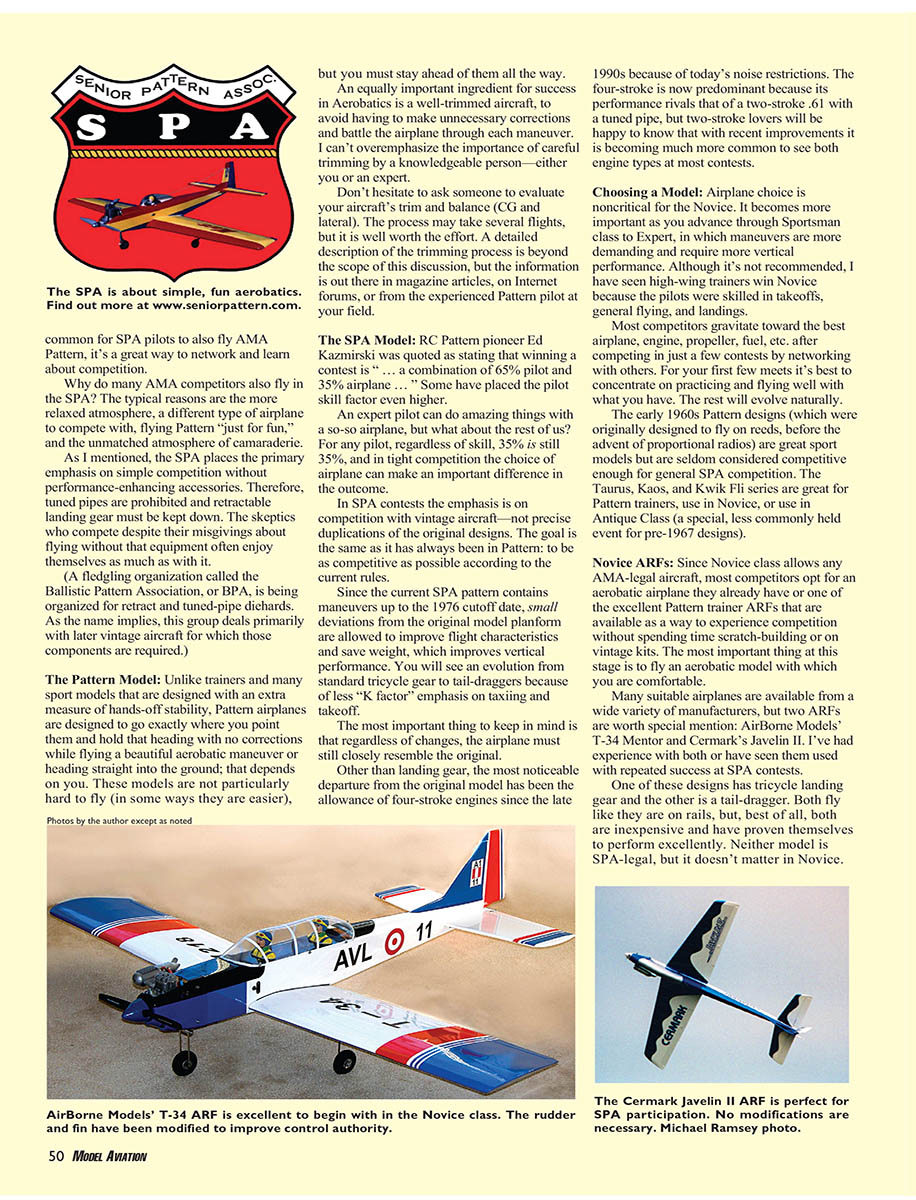
Joe Bridi has a well-deserved reputation for good-flying designs, from the early Kaos to later models outside the SPA time frame. This sleek, curvaceous mid-1970s design is one of his best-known contributions to R/C and has always been a popular standard among pilots.
Coming out near the end of the "legal" period, this airplane is equally at home with or without a tuned pipe and retracts. It is smooth and quite fast, even without SPA-illegal gear.
A-6 Intruder
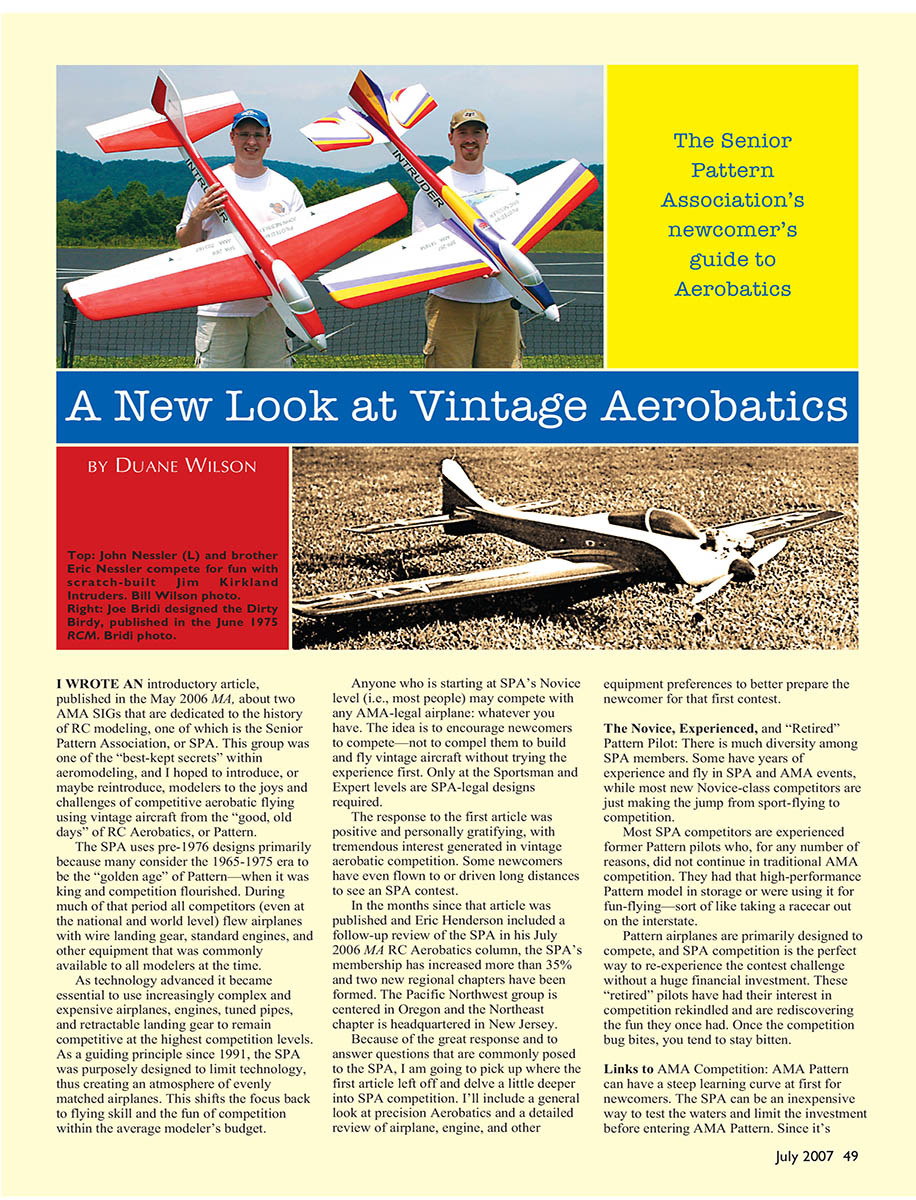
Jim Kirkland won the 1970 Nats with this design, which was inspired by the US Navy fighter. The Intruder's primary virtue for SPA use was its status as the only SPA-legal production ARF.
World Models produced its Intruder while totally unaware of its SPA potential and with significant changes from the original Kirkland design. However, once approved and the model developed a reputation as a good performer, it became popular.
Last year World Models discontinued production of the design just as it was being recommended to many new SPA members. The remaining kits were running out and the Intruder seemed near the point of extinction. But the story was not over.
Months later management at World Models' US headquarters—Airborne Models—was contacted and a case was made for reintroducing the airplane. Within two days word came back that not only was it going to reverse its decision, but it would produce an improved Intruder.
When asked for improvement suggestions we were more than happy to oblige. Eric Nessler, an expert pilot familiar with the Intruder, detailed on paper to Airborne engineers the changes needed for it to fly its best in a contest setting. It is our understanding that all major modification suggestions were incorporated into the new version. Even the color scheme was changed to make the model look better.
We have not had the opportunity to test-fly the airplane as of this writing, but there is every indication that Airborne has a winner. The A-6 is available for $199.99.
For those interested in a true-to-the-original Kirkland Intruder more suited to two-stroke engines, a fiberglass/foam kit is available through Dan Hines at Carolina Custom Aircraft for $255 plus shipping and handling.
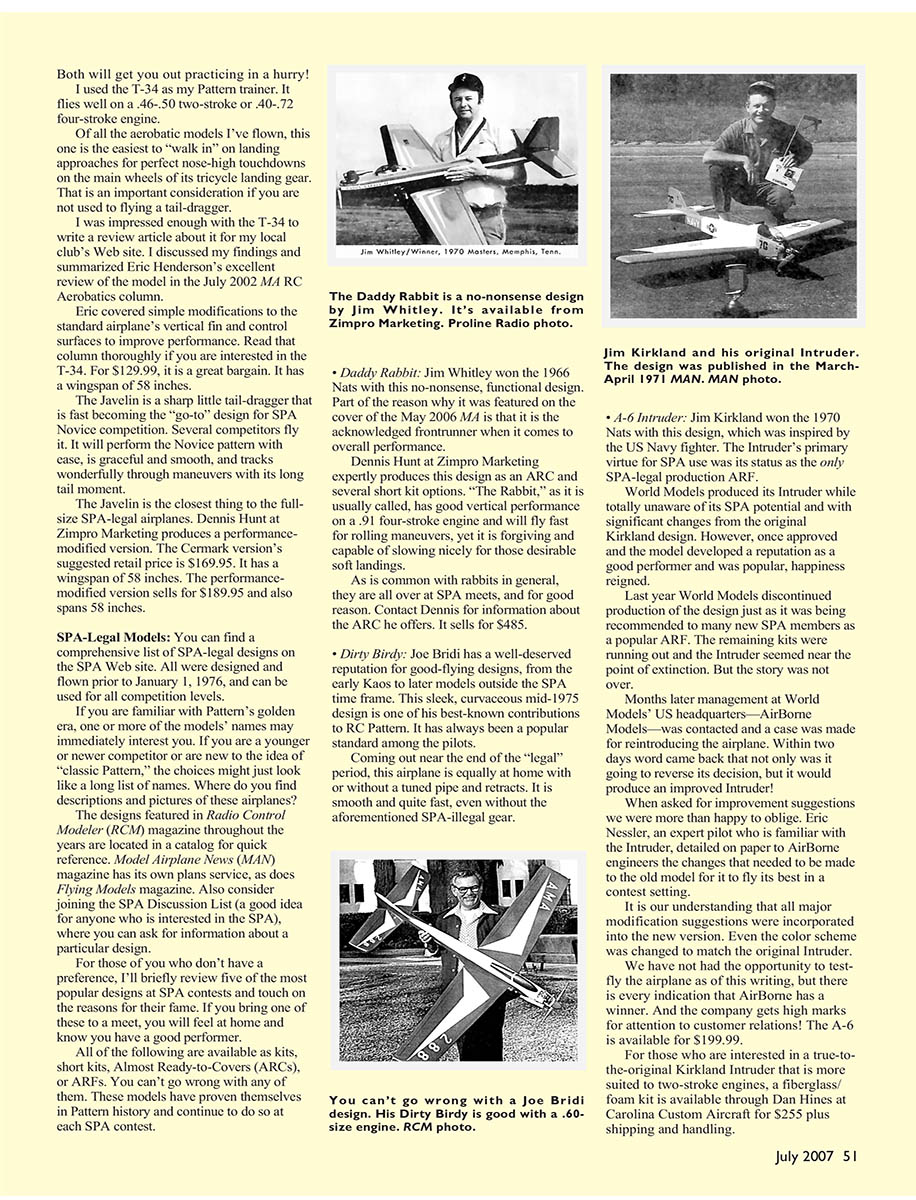
Phantom 1
Although it is not as immediately recognizable as some classic Pattern designs, Bob Klineyoung's 1973 Phantom 1 has excellent overall performance that rivals the Daddy Rabbit.
SPA President Bruce Underwood and his son Cass are consistent winners in their respective classes with this design. You can have the same winning model, but you're going to have to practice as much as they do to win.
This design is available in several wing/stabilizer short-kit versions; the fuselage needs to be scratch-built from plans. Contact Dennis Hunt for details.
King Altair
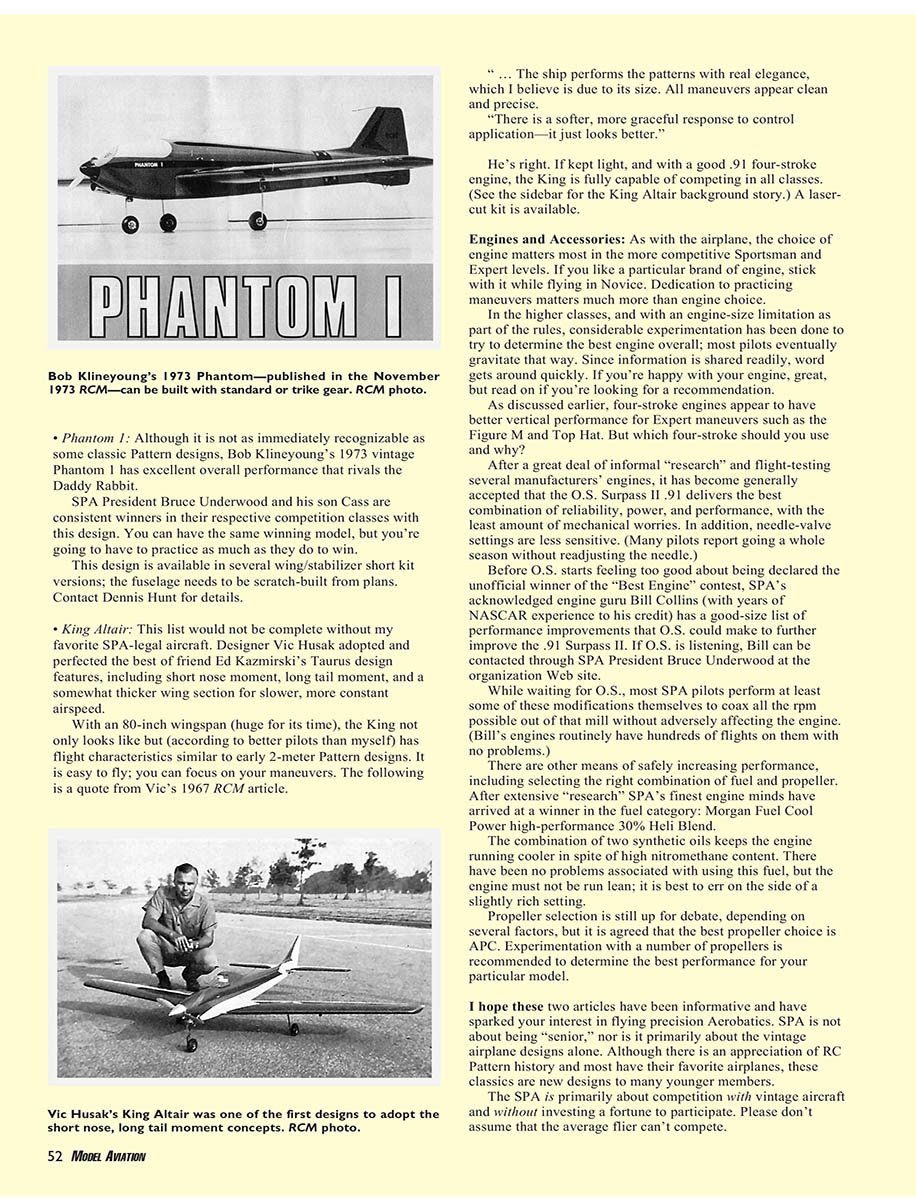
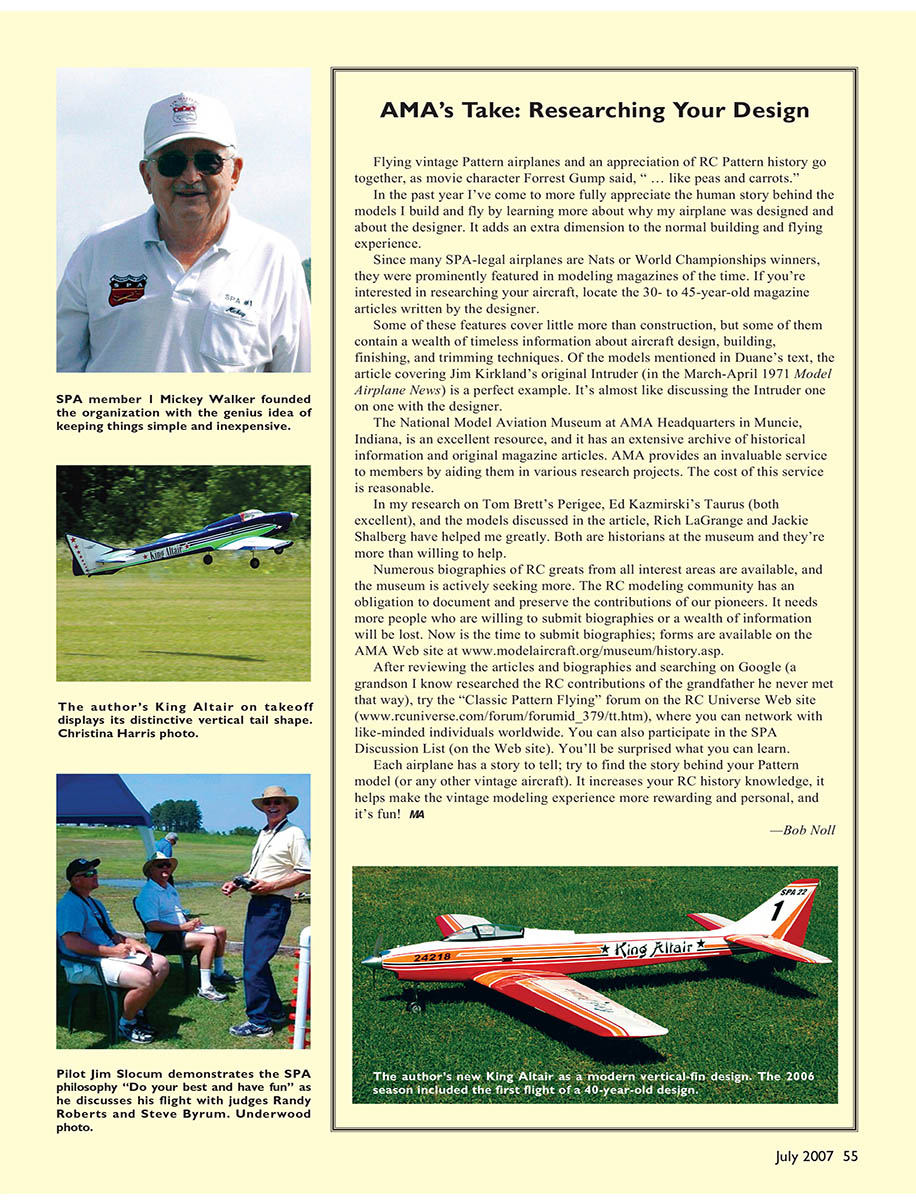
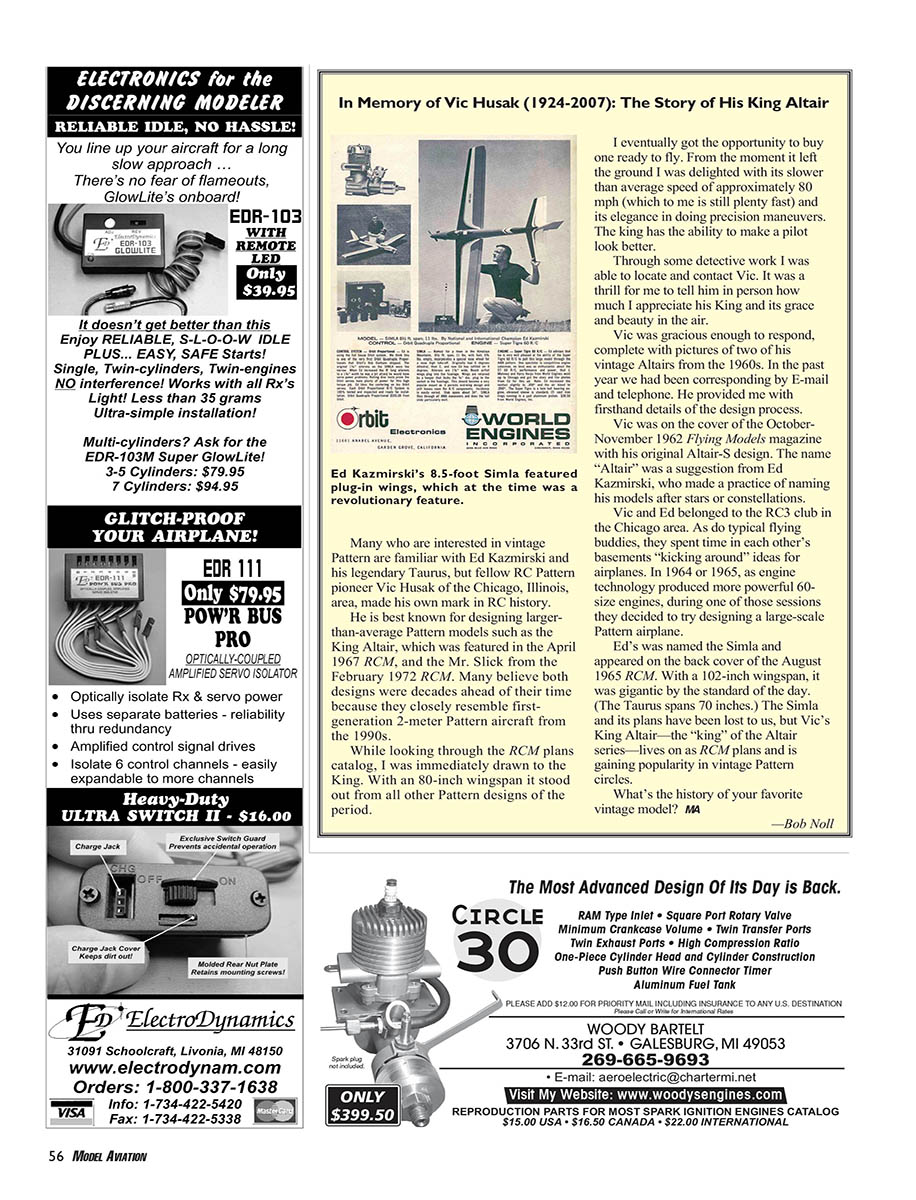
This list would not be complete without my favorite SPA-legal aircraft. Designer Vic Husak adopted and perfected the best of Fred Kazmirski's Taurus design features, including short nose moment, long tail moment, and a somewhat thicker wing section for slower, more constant airspeed.
With an 80-inch wingspan (huge for its time), the King not only looks like but—according to better pilots than myself—has flight characteristics similar to early 2-meter Pattern designs. It is easy to fly; you can focus on your maneuvers.
Vic Husak wrote in his 1967 RCM article: "The ship performs the patterns with real elegance, which I believe is due to its size. All maneuvers appear clean and precise. There is a softer, more graceful response to control application—it just looks better."
He's right. If kept light and with a good .91 four-stroke engine, the King is fully capable of competing in all classes. A laser-cut kit is available.
Engines and Accessories
As with the airplane, engine choice matters most in the more competitive Sportsman and Expert levels. If you like a particular brand of engine, stick with it while flying in Novice. Dedication to practicing maneuvers matters much more than engine choice.
In the higher classes, and with an engine-size limitation as part of the rules, considerable experimentation has been done to determine the best engine overall; most pilots eventually gravitate toward a consensus. Since information is shared readily, word gets around quickly. If you're happy with your engine, great. If you're looking for a recommendation, read on.
As discussed earlier, four-stroke engines appear to have better vertical performance for Expert maneuvers such as the Figure M and Top Hat. But which four-stroke should you use and why?
After a great deal of informal research and flight-testing several manufacturers' engines, it has become generally accepted that the O.S. Surpass II .91 delivers the best combination of reliability, power, and performance, with the least amount of mechanical worries. In addition, needle-valve settings are less sensitive—many pilots report going a whole season without readjusting the needle.
SPA's acknowledged engine guru Bill Collins (with years of NASCAR experience to his credit) has a list of performance improvements that O.S. could make to further improve the .91 Surpass II. If O.S. is listening, Bill can be contacted through SPA President Bruce Underwood at the organization website.
While waiting for O.S., most SPA pilots perform at least some of these modifications themselves to coax all the rpm possible out of that mill without adversely affecting the engine. Bill's engines routinely have hundreds of flights on them with no problems.
There are other means of safely increasing performance, including selecting the right combination of fuel and propeller. After extensive testing SPA's engine experts have arrived at a winner in the fuel category: Morgan Fuel Cool Power high-performance 30% Heli Blend.
The combination of two synthetic oils keeps the engine running cooler despite the high nitromethane content. There have been no problems associated with using this fuel, but the engine must not be run lean; it is best to err on the side of a slightly rich setting.
Propeller selection is still up for debate, depending on several factors, but it is agreed that the best propeller choice is APC. Experimentation with a number of propellers is recommended to determine the best performance for your particular model.
I hope these articles have been informative and have sparked your interest in flying precision Aerobatics. SPA is not about being "senior," nor is it primarily about the vintage airplane designs alone. Although there is an appreciation of RC Pattern history and most have their favorite airplanes, these classics are new designs to many younger members.
The SPA is primarily about competition with vintage aircraft without investing a fortune to participate. Please don't assume that the average flier can't compete. Don't let the year of a design fool you; Pattern models of any vintage are high-performance and specifically designed for beautiful maneuvers and competition. Aerobatics is not for everyone, but it may be for you if you've read this far.
The SPA wants to grow to the point where contests can take place across the country. In addition to our two new chapters, we have significant growth in many areas. All it takes is five to ten enthusiastic members to get things started, and you can expect SPA leadership support to help you along.
To learn more about the SPA, check out our website and refer to or download the official competitor's guide for rules and detailed maneuver descriptions. I am available to answer any questions you might have. See you at a contest soon.
Duane Wilson [email protected]
Sources
- A-6 Intruder: Airborne Models — www.airborne-models.com
- Airborne Models T-34 Mentor ARF review — www.airbornemodelers.org/articles/articles.html
- Ballistic Pattern Association — www.ballisticpattern.com
- Daddy Rabbit: Dennis Hunt — [email protected]
- Dirty Birdy — www.bridairplanes.com/crew/index.html
- Fiberglass/foam A-6 Intruder: Dan Hines, Carolina Custom Aircraft — [email protected]
- Flying Models magazine — www.flying-models.com
- Javelin II ARF — www.cermark.com
- King Altair laser-cut kit — [email protected]
- MAN magazine — www.modelairplanenews.com
- Performance-modified Javelin II ARF: Dennis Hunt
- RCM magazine — www.rcmmagazine.com
- SPA — www.seniorpattern.com
- T-34 Mentor ARF: Airborne Models
Is SPA Aerobatics Right for You?
Many of us are into RC for different reasons, and many pilots are content to fly random maneuvers just for fun. That is fine, but you may never be the same once you see someone who really knows what he or she is doing perform beautiful, graceful aerobatics.
That was my experience as a young teen watching Ed Kazmirski, Don Lowe, and others do their magic with these airplanes. I vividly remember Howard Thombs cutting his swept-wing Taurus's throttle while rolling into a Split S and then making a perfect landing—seemingly without corrections.
That was all it took to change me for life. For me, the competitive aspect of aerobatics is secondary to the joy and beauty of mastering a graceful Cuban Eight or Double Stall Turn.
There is a great difference between random loops and rolls wherever the airplane happens to be and precision Aerobatics. At first glance Aerobatics seems deceptively simple. The real challenge comes when the word "precision" is added.
It's amazing how challenging it can be at first to simply perform Straight Flight, level and parallel to the runway, back into a Procedure Turn (a 90° turn and then 270° in the opposite direction), and return in Straight Flight along the same path at the same altitude. If you haven't tried it yet, give it a shot the next time you're at the field, and picture yourself being judged all the while!
I have just described the three Novice sequences after Take Off. Although maneuvers become progressively more complex as you go up the ranks from Novice to Sportsman to Expert, the emphasis on precision remains the same.
Don't let the term "Pattern" or the thought of competing in some form of organized competition intimidate you. As described, half the Novice pattern consists of flight elements you routinely perform during every flight.
The real question to ask yourself is whether the challenge of practicing maneuvers to make them beautiful and precise appeals to you. If it does, you can do this. All you need is the incentive to practice in the pursuit of perfection that SPA competition provides. Without competition in front of judges, there is little incentive to work on getting those maneuvers just right.
Although competition is real, the atmosphere at an SPA meet is relaxed and nonthreatening. It is a step between local sport flying and serious AMA competition, and the competitors are the best RC people I've ever met.
An unexpected benefit of precision flying is that it quickly sharpens a pilot's flying ability. In a short time you will find that a much more confident, disciplined individual is operating those transmitter sticks.
— Duane Wilson
Transcribed from original scans by AI. Minor OCR errors may remain.

