
Newcomers
EVERY NOW and then I like to share mail with you; the following letter from AMA Education Coordinator Jack Frost seemed most appropriate.
“In May [2001], my wife Jill and I headed for our nephew’s wedding to be held in Jacksonville NC June 2. Since it was on the way and we had the opportunity, we decided to stop and see our son David, daughter-in-law Susan, and 10-year-old grandson Joshua, who live in Fayetteville NC.
“For quite some time, I have wanted to help my son and grandson become involved in model aviation. The problem is that my son is an Army captain and is always on the move. We just never seem to be able to make the hookup.
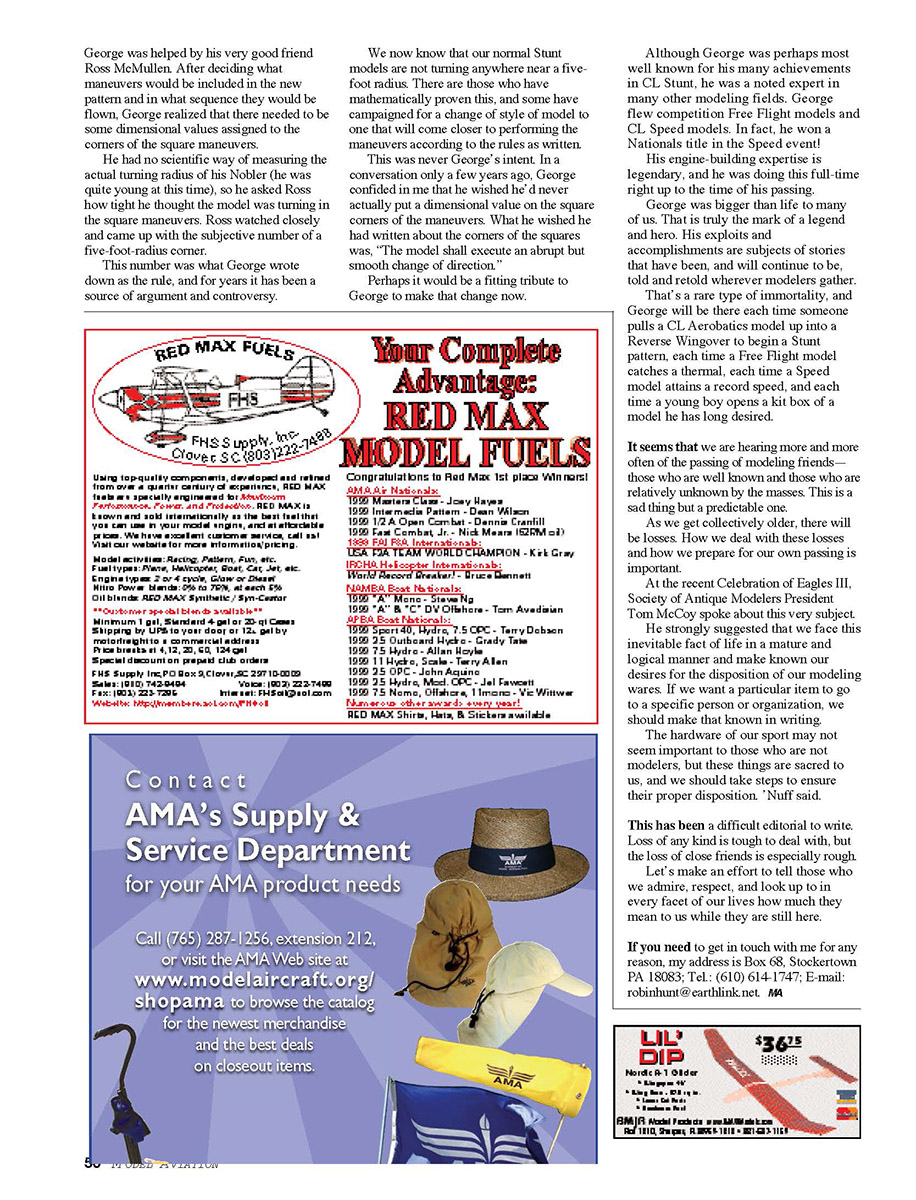
“Since the wedding invitation had given us considerable time to plan, I started building an airplane for David and Joshua in my spare time. I chose a Dynaflite® Butterfly, powered with an O.S. .20. It was covered with UltraCote™ and used a Hitec flash four-channel radio system. Upon completion of the model, I also acquired [AMA] memberships for my son and grandson.
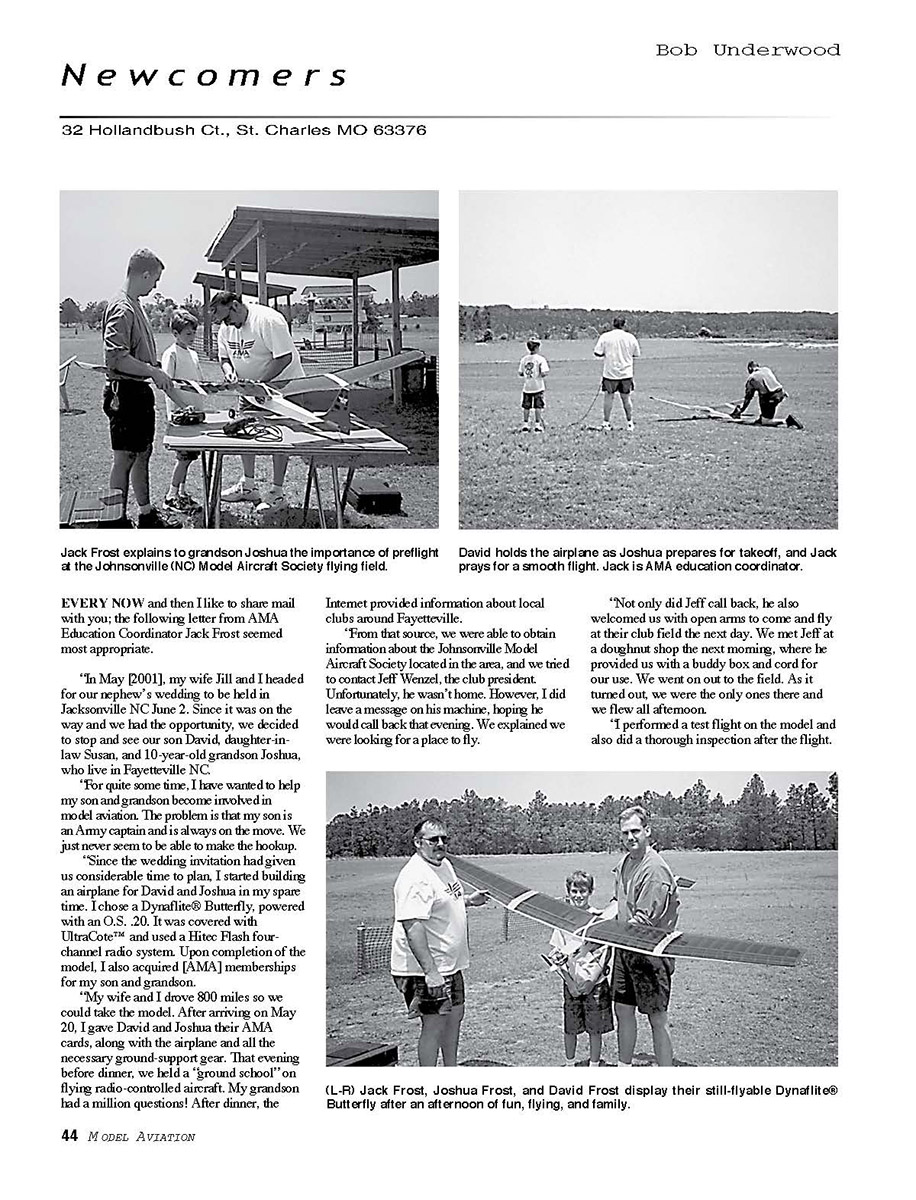
“My wife and I drove 800 miles so we could take the model. After arriving on May 20, I gave David and Joshua their AMA cards, along with the airplane and all the necessary ground-support gear. That evening before dinner, we held a ‘ground school’ on flying radio-controlled aircraft. My grandson had a million questions! After dinner, the Internet provided information about local clubs around Fayetteville.
“From that source, we were able to obtain information about the Johnsonville Model Aircraft Society located in the area, and we tried to contact Jeff Wenzel, the club president. Unfortunately, he wasn’t home. However, I did leave a message on his machine, hoping he would call back that evening. We explained we were looking for a place to fly.
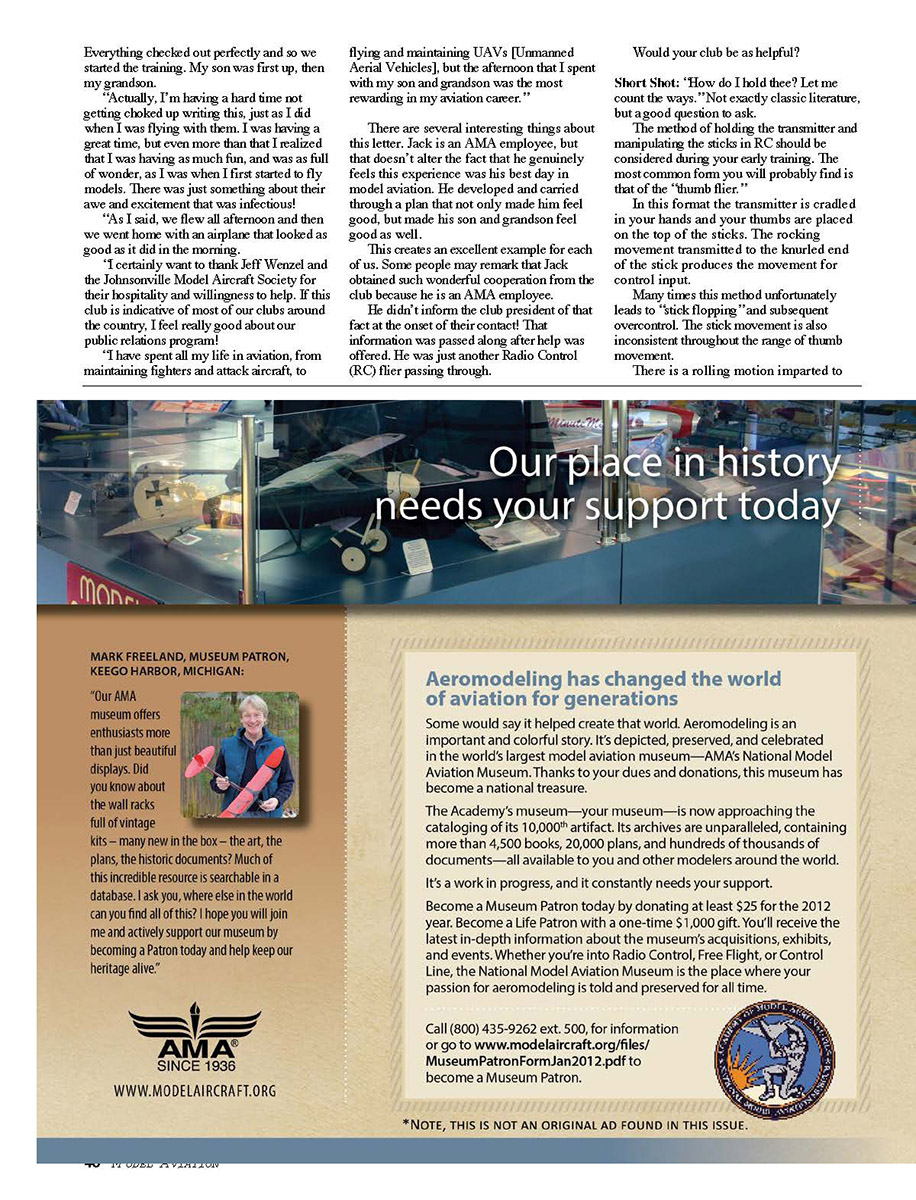
“Not only did Jeff call back, he also welcomed us with open arms to come and fly at their club field the next day. We met Jeff at a doughnut shop the next morning, where he provided us with a buddy box and cord for our use. We went on out to the field. As it turned out, we were the only ones there and we flew all afternoon.
“I performed a test flight on the model and also did a thorough inspection after the flight. I have spent all my life in aviation, from maintaining fighters and attack aircraft, to flying and maintaining UAVs [Unmanned Aerial Vehicles], but the afternoon that I spent with my son and grandson was the most rewarding in my aviation career.
There are several interesting things about this letter. Jack is an AMA employee, but that doesn't alter the fact that he genuinely feels this experience was his best day in model aviation. He developed and carried through a plan that not only made him feel good, but made his son and grandson feel good as well.
This creates an excellent example for each of us. Some people may remark that Jack obtained such wonderful cooperation from the club because he is an AMA employee.
He didn't inform the club president of the fact at the onset of their contact! That information was passed along after help was offered. He was just another Radio Control (RC) flier passing through.
Would your club be as helpful?
Short Shot: "How do I hold the? Let me count the ways." Not exactly classic literature, but a good question to ask.
The method of holding the transmitter and manipulating the sticks in RC should be considered during your early training. The most common form you will probably find is that of the "thumb flip."
In this format the transmitter is cradled in your hands and your thumbs are placed on the top of the sticks. The rocking movement transmitted to the knurled end of the stick produces the movement for control input.
Many times this method unfortunately leads to "stick flopping" and subsequent overcontrol. The stick movement is also inconsistent throughout the range of thumb movement.
There is a rolling motion imparted to
Transcribed from original scans by AI. Minor OCR errors may remain.

