
NIRAC Indoor Championships
by John Worth
Overview
The potential of last year’s first Indoor Championships—which, as a new event on the aeromodeling scene, was compromised by conflicts with other events and a late site change—was realized this year with a much bigger number of entries and great flying.
The annual event, held again this year at the Oakland Yard Athletics dome in Waterford, Michigan, June 4–6, had many interesting models, action, and people. There were 33 fliers from 11 states and Canada.
The National Indoor Remote-controlled Aircraft Council (NIRAC) organized last year’s and this year’s championships. There were six competition events this year and several open (fun-fly) sessions. The competition events were significantly different from each other, and the open flying included indoor RC models of all types. A great variety of models were flown, embracing almost the entire spectrum of indoor RC models.
NIRAC Hall of Fame
In addition to the flying, NIRAC Hall of Fame presentations were made at the Saturday-night banquet to modelers credited with important contributions to the development, progress, promotion, and achievements in indoor RC activity: Joe Malinchak, Clarence and Dan Hurd, Jack McGillivray, and myself.
Grand Champion and top competitors
Bob Wilder (Colleyville, TX), the first NIRAC president, was Grand Champion of the weekend. He flew in every competition event. He won first places in Cargo and Old-Timer Climb and Glide, a second in Glider, and two thirds in Endurance and Scale.
Henry Pasquet (Ellsinore, MO) was close behind throughout the weekend, with a first place in Endurance, two seconds (in Cargo and Racing), and a third in Glider.
Events and Results
Climb and Glide and Glider
Two of the most interesting events—Climb and Glide and Glider—are similar in that both involve timing only the gliding portion of the flight. The basic challenge is to get the model as close as possible to the building’s ceiling and achieve the longest timed gliding flight. The peak of the dome-shaped ceiling at Waterford is approximately 80 feet high.
Climb and Glide
- Models must be Old-Timer designs published or kitted before 1943.
- Minimum weight: 5 ounces.
- Maximum wingspan: 42 inches.
- Rise-off-ground takeoff is required.
- The gliding flight is timed after a maximum 30-second motor run.
Bob Wilder won this event flying his greatly enlarged RC version of the pre-World War II Quaker Flash free-flight model. Other Old-Timers flown included a Miss America, a Playboy Senior, a Flying Aces Stick, an Atomizer, and a Comet Clipper.
Glider
- Models must be unpowered.
- Maximum wingspan: 30 inches.
- Minimum weight: 30 grams.
- Objective: get the glider as high as possible by any means, then release it into a timed gliding flight.
- Launch methods used included balloons carrying an airplane, a powered model towing a glider, piggyback launches from a powered model, and hand towing.
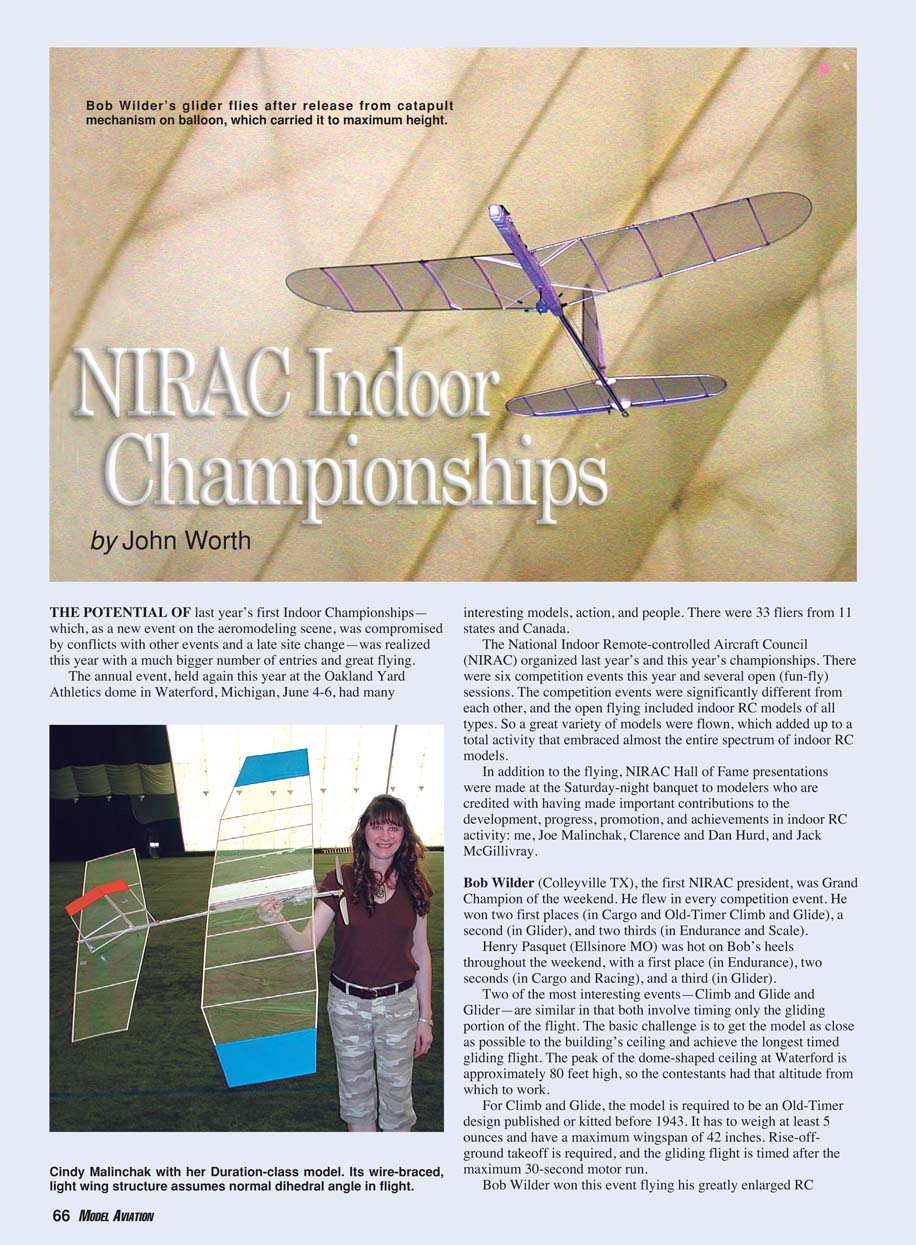
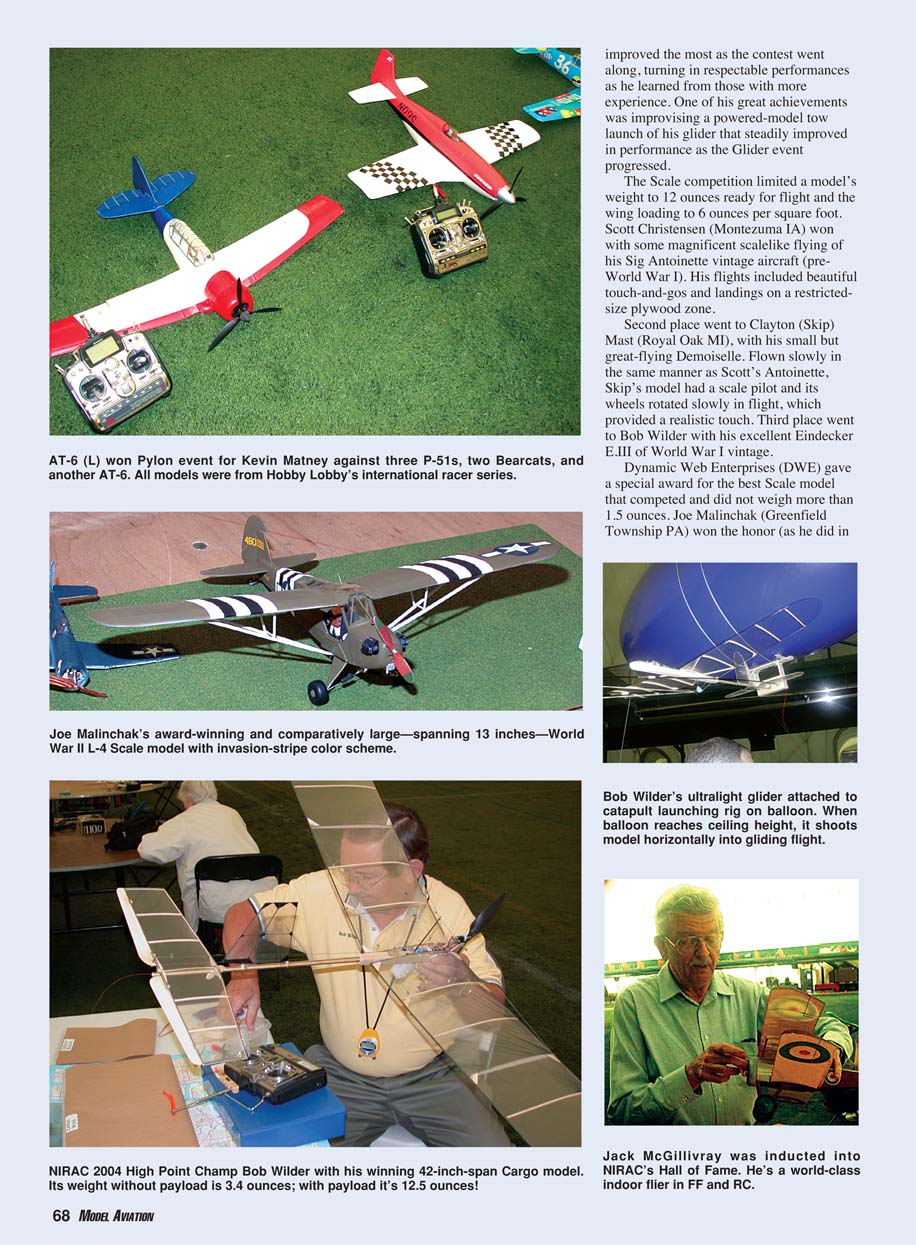
Dave Robelen (Farmville, VA) won Glider with a time of 1 minute, 15 seconds, using a clever piggyback arrangement: he launched his glider from the top of a powered model flown by helper Bill Conkling (Williamsburg, VA). Dave beat Bob Wilder, who used a very large balloon (more like a blimp) carrying a catapult mechanism that launched the glider into horizontal flight, allowing launch at maximum altitude. Although Dave’s launcher couldn’t be flown as close to the ceiling, his glider achieved a better glide and won him the event and the meet’s Highest Achievement award.
Other launches involved simply dropping the glider vertically from a balloon (which cost altitude), or hand towing (simple but hard to reach peak dome height).
Endurance and Cargo
Although more subdued in action, Endurance and Cargo were of great interest. Both feature power restrictions:
- Endurance (also called Duration, AMA event 627) allows a maximum of four 50 mAh Ni-Cd cells to fly a model of any size.
- Cargo limits battery voltage to a maximum of 7.4 volts, whether Li-Poly, Ni-Cd, or NiMH.
Endurance Henry Pasquet won Endurance with a world-record-setting flight of 33 minutes, 37 seconds, breaking the record he set a week earlier at the AMA Nationals in Johnson City, Tennessee. His model weighed only 31 grams (1.09 ounces).
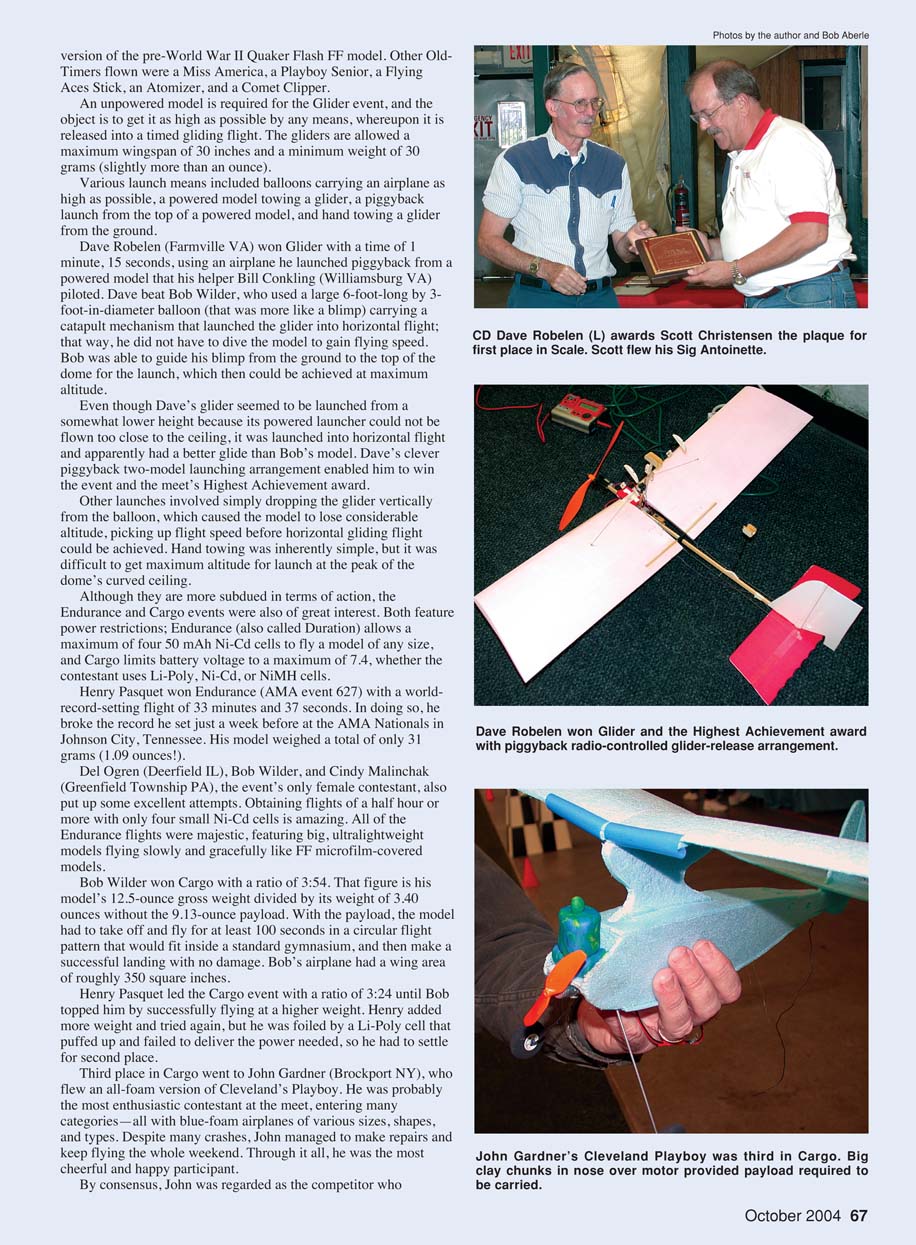
Del Ogren (Deerfield, IL), Bob Wilder, and Cindy Malinchak (Greenfield Township, PA)—the event’s only female contestant—also posted excellent attempts. Obtaining flights of a half hour or more with only four small Ni-Cd cells was impressive. The Endurance flights featured big ultralight models flying slowly and gracefully like free-flight microfilm-covered models.
Cargo Bob Wilder won Cargo with a ratio of 3:54 (12.5-ounce gross weight divided by 3.40 ounces empty weight, with a 9.13-ounce payload). With the payload, the model had to take off and fly for at least 100 seconds in a circular flight pattern that would fit inside a standard gymnasium, then make a successful landing with no damage. Bob’s airplane had a wing area of roughly 350 square inches.
Henry Pasquet had led Cargo with a ratio of 3:24 until Bob topped him by successfully flying at a higher weight. Henry added more weight and tried again, but a Li-Poly cell puffed up and failed to deliver power, forcing him to settle for second place.
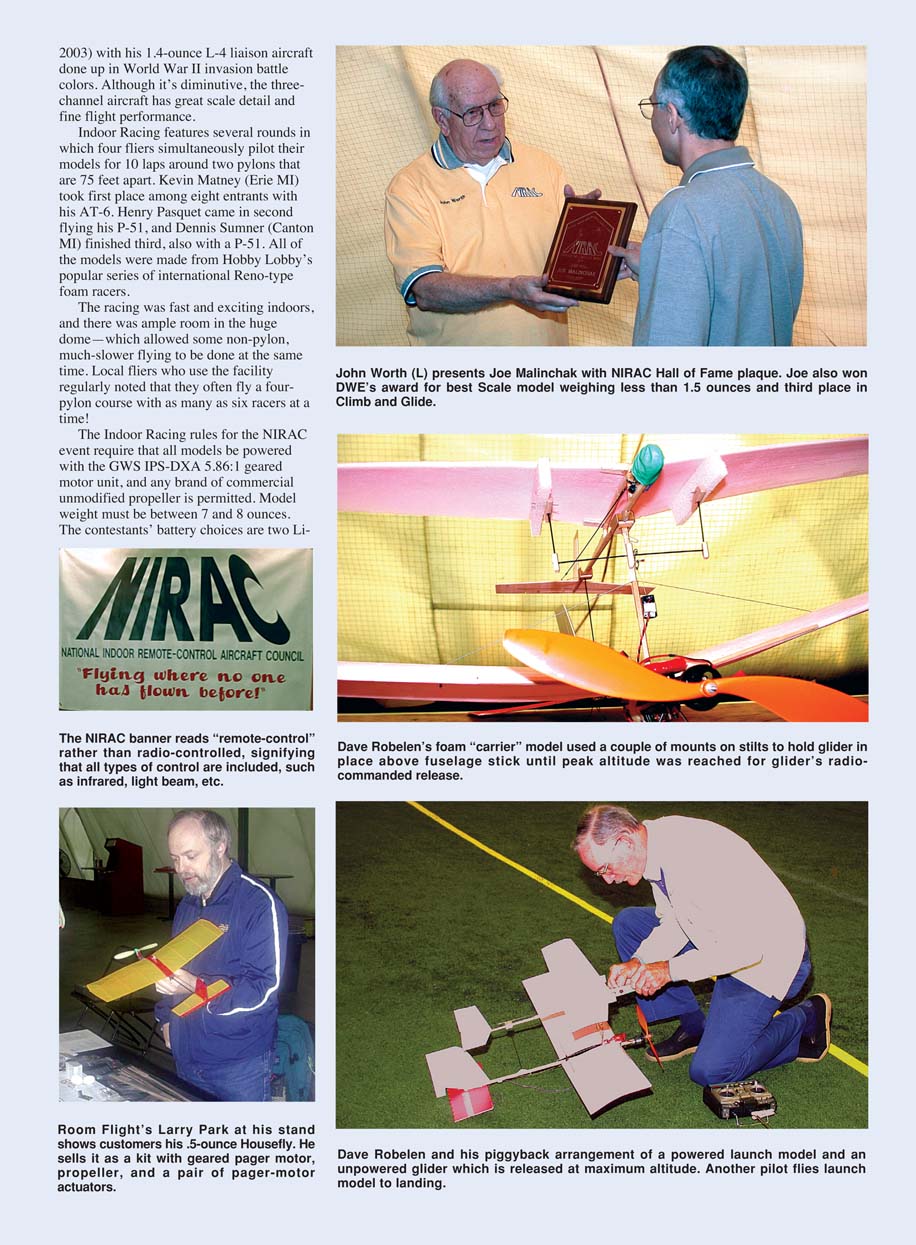
Third place in Cargo went to John Gardner (Brockport, NY), who flew an all-foam version of Cleveland’s Playboy. John was probably the most enthusiastic contestant, entering many categories—all with blue-foam airplanes of various sizes and shapes. Despite many crashes, he kept repairing and flying the whole weekend and was widely regarded as the competitor who improved the most as the contest progressed.
Scale
Scale competition limited a model’s weight to 12 ounces ready for flight and wing loading to 6 ounces per square foot.
Results
- 1st: Scott Christensen (Montezuma, IA) — Sig Antoinette vintage aircraft (pre–World War I), with magnificent scalelike flying including beautiful touch-and-gos and landings on a restricted-size plywood zone.
- 2nd: Clayton (Skip) Mast (Royal Oak, MI) — Demoiselle, small but great-flying, flown slowly with a scale pilot and slowly rotating wheels for realism.
- 3rd: Bob Wilder — excellent Eindecker E.III (World War I vintage).
Dynamic Web Enterprises (DWE) gave a special award for the best Scale model that did not weigh more than 1.5 ounces. Joe Malinchak (Greenfield Township, PA) won the honor (as he did in 2003) with his 1.4-ounce L-4 liaison aircraft painted in World War II invasion battle colors. Although diminutive, the three-channel aircraft had great scale detail and fine flight performance.
Indoor Racing
Indoor Racing features several rounds in which four fliers simultaneously pilot their models for 10 laps around two pylons 75 feet apart.
Results
- 1st: Kevin Matney (Erie, MI) — AT-6 (among eight entrants)
- 2nd: Henry Pasquet — P-51
- 3rd: Dennis Sumner (Canton, MI) — P-51
The racing was fast and exciting indoors, and there was ample room in the huge dome—which also allowed some non-pylon, slower flying at the same time. Local fliers noted they often fly a four-pylon course with as many as six racers at a time.
Indoor Racing rules for the NIRAC event
- All models powered with the GWS IPS-DXA 5.86:1 geared motor unit.
- Any brand of commercial unmodified propeller permitted.
- Model weight: 7–8 ounces.
- Battery choices: two Li-Poly cells, six Ni-Cd cells, or six NiMH cells (approx. 7.2 volts).
- Models must be replicas of full-scale, single-engine aircraft that have participated in the Unlimited class of pylon racers, with three-dimensional fuselages closely following the original shape.
- Wings must be single-surface, undercambered with a minimum of 8% thickness from the top of the airfoil to its two lowest points along the full span.
- Minimum wing area: 135 square inches.
- Landing gear optional; launching by hand.
Awards, Organization, and Thanks
The championships ended Sunday afternoon with a great array of NIRAC plaques awarded. There was a special award from E Cubed RC for the highest number of points by a contestant who used an Azarr short RC antenna, which Bob Wilder won.
Current (second) NIRAC President Dave Robelen organized and directed this year's event (and was the contest director last year). Last year's president, Bob Wilder, organized the 2003 Champs. Dave is already developing plans for the 2005 Indoor RC Championships, likely to be held at the same place and roughly the same time.
NIRAC officials paid tribute to the 2004 event sponsors; their participation made it a financial and operational success and helped assure these contests will continue. Thanks to:
- Air Age Media
- Balsa Products
- Castle Creations
- Dynamic Web Enterprises (DWE)
- FMA Direct
- Maplegate Media
- RC Groups
- Sky Hooks and Rigging
Thanks also to the on-site vendors: DJ Aerotech, DWE, and Room Flight.
We appreciate the efforts of Oakland Yard Athletics facility manager Dave Dobrian and Special Events Coordinator Julie Dean (who organized a fine banquet). Although Bill Smead (Palatine, IL) was a contestant, he volunteered to help with registration and raffle-ticket sales (which helped pay for NIRAC's weekend expenses). Bill Conkling served as an assistant and Scale judge for Dave Robelen.
Conclusion
Another historic national event for the fledgling indoor RC activity is now in the AMA record books. As a relatively new and steadily growing aeromodeling category, it is firmly established and ready to go on to bigger and better things.
As an official AMA SIG, NIRAC is fulfilling the promise it made when it was established. This progress is a tribute to founder Bob Wilder’s vision and organizational ability. Much is also owed to NIRAC’s current vice president, Bob Aberle, who has provided yeoman volunteer service as promoter, photographer, liaison to the SIG and the AMA, and all-around advisor.
John Worth 4326 Andes Dr. Fairfax, VA 22030
Transcribed from original scans by AI. Minor OCR errors may remain.

