
Old Rhinebeck Aerodrome
by Aaron Baldwick
There are only a few places in the world with the magical quality that appeals to kids and the kid in all of us — a place where you can stop thinking about what's going on in your life and lose yourself.
One such place that has been a special part of my and my family's life is the Old Rhinebeck Aerodrome Aviation Museum in Rhinebeck, New York. It's much more than a collection of old airplanes, hangars, and glass-box displays. It's a living piece of aviation history.
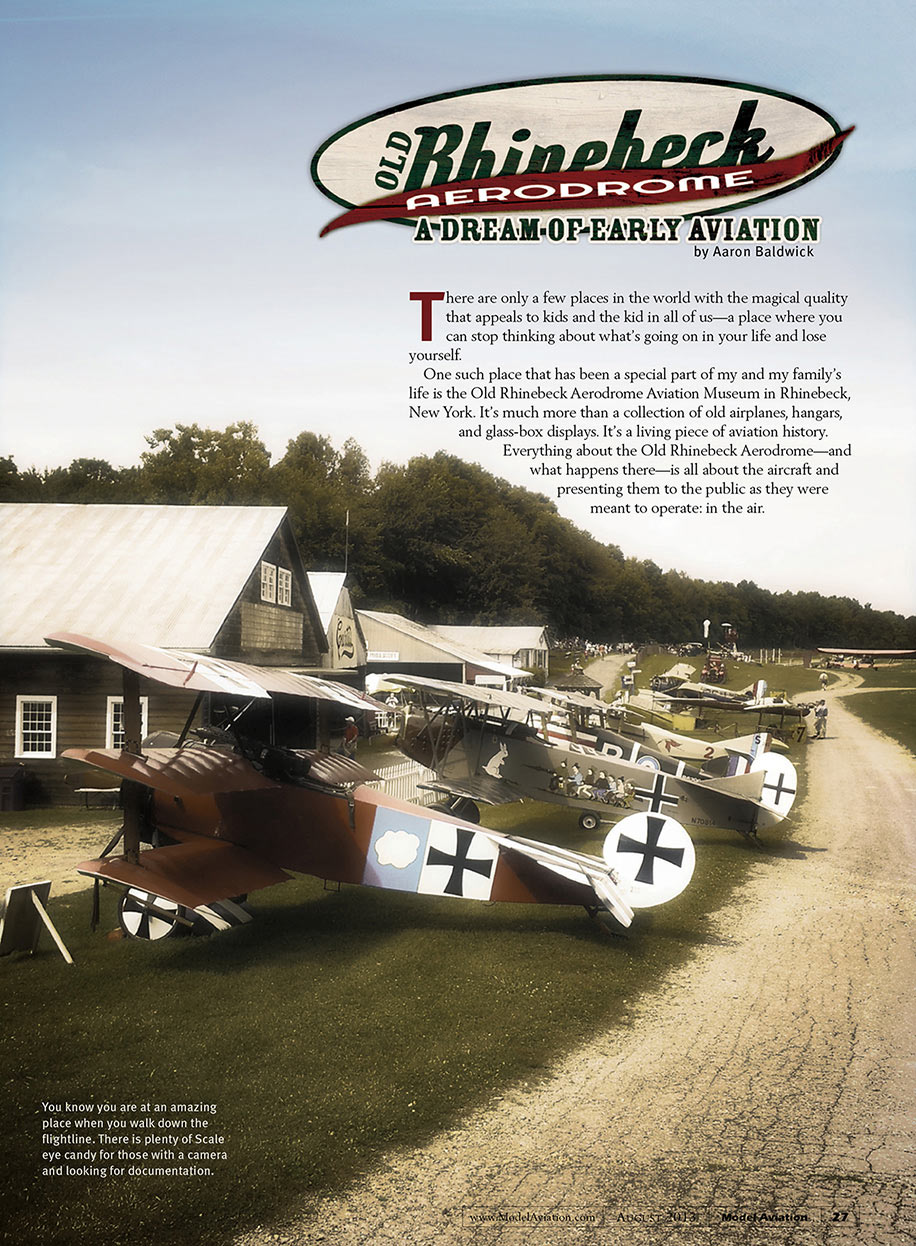
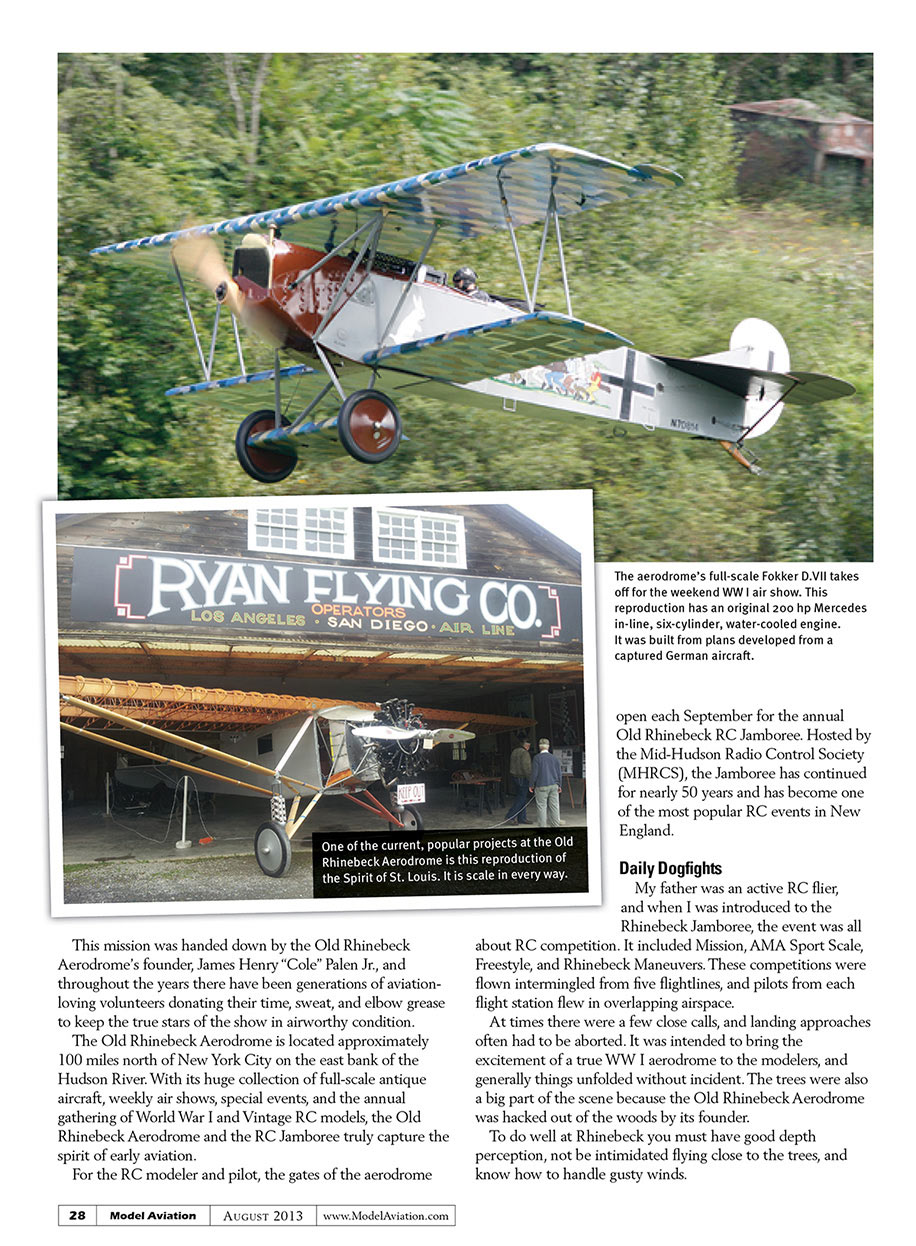
Everything about the Old Rhinebeck Aerodrome — and what happens there — is all about the aircraft and presenting them to the public as they were meant to operate: in the air. This mission was handed down by the Old Rhinebeck Aerodrome's founder, James Henry "Cole" Palen Jr., and throughout the years there have been generations of aviation-loving volunteers donating their time, sweat, and elbow grease to keep the true stars of the show in airworthy condition.
The Old Rhinebeck Aerodrome is located approximately 100 miles north of New York City on the east bank of the Hudson River. With its huge collection of full-scale antique aircraft, weekly air shows, special events, and the annual gathering of World War I and Vintage RC models, the Old Rhinebeck Aerodrome and the RC Jamboree truly capture the spirit of early aviation.
For the RC modeler and pilot, the gates of the aerodrome open each September for the annual Old Rhinebeck RC Jamboree. Hosted by the Mid-Hudson Radio Control Society (MHRCS), the Jamboree has continued for nearly 50 years and has become one of the most popular RC events in New England.
Daily Dogfights
My father was an active RC flier, and when I was introduced to the Rhinebeck Jamboree, the event was all about RC competition. It included Mission, AMA Sport Scale, Freestyle, and Rhinebeck Maneuvers. These competitions were flown intermingled from five flightlines, and pilots from each flight station flew in overlapping airspace.
At times there were a few close calls, and landing approaches often had to be aborted. It was intended to bring the excitement of a true WW I aerodrome to the modelers, and generally things unfolded without incident. The trees were also a big part of the scene because the Old Rhinebeck Aerodrome was hacked out of the woods by its founder.
To do well at Rhinebeck you must have good depth perception, not be intimidated flying close to the trees, and know how to handle gusty winds. There was also the threat of flying into one of several full-size buildings made from plywood that set the stage for the full-scale air show that capped the day’s excitement. On some weekends, there would have been as many as 500 RC sorties flown.
As with all good things, however, the heat of the Jamboree competition began to cool and the emphasis slowly became one of the largest fun-fly events in the area. With this change, the quality and craftsmanship of the models began to improve, as did their sizes. Although the majority of the model airplanes that show up today for the RC Jamboree are considered Giant Scale, the event still welcomes all sizes and types of vintage aircraft.
RC aircraft in the Jamboree must be Scale models of airplanes built and flown before 1939. Vintage-looking Ugly Stiks, Elders, Antics, etc., are ineligible. Aircraft and prototypes of airplanes used in World War II combat situations (not only used for training purposes) also are ineligible.
Minor changes to the models to enhance flight performance and safety (such as adding ailerons to a model of an airplane that was controlled with wing warping) are allowed, but the general shape, finish, color, and markings of the prototype aircraft must be maintained.
A Dream of Early Flight
Another good reason to attend the annual Rhinebeck RC Jamboree is the wonderful collection of aircraft in the museum. A short walk up the hill by the parking lot brings you to a number of old hangars, all built by Cole, that house his amazing collection of antique and vintage aircraft.
Cole’s dream of early flight began when he purchased six WW I airplanes from Roosevelt Field in 1951. The first WW I-era airplane he restored was a French Spad XIII, which he worked on in his father’s barn. He began flying it in 1956. His Spad XIII now resides in the National Museum of the United States Air Force in Dayton, Ohio.
Cole purchased an old farm in 1958 with the idea of converting the property into a small airport. With his passion and commitment to building and restoring old airplanes, the Old Rhinebeck Aerodrome was born. By 1959, Cole had a short, but rough, runway that enabled him to fly his airplanes.
Other aviation enthusiasts began to hear about his operation. The weekend air shows began in 1960, and in the early years, the crew putting on each show was often larger than the audience watching.
In the mid-1960s he restored his Curtiss Jenny in the living room of his Rhinebeck home. After several rebuilds, it is still flying as one of the show airplanes that performs every weekend.
After the 1993 season, Cole and his wife, Rita, traveled to their winter home in Florida where he also had a workshop. At the end of the year, Rita became ill and was hospitalized. It was during this time that Cole passed away in his sleep on December 8, 1993. Rita recovered and went on to continue her husband's legacy until her death in 2002.
Shortly before he passed away, Cole established the museum as a nonprofit organization. The aerodrome has been managed by an executive committee to oversee the operation of the aerodrome and museum since then. Today, the Old Rhinebeck Aerodrome maintains its focus to keep Cole's dreams alive with the hard work and dedication of a small group of museum friends and many volunteers.
It's All Part of the Show!
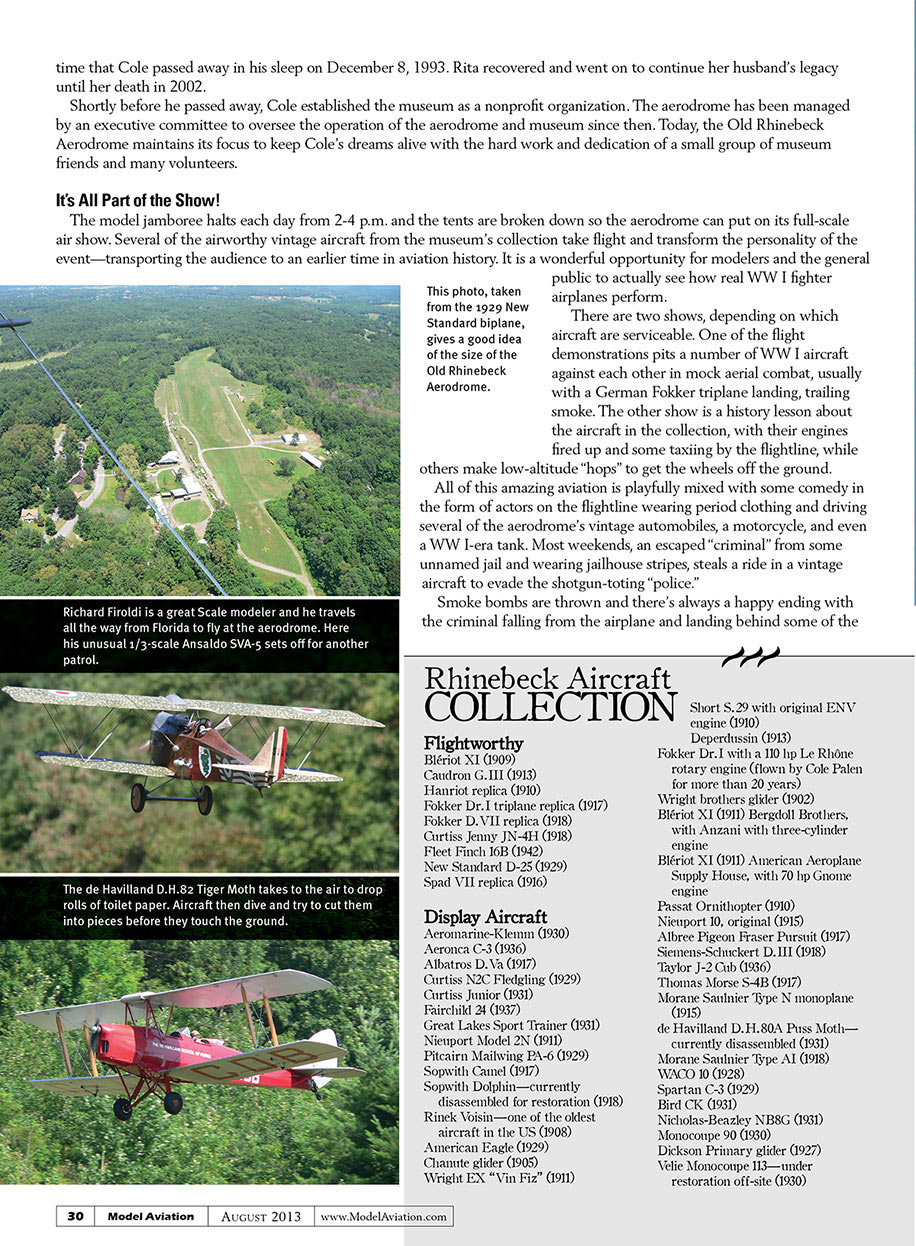
The model jamboree halts each day from 2-4 p.m. and the tents are broken down so the aerodrome can put on its full-scale air show. Several of the airworthy vintage aircraft from the museum's collection take flight and transform the personality of the event—transporting the audience to an earlier time in aviation history. It is a wonderful opportunity for modelers and the general public to actually see how real WW I fighter airplanes perform.
There are two shows, depending on which aircraft are serviceable. One of the flight demonstrations pits a number of WW I aircraft against each other in mock aerial combat, usually with a German Fokker triplane landing, trailing smoke. The other show is a history lesson about the aircraft in the collection, with their engines fired up and some taxiing by the flightline, while others make low-altitude "hops" to get the wheels off the ground.
All of this amazing aviation is playfully mixed with some comedy in the form of actors on the flightline wearing period clothing and driving several of the aerodrome's vintage automobiles, a motorcycle, and even a WW I-era tank. Most weekends, an escaped "criminal" from some unnamed jail and wearing jailhouse stripes, steals a ride in a vintage aircraft to evade the shotgun-toting "police."
Smoke bombs are thrown and there's always a happy ending with the criminal falling from the airplane and landing behind some of the buildings, only to emerge unharmed and hauled off in the paddy wagon.
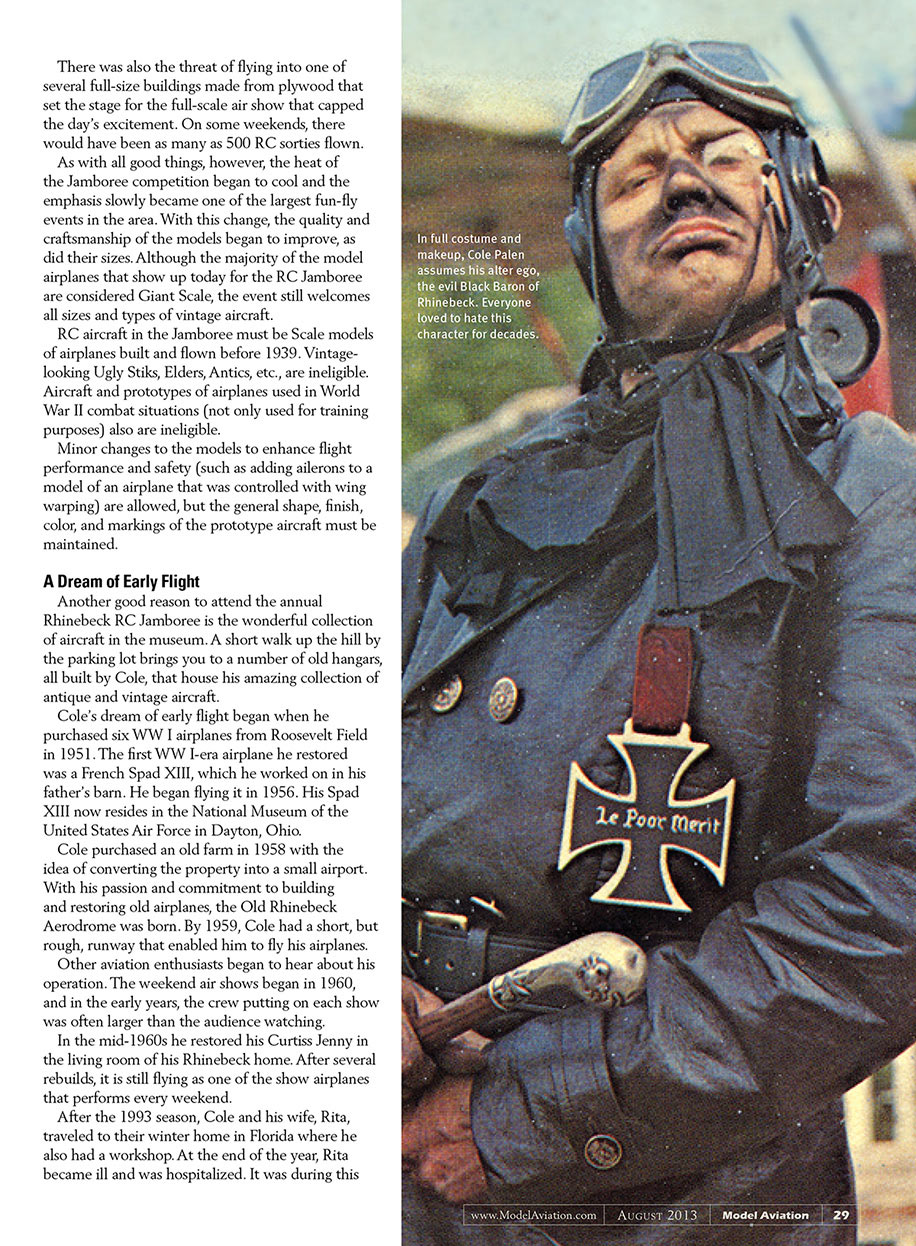
My favorite performance was like a dream born on an old movie set. It had a villain, the Black Baron of Rhinebeck; a hero, Sir Percy Goodfellow; and a damsel in distress, Trudy Truelove. Cole Palen, flying his Fokker triplane, was the villainous Black Baron; the original Trudy (the target of the Baron's unanswered advances) was Judy Meyers; and Dick King flew his reproduction Sopwith Pup as Sir Percy, whose job was to bring the Black Baron to justice. It was magical.
Today, some of the best pilots pay homage to Cole and the rest of the gang by reenacting some of the original hijinks that were so much a part of the aerodrome's history.
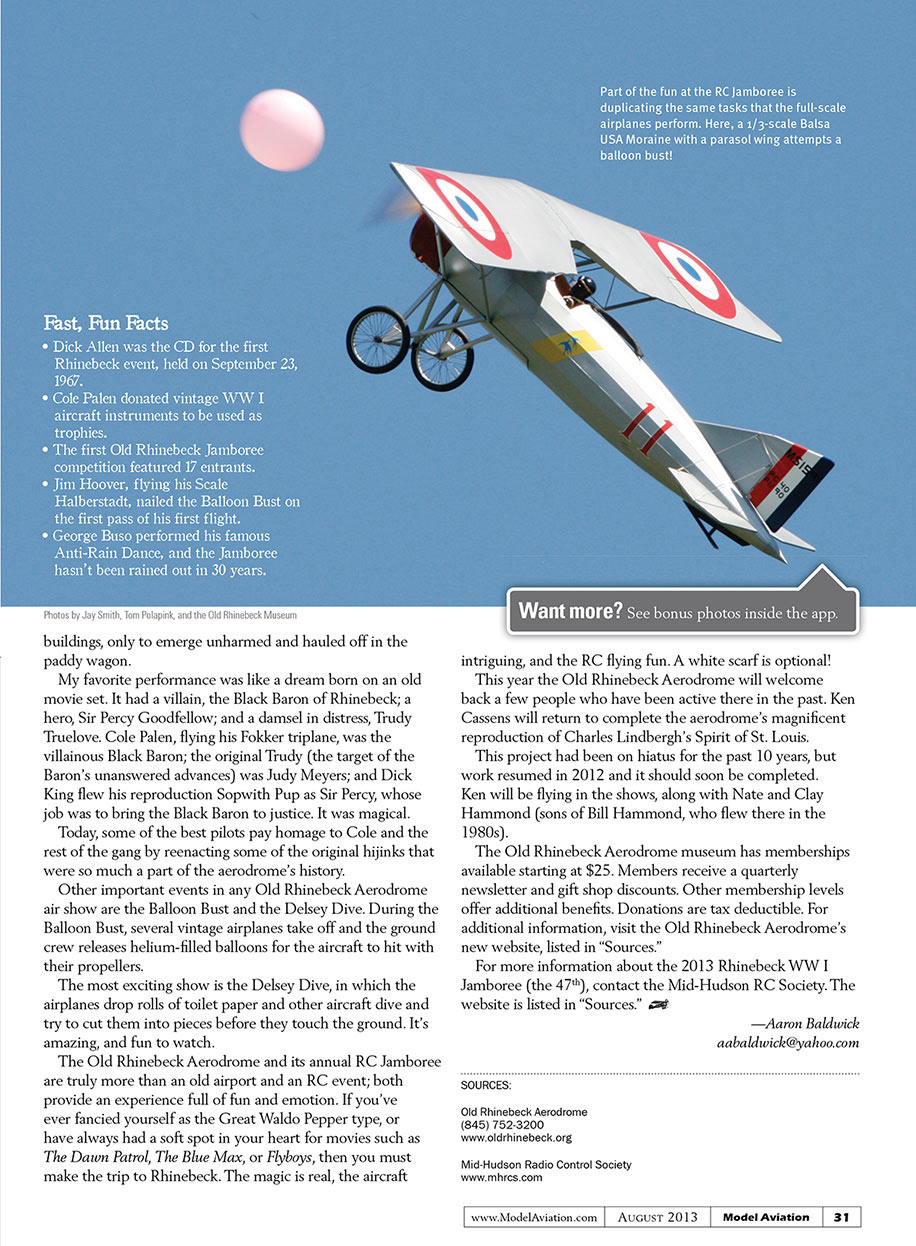
Other important events in any Old Rhinebeck Aerodrome air show are the Balloon Bust and the Delsey Dive. During the Balloon Bust, several vintage airplanes take off and the ground crew releases helium-filled balloons for the aircraft to hit with their propellers.
The most exciting show is the Delsey Dive, in which the airplanes drop rolls of toilet paper and other aircraft dive and try to cut them into pieces before they touch the ground. It's amazing, and fun to watch.
The Old Rhinebeck Aerodrome and its annual RC Jamboree are truly more than an old airport and an RC event; both provide an experience full of fun and emotion. If you've ever fancied yourself as the Great Waldo Pepper type, or have always had a soft spot in your heart for movies such as The Dawn Patrol, The Blue Max, or Flyboys, then you must make the trip to Rhinebeck. The magic is real, the aircraft intriguing, and the RC flying fun. A white scarf is optional!
This year the Old Rhinebeck Aerodrome will welcome back a few people who have been active there in the past. Ken Cassens will return to complete the aerodrome's magnificent reproduction of Charles Lindbergh's Spirit of St. Louis. This project had been on hiatus for the past 10 years, but work resumed in 2012 and it should soon be completed. Ken will be flying in the shows, along with Nate and Clay Hammond (sons of Bill Hammond, who flew there in the 1980s).
The Old Rhinebeck Aerodrome museum has memberships available starting at $25. Members receive a quarterly newsletter and gift shop discounts. Other membership levels offer additional benefits. Donations are tax deductible. For additional information, visit the Old Rhinebeck Aerodrome's new website, listed in "Sources."
For more information about the 2013 Rhinebeck WW I Jamboree (the 47th), contact the Mid-Hudson RC Society. The website is listed in "Sources."
—Aaron Baldwick [email protected]
SOURCES:
Old Rhinebeck Aerodrome (845) 752-3200 www.oldrhinebeck.org
Mid-Hudson Radio Control Society www.mhrcs.com
Transcribed from original scans by AI. Minor OCR errors may remain.

