
New events at this year's SAM Champs
Bob Angel
New flying sites become harder to find as old ones disappear because of “progress.” Nowhere is that more apparent than in Old-Timer (OT) flying.
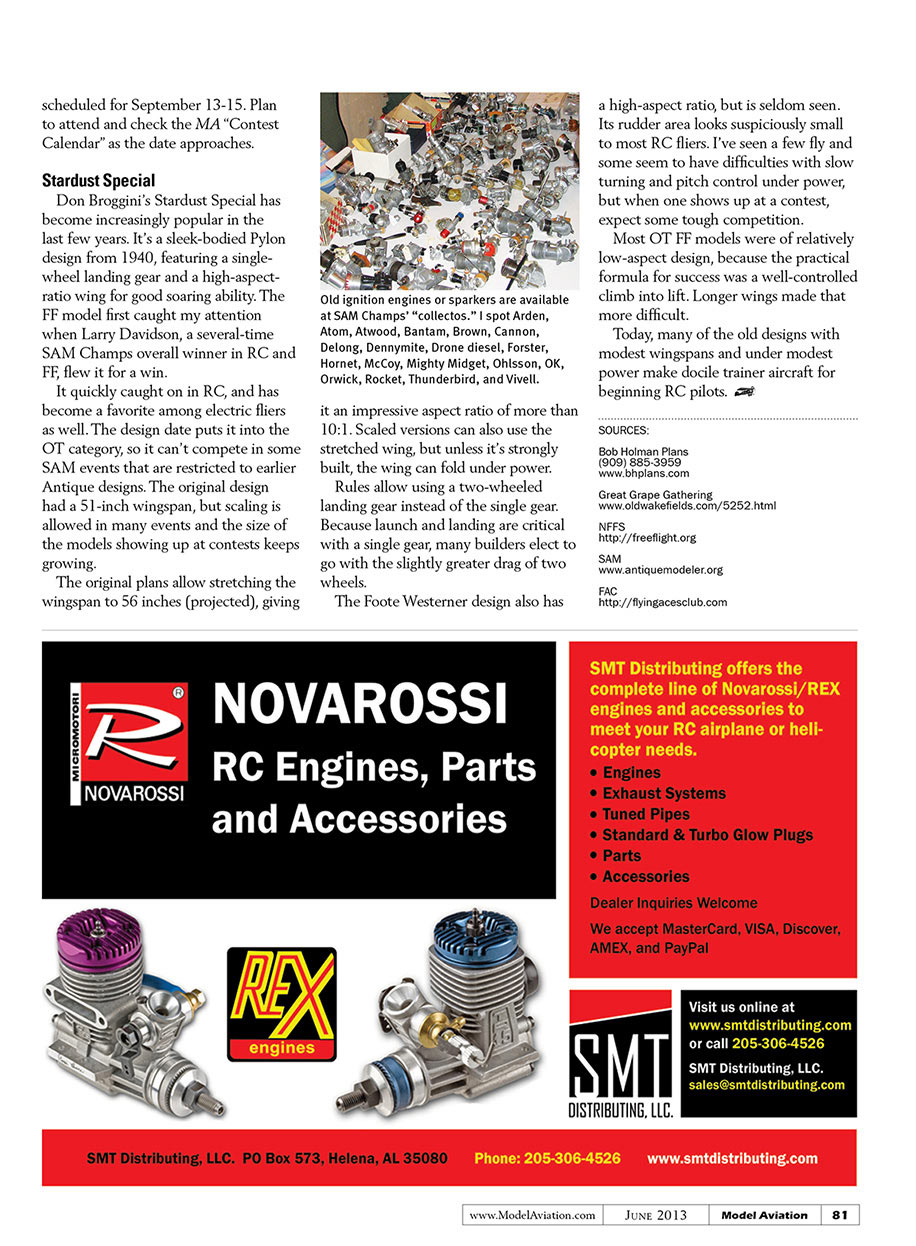
The nature of FF requires much more open space to allow chase and recovery in any direction from the launch point. Engine noise is a problem for FF and RC, even in a world already filled with noise. Most antique spark ignition engines were never designed for mufflers and risk overheating and being damaged if a muffler is somehow adapted.
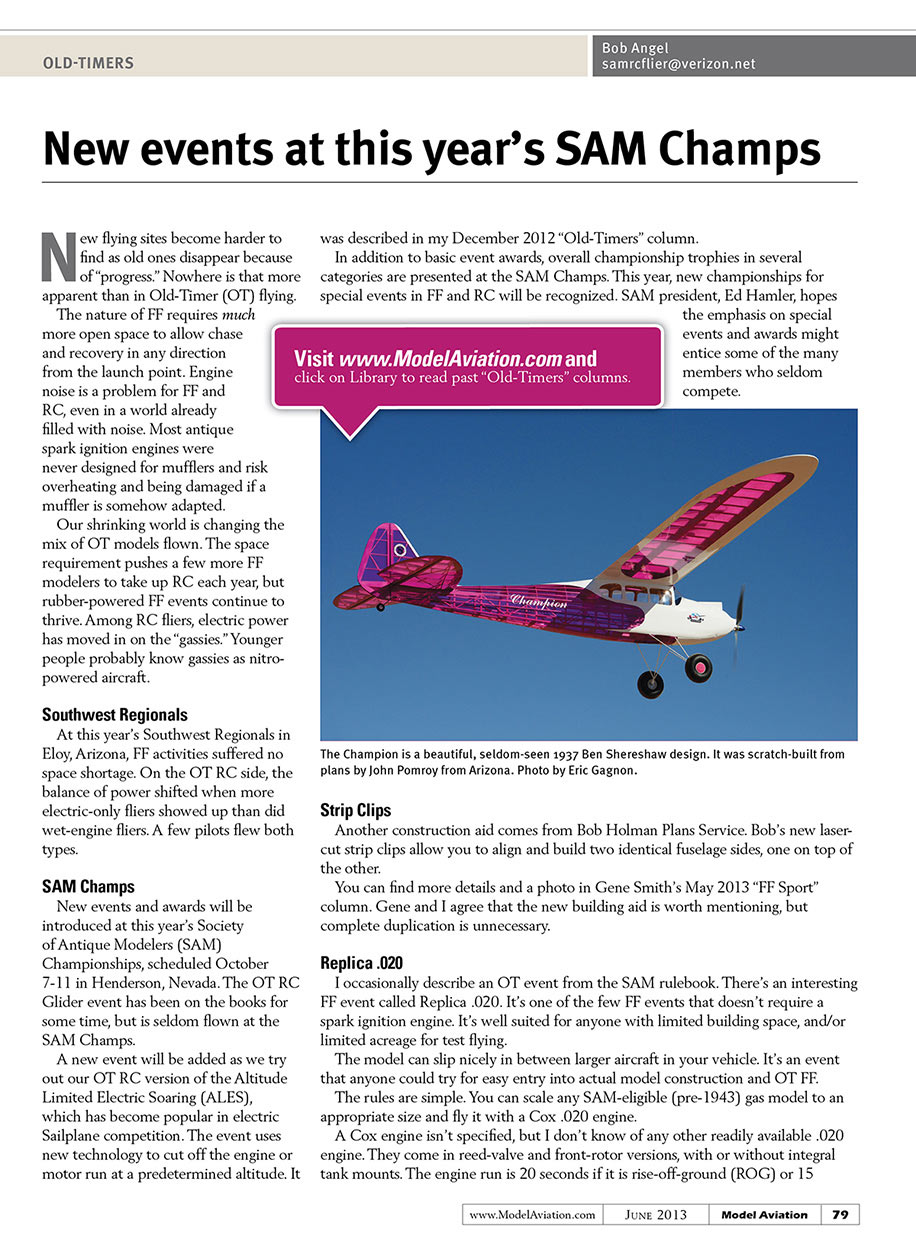
Our shrinking world is changing the mix of OT models flown. The space requirement pushes a few more FF modelers to take up RC each year, but rubber-powered FF events continue to thrive. Among RC fliers, electric power has moved in on the “gassies.” Younger people probably know gassies as nitro-powered aircraft.
Southwest Regionals
At this year’s Southwest Regionals in Eloy, Arizona, FF activities suffered no space shortage. On the OT RC side, the balance of power shifted when more electric-only fliers showed up than did wet-engine fliers. A few pilots flew both types.
SAM Champs
New events and awards will be introduced at this year’s Society of Antique Modelers (SAM) Championships, scheduled October 7-11 in Henderson, Nevada. The OT RC Glider event has been on the books for some time, but is seldom flown at the SAM Champs.
A new event will be added as we try out our OT RC version of the Altitude Limited Electric Soaring (ALES), which has become popular in electric Sailplane competition. The event uses new technology to cut off the engine or motor run at a predetermined altitude. It was described in my December 2012 “Old-Timers” column.
In addition to basic event awards, overall championship trophies in several categories are presented at the SAM Champs. This year, new championships for special events in FF and RC will be recognized. SAM president, Ed Hamler, hopes the emphasis on special events and awards might entice some of the many members who seldom compete.
Strip Clips
Another construction aid comes from Bob Holman Plans Service. Bob’s new laser-cut strip clips allow you to align and build two identical fuselage sides, one on top of the other.
You can find more details and a photo in Gene Smith’s May 2013 “FF Sport” column. Gene and I agree that the new building aid is worth mentioning, but complete duplication is unnecessary.
Replica .020
I occasionally describe an OT event from the SAM rulebook. There’s an interesting FF event called Replica .020. It’s one of the few FF events that doesn’t require a spark ignition engine. It’s well suited for anyone with limited building space, and/or limited acreage for test flying.
The model can slip nicely in between larger aircraft in your vehicle. It’s an event that anyone could try for easy entry into actual model construction and OT FF.
The rules are simple. You can scale any SAM-eligible (pre-1943) gas model to an appropriate size and fly it with a Cox .020 engine.
A Cox engine isn’t specified, but I don’t know of any other readily available .020 engine. They come in reed-valve and front-rotor versions, with or without integral tank mounts. The engine run is 20 seconds if it is rise-off-ground (ROG) or 15 seconds when hand launched.
The event's single paragraph in the rulebook contains a few more minor construction constraints, but it doesn't spell out the number of flights or maximum times. In such cases, the CD can define the rules; however, those details are usually standardized through prevailing practice.
Gene Wallock, a veteran FF CD, informs me that usual practice is to allow six attempts for three official flights, which are totaled for the score. Maxes are 3 minutes, which are usually extended if a tiebreaking flyoff is required.
Great Grape Gathering
The Great Grape Gathering happens each September as SAM 86 of Canada is joined by the Western New York Free Flight Society (WNYFFS). It's held at the 1941 Historical Air Group's spacious grass airfield in Geneseo, New York. Thirty-two events from SAM, the National Free Flight Society (NFFS), AMA, and Flying Aces Club (FAC) are featured during the three-day gathering.
The Great Grape Gathering is an active social event. It includes a Friday night fish fry at a local restaurant, with a full range of excellent food at reasonable prices. Saturday features an on-site chicken dinner, put on by the WNYFFS women. The beverage of choice is usually the bottles of wine won as prizes. (You knew there had to be a reason why it's called the Great Grape Gathering. Try saying that fast three times!)
A neat website features extensive reports of previous events. Narratives and excellent photos are included, along with the results. Check the "Sources" for more information. The 2013 contest is scheduled for September 13–15. If you want to be with the group, contact SAM 86 for entry info.
Stardust Special
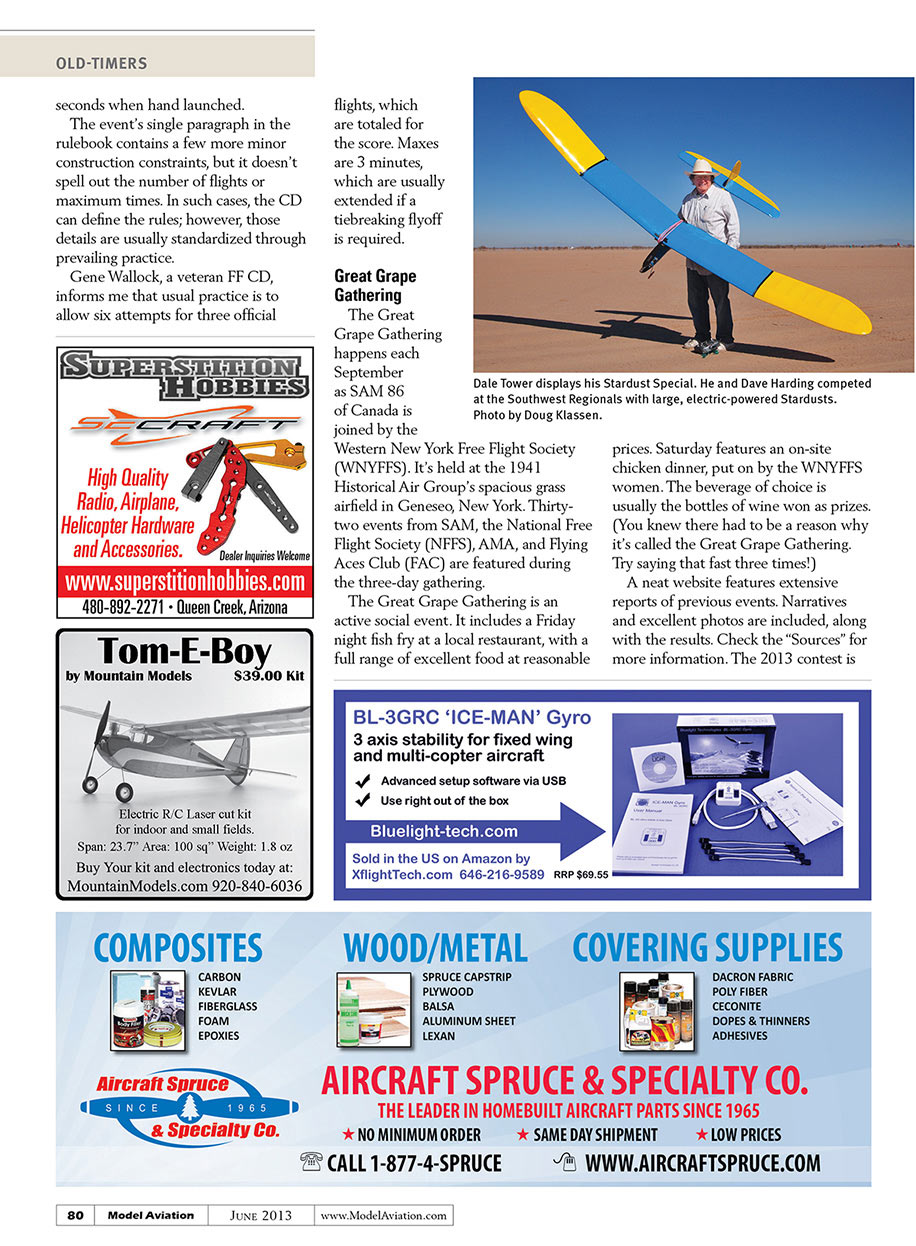
Don Broggini's Stardust Special has become increasingly popular in the last few years. It's a sleek-bodied Pylon design from 1940, featuring a single-wheel landing gear and a high-aspect-ratio wing for good soaring ability. The FF model first caught my attention when Larry Davidson, a several-time SAM Champs overall winner in RC and FF, flew it for a win.
It quickly caught on in RC, and has become a favorite among electric fliers as well. The design date puts it into the OT category, so it can't compete in some SAM events that are restricted to earlier Antique designs. The original design had a 51-inch wingspan, but scaling is allowed in many events and the size of the models showing up at contests keeps growing.
The original plans allow stretching the wingspan to 56 inches (projected), giving an impressive aspect ratio of more than 10:1. Scaled versions can also use the stretched wing, but unless it's strongly built, the wing can fold under power.
Rules allow using a two-wheeled landing gear instead of the single gear. Because launch and landing are critical with a single gear, many builders elect to go with the slightly greater drag of two wheels.
The Foote Westerner design also has a high-aspect ratio, but is seldom seen. Its rudder area looks suspiciously small to most RC fliers. I've seen a few fly and some seem to have difficulties with slow turning and pitch control under power, but when one shows up at a contest, expect some tough competition.
Most OT FF models were of relatively low-aspect design, because the practical formula for success was a well-controlled climb into lift. Longer wings made that more difficult.
Today, many of the old designs with modest wingspans and under modest power make docile trainer aircraft for beginning RC pilots.
SOURCES:
- Bob Holman Plans
(909) 885-3959 www.bhplans.com
- Great Grape Gathering
www.oldwakefields.com/5252.html
- NFFS
- SAM
- FAC
Transcribed from original scans by AI. Minor OCR errors may remain.

