
A plea for new event or project photos
Bob Angel [email protected]
The Internet has advantages and disadvantages. I like Model Aviation's Digital Library because I can share volumes of information beyond the limitations of this column.
I often refer to columns I and others have written when it adds to the subject matter, but people often forget that the entire world isn't computerized and many are excluded from this "inside" information.
New Photos Needed
Although I intercept many attached email photographs, it is growing harder to find previously unpublished ones. Good, clear, 4 x 6 mailed photos are still welcomed. Check the "Sources" listing for my contact information.
Here's my plea: If you'd like to share photos of your favorite event or project, isolate one or two and forward them to me with a note verifying that they are exclusives.
The usual rules of good photography apply: no beer cans or rusty bicycles lying in the background. The odds of publication drop if I happen to notice an AMA number missing from a wing!
Spark Ignition
Spark ignition engines are sometimes intimidating, even for people already flying Old-Timer (OT) aircraft with glow, diesel, rubber, or electric power. Adding to that trepidation is the fact that most old spark engines should be hand started to prevent damaging the lower end. With a good, solid ignition system, you can get the same reliable start and the performance of a glow engine.
The spark coil and ignition setup is probably the most mysterious part. I know of only two sources for new spark coils. Larry Davidson and Woody Bartlett both offer new, lightweight coils (see "Sources"), along with spark plugs and other OT supplies. If anyone knows of another supplier, let me know.
Woody offers an original system consisting of coil, condenser, high-tension lead, and simple wiring instructions. Larry supplies similar coils and modern, transistorized systems. The transistor systems operate in conjunction with the coil, adding reliability and reducing spark noise for RC.
The new coils are slightly less rugged than older, heavier-duty ones. They can quickly burn out if left inactive under battery load with the ignition points closed. Larry, as well as Marvin Stern, sells transistorized switching circuits that switch themselves off to prevent coil burnout when the points are inactive for a second or so.
With an ignition system, the main path to success is having good, clean wiring connections. Use solder, not twisted-wire or crimped connections. Snap-in battery boxes are a source of problems, as they have always been.
Old-Timers
Bob Angel
Two or three freshly charged AA Ni-Cds welded or soldered in series, along with a transistorized system, are sufficient.
More breaking in was required for older engines because machinery was less accurate. As with older automobile engines, they were typically set up with much tighter clearances. The break-in procedure produced that final close piston-to-cylinder fit needed for the best performance. Many wouldn't even run out a tank of fuel without being nursed through a number of runs at a slow, rich setting.
The break-in procedure is roughly the same as it is for a modern, non-ABC speed engine. The first few hand starts are easier using a large propeller.
After finding the needle-valve and spark settings, use a smaller-diameter and/or lower-pitch propeller than you'll use for flying. A richer setting allows a cooler run at a faster speed.
Consider advancing the spark as being similar to leaning the needle. Too lean or too much advance leads to overheating and flameout.
Methanol-based nitro fuel is good for breaking in an engine, because it allows it to run cooler and faster than does gasoline. But remember, methanol (or ethanol in gasoline) will destroy old plastic fuel tanks.
I have written several related articles in previous columns that should help a beginner who is getting started in running old spark engines. For those with old copies of MA or with access to MA's Digital Library, I'll list some for further reading.
- Transistorized ignition systems were covered in August 2007, June 2008, June 2010, and August 2010.
- Reducing spark-ignition radio frequency interference with 2.4 GHz radios, October 2007.
- Freeing up frozen engines, February 2008.
- Basics of running spark engines plus a wiring diagram, April 2008.
- Fuel mixes, October 2011.
You'll also find a wealth of engine-related information in many issues of the Society of Antique Modelers' (SAM) publication, SAM Speaks. These are available on two CDs of 191 issues up through December 2006. The US price is $32 postpaid. The cost is $41 in other countries. This project is worth the price. Shipment is handled by Karl Gies.
Engine Photos
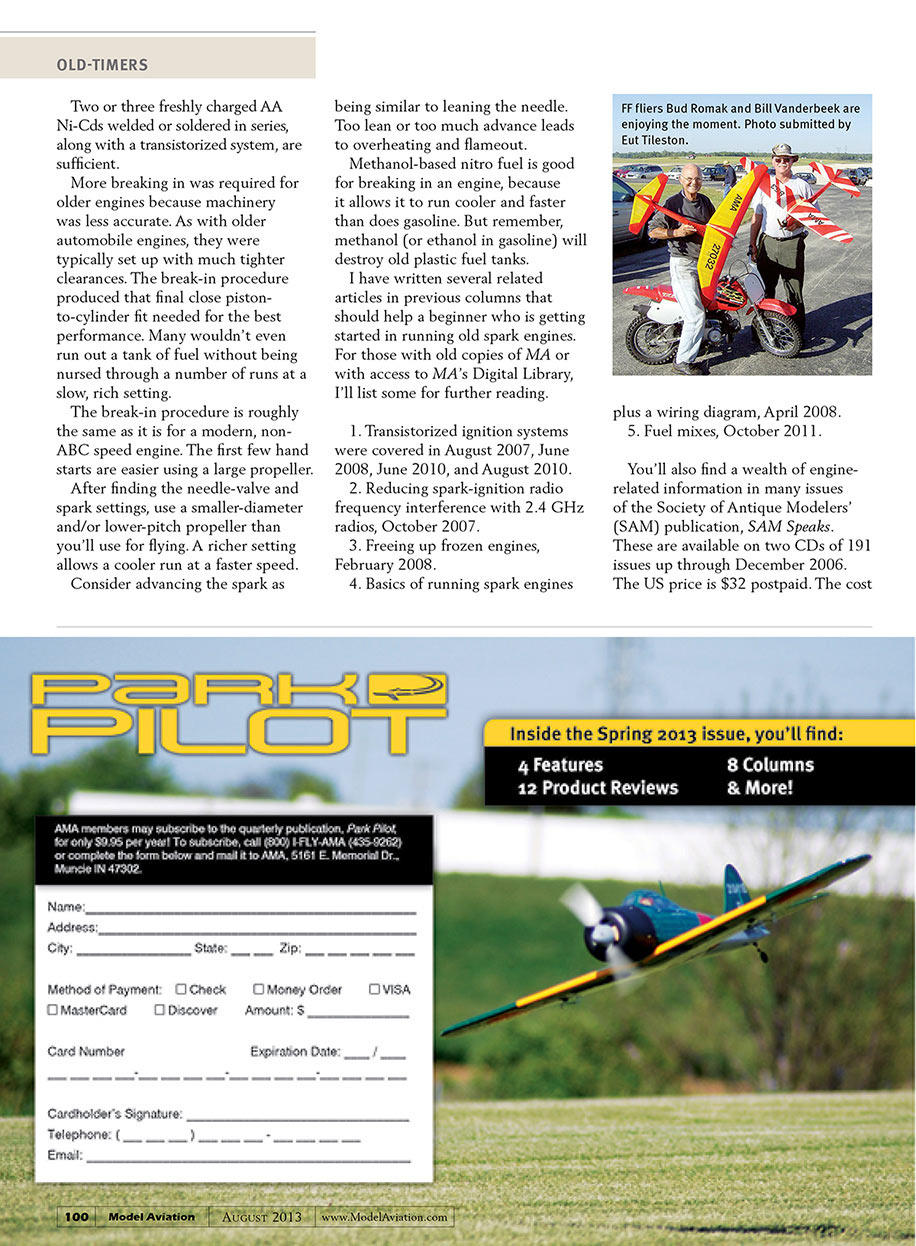
Because I'm on an engine theme, I'd like to point out some facts about the photos in this column. The popular Atwood Super Champion and the Super Cyclone engines competed with each other at one time. Both enjoyed some popularity in tether cars as well as in CL and FF flying.
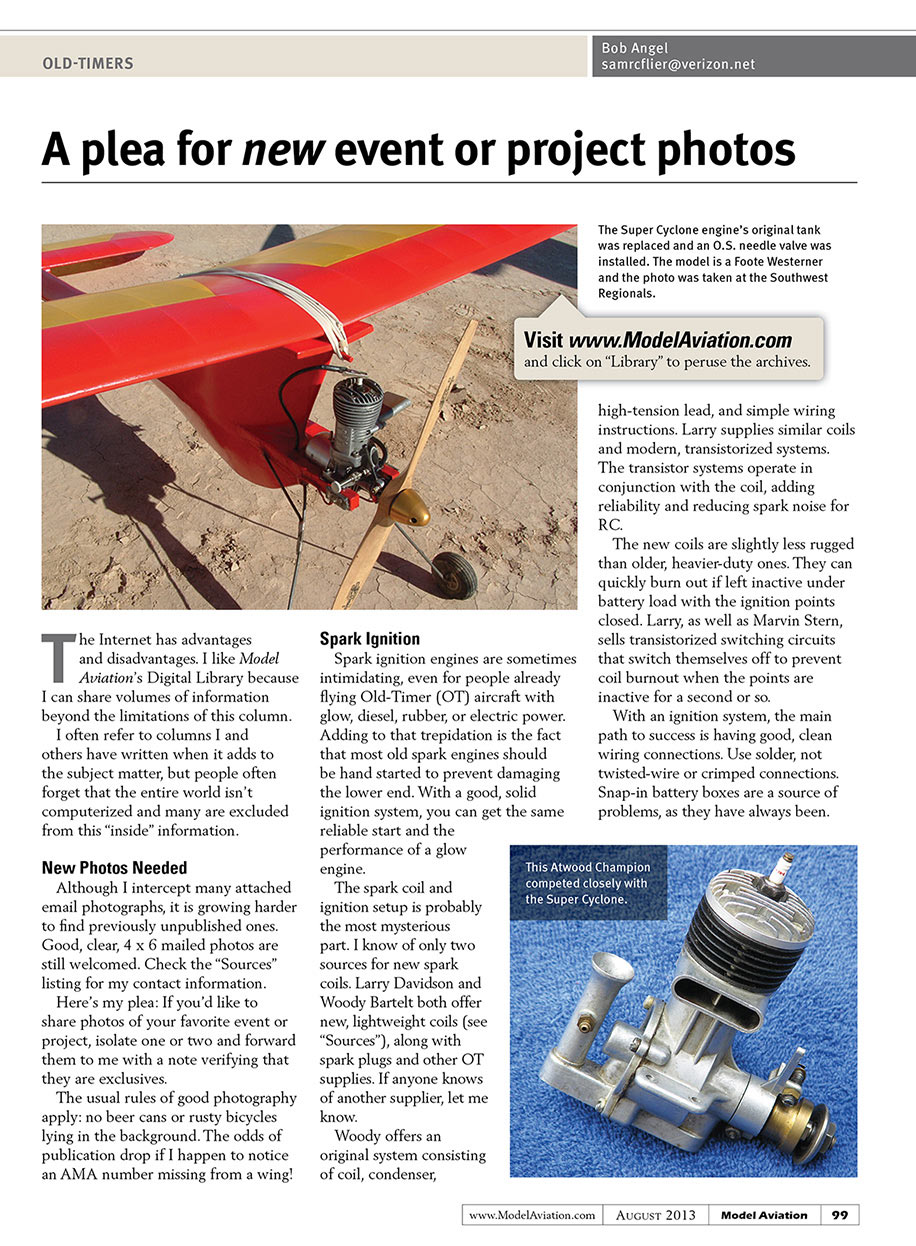
The pictured Super Cyclone has a commercially supplied metal fuel tank installed on the backplate, replacing the original amber-colored plastic tank. This allowed methanol fuel to be used. Alcohol quickly ruins the older plastics. The engine is a popular choice for OT FF today.
The Atwood Champion has an unusual feature in its dual induction system. The casting shape running along the bottom of the crankcase houses a rectangular passage, supplying updraft carburetion to rotary valves at the front and rear.
There were many early experiments with dual (front and rear) induction systems. A commercially made hop-up kit was offered, which was fitted to the front of a rear-intake, side port engine.
Trying to synchronize the two needle-valve assemblies for easy starting and consistent running was a major drawback. The Atwood's single stovepipe intake makes needle-valve setting as easy as any other engine.
SOURCES:
- Larry Davidson
(540) 721-4563 [email protected]
- Woody Bartlett
(269) 665-9693 www.woodyengines.com
- Marvin Stern
(732) 928-0884 [email protected]
- SAM Speaks
Karl Gies (406) 538-8503 [email protected]
- Bob Angel
1001 Patterson Rd. Santa Maria CA 93455 [email protected]
Transcribed from original scans by AI. Minor OCR errors may remain.

