
OLD-TIMERS
Mike Keville
31 Franklin Pkwy., Brunswick ME 04011 E-mail: [email protected]
Colonel Bob Thacker — career and the Tornado
During his 31-year career with the US Air Force, Colonel Bob Thacker, now retired, flew in three wars, participated in the service test program for the Lockheed P-80, and later graduated from the Test Pilots' Academy at Edwards Air Force Base in California. He is perhaps best known for his 1947 record-setting flight from Honolulu, Hawaii, to New York in the P-82 Twin Mustang "Betty Jo," named for his wife.
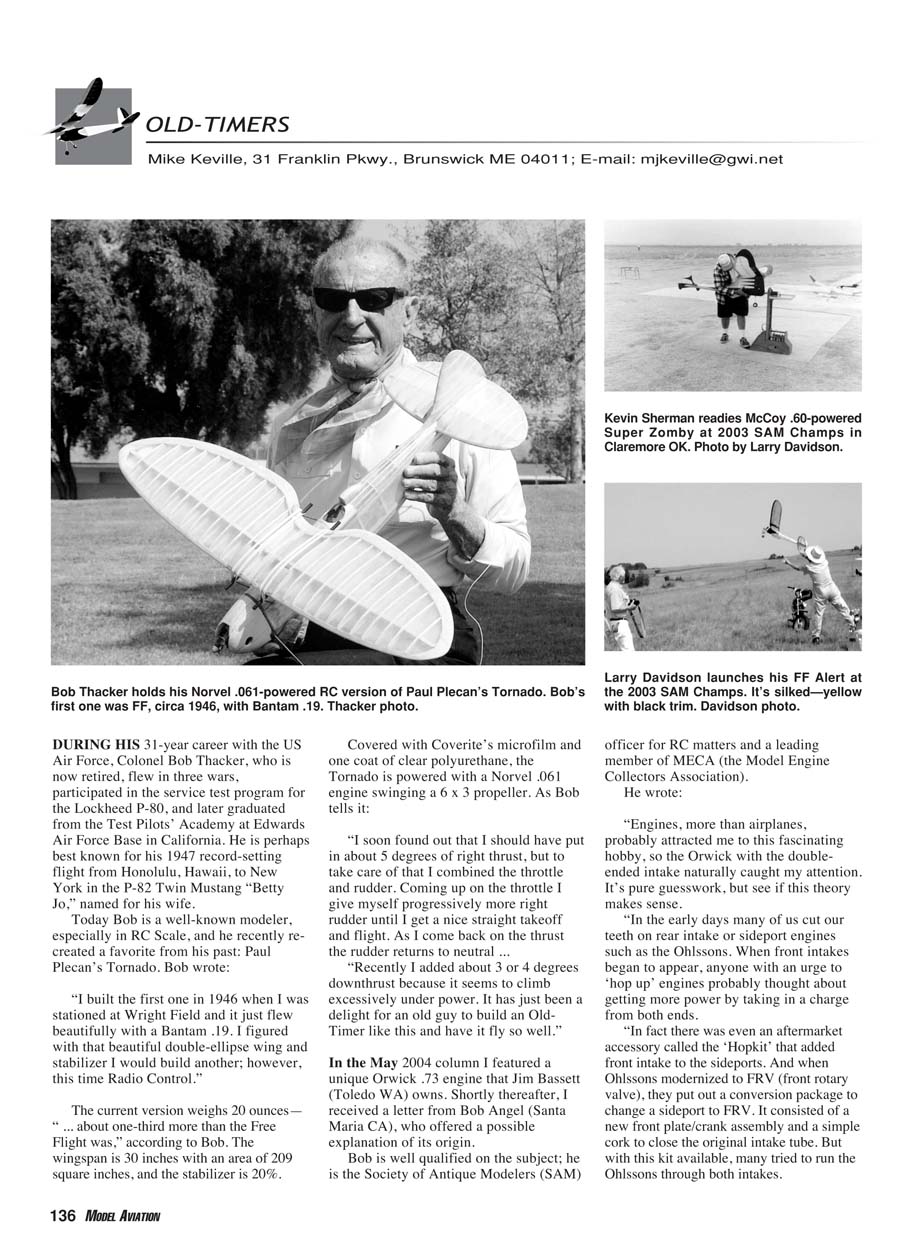
Today Bob is a well-known modeler, especially in RC Scale, and he recently recreated a favorite from his past: Paul Plecan's Tornado. Bob wrote: "I built the first one in 1946 when I was stationed at Wright Field and it just flew beautifully with a Bantam .19. I figured with that beautiful double-ellipse wing and stabilizer I would build another; however, this time Radio Control."
The current version weighs 20 ounces—"about one-third more than the Free Flight was," according to Bob. The wingspan is 30 inches with an area of 209 square inches, and the stabilizer area is 20%. Covered with Coverite's microfilm and one coat of clear polyurethane, the Tornado is powered with a Norvel .061 engine swinging a 6 x 3 propeller.
Bob continues: "I soon found out that I should have put in about 5 degrees of right thrust, but to take care of that I combined the throttle and rudder. Coming up on the throttle I give myself progressively more right rudder until I get a nice straight takeoff and flight. As I come back on the thrust the rudder returns to neutral.
"Recently I added about 3 or 4 degrees downthrust because it seems to climb excessively under power. It has just been a delight for an old guy to build an Old-Timer like this and have it fly so well."
The Orwick .73 engine — reader insights
In the May 2004 column I featured a unique Orwick .73 engine that Jim Bassett (Toledo, WA) owns. Shortly thereafter I received a letter from Bob Angel (Santa Maria, CA), who offered a possible explanation of its origin. Bob is well qualified on the subject; he is the Society of Antique Modelers (SAM) officer for RC matters and a leading member of MECA (the Model Engine Collectors Association). He wrote:
"Engines, more than airplanes, probably attracted me to this fascinating hobby, so the Orwick with the double-ended intake naturally caught my attention. It's pure guesswork, but see if this theory makes sense.
"In the early days many of us cut our teeth on rear intake or sideport engines such as the Ohlssons. When front intakes began to appear, anyone with an urge to 'hop up' engines probably thought about getting more power by taking in a charge from both ends.
"In fact there was even an aftermarket accessory called the 'Hopkit' that added front intake to the sideports. And when Ohlssons modernized to FRV (front rotary valve), they put out a conversion package to change a sideport to FRV. It consisted of a new front plate/crank assembly and a simple cork to close the original intake tube. But with this kit available, many tried to run the Ohlssons through both intakes. These modifications weren't an instant success, as attested to by the fact that they never caught on, set records, or went mainstream. First, they were very hard to start and adjust (starters were uncommon). And without tank pressure (also uncommon) they had poor fuel draw because the venturi effect was reduced at both ends.
"Atwood .60 engines did successfully use a modified version of the dual intake, but they inducted their charge through just a single downdraft rear intake tube which then fed both front and rear intakes through a passage cast along the crankcase bottom.
"Obviously if Henry Orwick just wanted to compare front vs. rear induction he wouldn't need the elaborate front cutoff, but could have simply 'corked up' either end alternately. I would suspect he was looking toward a production model, which would solve the hard starting/adjustment problem. He would have planned to start the engine on the rear intake, then gradually open the front intake and get an adjustment with the engine running. Sound plausible?"
Thanks, Bob.
If other readers have information or thoughts on the subject, feel free to share them here or send them to Jim Bassett at Box 298, Toledo, WA 98591.
American Aeromodeling — historical notes
Several years ago I was privileged to receive the publication American Aeromodeling, The Earliest Years, 1907 to 1934, written by Frank Anderson. I don't know if it (and other volumes covering later years) is still available, but I will provide his address for inquiries. Following are some facts from that book that readers may find fascinating:
- Ray Arden is credited with inventing—or at least refining for model-engine use—the glow plug in 1947. He is known for his Atom and Arden engines of the 1940s. He also designed and built an aircraft engine in 1907 and flew it in 1908. The four-stroke power plant turned 2,000 rpm; the bore and stroke were each 1.25 inches.
- In 1907, Great Britain's A. V. Roe won the London Daily Mail's model-aircraft competition. Two years later he produced the first of many full-scale Avro aircraft.
- According to John Carisi, editor of Model Aircraft Engineer in 1934, Frank Shober "discovered" the use of the substance we know as "dope" for coating fabrics and tissues in 1912. He found it in a coffin factory and adapted it for use on model airplanes.
- In its 1914 catalog, Ideal described the product as "Bamboo Varnish"—prepared by Ambroid, which advertised in Ideal's early catalogs. Another early term for dope was "bambooola." Do any of you remember that term?
The volume also gives detailed accounts and entrant listings for national competitions from 1928 to 1934. There are two other volumes: Number 2, 1935–1941, and Number 3, 1941–1947. I was remiss in researching to see if they are still available (my apologies), but I highly recommend you write to Frank at Anderson Productions, 753 Hunan St. NE, Palm Bay, FL 32907, for prices and availability.
Box Car Chief and Al Brush
In the December 1990 Flying Models (then edited by MA Aeromodeling Editor Bob Hunt), I had a construction article published for a 1947 CL Stunt design called the Box Car Chief. Originally kitted by Ricks Manufacturing Co. in Los Angeles, California, the design is somewhat unusual for a CL Stunter because it has a high wing. Notwithstanding that, it is an excellent flier and is often seen today in Old Time Stunt competition.
Al Brush cut the parts for the Box Car Chief, and today he produces quality Old Timer Free Flight Rubber kits. Although I haven't seen Al or his wife Tina since 1989, I'll give you an unsolicited (honest!) testimonial regarding his work. I recall that the contest-grade balsa was cleanly and accurately cut to exact shape, requiring little or no sanding for a perfect fit. The model nearly fell together. I assembled it with Duco cement, covered it with Japanese tissue, and finished it with clear Randolph dope—um, I mean "bambooola."
Since I had seen several of Al's own CL models, it did not come as a surprise that his woodcutting was crisp and precise. He was (and apparently still is) a master craftsman who didn't settle for second best.
Al's current offerings include Old Time Stick and Cabin Rubber designs containing all the needed accessories. SAM members receive SAM Speaks, so many of them have probably seen his advertisements on the back cover.
Contact Al: 25500 Aquila Ct., Sun City, CA 92586 Phone: (909) 301-9975 E-mail: [email protected] Web: www.inland.net/~abrush (that's a tilde after the slash—not a dash)
Photos
Photos: First and foremost, I need some. Second, 4 x 6-inch color glossies work best—but only if there is no writing on the back. Do try for uncluttered backgrounds, and please use flash or other direct light when showing faces. Few things are more disappointing (and unusable) than a photo of someone with a lovely model but no facial features because of shadow.
Quoting fellow columnist Bob Kopski in the May 2004 issue: "Be sure to turn off the camera time/date stamp" and "MA cannot work with prints from digital cameras—no matter how good they look."
Photos will be returned to you if you request it, but it takes a few months. MA
Transcribed from original scans by AI. Minor OCR errors may remain.

