
OLD-TIMERS
Mike Keville, 31 Franklin Pkwy., Brunswick ME 04011; E-mail: [email protected]
The July 2004 column (page 140) included a photo of a model identified as a "Foote Westerner." Apparently that was an error, despite the model having been identified as such by the person who submitted the photo. An E-mail message from Royce Childress (Kent WA) read:
"That picture of a Foote Westerner sure isn't like Don Foote used to fly at Rosecrans and Western in the '40s. The wing is wrong. The Westerner's wing had a distinctive 'backward,' rounded swept-back tip, and the rudder looked like a rounded squatty lump. The airplane in the picture has a tapered but straight leading edge on the tips, and the rudder looks a little too tall.
"Possibly by the '50s the design had been changed to make it easier to build, but I'll bet a ham sandwich and a cup of coffee it wasn't changed by Don Foote."
Perhaps someone will be kind enough to check that issue and send me the model's correct identification.
If your Old-Time interests run toward Rubber or Glider, there is an excellent reference that lists all 2004 Society of Antique Modelers (SAM)-approved designs in those categories. The Glider grouping includes Towline and Hand Launched.
A labor of love compiled by Gene Wallock, the attractive spiral-bound catalog contains more than 1,800 plans and their sources, supplier names, design rules, and recommended models for SAM competition. Gene was kind enough to send a copy here, which I greatly appreciate. You can obtain a copy by sending your name, address, and $10 to SAM Secretary Charlie Reich at 310 Wisteria Rd., Saint Augustine FL 32086.
Bob Holman Plans—a prime source for Old-Time and Nostalgia plans and kits—offers a super catalog that shows plan views and includes many photos. Kits include CAD-drawn plans, many by Jim O'Reilly, and laser-cut parts (nose blocks and propellers not included). Those who are re-entering the hobby after many years will find that the catalog features a mouthwatering selection, including Jimmie Allen designs from the 1930s, Earl Stahl Rubber Scale designs, Nostalgia Gas designs such as the Zeek, the Fubar, and the Civy Boy 84, and a wide array of Rubber and Gas designs from the early 1940s.
Bob also offers laser-engraved (not router-cut) plaques for contest awards. Contact Bob Holman Plans:
- Mail: Box 741, San Bernardino CA 92402
- Tel.: (909) 885-3959
- Fax: (909) 889-9307
- E-mail: [email protected]
- Web site: www.bhplans.com
Dave Seale (Dedham MA)
"In the summer of 1951 I was living in GI student housing on the campus of Purdue University. Right across the street was a large grass field used for various school functions. Three of us tried our hand at CL using an all-balsa kit, the 'Junior 29' [one in a series of kits produced by the Testors Corporation].
"The first one crashed on its fourth flight. When rebuilt we replaced the O&R .33 with an O&R .60. Wow, did that baby move! Our simple arithmetic clocked it at 85 mph—a big deal to us at the time. The second airplane faired much better, flying more than 50 flights before it was time to get back to business in September."
Harry Fisher (Bordentown NJ)
"Yesteryear was exactly as you said. Model engines were heard in all of our parks and baseball fields. The audience was mixed—old grandfathers to young grandchildren. Some even entered the hobby.
"I remember getting my Buccaneer and equipment together for the three-block trip to the ball field ... We had a good-sized crowd during our first flight. Everyone loved it. We always did ROG [rise-off-ground] and short engine runs. The Buccaneer would do lazy circles and make great landings."
Harry went on to write that he had ordered two short kits from Klarich Custom Kits in California ((916) 635-3080), and as soon as he could find another O&R .60, he planned on flying another Buccaneer.
Earl Cayton (San Francisco CA)
Earl, known for a wide array of FF and CL designs published in the 1950s, recalled:
"I see that the old Jim Walker Firebaby is back in production. It is a great little CL airplane for a beginner or a sport model for advanced modelers. This brings back an old memory.
"During the Korean War I was an instructor pilot in F-86 and F-94 fighters at Portland Air Base in Oregon. The first time I saw a Firebaby was when Jim brought six of them to our CL circle and proceeded to fly three at one time. He had a handle in each hand and a third handle fastened to his helmet. I don't know how he did it because I wouldn't even try to fly two at a time!
"I think Jim was the father of ARF models (because he had a line of ARF RC merchandise planned before he passed away suddenly in the mid-1950s)."
Tex Newman (Erie CO)
"The idea of simplified Scale competition is great. I began model building 55 years ago with Comet Rubber Scale models. The love and thrill of seeing one in the air is still there.
"[Your] mention of the Monogram Speedee-Bilt Long Midget brought back memories. When I was 10 years old I built three of those and entered the best one in a Monogram-sponsored 'beauty' contest at the local hobby shop, winning a third-place ribbon that still hangs in a display case in my workshop."
Tex enclosed a photocopied photo of himself at age 10, holding a Long Midget and a Master Modelcraft Wing Dingus biplane powered by an OK Cub .049.
Bob Haines (Uncasville CT)
Bob flies a 54-inch American Ace on RC. He wrote that it is "a real thermal sniffer. The SAM 7 group used to let me fly it just for fun at their Westover AFB [MA] Free Flight contests before they were kicked off the base."
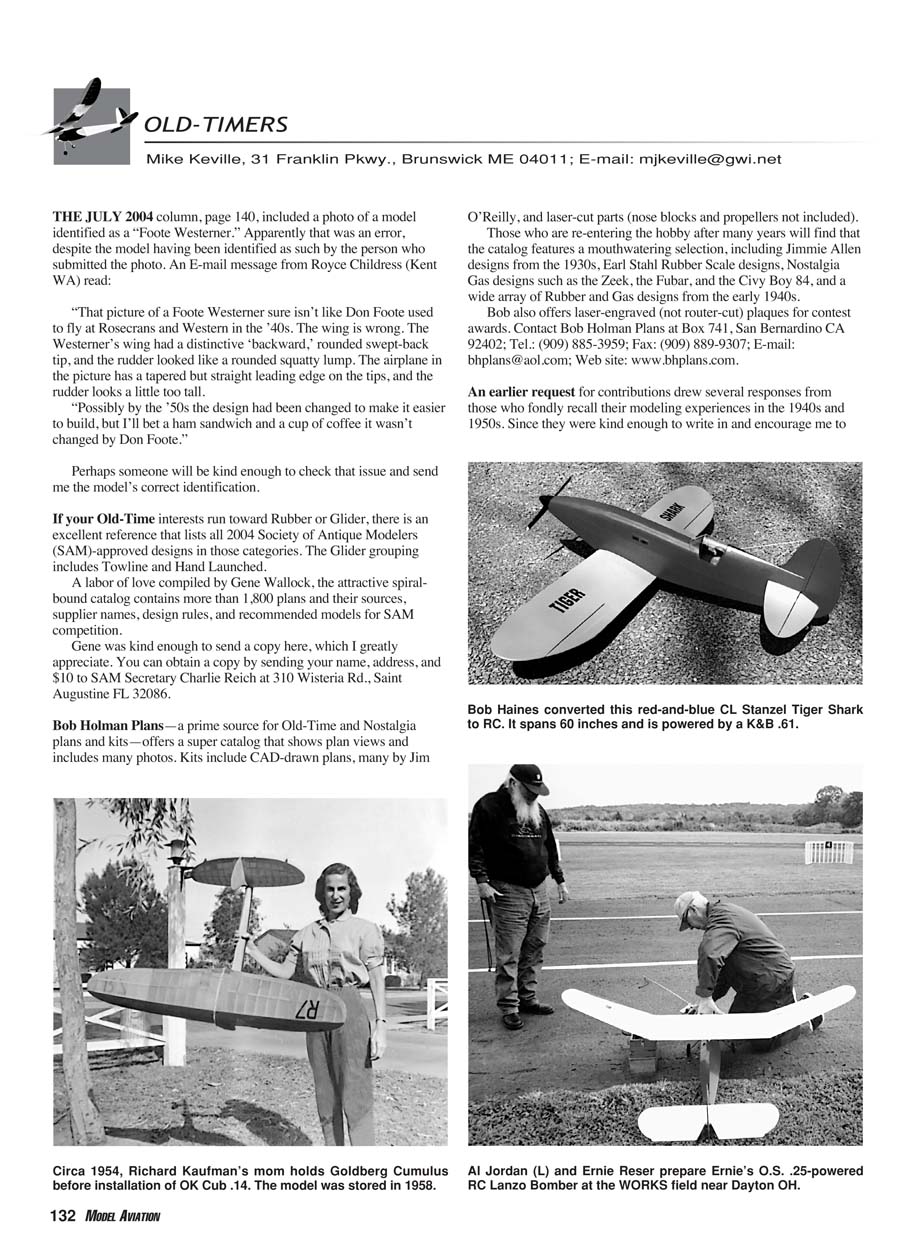
Bob also liked the looks of a vintage CL design—the Stanzel Tiger Shark—and enlarged one and converted it to include four-channel RC. The red-and-blue model spans roughly 60 inches and is powered by a K&B .61 engine. As one might suspect, it flew "rather fast," according to Bob.
Richard Kaufman (Phoenix AZ)
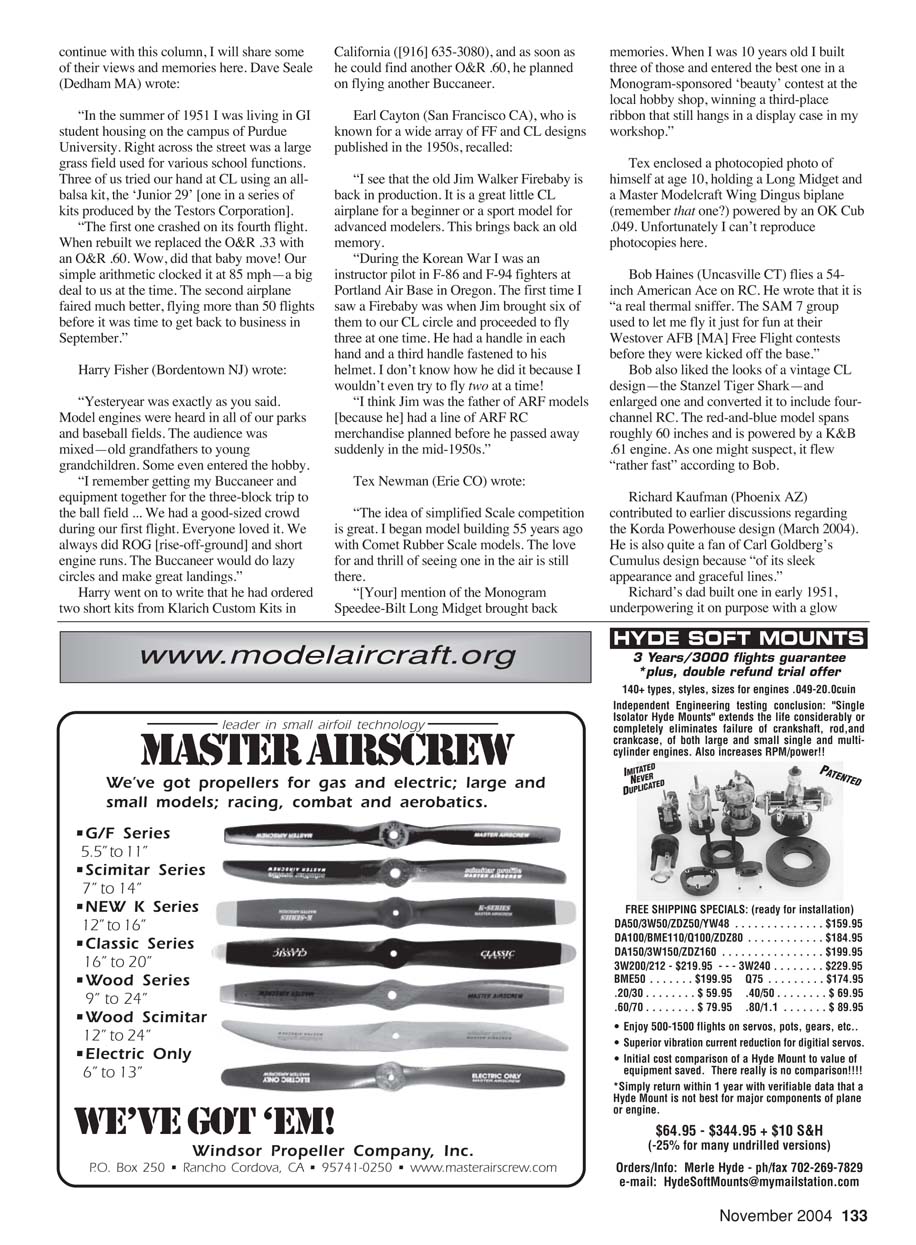
Richard contributed to earlier discussions regarding the Korda Powerhouse design (March 2004). He is also quite a fan of Carl Goldberg's Cumulus design because "of its sleek appearance and graceful lines."
Richard's dad built one in early 1951, underpowering it on purpose with a Glow Arden .09. The theory was that it was less likely to crash. Three years later, bored with the slower flight, an OK Cub .14 was installed. After some initial adjustments, the model flew well.
The Cumulus was put in storage in 1958, where it remains today. Richard enclosed a 1954 photo of his mom holding the model.
Carl Romillat (O'Brien FL)
Carl made my day by writing, "The first thing I look for in Model Aviation is the Old-Timers column." He added that he finds no pleasure in RTF designs, preferring to build his own instead.
This is a common feeling among those of us who entered the hobby in the 1940s or 1950s (or earlier). Whether it's FF, CL, or RC, there is just no substitute for the feel of balsa, the aroma of cellulose cement and doped finishes, and the pride of seeing our own creations in the air.
Warren Behymer (Wilmington OH)
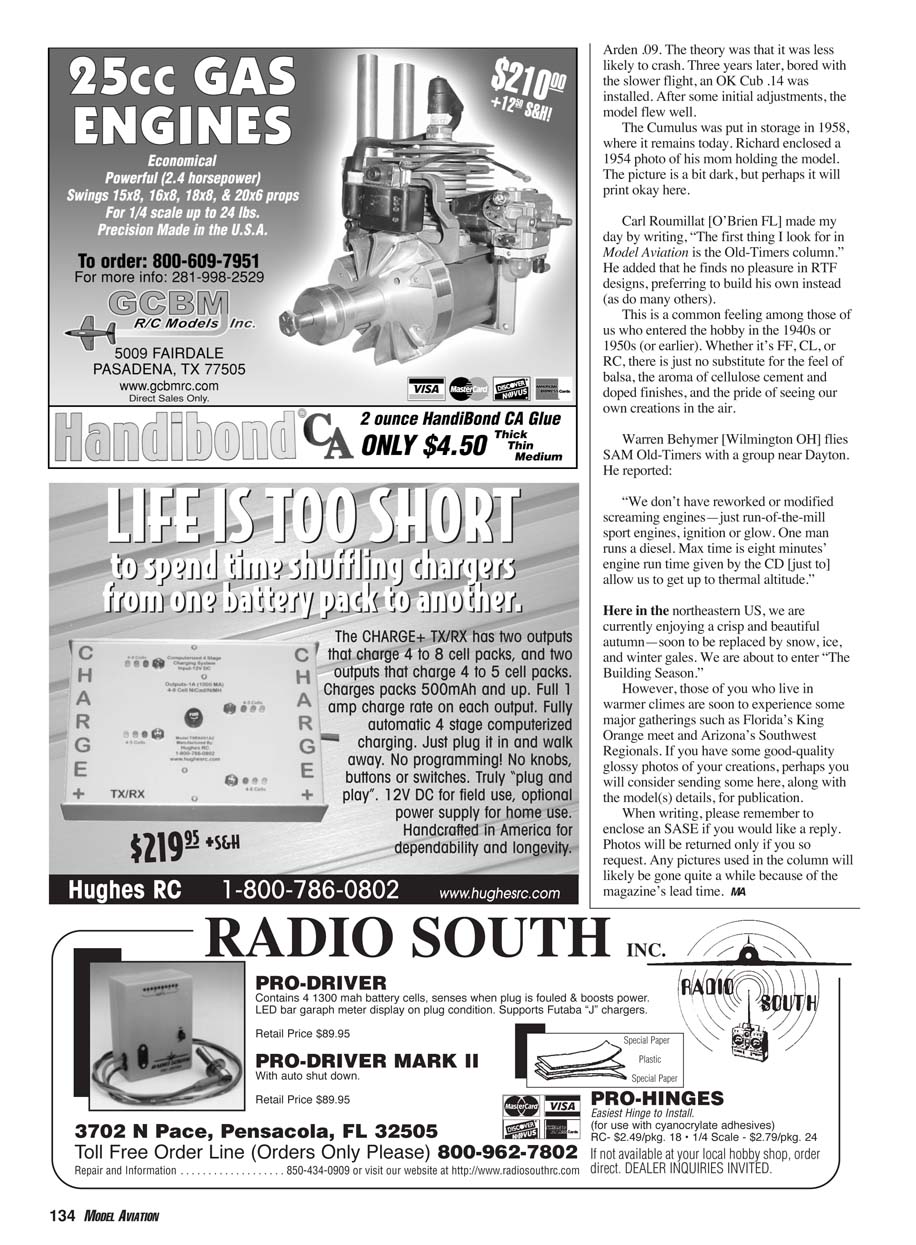
Warren flies SAM Old-Timers with a group near Dayton. He reported:
"We don't have reworked or modified screaming engines—just run-of-the-mill sport engines, ignition or glow. One man runs a diesel. Max time is eight minutes' engine run time given by the CD [just to] allow us to get up to thermal altitude."
Here in the northeastern US, we are currently enjoying a crisp and beautiful autumn—soon to be replaced by snow, ice, and winter gales. We are about to enter "The Building Season."
However, those of you who live in warmer climes are soon to experience some major gatherings such as Florida's King Orange meet and Arizona's Southwest Regionals. If you have some good-quality glossy photos of your creations, perhaps you will consider sending some here, along with the model(s) details, for publication.
When writing, please remember to enclose an SASE if you would like a reply. Photos will be returned only if you so request. Any pictures used in the column will likely be gone quite a while because of the magazine's lead time.
Transcribed from original scans by AI. Minor OCR errors may remain.

