
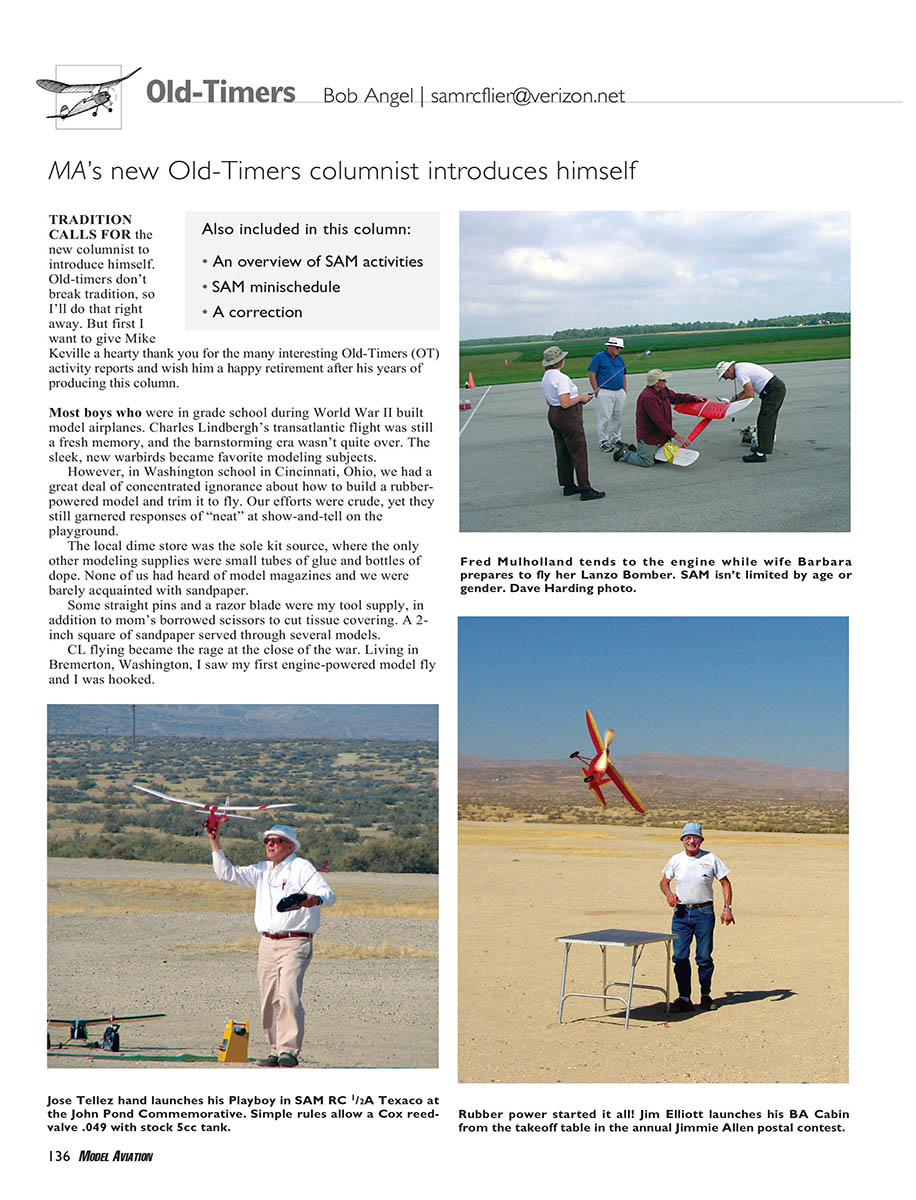
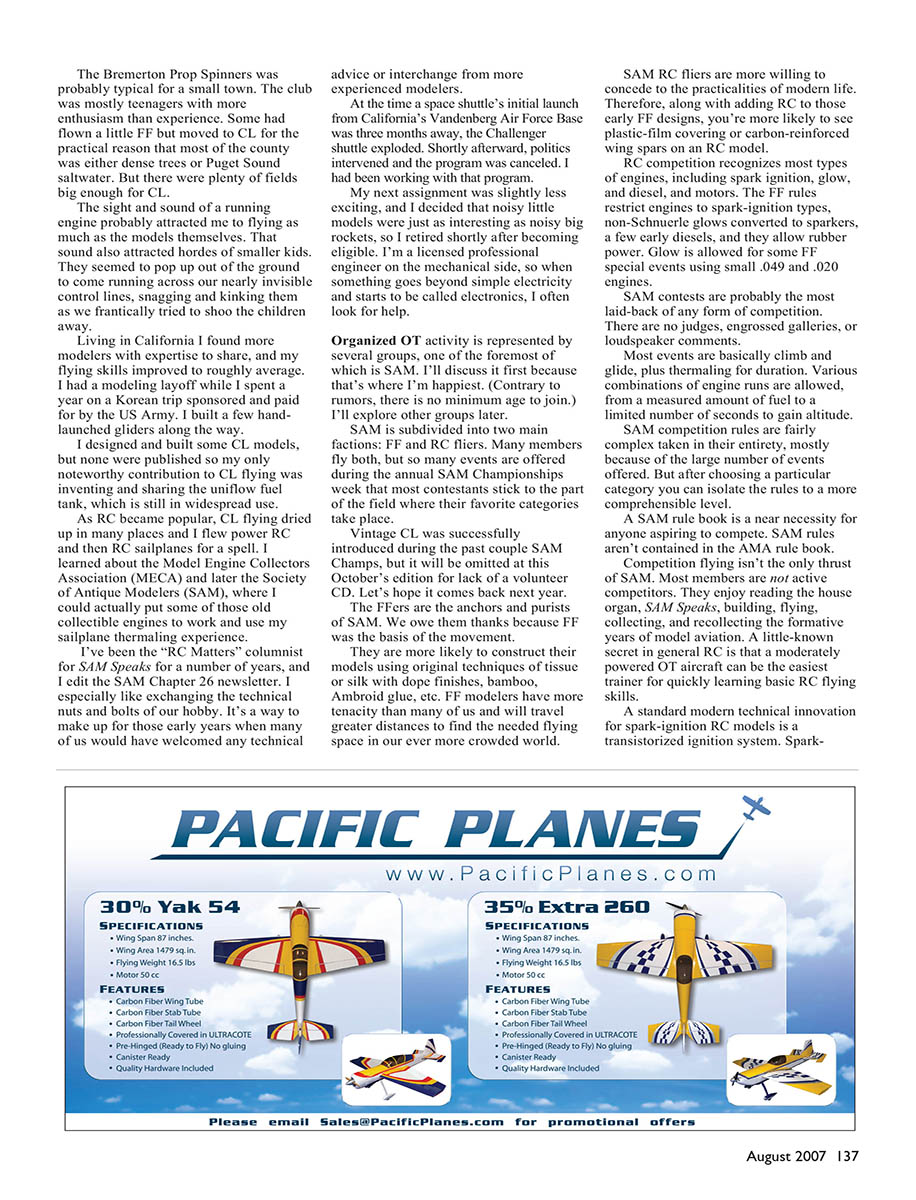
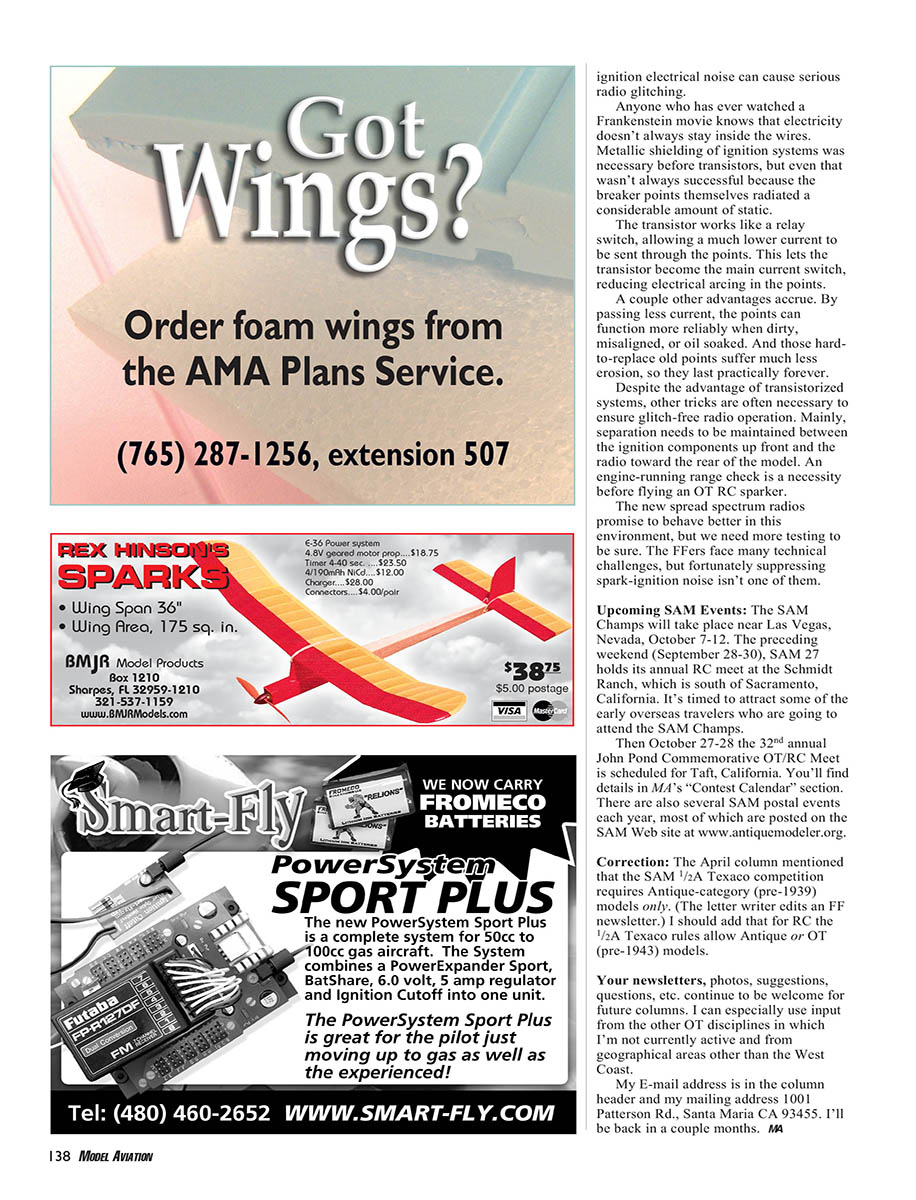
MA's new Old-Timers columnist introduces himself
Tradition calls for the new columnist to introduce himself. Old-timers don’t break tradition, so I’ll do that right away. But first I want to give Mike Keville a hearty thank you for the many interesting Old-Timers (OT) activity reports and wish him a happy retirement after his years of producing this column.
Also included in this column:
- An overview of SAM activities
- SAM minischedule
- A correction
Most boys who were in grade school during World War II built model airplanes. Charles Lindbergh’s transatlantic flight was still a fresh memory, and the barnstorming era wasn’t quite over. The sleek, new warbirds became favorite modeling subjects.
However, in Washington School in Cincinnati, Ohio, we had a great deal of concentrated ignorance about how to build a rubber-powered model and trim it to fly. Our efforts were crude, yet they still garnered responses of “neat” at show-and-tell on the playground.
The local dime store was the sole kit source, where the only other modeling supplies were small tubes of glue and bottles of dope. None of us had heard of model magazines and we were barely acquainted with sandpaper.
Some straight pins and a razor blade were my tool supply, in addition to Mom’s borrowed scissors to cut tissue covering. A 2-inch square of sandpaper served through several models.
CL flying became the rage at the close of the war. Living in Bremerton, Washington, I saw my first engine-powered model fly and I was hooked.
The club was probably typical for a small town. The membership was mostly teenagers with more enthusiasm than experience. Some had flown a little free flight (FF) but moved to control line (CL) for the practical reason that most of the county was either dense trees or Puget Sound saltwater. But there were plenty of fields big enough for CL. The sight and sound of a running engine probably attracted me to flying as much as the models themselves. That sound also attracted hordes of smaller kids. They seemed to pop up out of the ground to come running across our nearly invisible control lines, snagging and kinking them as we frantically tried to shoo the children away.
Living in California I found more modelers with expertise to share, and my flying skills improved to roughly average. I had a modeling layoff while I spent a year on a Korean trip sponsored and paid for by the U.S. Army. I built a few hand-launched gliders along the way. I designed and built some CL models, but none were published, so my only noteworthy contribution to CL flying was inventing and sharing the uniflow fuel tank, which is still in widespread use.
As RC became popular, CL flying dried up in many places and I flew power RC and then RC sailplanes for a spell. I learned about the Model Engine Collectors Association (MECA) and later the Society of Antique Modelers (SAM), where I could actually put some of those old collectible engines to work and use my sailplane thermaling experience. I’ve been the “RC Matters” columnist for SAM Speaks for a number of years, and I edit the SAM Chapter 26 newsletter. I especially like exchanging the technical nuts and bolts of our hobby. It’s a way to make up for those early years when many of us would have welcomed any technical advice or interchange from more experienced modelers.
At the time a space shuttle’s initial launch from California’s Vandenberg Air Force Base was three months away, the Challenger shuttle exploded. Shortly afterward, politics intervened and the program was canceled. I had been working with that program.
My next assignment was slightly less exciting, and I decided that noisy little models were just as interesting as noisy big rockets, so I retired shortly after becoming eligible. I'm a licensed professional engineer on the mechanical side, so when something goes beyond simple electricity and starts to be called electronics, I often look for help.
Organized OT activity is represented by several groups, one of the foremost of which is SAM. I’ll discuss it first because that’s where I’m happiest. (Contrary to rumors, there is no minimum age to join.) I’ll explore other groups later.
SAM is subdivided into two main factions: FF and RC fliers. Many members fly both, but so many events are offered during the annual SAM Championships week that most contestants stick to the part of the field where their favorite categories take place.
Vintage CL was successfully introduced during the past couple of SAM Champs, but it will be omitted at this October’s edition for lack of a volunteer contest director. Let’s hope it comes back next year.
The FFers are the anchors and purists of SAM. We owe them thanks because FF has the basis of the movement. They are more likely to construct their models using original techniques of tissue or silk with dope finishes, balsa, bamboo, Ambroid glue, etc. FF modelers have more tenacity than many of us and will travel greater distances to find the needed flying space in our ever more crowded world.
SAM RC fliers are more willing to concede to the practicalities of modern life. Therefore, along with adding RC to those early FF designs, you’re more likely to see plastic-film covering or carbon-reinforced wing spars on an RC model.
RC competition recognizes most types of engines, including spark ignition, glow, diesel, and electric motors. The FF rules restrict engines to spark-ignition types, non-schnuerle glow conversions to sparkers, a few early diesels, and they allow rubber power. Glow is allowed for some FF special events using small .049 and .020 engines.
SAM contests are probably the most laid-back of any form of competition. There are no judges, engrossed galleries, or loudspeaker comments.
Some events are basically climb-and-glide, plus thermaling for duration. Various combinations of engine runs are allowed, from a measured amount of fuel to a limited number of seconds to gain altitude.
SAM competition rules are fairly complex taken in their entirety, mostly because of the large number of events offered. But after choosing a particular category you can isolate the rules to a more comprehensible level.
A SAM rule book is a near necessity for anyone aspiring to compete. SAM rules aren’t contained in the AMA rule book.
Competition flying isn’t the only thrust of SAM. Most members are not active competitors. They enjoy reading the house organ, SAM Speaks, building, flying, collecting, and recollecting the formative years of model aviation. A little-known secret in general RC is that a moderately powered OT aircraft can be the easiest trainer for quickly learning basic RC flying skills.
A standard modern technical innovation for spark-ignition RC models is a transistorized ignition system. Spark-ignition electrical noise can cause serious radio glitching.
Anyone who has ever watched a Frankenstein movie knows that electricity doesn't always stay inside the wires. Metallic shielding of ignition systems was necessary before transistors, but even that wasn't always successful because the breaker points themselves radiated a considerable amount of static.
The transistor works like a relay switch, allowing a much lower current to be sent through the points. This lets the transistor become the main current switch, reducing electrical arcing in the points.
A couple other advantages accrue. By passing less current, the points can function more reliably when dirty, misaligned, or oil-soaked. And those hard-to-replace old points suffer much less erosion, so they last practically forever.
Despite the advantage of transistorized systems, other tricks are often necessary to ensure glitch-free radio operation. Mainly, separation needs to be maintained between the ignition components up front and the radio toward the rear of the model. An engine-running range check is a necessity before flying an OT RC sparker.
The new spread-spectrum radios promise to behave better in this environment, but we need more testing to be sure. The FFers face many technical challenges, but fortunately suppressing spark-ignition noise isn't one of them.
Upcoming SAM Events:
- SAM Champs near Las Vegas, Nevada — October 7–12.
- SAM 27 annual RC meet at the Schmidt Ranch, south of Sacramento, California — September 28–30 (timed to attract some early overseas travelers who are going to attend the SAM Champs).
- 32nd annual John Pond Commemorative OT/RC Meet, Taft, California — October 27–28.
You'll find details in MA's "Contest Calendar" section. There are also several SAM postal events each year, most of which are posted on the SAM website at www.antiquemodeler.org.
Correction:
The April column mentioned that the SAM 1/2A Texaco competition requires Antique-category (pre-1939) models only. (The letter writer edits an FF newsletter.) I should add that for RC the 1/2A Texaco rules allow Antique or OT (pre-1943) models.
Your newsletters, photos, suggestions, questions, etc., continue to be welcome for future columns. I can especially use input from the other OT disciplines in which I'm not currently active and from geographical areas other than the West Coast.
My e-mail address is in the column header and my mailing address is: 1001 Patterson Rd., Santa Maria, CA 93455.
I'll be back in a couple months.
MA
Transcribed from original scans by AI. Minor OCR errors may remain.

