
Celebration of Radio Control
Bob Angell | [email protected]
Competition flying is pursued by a relatively small percentage of model builders. That's true of the general AMA population as well as old-time modelers. But competition influences our hobby/sport in a larger proportion than the numbers who participate.
Most noncompetitors still follow the reports of at least some contests, and many attend as spectators for camaraderie and the learning experience. Competition rules have always influenced available engine sizes, model designs, and plans and kit availability. By following contest rules, a novice can make rational decisions when trying to match power plants or other equipment with specific models.
The best and sometimes only way to persuade large numbers of modelers to travel long distances to fly together is to hold a contest. The Society of Antique Modelers (SAM) organization got its start with a few early gatherings centered primarily around competition. Later, the Vintage Radio Control Society (VR/CS) began life with simple, fun gatherings.
At first, the VR/CS decided against having any "SAM-type" competition or scorekeeping. Approximately five years into the organization's existence, Art Schroeder, the newsletter editor, raised the question of whether some form of competition should be introduced. Competition events were gradually added, and the VR/CS gatherings began gaining momentum.
This year the VR/CS will be hosting a full five-day event at AMA's International Aeromodeling Center in Muncie, Indiana. It's called the "Celebration of RC," and it will consist of a well-balanced program of:
- competition
- fun-flying
- vintage-equipment displays
- Concours judging
- a banquet with speakers
The event will take place September 22–26, so there's plenty of time to make plans. Watch AMA's "Contest Calendar" and other announcements for details.
Sam Speaks, the official bimonthly publication of the SAM organization, is a valuable resource for Old-Timer (OT) event information, history, how-to articles, and more about vintage free-flight (FF) and radio-control (RC) activities. SAM President Jim O'Reilly has announced that if any non-SAM member would like a sample copy, let him or me know and we'll see that a copy is mailed to you. Don't forget to include your street address. It may not be the latest issue, but since we're dealing in history anyway, what's the difference?
OT gliders haven't been scheduled at the last couple of SAM Championships, but they will be flown at the Champs in Henderson, Nevada, this year. The RC special event rules are simple: the glider (or "sailplane" if you prefer) must have been designed or kitted before 1947. The design may be scaled up or down to a wingspan of no more than 120 inches. Launch will be by hi-start supplied by the contest management or your own launch device. You shoot for a precision total of 20 minutes with three or fewer flights.
The contest manager has also announced that the FF Towline Glider event will allow either a hand towline or a hi-start. The rules for this event are slightly more complex, especially when it comes to model selection. The FF models must have been designed or kitted before 1943. If you're serious about either of the two events mentioned, you'll need a SAM rule book, which is available for $5, to get all of the details.
The Texaco event
The Texaco event was originally sponsored by the Texaco oil company in the 1930s. It was also one of the first events to be resurrected when the OT movement began with the first SAM meets.
The concept is to use a measured amount of fuel to fly for the longest duration possible. The fuel allotment is based on the aircraft weight. That amount has changed throughout the years, but today it amounts to 1/4 ounce per pound for FF and 4 cc (just more than 1/8 ounce) per pound for RC. It stops at 7 pounds in both cases, although the aircraft can weigh more than that.
Only Antique-class (pre-1939) models are flown in Texaco, and most fliers usually get the longest duration with the larger aircraft. I've never followed an FF Texaco flight to its conclusion, but I've often wondered how the models manage to avoid landing in the next state downwind.
RC Texaco models often fly for longer than an hour with roughly half the fuel allotment that the FF competitors use. I suspect that the trick is to get the FF flights in at the crack of dawn, before any breeze starts. This may be one reason why FF Texaco remains a special event that may or may not be flown at the annual SAM Champs.
The preceding is a description of Texaco with only minor modifications from the original 1930s event. There are several other so-called Texaco contest events that are derivatives of that original, including 1/2A Texaco, Brown Junior Texaco, Class A Texaco, and Electric Texaco. If you get serious about flying any of these events in competition, you'll need a SAM rule book to learn the fine points.
Arden engines
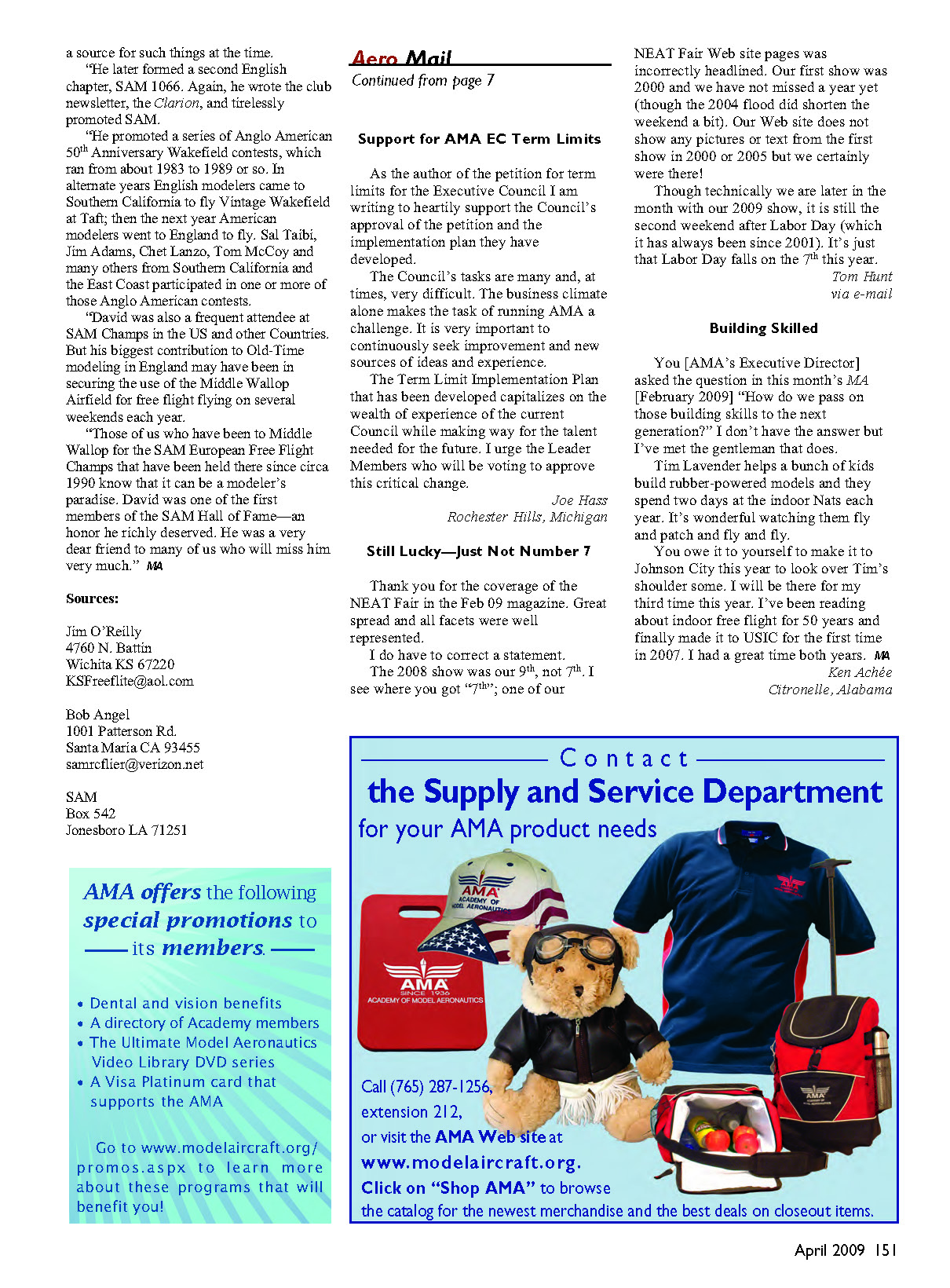
Arden engines are generally credited with bringing the first really useful power to smaller aircraft. They were, and remain, among the best-running spark-ignition engines in the .09 and .19 sizes.
Inventor Ray Arden recognized the need for more compact and lighter ignition systems for smaller airplanes. He designed his own compact coils and even a small FF "power pack" containing coil, condenser, and a pneumatic F/T timer.
Arden didn't stop there. He's also credited with inventing, or at least producing, the first practical glow plugs right after World War II. The glow plug allowed modelers to remove the breaker points, along with the heavy and bulky coil, condenser, and batteries, all of which could be troublesome. When they removed those then‑obsolete ignition timers, most threw them away, often to the disappointment of today's engine collectors.
The Arden engines, along with many other brands, were soon modified and sold without timers as the new glow model engines. Some engine builders omitted the points; others, such as Ohlsson & Rice, made add-on covers for the cam openings, while still others produced new and smoother-looking crankcase castings with no provision for points.
Within just a few years after World War II, spark-ignition engines reached the peak of production and then quickly faded from the scene. Those years left engine collectors with most of the prized collectibles we enjoy today.
The buildup started with the loss of wartime production contracts, leaving hundreds of machine shops without enough work. An obvious market would be model engines, which were in high demand because they hadn't been produced during the war. But that need was too obvious to too many manufacturers, and the market couldn't support the dozens of new engine brands. The number of engine makers quickly narrowed, and the glow plug finally spelled the end of the spark-ignition era. We were left with some great collectibles, most of which had interesting and unique attributes.
David Baker passed away on January 1, 2009. He was well known as a primary spark plug in the OT movement in England. I'll let former SAM President Mike Myers briefly summarize David's modeling life:
"David Baker was one of the prime organizers in setting up SAM 35—the first English SAM chapter. He started the club newsletter. He and a couple of friends bought modelling supplies in bulk and sold them to other OT modelers who didn't have a source for such things at the time.
"He later formed a second English chapter, SAM 1066. Again, he wrote the club newsletter, the Clarion, and tirelessly promoted SAM.
"He promoted a series of Anglo-American 50th Anniversary Wakefield contests, which ran from about 1983 to 1989 or so. In alternate years English modelers came to Southern California to fly Vintage Wakefield at Taft; then the next year American modelers went to England to fly. Sal Taibi, Jim Adams, Chet Lanzo, Tom McCoy and many others from Southern California and the East Coast participated in one or more of those Anglo-American contests.
"David was also a frequent attendee at SAM Champs in the US and other countries. But his biggest contribution to Old-Time modeling in England may have been in securing the use of Middle Wallop Airfield for free-flight flying on several weekends each year.
"Those of us who have been to Middle Wallop for the SAM European Free Flight Champs that have been held there since circa 1990 know that it can be a modeler's paradise. David was one of the first members of the SAM Hall of Fame—an honor he richly deserved. He was a very dear friend to many of us who will miss him very much."
Sources
- Jim O'Reilly
4760 N. Battin Wichita, KS 67220 [email protected]
- Bob Angell
1001 Patterson Rd. Santa Maria, CA 93455 [email protected]
- SAM
Box 542 Jonesboro, LA 71251
Transcribed from original scans by AI. Minor OCR errors may remain.

