
The Southwest Regionals
Event overview
The western contest season kicks off with the Southwest Regionals, held in Eloy, Arizona, each January. This was the 59th year for the event. It’s a three-day meet, with several contests rolled into one, including AMA, FAI, Old-Timer (OT) FF, and OT RC. When it was held at the Buckeye, Arizona, airport years ago, a full range of CL events was also flown. I made it to the contest again this year and enjoyed flying in five RC events.
RC and FF activity
On the RC side of the field, you could fly nearly anytime because of a combination of great weather, more fliers on 2.4 GHz, and slightly fewer participants, in part because of fuel prices and the economy. The FF side looked as busy as ever. But fewer registered RC pilots didn’t mean fewer attendees. This has become one of the gathering places for OT enthusiasts, and most of them travel across several states to socialize and perhaps to fly some as the mood strikes.
An open swap meet was held one afternoon in the FF area, and an evening campfire and cookout was held in the RC area. Next year’s event, the 60th running, should be a good one.
Alfredo Herbon and the Airone glider
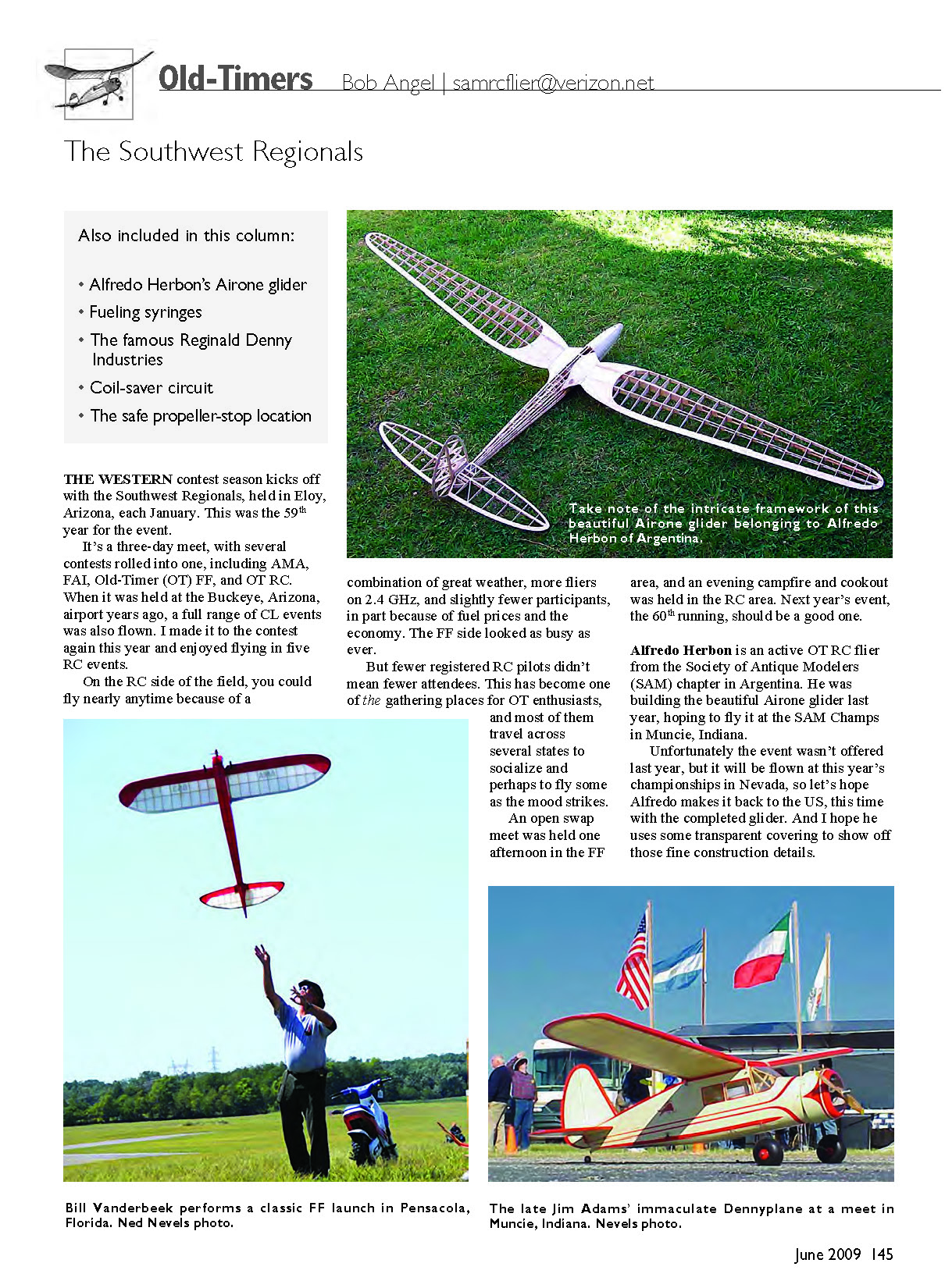
Alfredo Herbon is an active OT RC flier from the Society of Antique Modelers (SAM) chapter in Argentina. He was building the beautiful Airone glider last year, hoping to fly it at the SAM Champs in Muncie, Indiana. Unfortunately the event wasn’t offered last year, but it will be flown at this year’s championships in Nevada, so let’s hope Alfredo makes it back to the US, this time with the completed glider. And I hope he uses some transparent covering to show off those fine construction details.
Fueling syringes
Fueling syringes are used to officially measure fuel allotments for SAM Texaco and other fuel-limit events. The contest director usually keeps one or two 50 cc calibrated glass syringes on hand for that purpose.
Many of us switch to using syringes rather than squeeze bulbs or fuel pumps for our models. A clear syringe lets you spot any gross fuel contamination, is cleaner than a fuel bulb, and is safer than an electric fuel pump. It also minimizes air exposure and resulting water absorption by glow fuel.
Since competition aircraft usually carry a small fuel supply—less than 2 ounces—a single syringe load is enough to fill a tank. That small quantity aboard keeps weight low and is a safety factor.
Most fuel-restriction events are flown at wide-open throttle and use shutoff systems rather than carburetors. Various shutoff schemes use either an interruption of the spark-ignition system or a shutoff or flood-off of the fuel supply. On rare occasions, these systems can fail to work. When that happens, the airplane is usually at the edge of visibility, where it could do a loop under power and fold a wing. That's when you don't want to be carrying much more fuel than is needed for the allotted run time.
There is a safety issue with glass syringes: they can break. Last year, fellow columnist Joe Wagner, author of "The Engine Shop," reported finding blood on his hands before noticing a broken syringe. After that incident, Joe started putting his syringe in its shipping box before placing it back among the tools in his flight box. I've been doing something similar, by pushing syringes inside a short length of foam water-pipe insulation.
Frequent syringe breakage has become a problem, since glass syringes are now imported. They are cheaper in price (good) but of lower quality (bad). They are no longer tempered glass; they are thinner and brittle. After reading Joe's report, I started wrapping the glass barrels with clear packaging tape or Du-Bro Hinge Tape, hoping to protect against breakage and to safely contain the glass if/when breakage does occur.
Plastic syringes are more readily available, much cheaper, and safer than glass. They're usable for most glow fuels, but the petroleum-based fuels and lubricants usually swell the rubber plungers, making them useless in a short time.
Reginald Denny
Reginald Denny was a well-known movie actor whose career began in the silent-film era and lasted well beyond. He personified the suave, refined English gentleman. Reginald became a Royal Air Force pilot in World War I and developed an interest in modeling and early radio control.
He started Reginald Denny Industries and opened a hobby shop in downtown Hollywood, California, around 1934. I was fortunate enough to visit that shop once before it closed in the 1960s. Nicely constructed models hung from the ceiling and even nonmodelers could enjoy it, much as they would a small museum.
Reginald Denny also manufactured engines, kits, and even larger radio-controlled, drone-type target models for the military during World War II. The product best known to modelers was probably the Dennymite engine. It was designed for model aircraft but was also a favorite for model car use before the war. Several hop-up kits and modifications for the engines were available and used mainly by race-car enthusiasts. The Dennymites were later outpaced in race cars by more modern, stronger-running engines such as the Hornets, McCoys, and Doolings.
Bob Hope, Jimmy Stewart, Henry Fonda, Robert Montgomery, and many other well-known actors were aeromodeling enthusiasts, along with Reginald Denny. The late Paul Harvey was a modeler, and he probably would have presented the following as "The Rest of the Story."
During World War II, Hollywood and the media were patriotic supporters of our military. Many women went to work, building machinery in support of the war effort. A news reporter showed up at the Radio Plane Munitions factory in Burbank, California, to take some publicity photos of females in the workforce. He selected a pretty, dark-haired girl named Norma. He snapped a photo of her, clad in neat shop coveralls, installing a propeller on one of the drone aircraft.
The picture was posed, but the job was a real one at the time. That led to modeling contracts for the young lady, and later to the movies. Today we remember Norma Jean Baker as Marilyn Monroe.
A construction article by Dee B. Mathews and Larry Kruse for the Dennyplane was presented in the January 1977 Model Aviation. The late Jim Adams probably built the Dennyplane that is shown from those plans.
Coil-saver circuit
I mentioned a coil-saver circuit in my February 2009 column. It's a transistorized trigger circuit that shuts itself off shortly after the points stop moving and are in the closed position. It's an old design that was published in the December 1976 Model Builder magazine.
This circuit is not used much today, probably because of its relatively high parts count and the ready availability of compact commercial transistorized trigger systems. But I've received a couple requests for the wiring diagram. One of the requests came from Don Hutchinson, an OT CL Precision Aerobatics flier, who said that he and other spark-ignition fliers were occasionally burning out coils. That surprised me, because I thought the short time between when a CL engine shuts down and being able to switch the ignition system off would not cause a coil to be cooked.
If anyone is interested in the coil-saver circuit, you can look it up in your stacks of old Model Builder magazines, e-mail me a request for an electronic copy, or send an SASE for a copy. My copy was scanned and is readable, but possibly not as clean as you can get from Gene Wallock, the SAM librarian, for a small fee. Perhaps some electronic genius among us might be able to update and simplify that circuit and share it. The SAM Library Service is useful for getting reprints of old magazine articles. Please have the magazine name and issue date for any request, because it would be unreasonable to ask Gene to do that kind of research.
Where does the propeller stop?
We usually put the propeller on so that it's in the horizontal position as the piston comes up against compression. For those few of us who still sometimes hand crank to start, that's the useful position. We also suppose it to be the position in which the propeller will come to rest when the engine is shut down.
But Mr. Murphy and his law have a way of seeing to it that the propeller stops in what we call the 5 o'clock position, or vertical. An easily broken wooden propeller will do this more often than a plastic one.
You can look at where the propeller has stopped and then reposition it, hoping it will stop horizontally the next time. But Murphy is looking over your shoulder, so don't count on it.
The preceding could account for the reason why Larry Davidson doesn't burn out coils in his FF airplanes, although he has no way to shut off the ignition when his engine quits. Those screaming, hot power plants of his are probably loose enough to allow the piston to come to rest high enough so that the points have opened. If an engine stops at the top of the compression stroke, the points are usually closed. MA
Sources
- Bob Angel
1001 Patterson Rd. Santa Maria CA 93455
- Gene Wallock
13 NW Sandy Trail Lawton OK 73505 (580) 536-0303 [email protected]
Transcribed from original scans by AI. Minor OCR errors may remain.

