
The SAM Eurochamps
The VII SAM (Society of Antique Modelers) Eurochamps was held in Suhl, Germany, June 10–14, 2009. It was sponsored by the Suhl Modellsportclub, SAM 85, Graupner, and the city of Suhl.
Ed Hamler and several others from SAM USA have regularly attended the European meets. This year Ed volunteered to CD the event. He didn't have to relearn on which side of the road to drive, but he did have to brush up on a few rules, because European SAM rules, U.S. rules, and events vary slightly.
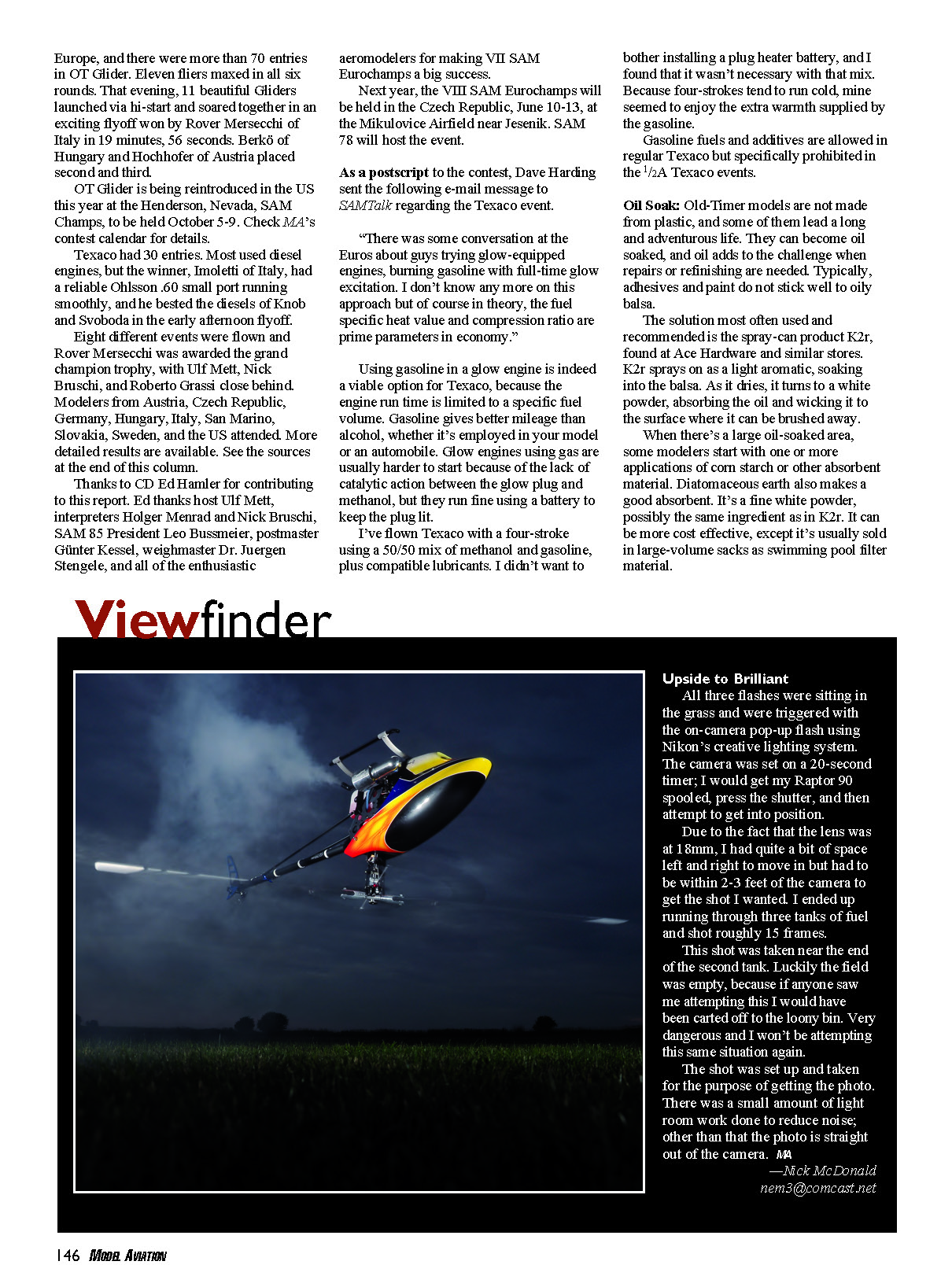
As in the U.S., the 1/2A Texaco and electric classes are popular. With 26 entries in 1/2A, the top three finishers were Mokran, Grassi, and Svoboda.
Among the 33 entries in ELOT (Electric Old Timer), six competitors maxed out and a flyoff was launched late Saturday evening. Italians Mersecchi and Grassi garnered first and second, with flights approaching 40 minutes. Bulin was third with a flight lasting more than 20 minutes.
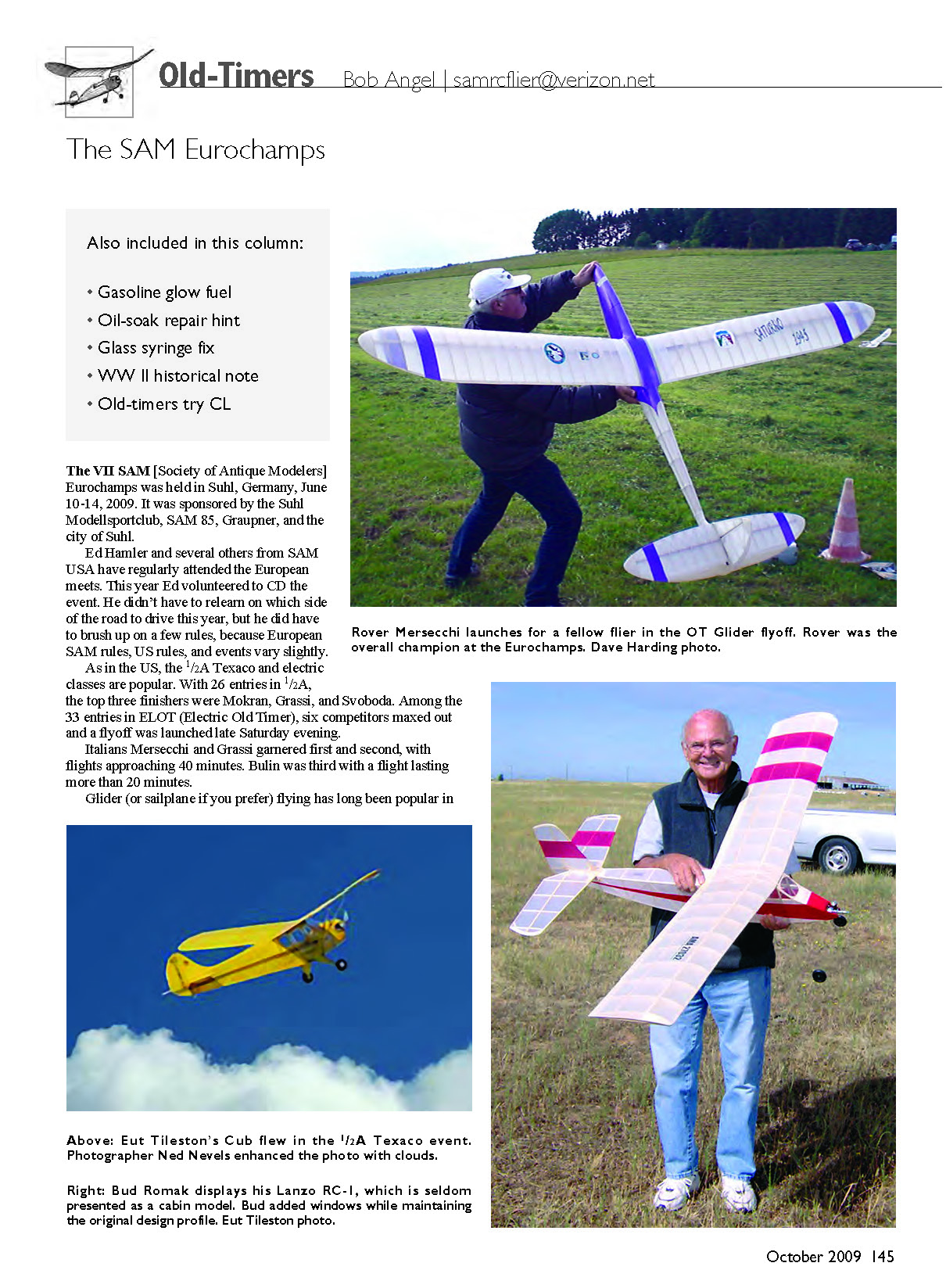
Glider (or sailplane, if you prefer) flying has long been popular in Europe, and there were more than 70 entries in OT Glider. Eleven fliers maxed in all six rounds. That evening, 11 beautiful gliders launched via hi-start and soared together in an exciting flyoff won by Rover Mersecchi of Italy in 19 minutes, 56 seconds. Berkö of Hungary and Hochhofer of Austria placed second and third.
Texaco had 30 entries. Most used diesel engines, but the winner, Imoletti of Italy, had a reliable Ohlsson .60 small-port running smoothly, and he bested the diesels of Knob and Svoboda in the early-afternoon flyoff.
Eight different events were flown. Rover Mersecchi was awarded the grand champion trophy, with Ulf Mett, Nick Bruschi, and Roberto Grassi close behind. Modelers from Austria, the Czech Republic, Germany, Hungary, Italy, San Marino, Slovakia, Sweden, and the U.S. attended. More detailed results are available; see the sources at the end of this column.
Thanks to CD Ed Hamler for contributing to this report. Ed thanks the following for making VII SAM Eurochamps a big success:
- Ulf Mett (host)
- Holger Menrad and Nick Bruschi (interpreters)
- Leo Bussmeier (SAM 85 President)
- Günter Kessel (postmaster)
- Dr. Juergen Stengele (weighmaster)
- All of the enthusiastic aeromodelers
Next year, the VIII SAM Eurochamps will be held in the Czech Republic, June 10–13, at the Mikulovice Airfield near Jesenik. SAM 78 will host the event.
As a postscript to the contest, Dave Harding sent the following e-mail message to SAMTalk regarding the Texaco event: "There was some conversation at the Euros about guys trying glow-equipped engines, burning gasoline with full-time glow excitation. I don't know any more on this approach but of course in theory, the fuel specific heat value and compression ratio are prime parameters in economy."
Using gasoline in a glow engine is indeed a viable option for Texaco, because the engine run time is limited to a specific fuel volume. Gasoline gives better mileage than alcohol, whether it's employed in your model or an automobile. Glow engines using gas are usually harder to start because of the lack of catalytic action between the glow plug and methanol, but they run fine using a battery to keep the plug lit. I've flown Texaco with a four-stroke using a 50/50 mix of methanol and gasoline, plus compatible lubricants. I didn't want to bother installing a plug-heater battery, and I found that it wasn't necessary with that mix. Because four-strokes tend to run cold, mine seemed to enjoy the extra warmth supplied by the gasoline.
Gasoline fuels and additives are allowed in regular Texaco but specifically prohibited in the 1/2A Texaco events.
Oil Soak
Old-Timer models are not made from plastic, and some of them lead a long and adventurous life. They can become oil-soaked, and oil adds to the challenge when repairs or refinishing are needed. Typically, adhesives and paint do not stick well to oily balsa.
The solution most often used and recommended is the spray-can product K2r, found at Ace Hardware and similar stores. K2r sprays on as a light aromatic, soaking into the balsa. As it dries, it turns to a white powder, absorbing the oil and wicking it to the surface where it can be brushed away.
When there's a large oil-soaked area, some modelers start with one or more applications of corn starch or other absorbent material. Diatomaceous earth also makes a good absorbent. It's a fine white powder, possibly the same ingredient as in K2r. It can be more cost-effective, except it's usually sold in large-volume sacks as swimming-pool filter material.
When all of these tricks have been utilized and the result is still not quite satisfactory, I’ve found that thin CA seems to soak into slightly oily wood and cure into a nice, hard surface that is suitable for gluing or refinishing. CA can be sparingly applied by wiping or patting across the surface using the backing material from plastic film covering. It doesn’t stick to that type of plastic, and the result sands reasonably well.
Glass Syringes
In my June 2009 column, I mentioned that the imported syringes some of us prefer for gasoline fueling were thin, untempered glass and easily broken. Gordon Smith of Santa Barbara, California, sent the following hint to make them more durable and safer to use:
“Here’s a tip about making cheap glass items less brittle and therefore safer to use. My Child Bride (of 60 years) and I have found that the main difference between cheap glass items like water glasses and the more expensive ones is that the cheapies are not properly stress relieved.
“We put them in a large pot of cold water, bring the water slowly to boiling, and then turn off the heat and let the whole thing cool to room temperature before removing the glass items. This anneals the glass, which makes it much more flexible and less likely to break. Try it on your glass syringes; I think you will be happy with the result!”
Thanks, Gordon. That sounds reasonable, but I suggest that you anneal only the outer barrel, because the plunger unit is sealed with air inside. I wouldn’t want you to risk pressurizing it and creating a possible explosion. Usually only the outer barrel breaks.
Rocky Giordano sent another potential solution:
“The Fortuna brand PP/PE syringes are translucent plastic and have no rubber piston. The piston is part of the plastic plunger (either PE or PP) and nothing will bother it.
“Norvel used to sell them, but Norvel is extinct. You can get them from Sigma-Aldrich Company [see ‘Sources’] if you buy them in quantity. The variety of syringes offered is confusing, but I prefer the 20 and 50 ml sizes without the Luer Lock tips.”
Thanks, Rocky. Gasoline and mineral oils will cause rubber plunger seals in most plastic syringes to swell and become unusable. Glow fuels seldom cause that problem.
History Lesson
George Schroedter, now 81, sent the following interesting tidbit from the 1940s, when gasoline and other things were rationed:
“Your column brought back some memories. I recall that obtaining the white gas and the SAE 70 oil during WWII required going to the local Ration Board and filling out a form on which I gave the details of my two engines: an Ohlsson .19 and a Super Cyke. Included among the data asked for were the horsepower and the displacement. I’d turn it in and then had to come back a couple of days later to pick up some ‘E’ ration stamps to turn in at the filling station.
“Those were the wonderful days of flying at Western & Rosecrans and the semiannual contests put on by the Los Angeles Gas Model Airplane Club (LAGMAC).
“Good flying.”
Fliers crash—not models!
Control-line (CL) flying can be a dizzying experience for those who have never done it or who have been away for a few years. My friend Jim Bierbauer decided we needed to relive our youth, so he dug out one of his old CL models and brought it to the regular OT flying session.
We wisely decided to alternate as pilot, in anticipation of possible problems. I took off with it first and found that time had warped the wings too far out of trim to permit switching between inverted and upright flight to unwind brain, inner ear, and eyeballs. The world was spinning and becoming more blurry with each revolution.
Roughly halfway through the flight, I yelled for Jim to come in and take over. The handoff went smoothly enough, and we managed to complete the flight without crashing the airplane. But in each case, as soon as the body stopped rotating, the brain did not, while the eyes suddenly saw the spinning world come to a stop. And in both cases we crashed dizzily to the ground.
Two positive things came from this experience: the model was intact and no one had a video camera! MA
Sources
- SAM Eurochamps results: www.flugmodellsportclub-suhl.de/
- PP/PE fueling syringes: www.sigmaaldrich.com
- Society of Antique Modelers: www.antiquemodeler.org
Transcribed from original scans by AI. Minor OCR errors may remain.

