
Vintage Old-Timer event
Bob Angel
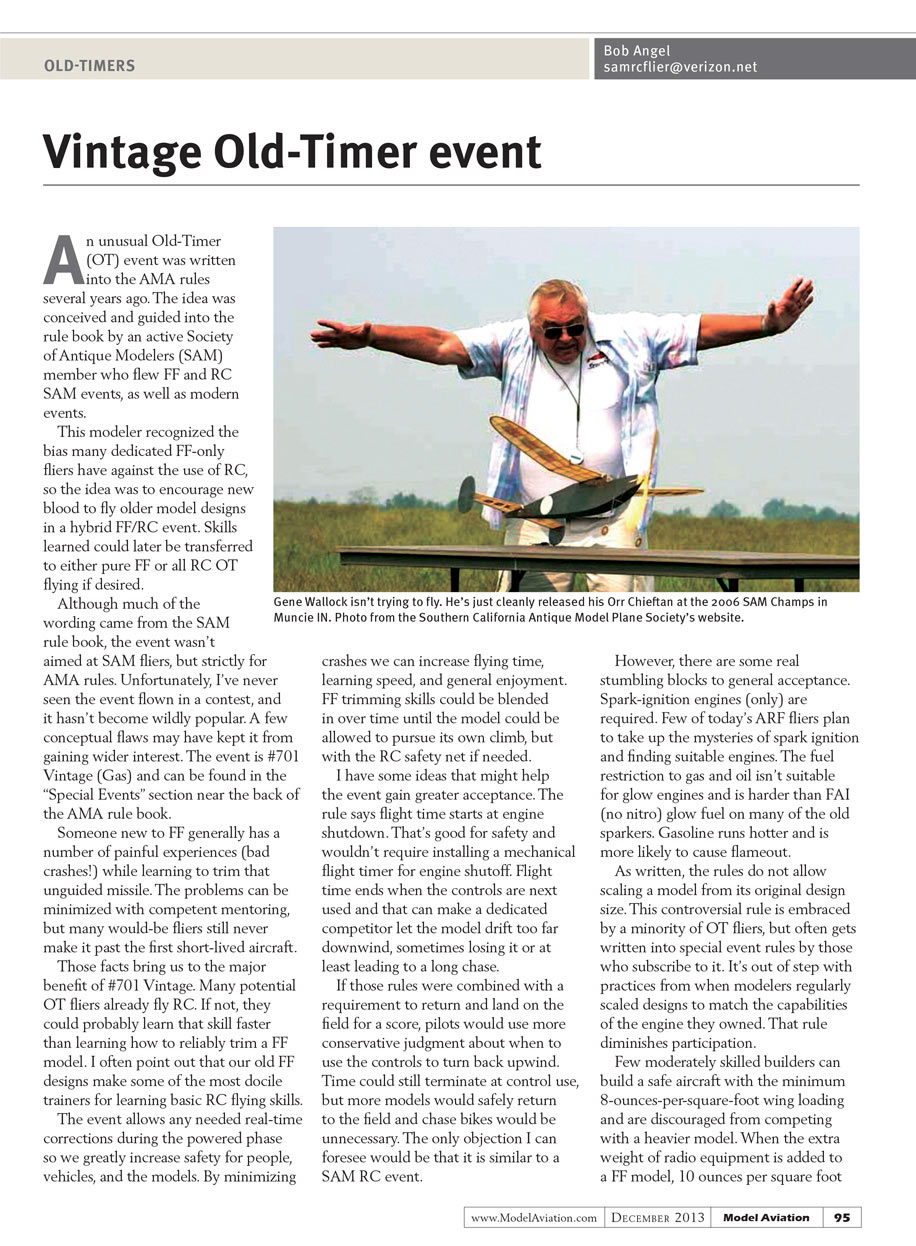
An unusual Old-Timer (OT) event was written into the AMA rules several years ago. The idea was conceived and guided into the rule book by an active Society of Antique Modelers (SAM) member who flew FF and RC SAM events, as well as modern events.
This modeler recognized the bias many dedicated FF-only fliers have against the use of RC, so the idea was to encourage new blood to fly older model designs in a hybrid FF/RC event. Skills learned could later be transferred to either pure FF or all RC OT flying if desired.
Although much of the wording came from the SAM rule book, the event wasn’t aimed at SAM fliers, but strictly for AMA rules. Unfortunately, I’ve never seen the event flown in a contest, and it hasn’t become wildly popular. A few conceptual flaws may have kept it from gaining wider interest. The event is #701 Vintage (Gas) and can be found in the “Special Events” section near the back of the AMA rule book.
Someone new to FF generally has a number of painful experiences (bad crashes!) while learning to trim that unguided missile. The problems can be minimized with competent mentoring, but many would-be fliers still never make it past the first short-lived aircraft.
Those facts bring us to the major benefit of #701 Vintage. Many potential OT fliers already fly RC. If not, they could probably learn that skill faster than learning how to reliably trim a FF model. I often point out that our old FF designs make some of the most docile trainers for learning basic RC flying skills.
The event allows any needed real-time corrections during the powered phase so we greatly increase safety for people, vehicles, and the models. By minimizing crashes we can increase flying time, learning speed, and general enjoyment. FF trimming skills could be blended in over time until the model could be allowed to pursue its own climb, but with the RC safety net if needed.
I have some ideas that might help the event gain greater acceptance. The rule says flight time starts at engine shutdown. That’s good for safety and wouldn’t require installing a mechanical flight timer for engine shutoff. Flight time ends when the controls are next used and that can make a dedicated competitor let the model drift too far downwind, sometimes losing it or at least leading to a long chase.
If those rules were combined with a requirement to return and land on the field for a score, pilots would use more conservative judgment about when to use the controls to turn back upwind. Time could still terminate at control use, but more models would safely return to the field and chase bikes would be unnecessary. The only objection I can foresee would be that it is similar to a SAM RC event.
However, there are some real stumbling blocks to general acceptance. Spark-ignition engines (only) are required. Few of today’s ARF fliers plan to take up the mysteries of spark ignition and finding suitable engines. The fuel restriction to gas and oil isn’t suitable for glow engines and is harder than FAI (no nitro) glow fuel on many of the old sparkers. Gasoline runs hotter and is more likely to cause flameout.
As written, the rules do not allow scaling a model from its original design size. This controversial rule is embraced by a minority of OT fliers, but often gets written into special event rules by those who subscribe to it. It’s out of step with practices from when modelers regularly scaled designs to match the capabilities of the engine they owned. That rule diminishes participation.
Few moderately skilled builders can build a safe aircraft with the minimum 8-ounces-per-square-foot wing loading and are discouraged from competing with a heavier model. When the extra weight of radio equipment is added to a FF model, 10 ounces per square foot is more practical and a more achievable goal.
If any SAM chapter or AMA club would like to try the Vintage event, the AMA event rules are a good starting point, but nothing says the rules can't be altered for improvement, as long as the changes are advertised well ahead of the event.
Engines and OT
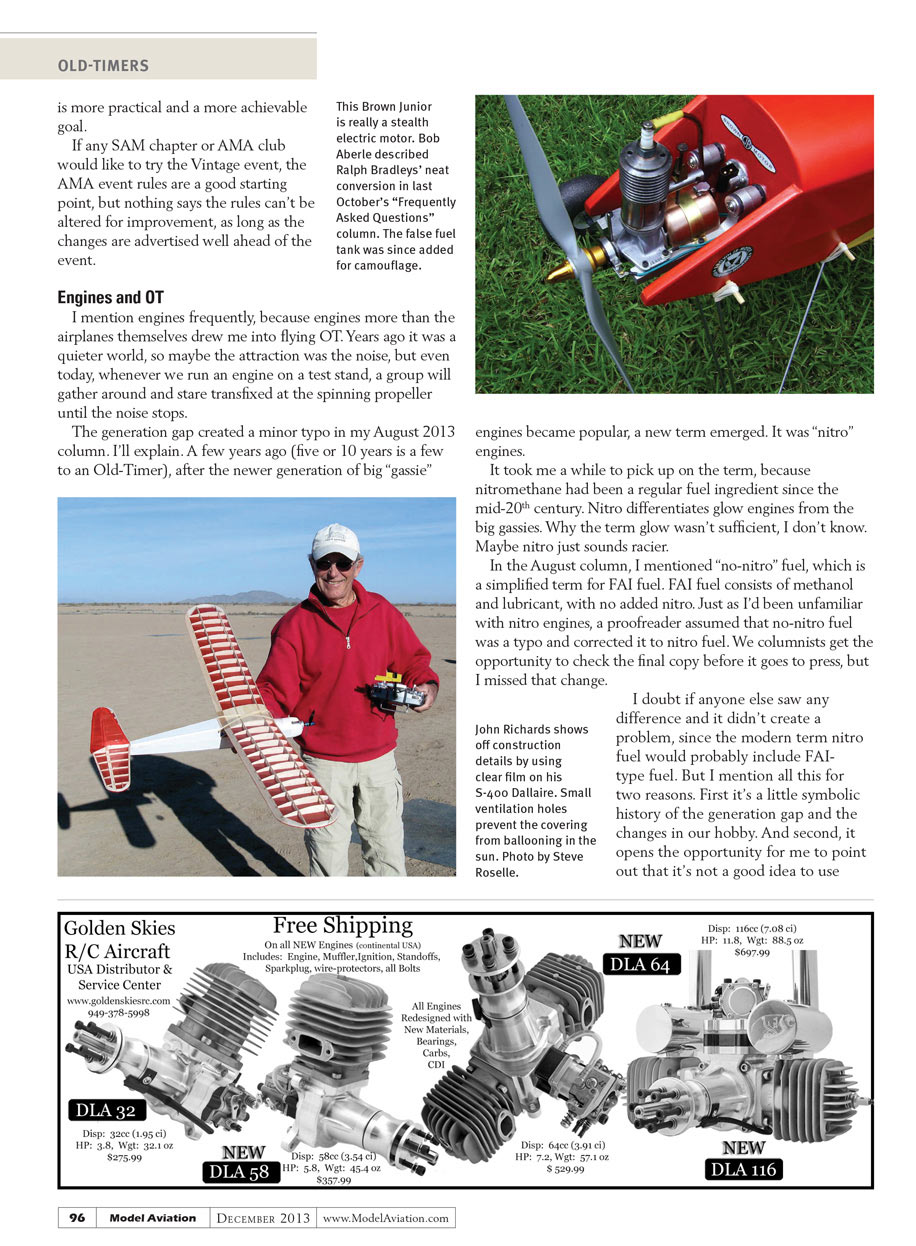
I mention engines frequently, because engines more than the airplanes themselves drew me into flying OT. Years ago it was a quieter world, so maybe the attraction was the noise, but even today, whenever we run an engine on a test stand, a group will gather around and stare transfixed at the spinning propeller until the noise stops.
The generation gap created a minor typo in my August 2013 column. I'll explain. A few years ago (five or 10 years is a few to an Old-Timer), after the newer generation of big "gassie" engines became popular, a new term emerged. It was "nitro" engines.
It took me a while to pick up on the term, because nitromethane had been a regular fuel ingredient since the mid-20th century. Nitro differentiates glow engines from the big gassies. Why the term glow wasn't sufficient, I don't know. Maybe nitro just sounds racier.
In the August column, I mentioned "no-nitro" fuel, which is a simplified term for FAI fuel. FAI fuel consists of methanol and lubricant, with no added nitro. Just as I'd been unfamiliar with nitro engines, a proofreader assumed that no-nitro fuel was a typo and corrected it to nitro fuel. We columnists get the opportunity to check the final copy before it goes to press, but I missed that change.
I doubt if anyone else saw any difference and it didn't create a problem, since the modern term nitro fuel would probably include FAI-type fuel. But I mention all this for two reasons. First it's a little symbolic history of the generation gap and the changes in our hobby. And second, it opens the opportunity for me to point out that it's not a good idea to use modern glow fuel in old engines. If you use modern glow fuel in spark-ignition engines, the higher combustion temperatures, plus the oil content and additives, can damage parts or cause failure. Use the appropriate fuel. “real” nitrated fuel in antique engines.
SAM competition rules allow the option of running either gas and oil, or FAI-type no-nitro fuel in spark ignition engines. When not competing, we often run them with a glow plug and glow fuel either to break in an engine or to identify a possible ignition problem. Some use a mild nitro mix (10% or less) for this and get away with it, but once I didn’t.
When I first became an engine collector, I’d acquired a nice, old Phantom P-30 and was eager to hear it run. Not wanting to assemble an ignition system, I put it on a test stand, installed a glow plug, and fueled it up with mild nitro fuel. It started easily and purred nicely. As I leaned it out, it began the two-cycle sound, then kerpow!
The rod had let go and the pot metal crankcase was shattered. I’d learned a disappointing lesson.
SOURCES:
SAM - US Chapters www.antiquemodeler.org
AMA Competition Regulations www.modelaircraft.org/events/compreg.aspx
Transcribed from original scans by AI. Minor OCR errors may remain.

