
OLD-TIMERS
Mike Keville, 6218 E. Evergreen St., Mesa AZ 85205; E-mail: [email protected]
IN MUCH of the Northern Hemisphere the flying season will soon end as the "gales of November" signal the start of another building season. It's a different story here in Arizona and a few other locations, of course, but for the most part it's nearly time to begin cutting wood.
Speaking of which, it seems that many of the inquiries I receive begin with, "Where can I find plans for ... ?" I can answer most of those questions easily, thanks to numerous cottage-industry sources.
I have copies of a list of sources for those seeking plans or kits for Old-Time (OT) designs. I can send it as an E-mail attachment or by regular mail if you enclose a self-addressed, stamped envelope (SASE).
One such source is Bob Holman in California. He offers computer-aided-design (CAD)-drawn plans and laser-cut parts for a variety of OT Rubber, Glider, and Gas designs.
In Bob's words, "I use mostly Sig wood and pay a little extra for lighter wood. Most of the parts are cut from plans that have been redrawn in CAD, many by Jim O'Reilly of Kansas. Some of the original OT plans were not very accurate, and with CAD the problems can be corrected."
Earlier this year I obtained one of Bob's offerings. The laser-cutting was crisp and accurate; the plans were excellent. There are too many designs to list here, but if this one is typical you can't go wrong.
Send a legal-size SASE requesting a list to Bob Holman Plans, Box 741, San Bernardino CA 92402; Tel.: (909) 885-3959; E-mail: [email protected]. His Web site is www.angelfire.com/ct/bhplans
Other inquiries concern plans for early Radio Control (RC) designs. A good number of them are available from Tom Dixon.
Although most of Tom's plans are Control Line (CL) Stunt, the Old-Time RC list includes Doug Spreng's Stormer, Berkeley's Bootstraps and Royal Rudderbug, Phil Kraft's Kwik-Fli Mk II and Mk III, Hal deBolt's Live Wire Champ and Cruiser, Ed Kazmarski's Orion and Taurus, and several others.
Contact Tom at Box 67/1166, Marietta GA 30066; Tel./Fax: (770) 973-9238.
From the replies I've received, it's apparent that many of you favor the idea of including designs from the 1950s in this column. In Free Flight (FF) it's called Nostalgia Gas; in CL Stunt the category is known as Classic.
From all indications, an FF favorite is the Zeek designed by Lew Mahieu. Remember those 1950s magazine photos of the gorgeous versions Toshi Matsuda of Los Angeles built and flew?
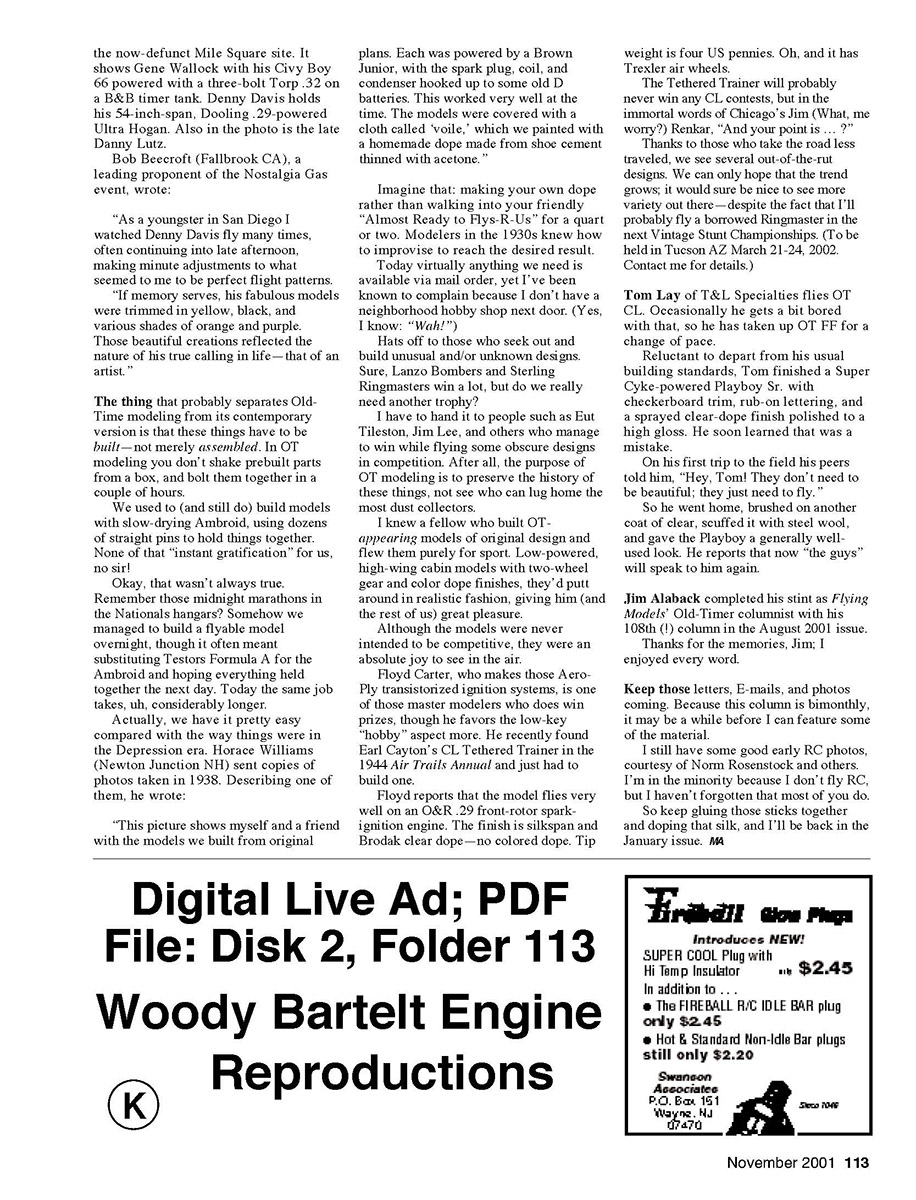
John Brownlee (Yuba City CA) sent an early-1950s photo of his Class B-C Zeek powered by a Veco .31. He wrote:
"This size was never kitted. Lyman Armstrong and I got the plans from Bill Crawford, who took over the Zeek kit business near the end of its run. I flew this model in contests at Marysville, Sacramento, Bakersfield, and Taft and had some success with it."
John enclosed other photos from the 1940s and 1950s that I'll feature in future columns.
Another favorite is Paul Gilliam's Clevey Boy. Tandy Walker sent a great copy of a photo taken by Paul himself in 1953 at the now-defunct Mile Square site. It shows Gene Wallock with his Clevey Boy 66 powered with a three-bolt Torp .32 on a B&B timer tank. Denny Davis holds his 54-inch-span, Dooling .29-powered Ultra Hogan. Also in the photo is the late Danny Lutz.
Bob Beecroft (Fallbrook CA), a leading proponent of the Nostalgia Gas event, wrote:
"As a youngster in San Diego I watched Denny Davis fly many times, often continuing into late afternoon, making minute adjustments to what seemed to me to be perfect flight patterns.
"If memory serves, his fabulous models were trimmed in yellow, black, and various shades of orange and purple. Those beautiful creations reflected the nature of his true calling in life—that of an artist."
The thing that probably separates Old-Time modeling from its contemporary version is that these things have to be built—not merely assembled. In OT modeling you don't shake prebuilt parts from a box, and bolt them together in a couple of hours.
We used to (and still do) build models with slow-drying Ambroid, using dozens of straight pins to hold things together. None of that "instant gratification" for us, no sir!
Okay, that wasn't always true.
Remember those midnight marathons in the Nationals hangars? Somehow we managed to build a flyable model overnight, though it often meant substituting Testors Formula A for the Ambroid and hoping everything held together the next day. Today the same job takes, uh, considerably longer.
Actually, we have it pretty easy compared with the way things were in the Depression era. Horace Williams (Newton Junction NH) sent copies of photos taken in 1938. Describing one of them, he wrote:
"This picture shows myself and a friend with the models we built from original plans. Each was powered by a Brown Junior, with the spark plug, coil, and condenser hooked up to some old D batteries. This worked very well at the time. The models were covered with a cloth called 'voile,' which we painted with a homemade dope made from shoe cement thinned with acetone."
Imagine that: making your own dope rather than walking into your friendly "Almost Ready to Flys-R-Us" for a quart or two. Modelers in the 1930s knew how to improvise to reach the desired result.
Today virtually anything we need is available via mail order, yet I've been known to complain because I don't have a neighborhood hobby shop next door. (Yes, I know: "Mah!")
Hats off to those who seek out and build unusual and/or unknown designs. Sure, Lanzo Bombers and Sterling Ringmasters win a lot, but do we really need another trophy?
I have to hand it to people such as Eut Tileston, Jim Lee, and others who manage to win while flying some obscure designs in competition. After all, the purpose of OT modeling is to preserve the history of these things, not see who can lug home the most dust collectors.
I knew a fellow who built OT-appearing models of original design and flew them purely for sport. Low-powered, high-wing cabin models with two-wheel gear and color dope finishes, they'd put around in realistic fashion, giving him (and the rest of us) great pleasure.
Although the models were never intended to be competitive, they were an absolute joy to see in the air.
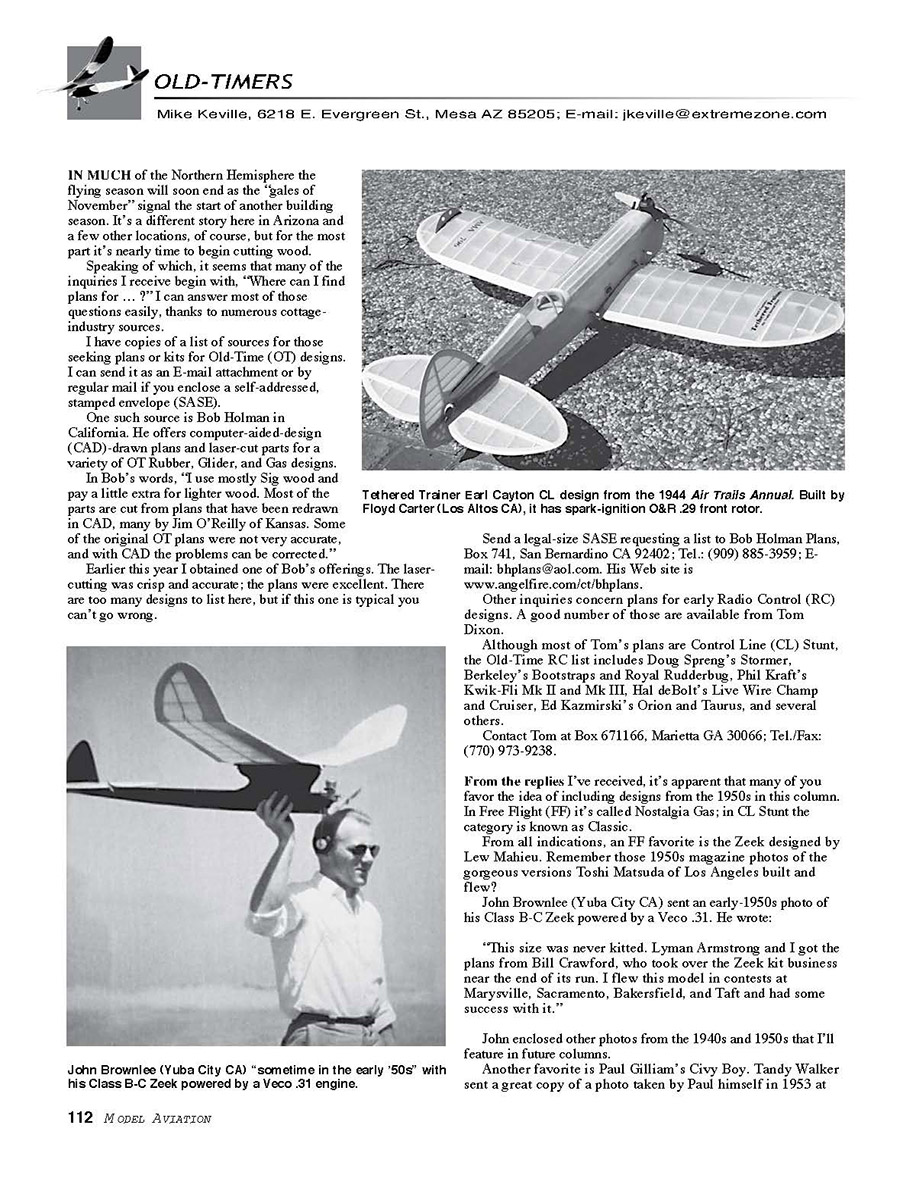
Floyd Carter, who makes those Aero-Ply transistorized ignition systems, is one of those master modelers who does win prizes, though he favors the low-key "hobby" aspect more. He recently found Earl Cayton's CL Tethered Trainer in the 1944 Air Trails Annual and just had to build one.
Floyd reports that the model flies very well on an O&R .29 front-rotor spark-ignition engine. The finish is silkspar and Brodak clear dope—no colored dope. Tip weight is four US pennies. Oh, and it has Trexler air wheels.
The Tethered Trainer will probably never win any CL contests, but in the immortal words of Chicago's Jim (What, me worry?) Renkar, "And your point is ...?"
Thanks to those who take the road less traveled, we see several out-of-the-rut designs. We can only hope that the trend grows; it would sure be nice to see more variety out there—despite the fact that I'll probably fly a borrowed Ringmaster in the next Vintage Stunt Championships. (To be held in Tucson AZ March 21-24, 2002. Contact me for details.)
Tom Lay of T&L Specialties flies OT CL. Occasionally he gets a bit bored with that, so he has taken up OT FF for a change of pace.
Reluctant to depart from his usual building standards, Tom finished a Super Cyke-powered Playboy Sr. with checkerboard trim, rub-on lettering, and a sprayed clear-dope finish polished to a high gloss. He soon learned that was a mistake.
On his first trip to the field his peers told him, "Hey, Tom! They don't need to be beautiful; they just need to fly."
So he went home, brushed on another coat of clear, scuffed it with steel wool, and gave the Playboy a generally well-used look. He reports that now "the guys" will speak to him again.
Jim Alaback completed his stint as Flying Models' Old-Timer columnist with his 108th (!) column in the August 2001 issue. Thanks for the memories, Jim; I enjoyed every word.
Keep those letters, E-mails, and photos coming. Because this column is bimonthly, it may be a while before I can feature some of the material.
I still have some good early RC photos, courtesy of Norm Rosenstock and others. I'm in the minority because I don't fly RC, but I haven't forgotten that most of you do.
So keep gluing those sticks together and doping that silk, and I'll be back in the January issue. MA
Transcribed from original scans by AI. Minor OCR errors may remain.

