
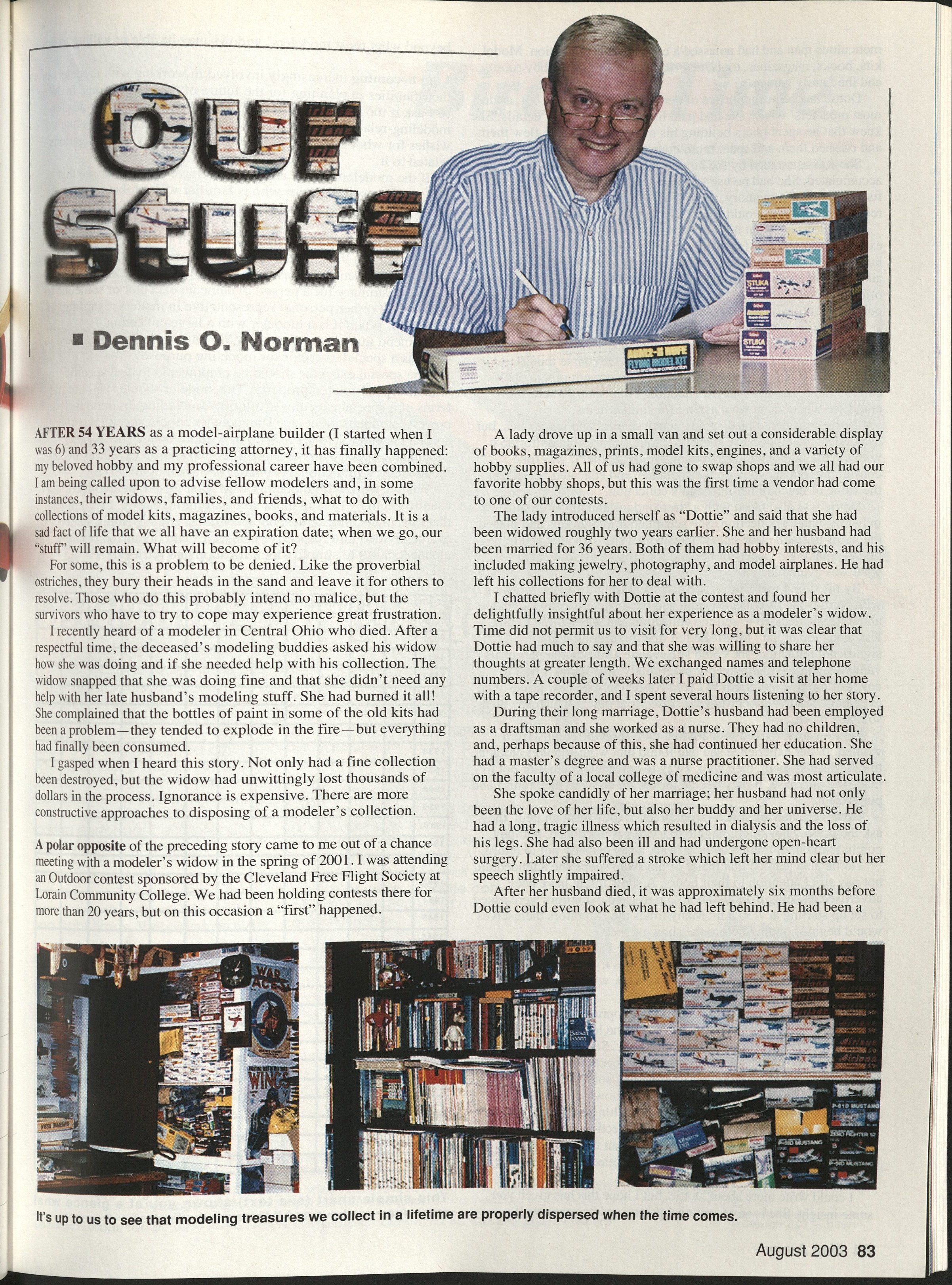
Our Stuff - 2003/08
Dennis O. Norman
AFTER 54 YEARS as a model-airplane builder (I started when I was 6) and 33 years as a practicing attorney, it has finally happened: my beloved hobby and my professional career have been combined. I am being called upon to advise fellow modelers and, in some instances, their widows, families, and friends, what to do with collections of model kits, magazines, books, and materials. It is a sad fact of life that we all have an expiration date; when we go, our "stuff" will remain. What will become of it?
For some, this is a problem to be denied. Like the proverbial ostriches, they bury their heads in the sand and leave it for others to resolve. Those who do this probably intend no malice, but the survivors who have to try to cope may experience great frustration.
I recently heard of a modeler in Central Ohio who died. After a respectful time, the deceased's modeling buddies asked his widow how she was doing and if she needed help with his collection. The widow snapped that she was doing fine and that she didn't need any help with her late husband's modeling stuff. She had burned it all! She complained that the bottles of paint in some of the old kits had been a problem—they tended to explode in the fire—but everything had finally been consumed.
I gasped when I heard this story. Not only had a fine collection been destroyed, but the widow had unwittingly lost thousands of dollars in the process. Ignorance is expensive. There are more constructive approaches to disposing of a modeler's collection.
A constructive example — Dottie
A polar opposite of the preceding story came to me out of a chance meeting with a modeler's widow in the spring of 2001. I was attending an outdoor contest sponsored by the Cleveland Free Flight Society at Lorain Community College. We had been holding contests there for more than 20 years, but on this occasion a "first" happened.
A lady drove up in a small van and set out a considerable display of books, magazines, prints, model kits, engines, and a variety of hobby supplies. All of us had gone to swap shops and we all had our favorite hobby shops, but this was the first time a vendor had come to one of our contests.
The lady introduced herself as "Dottie" and said that she had been widowed roughly two years earlier. She and her husband had been married for 36 years. Both of them had hobby interests, and his included making jewelry, photography, and model airplanes. He had left his collections for her to deal with.
I chatted briefly with Dottie at the contest and found her delightfully insightful about her experience as a modeler's widow. Time did not permit us to visit for very long, but it was clear that Dottie had much to say and that she was willing to share her thoughts at greater length. We exchanged names and telephone numbers. A couple of weeks later I paid Dottie a visit at her home with a tape recorder, and I spent several hours listening to her story.
During their long marriage, Dottie's husband had been employed as a draftsman and she worked as a nurse. They had no children, and, perhaps because of this, she had continued her education. She had a master's degree and was a nurse practitioner. She had served on the faculty of a local college of medicine and was most articulate.
She spoke candidly of her marriage; her husband had not only been the love of her life, but also her buddy and her universe. He had a long, tragic illness which resulted in dialysis and the loss of his legs. She had also been ill and had undergone open-heart surgery. Later she suffered a stroke which left her mind clear but her speech slightly impaired.
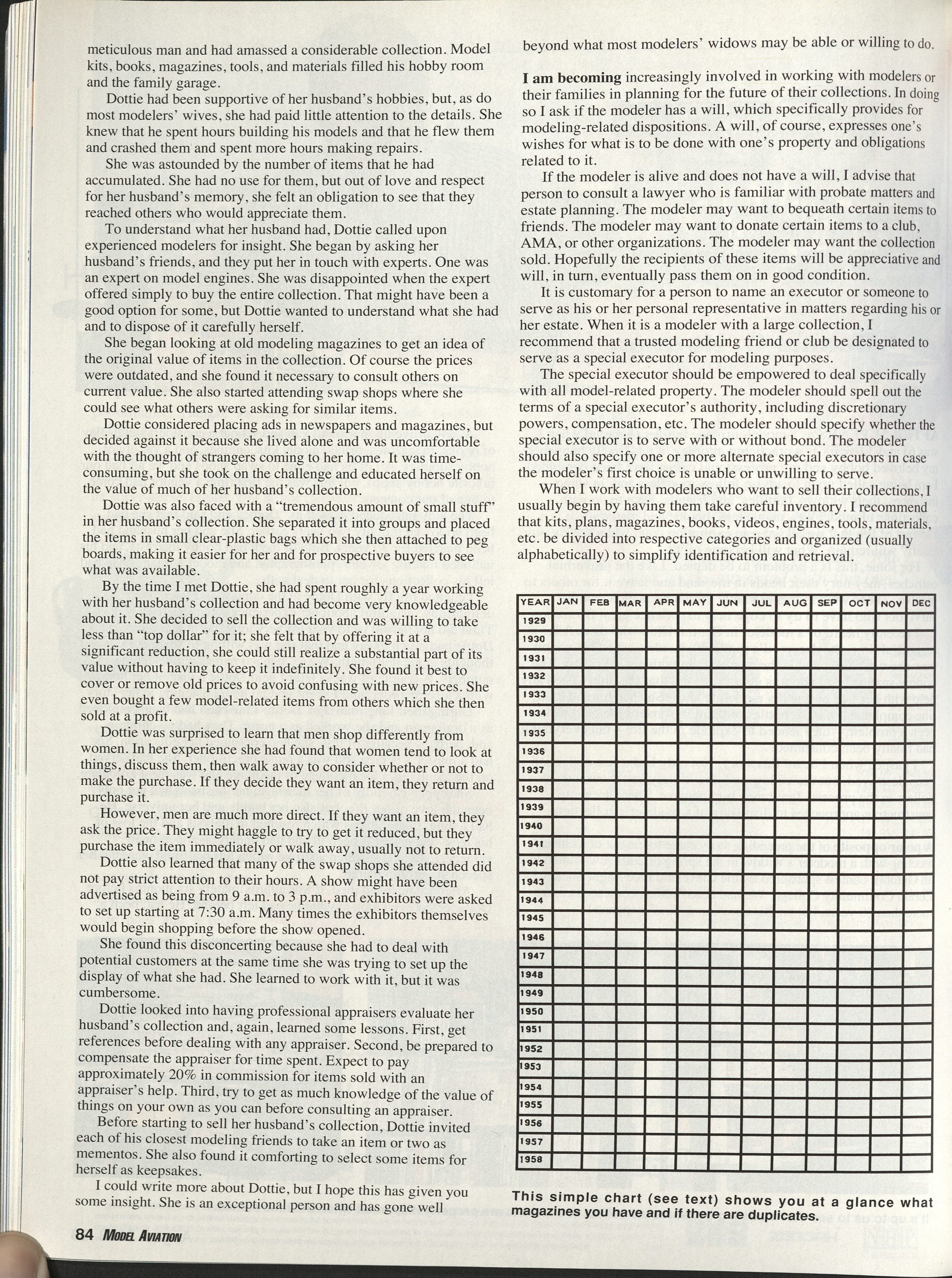
After her husband died, it was approximately six months before Dottie could even look at what he had left behind. He had been a meticulous man and had amassed a considerable collection. Model kits, books, magazines, tools, and materials filled his hobby room and the family garage.
Dottie had been supportive of her husband's hobbies, but, as do most modelers' wives, she had paid little attention to the details. She knew that he spent hours building his models and that he flew them and crashed them and spent more hours making repairs.
She was astounded by the number of items that he had accumulated. She had no use for them, but out of love and respect for her husband's memory, she felt an obligation to see that they reached others who would appreciate them.
How Dottie handled the collection
To understand what her husband had, Dottie called upon experienced modelers for insight. She began by asking her husband's friends, and they put her in touch with experts. One was an expert on model engines. She was disappointed when the expert offered simply to buy the entire collection. That might have been a good option for some, but Dottie wanted to understand what she had and to dispose of it carefully herself.
She began looking at old modeling magazines to get an idea of the original value of items in the collection. Of course the prices were outdated, and she found it necessary to consult others on current value. She also started attending swap shops where she could see what others were asking for similar items.
Dottie considered placing ads in newspapers and magazines, but decided against it because she lived alone and was uncomfortable with the thought of strangers coming to her home. It was time-consuming, but she took on the challenge and educated herself on the value of much of her husband's collection.
Dottie was also faced with a "tremendous amount of small stuff" in her husband's collection. She separated it into groups and placed the items in small clear-plastic bags which she then attached to peg boards, making it easier for her and for prospective buyers to see what was available.
By the time I met Dottie, she had spent roughly a year working with her husband's collection and had become very knowledgeable about it. She decided to sell the collection and was willing to take less than "top dollar" for it; she felt that by offering it at a significant reduction, she could still realize a substantial part of its value without having to keep it indefinitely. She found it best to cover or remove old prices to avoid confusing with new prices. She even bought a few model-related items from others which she then sold at a profit.
Dottie was surprised to learn that men shop differently from women. In her experience she had found that women tend to look at things, discuss them, then walk away to consider whether or not to make the purchase. If they decide they want an item, they return and purchase it.
However, men are much more direct. If they want an item, they ask the price. They might haggle to try to get it reduced, but they purchase the item immediately or walk away, usually not to return.
Dottie also learned that many of the swap shops she attended did not pay strict attention to their hours. A show might have been advertised as being from 9 a.m. to 3 p.m., and exhibitors were asked to set up starting at 7:30 a.m. Many times the exhibitors themselves would begin shopping before the show opened.
She found this disconcerting because she had to deal with potential customers at the same time she was trying to set up the display of what she had. She learned to work with it, but it was cumbersome.
Dottie looked into having professional appraisers evaluate her husband's collection and, again, learned some lessons.
- First, get references before dealing with any appraiser.
- Second, be prepared to compensate the appraiser for time spent.
- Third, expect to pay approximately 20% in commission for items sold with an appraiser's help.
- Fourth, try to get as much knowledge of the value of things on your own as you can before consulting an appraiser.
Before starting to sell her husband's collection, Dottie invited each of his closest modeling friends to take an item or two as mementos. She also found it comforting to select some items for herself as keepsakes.
I could write more about Dottie, but I hope this has given you some insight. She is an exceptional person and has gone well beyond what most modelers' widows may be able or willing to do.
Planning for the future of a collection
I am becoming increasingly involved in working with modelers or their families in planning for the future of their collections. In doing so I ask if the modeler has a will, which specifically provides for modeling-related dispositions. A will, of course, expresses one's wishes for what is to be done with one's property and obligations related to it.
If the modeler is alive and does not have a will, I advise that person to consult a lawyer who is familiar with probate matters and estate planning. The modeler may want to bequeath certain items to friends. The modeler may want to donate certain items to a club, the AMA, or other organizations. The modeler may want the collection sold. Hopefully the recipients of these items will be appreciative and will, in turn, eventually pass them on in good condition.
It is customary for a person to name an executor or someone to serve as his or her personal representative in matters regarding his or her estate. When it is a modeler with a large collection, I recommend that a trusted modeling friend or club be designated to serve as a special executor for modeling purposes.
The special executor should be empowered to deal specifically with all model-related property. The modeler should spell out the terms of a special executor's authority, including discretionary powers, compensation, etc. The modeler should specify whether the special executor is to serve with or without bond. The modeler should also specify one or more alternate special executors in case the modeler's first choice is unable or unwilling to serve.
When I work with modelers who want to sell their collections, I usually begin by having them take careful inventory. I recommend that kits, plans, magazines, books, videos, engines, tools, materials, etc. be divided into respective categories and organized (usually alphabetically) to simplify identification and retrieval.
Organizations that can help
- MECA (Model Engine Collectors Association), 3706 N. 33rd St., Galesburg MI 49053
- KAPA (Kits and Plans Antiquitous), 1788 Niobe Ave., Anaheim CA 92804
- SAM (Society of Antique Modelers), 203 N. Brockfield Dr., Sun City Center FL 33573
These groups are dedicated to the preservation of model-aviation relics and can be of great help in giving you a realistic idea of modeling-related items' values. They have large memberships which may provide you with answers to many of your questions and may be an excellent source of buyers. As Dottie did, you may even find items in their newsletters' want ads that you want to purchase.
Inventory methods — magazines, books, kits
When making an inventory of your collection, it is helpful to begin by sorting items into groups (magazines, kits, etc.). Having done this, I deal with each group separately.
Magazines
- Group magazines by title, then arrange them chronologically by individual issues.
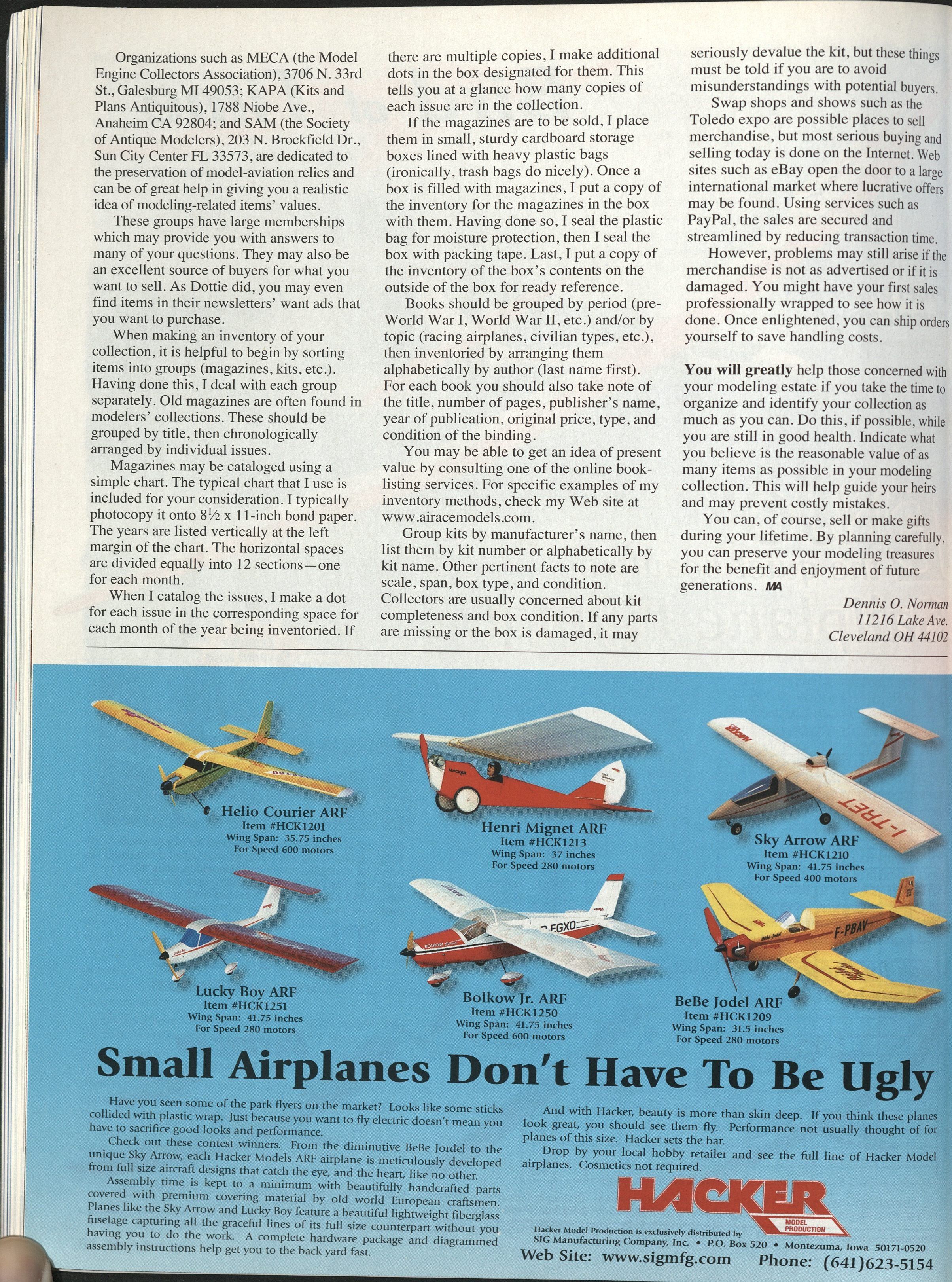
- Magazines may be cataloged using a simple chart: photocopy onto 8½ x 11-inch bond paper; list years vertically at the left margin; divide the horizontal space into 12 sections (one for each month).
- When cataloging the issues, make a dot for each issue in the corresponding month box. If there are multiple copies, make additional dots. This shows at a glance how many copies of each issue are in the collection.
- If the magazines are to be sold, place them in small, sturdy cardboard storage boxes lined with heavy plastic bags (trash bags work well). Once a box is filled, put a copy of the inventory for the magazines in the box with them, seal the plastic bag for moisture protection, then seal the box with packing tape. Put a copy of the inventory on the outside of the box for ready reference.
Books
- Group books by period (pre–World War I, World War II, etc.) and/or by topic (racing airplanes, civilian types, etc.).
- Inventory books by arranging them alphabetically by author (last name first).
- For each book note: title, number of pages, publisher, year of publication, original price, type, and condition of the binding.
- You may be able to get an idea of present value by consulting online book-listing services.
Kits
- Group kits by manufacturer's name, then list them by kit number or alphabetically by kit name.
- Note scale, span, box type, and condition.
- Collectors care about kit completeness and box condition. If parts are missing or the box is damaged, it may seriously devalue the kit. Be upfront with potential buyers.
For specific examples of my inventory methods, check my Web site at www.airacemodels.com.
Selling and shipping
Swap shops and shows such as the Toledo expo are possible places to sell merchandise, but most serious buying and selling today is done on the Internet. Web sites such as eBay open the door to a large international market where lucrative offers may be found. Using services such as PayPal, the sales are secured and streamlined by reducing transaction time.
However, problems may still arise if the merchandise is not as advertised or if it is damaged. You might have your first sales professionally wrapped to see how it is done. Once enlightened, you can ship orders yourself to save handling costs.
Final advice
You will greatly help those concerned with your modeling estate if you take the time to organize and identify your collection as much as you can. Do this, if possible, while you are still in good health. Indicate what you believe is the reasonable value of as many items as possible in your modeling collection. This will help guide your heirs and may prevent costly mistakes.
You can, of course, sell or make gifts during your lifetime. By planning carefully, you can preserve your modeling treasures for the benefit and enjoyment of future generations.
MA
Dennis O. Norman 11216 Lake Ave. Cleveland OH 44102
Transcribed from original scans by AI. Minor OCR errors may remain.

