
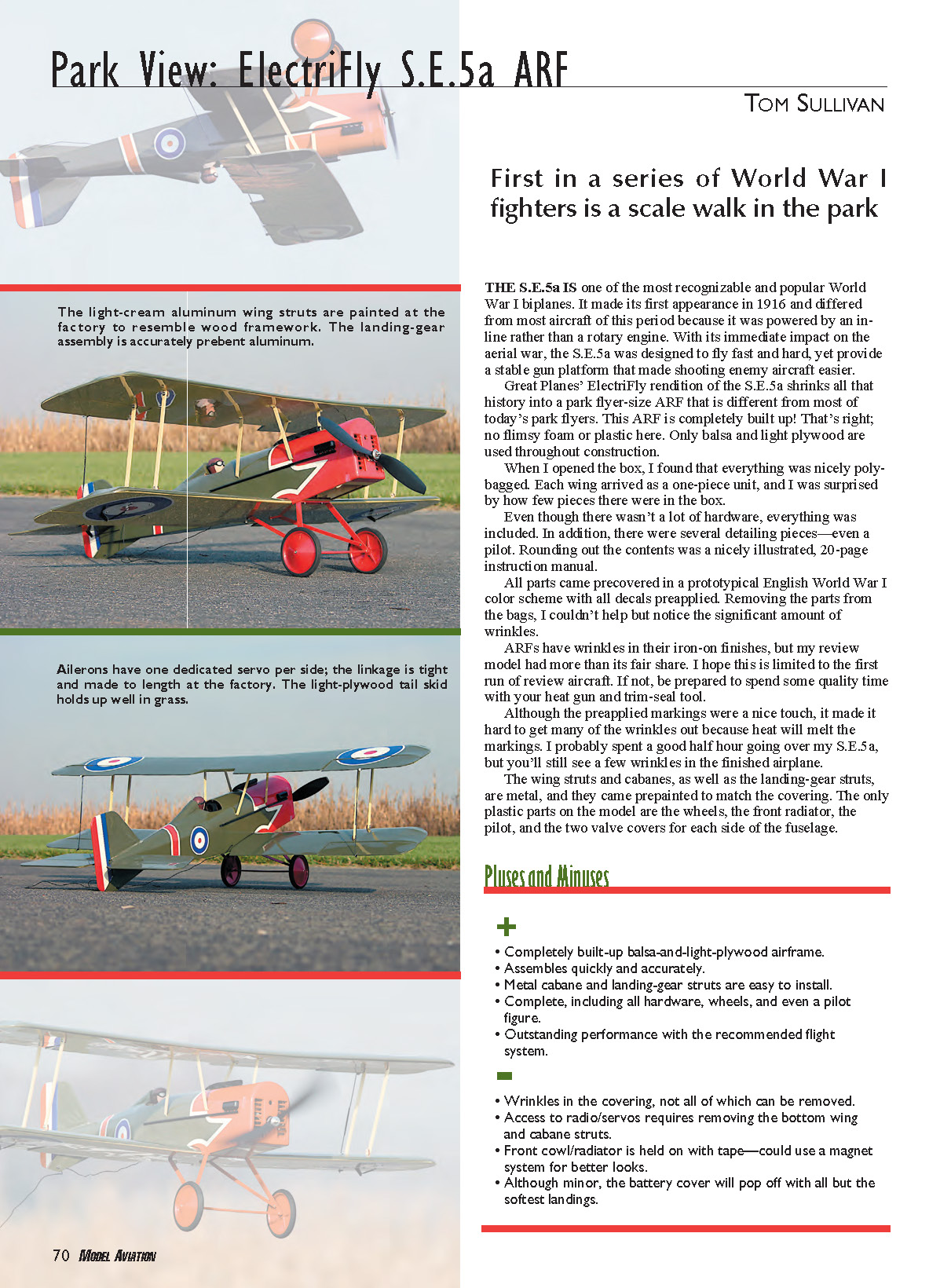
Park View: ElectriFly S.E.5a ARF
Tom Sullivan
First in a series of World War I fighters is a scale walk in the park
THE S.E.5a IS one of the most recognizable and popular World War I biplanes. It made its first appearance in 1916 and differed from most aircraft of this period because it was powered by an inline rather than a rotary engine. With its immediate impact on the aerial war, the S.E.5a was designed to fly fast and hard, yet provide a stable gun platform that made shooting enemy aircraft easier.
Great Planes' ElectriFly rendition of the S.E.5a shrinks all that history into a park flyer-size ARF that is different from most of today's park flyers. This ARF is completely built up! That's right; no flimsy foam or plastic here. Only balsa and light plywood are used throughout construction.
When I opened the box, I found that everything was nicely polybagged. Each wing arrived as a one-piece unit, and I was surprised by how few pieces there were in the box.
Even though there wasn't a lot of hardware, everything was included. In addition, there were several detailing pieces—even a pilot. Rounding out the contents was a nicely illustrated, 20-page instruction manual.
All parts came precovered in a prototypical English World War I color scheme with all decals preapplied. Removing the parts from the bags, I couldn't help but notice the significant amount of wrinkles.
ARFs have wrinkles in their iron-on finishes, but my review model had more than its fair share. I hope this is limited to the first run of review aircraft. If not, be prepared to spend some quality time with your heat gun and trim-seal tool.
Although the preapplied markings were a nice touch, it made it hard to get many of the wrinkles out because heat will melt the markings. I probably spent a good half hour going over my S.E.5a, but you'll still see a few wrinkles in the finished airplane.
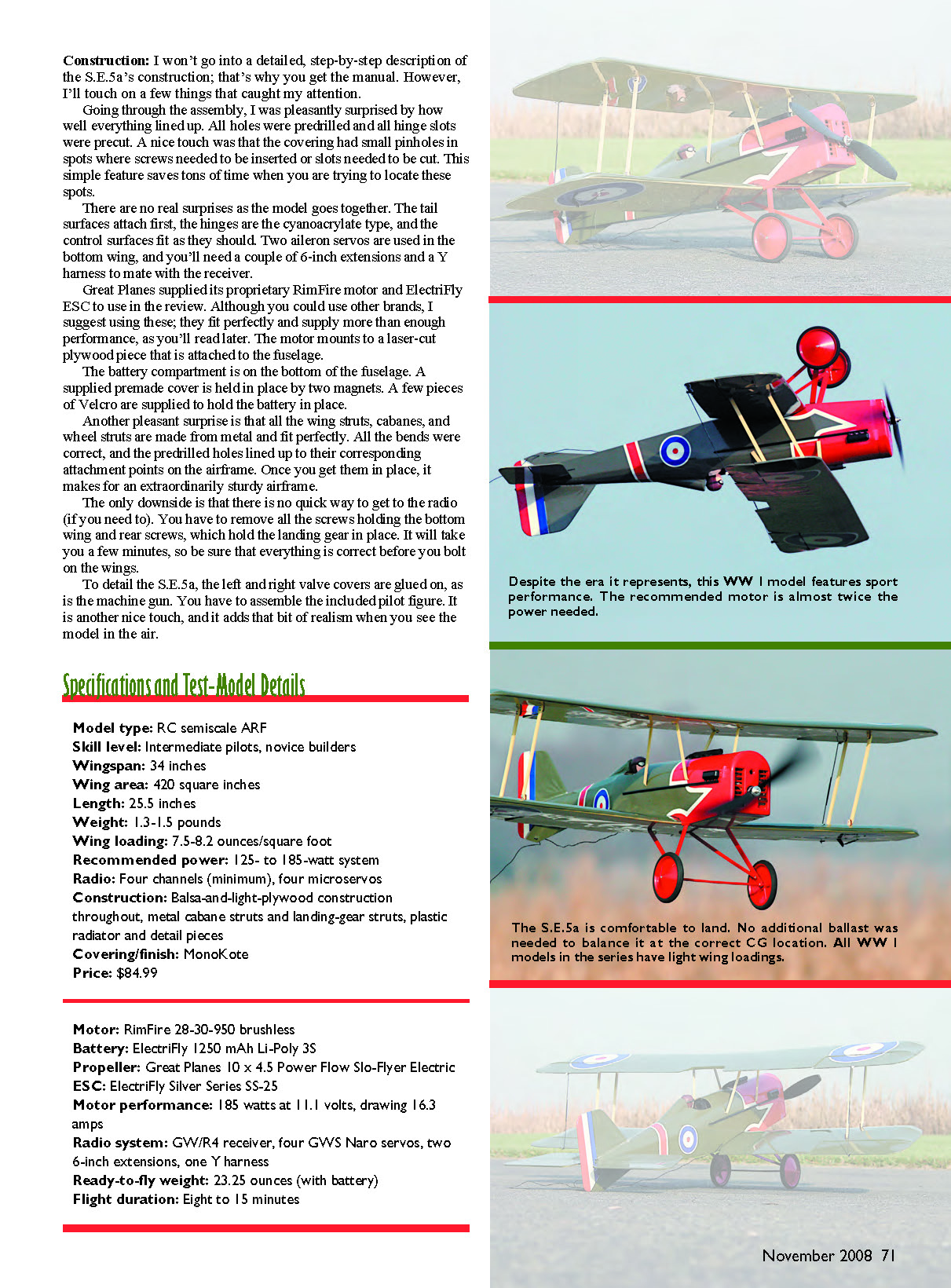
The wing struts and cabanes, as well as the landing-gear struts, are metal, and they came prepainted to match the covering. The only plastic parts on the model are the wheels, the front radiator, the pilot, and the two valve covers for each side of the fuselage.
Pluses and Minuses
- Completely built-up balsa-and-light-plywood airframe.
- Assembles quickly and accurately.
- Metal cabane and landing-gear struts are easy to install.
- Complete, including all hardware, wheels, and even a pilot figure.
- Outstanding performance with the recommended flight system.
- Wrinkles in the covering, not all of which can be removed.
- Access to radio/servos requires removing the bottom wing and cabane struts.
- Front cowl/radiator is held on with tape—could use a magnet system for better looks.
- Although minor, the battery cover will pop off with all but the softest landings.
Construction
I won't go into a detailed, step-by-step description of the S.E.5a's construction; that's why you get the manual. However, I'll touch on a few things that caught my attention.
Going through the assembly, I was pleasantly surprised by how well everything lined up. All holes were predrilled and all hinge slots were precut. A nice touch was that the covering had small pinholes in spots where screws needed to be inserted or slots needed to be cut. This simple feature saves tons of time when you are trying to locate these spots.
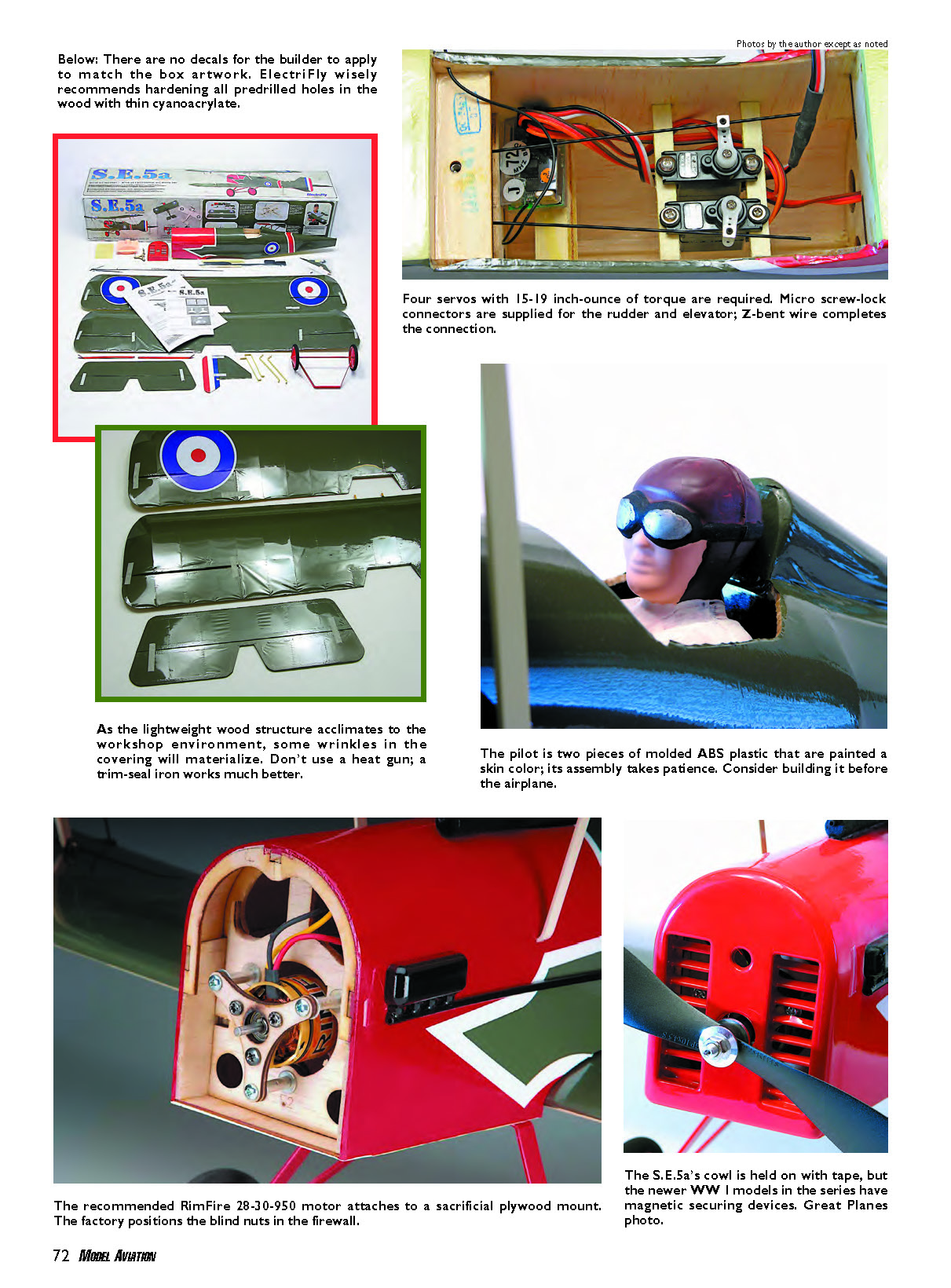
There are no real surprises as the model goes together. The tail surfaces attach first, the hinges are the cyanoacrylate type, and the control surfaces fit as they should. Two aileron servos are used in the bottom wing, and you'll need a couple of 6-inch extensions and a Y harness to mate with the receiver.
Great Planes supplied its proprietary RimFire motor and ElectriFly ESC to use in the review. Although you could use other brands, I suggest using these; they fit perfectly and supply more than enough performance, as you'll read later. The motor mounts to a laser-cut plywood piece that is attached to the fuselage.
The battery compartment is on the bottom of the fuselage. A supplied premade cover is held in place by two magnets. A few pieces of Velcro are supplied to hold the battery in place.
Another pleasant surprise is that all the wing struts, cabanes, and wheel struts are made from metal and fit perfectly. All the bends were correct, and the predrilled holes lined up to their corresponding attachment points on the airframe. Once you get them in place, it makes for an extraordinarily sturdy airframe.
The only downside is that there is no quick way to get to the radio (if you need to). You have to remove all the screws holding the bottom wing and rear screws, which hold the landing gear in place. It will take you a few minutes, so be sure that everything is correct before you bolt on the wings.
To detail the S.E.5a, the left and right valve covers are glued on, as is the machine gun. You have to assemble the included pilot figure. It is another nice touch, and it adds that bit of realism when you see the model in the air.
Specifications and Test-Model Details
- Model type: RC semiscale ARF
- Skill level: Intermediate pilots, novice builders
- Wingspan: 34 inches
- Wing area: 420 square inches
- Length: 25.5 inches
- Weight: 1.3-1.5 pounds
- Wing loading: 7.5-8.2 ounces/square foot
- Recommended power: 125- to 185-watt system
- Radio: Four channels (minimum), four microservos
- Construction: Balsa-and-light-plywood construction throughout, metal cabane struts and landing-gear struts, plastic radiator and detail pieces
- Covering/finish: MonoKote
- Price: $84.99
Motor: RimFire 28-30-950 brushless Battery: ElectriFly 1250 mAh Li-Poly 3S Propeller: Great Planes 10 x 4.5 Power Flow Slo-Flyer Electric ESC: ElectriFly Silver Series SS-25 Motor performance: 185 watts at 11.1 volts, drawing 16.3 amps Radio system: GWS R4 receiver, four GWS Nano servos, two 6-inch extensions, one Y harness Ready-to-fly weight: 23.25 ounces (with battery) Flight duration: Eight to 15 minutes
Below: There are no decals for the builder to apply to match the box artwork. ElectriFly wisely recommends hardening all predrilled holes in the wood with thin cyanoacrylate.
Four servos with 15-19 inch-ounce of torque are required. Micro screw-lock connectors are supplied for the rudder and elevator; Z-bent wire completes the connection.
As the lightweight wood structure acclimates to the workshop environment, some wrinkles in the covering will materialize. Don't use a heat gun; a trim-seal iron works much better.
The pilot is two pieces of molded ABS plastic that are painted a skin color; its assembly takes patience. Consider building it before the airplane.
The recommended RimFire 28-30-950 motor attaches to a sacrificial plywood mount. The factory positions the blind nuts in the firewall.
The S.E.5a's cowl is held on with tape, but the newer WW I models in the series have magnetic securing devices. Great Planes photo.
I wish I would have remembered to add a miniature scarf to my pilot before I did the in-flight shots. I added it after they were taken, and that little scarf fluttering in the breeze completes the model.
Spending a few hours each night, it took a couple evenings to complete the S.E.5a. Keep in mind that we have to pay extremely close attention to all the details in a review model, reading every word and making sure it all matches up. The average modeler could probably assemble this airplane in three to four hours.
Once completed, my review model came in at 23.25 ounces (just less than 1.5 pounds). This included the ElectriFly 1250 mAh Li-Poly battery. The CG was right on the money, so after a few detail photos were taken, it was off to the field.
Flying: Now for the fun part. With everything charged and ready to go, I taxied the S.E.5a a bit to get the hang of it. It isn't too bad on a paved surface. The grass was a bit too high to try, but I imagine the model would take off on relatively short grass.
The first takeoff was effortless. The S.E.5a lifted off in approximately 10 feet and climbed with authority. After a few trim passes, I found that it was comfortably cruising at a few clicks under half throttle. This power setting allowed me to fly the airplane in what I would refer to as a "scalelike" manner.
It could do loops and rolls, but only after a shallow dive. However, by applying a bit more power, I could wring it out. The S.E.5a will do respectable point rolls and inverted flight. It snaps and spins nicely. It also performs hammerheads and stall turns beautifully.
Being careful with my first landing, I brought the model in smoothly. But I learned on subsequent landings that it is easy for the battery cover to pop off with even a gentle bounce. Stick a small piece of tape on the back of the hatch to solve this problem.
I flew the S.E.5a several other times that day, exploring different aspects of its capabilities. It averaged an eight-minute flight time at high throttle settings. It could easily attain 13- to 15-minute flights if I managed the throttle.
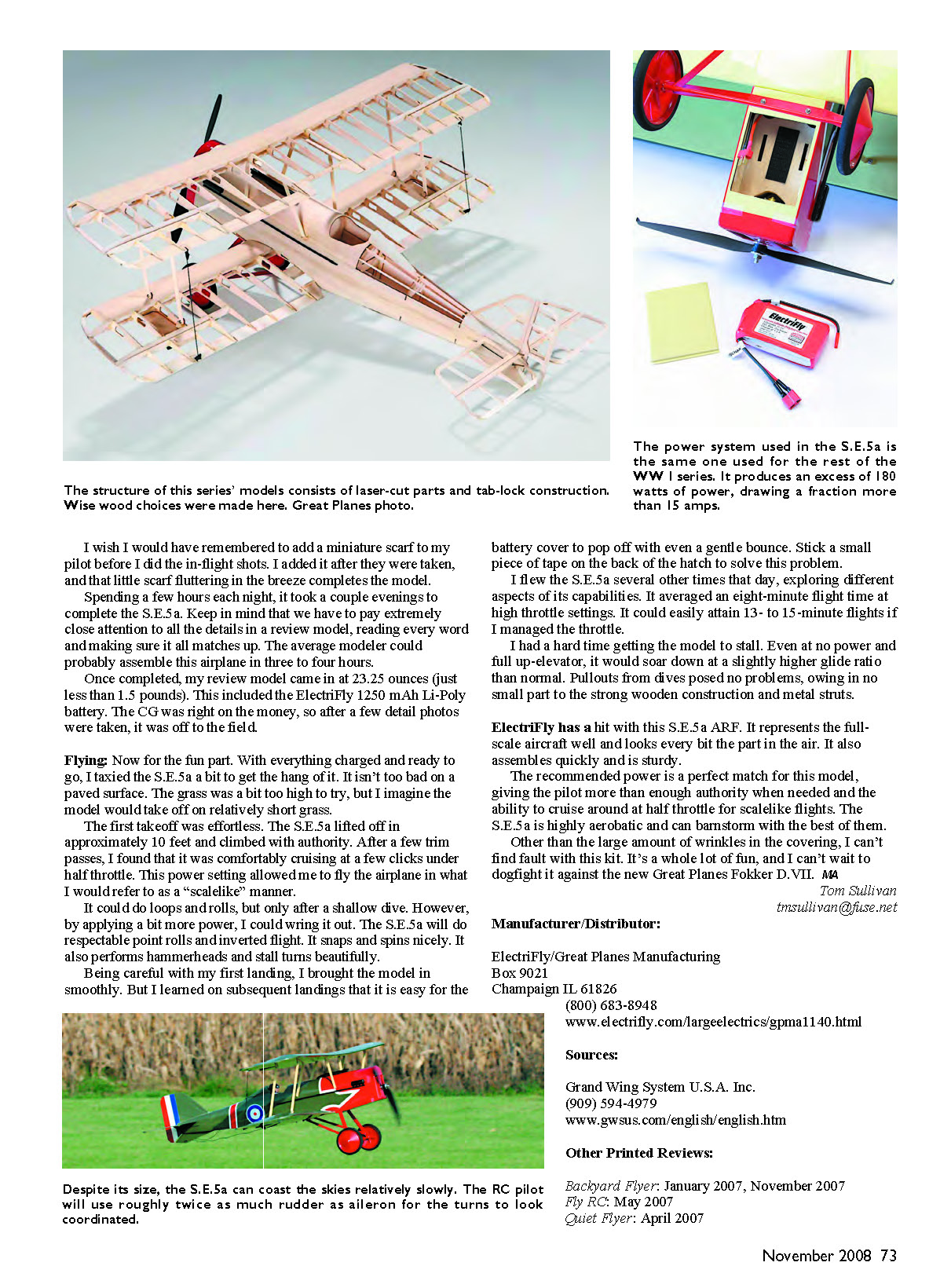
I had a hard time getting the model to stall. Even at no power and full up-elevator, it would soar down at a slightly higher glide ratio than normal. Pullouts from dives posed no problems, owing in no small part to the strong wooden construction and metal struts.
ElectriFly has a hit with this S.E.5a ARF. It represents the full-scale aircraft well and looks every bit the part in the air. It also assembles quickly and is sturdy.
The recommended power is a perfect match for this model, giving the pilot more than enough authority when needed and the ability to cruise around at half throttle for scalelike flights. The S.E.5a is highly aerobatic and can barnstorm with the best of them.
Other than the large amount of wrinkles in the covering, I can't find fault with this kit. It's a whole lot of fun, and I can't wait to dogfight it against the new Great Planes Fokker D.VII.
Tom Sullivan [email protected]
Manufacturer/Distributor:
ElectriFly/Great Planes Manufacturing Box 9021 Champaign IL 61826 (800) 683-8948 www.electrifly.com/largeelectrics/gpma1140.html
Sources:
Grand Wing System U.S.A. Inc. (909) 594-4979 www.gwsus.com/english/english.htm
Other Printed Reviews:
Backyard Flyer: January 2007, November 2007 Fly RC: May 2007 Quiet Flyer: April 2007
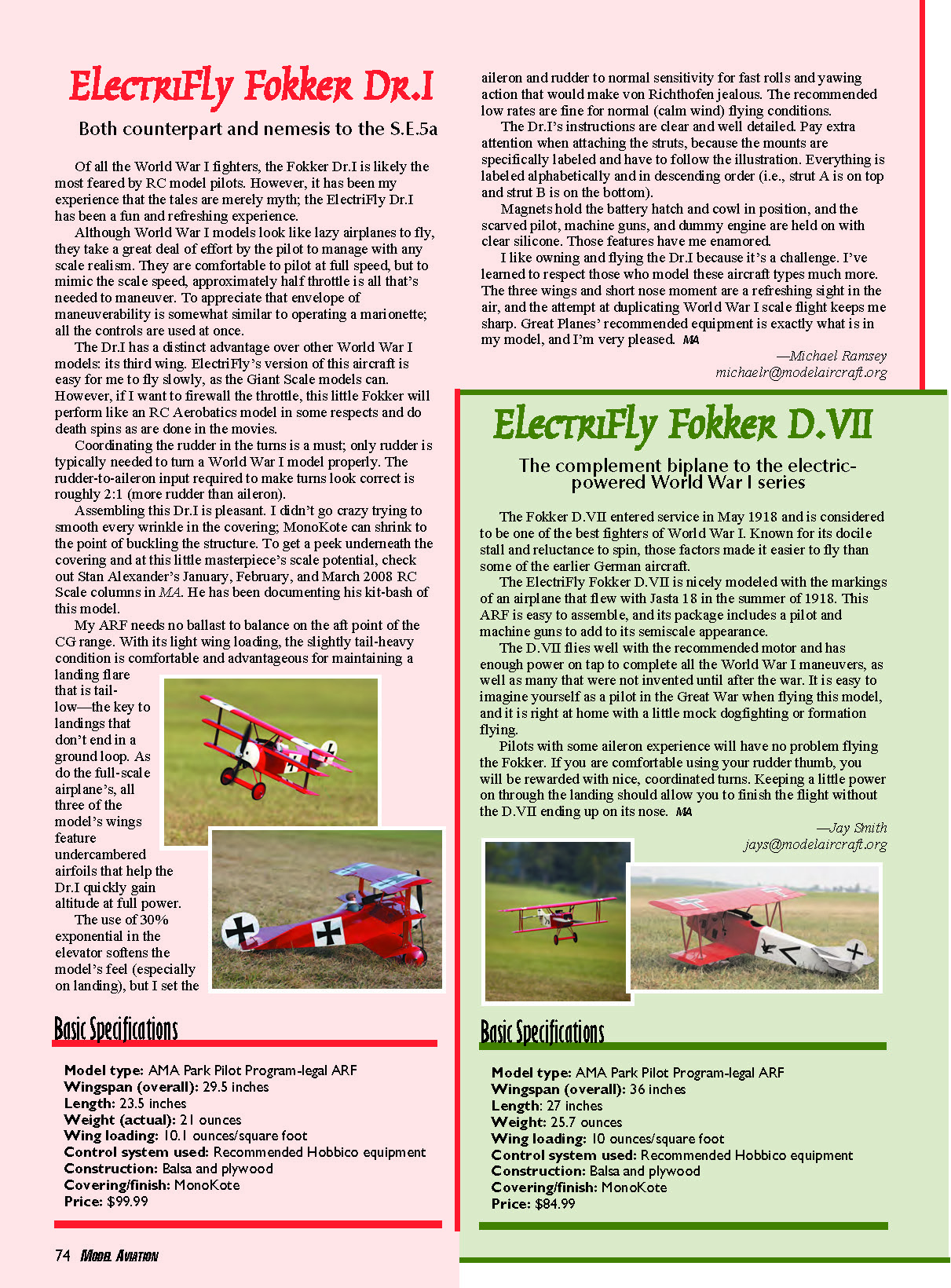
Basic Specifications
Model type: AMA Park Pilot Program-legal ARF
Wingspan (overall): 29.5 inches
Length: 23.5 inches
Weight (actual): 21 ounces
Wing loading: 10.1 ounces/square foot
Control system used: Recommended Hobbico equipment
Construction: Balsa and plywood
Covering/finish: MonoKote
Price: $99.99
Transcribed from original scans by AI. Minor OCR errors may remain.

