
Park View: Green RC Models Colorful Butterfly ARF
MICHAEL RAMSEY
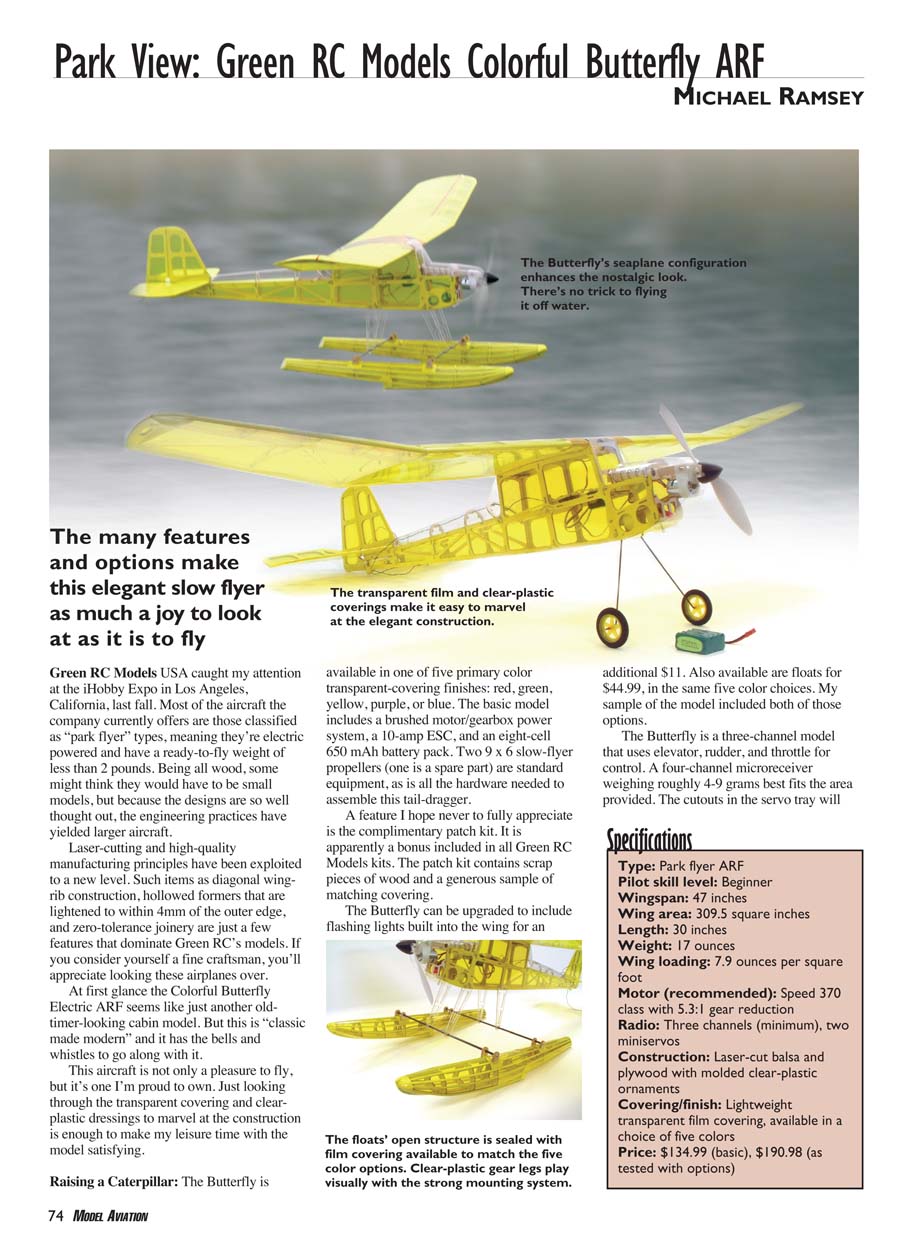
The many features and options make this elegant slow flyer as much a joy to look at as it is to fly.
Green RC Models USA caught my attention at the iHobby Expo in Los Angeles last fall. Most of the aircraft the company currently offers are park flyers—electric powered and with a ready-to-fly weight of less than 2 pounds. Although the models are all wood, thoughtful design and solid engineering yield aircraft larger than one might expect. Laser-cutting and high-quality manufacturing are used to a new level. Features such as diagonal wing-rib construction, hollowed formers lightened to within 4 mm of the outer edge, and zero-tolerance joinery dominate Green RC’s models. If you consider yourself a fine craftsman, you'll appreciate looking these airplanes over.
At first glance the Colorful Butterfly Electric ARF seems like just another old-timer-looking cabin model. But this is classic made modern, with the bells and whistles to match. The airplane is a pleasure to fly and a pleasure to own. Just looking through the transparent covering and clear-plastic dressings to marvel at the construction makes my leisure time with the model satisfying.
Raising a Caterpillar
The Butterfly is available in five transparent-covering colors: red, green, yellow, purple, or blue. The basic model includes a brushed motor/gearbox power system, a 10-amp ESC, and an eight-cell 650 mAh battery pack. Two 9 x 6 slow-flyer propellers (one spare) and all hardware needed to assemble this tail-dragger are standard equipment.
A complimentary patch kit is included with every Green RC Models kit; it contains scrap wood pieces and a generous sample of matching covering.
Optional upgrades include flashing lights built into the wing for an additional $11, and floats for $44.99 in the same five colors. My sample included both options.
The Butterfly is a three-channel model using elevator, rudder, and throttle. A four-channel micro receiver (weighing roughly 4–9 grams) best fits the provided bay. The cutouts in the servo tray will accept two mini servos, and the wing cutouts can accommodate almost any microservo that has at least a 10-ounce torque rating. If you don't use a four-channel receiver, you'll need a Y-harness to split a channel so the wing lights can be powered.
The box includes the separately wrapped motor/gearbox, ESC, and battery. Parts are supplied in zip-lock-sealed bags: the polyhedral wings are in two pieces joined by a carbon-fiber spar; the fuselage is in another bag with the clear-plastic turtledeck and canopy temporarily taped in place; the tail surfaces are packaged together and factory-finished with top hinging integral with the covering. The landing gear is 2 mm hardened wire with spoke wheels dyed to match the covering.
The printed materials are minimal but clear. The box contains full-color information and short five-step instructions—proof of how easy this model is to assemble. If this is your first ARF, you shouldn't experience much trouble putting the airplane together, aside from some fumbling with tiny screws.
There is no gluing involved with the Butterfly; it can be disassembled for shipping as easily as it can be readied for flight. I was happy with the alignment of parts and found no need for custom fitting or tweaking.
Pluses and Minuses
- Beautiful construction and engineering
- Modular components for easy assembly and storage
- High-quality materials and excellent craftsmanship
- Available in different colors with optional strobe lights and float kit
- Simple to fly
- Readily available replacement parts and upgrades (can be ordered on the website)
- Connectors between battery and ESC are reversed in some kits (newer kits have been revised)
- The included ESC may not last long
Specifications
- Type: Park flyer ARF
- Pilot skill level: Beginner
- Wingspan: 47 inches
- Wing area: 309.5 square inches
- Length: 30 inches
- Weight: 17 ounces
- Wing loading: 7.9 ounces per square foot
- Motor (recommended): Speed 370 class with 5.3:1 gear reduction
- Radio: Three channels (minimum), two mini servos
- Construction: Laser-cut balsa and plywood with molded clear-plastic ornaments
- Covering/finish: Lightweight transparent film covering, available in five colors
- Price: $134.99 (basic), $190.98 (as tested with options)
Assembly and Construction
The plywood-and-balsa fuselage is light and strong. Formers and sidepieces key together and join so tightly that only a small amount of adhesive is needed, contributing to the model’s light weight. I found no instances of poor craftsmanship—no drips of glue or gaps between parts.
The framework was free of warps and twists. Only the stabilizer/elevator had a minor twist that likely resulted from my handling while shrinking covering wrinkles; a slight twist-back and heat-gun touch-up made the surfaces true again.
The clear-plastic parts for the aft turtledeck, forward canopy area, and cowlings are lightweight and already trimmed to fit. They mount with 1 mm screws using the pinpoint laser-cut holes as guides. The plastic is soft enough that no drilling is necessary—just press the screws through the plastic and drive them into the wood. There are only eight screws in total because the canopy and cowling share two mounting points.
I used all supplied hardware, including nylon micro control horns that fit neatly into predrilled hard points. The pushrods come with threaded clevises, making radio setup and adjustment easy. The shock-absorbing stick motor mount is preset to the exact length needed for the offset motor/gearbox included, and the ESC is already hardwired to the motor.
I did need to change the plugs between the ESC and the included eight-cell battery because the kit's plug polarity was opposite to my charging setup. Typically the male red JST connector is on the battery, but this kit had the female plug on the battery; I swapped connectors rather than modify my charge equipment.
The included 10-amp ESC is a BEC type with a cutoff suitable for Ni-Cd and NiMH batteries. If you choose lighter Li-Poly batteries, keep the ESC limitations in mind and consider adding ballast in the nose to achieve a safe center of gravity.
On initial flights the supplied motor system felt underpowered. I swapped the ESC for a fresh unit from my spare parts box, which noticeably improved performance. I trust Green RC Models would have replaced the ESC had I reported the issue.
Expect to spend at least an hour and a half assembling the Butterfly—a little longer if you install the floats.
Metamorphosis
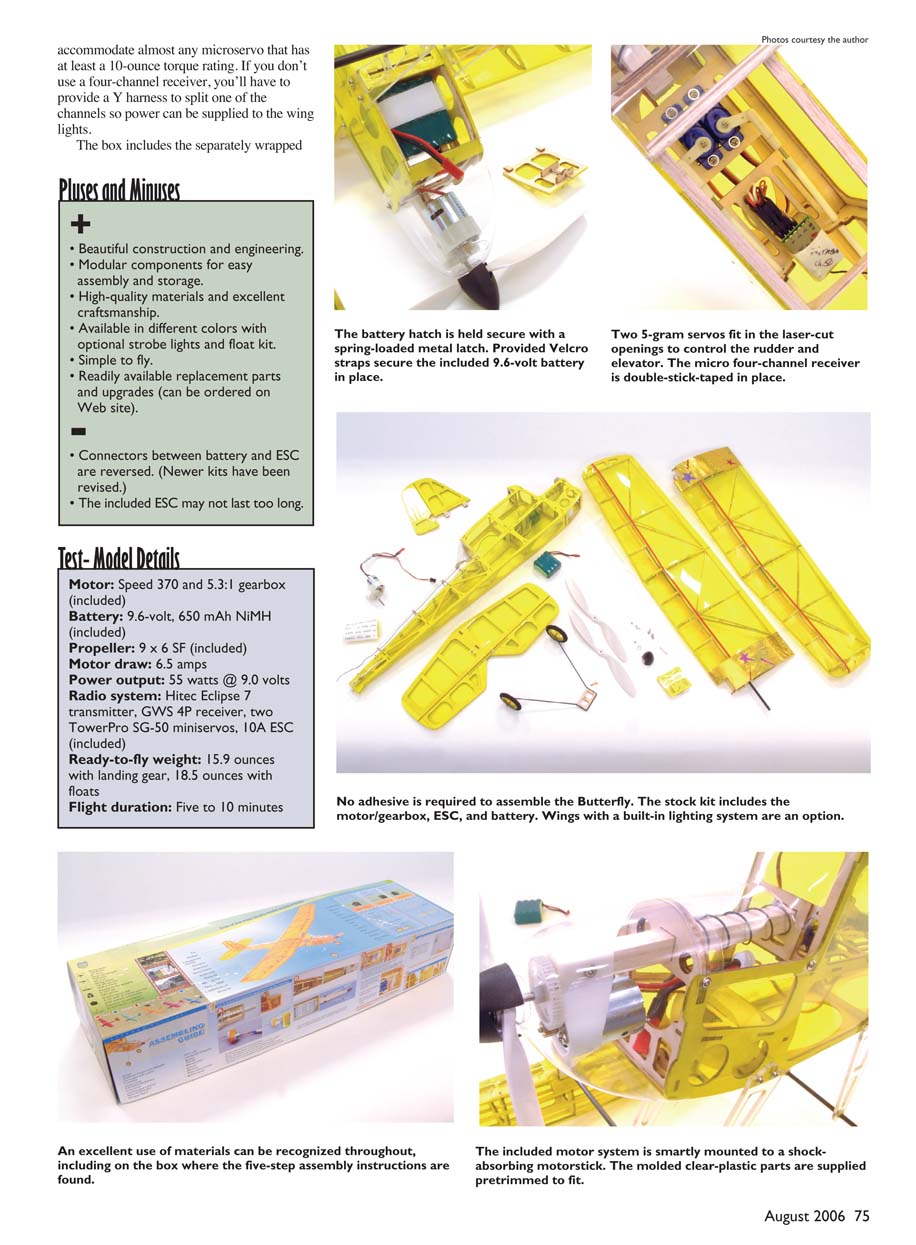
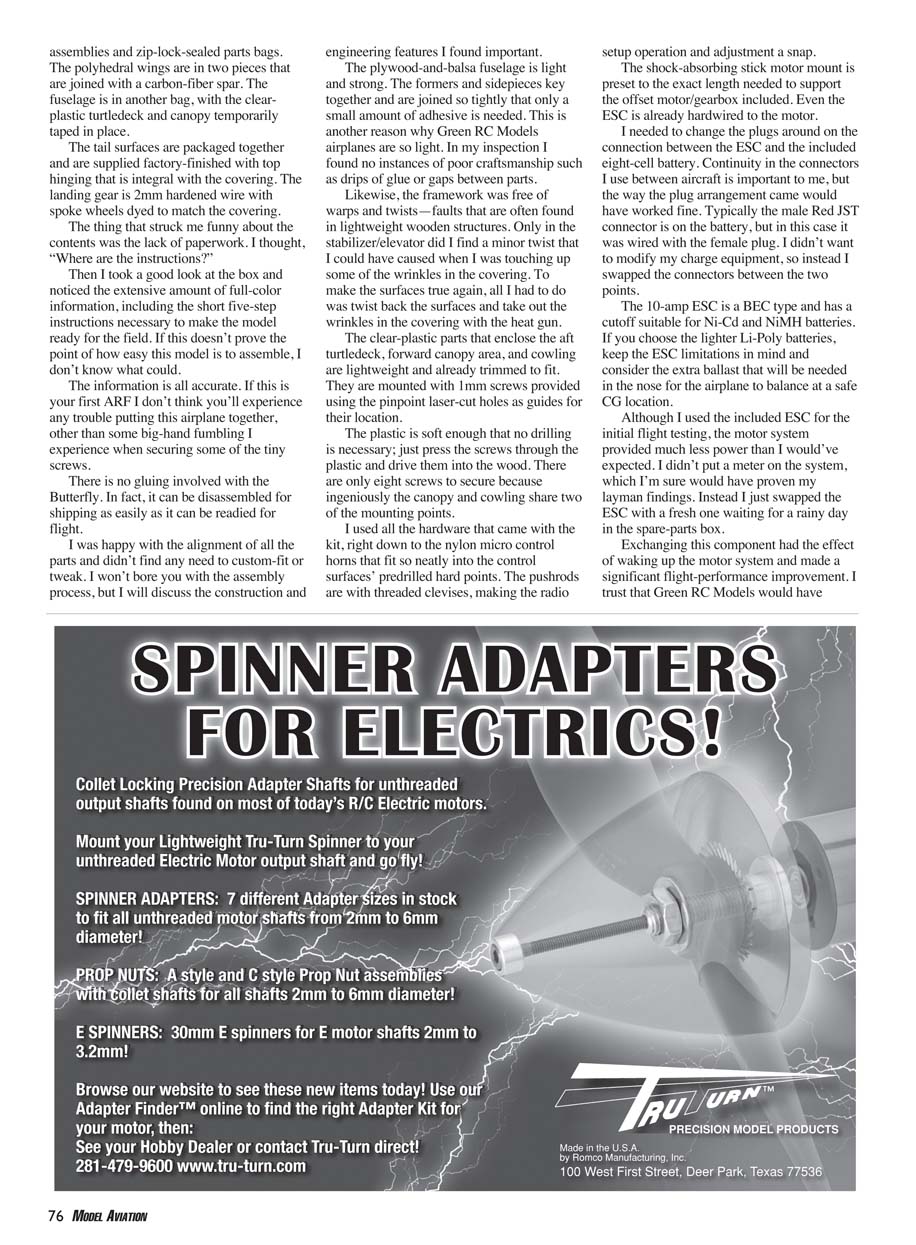
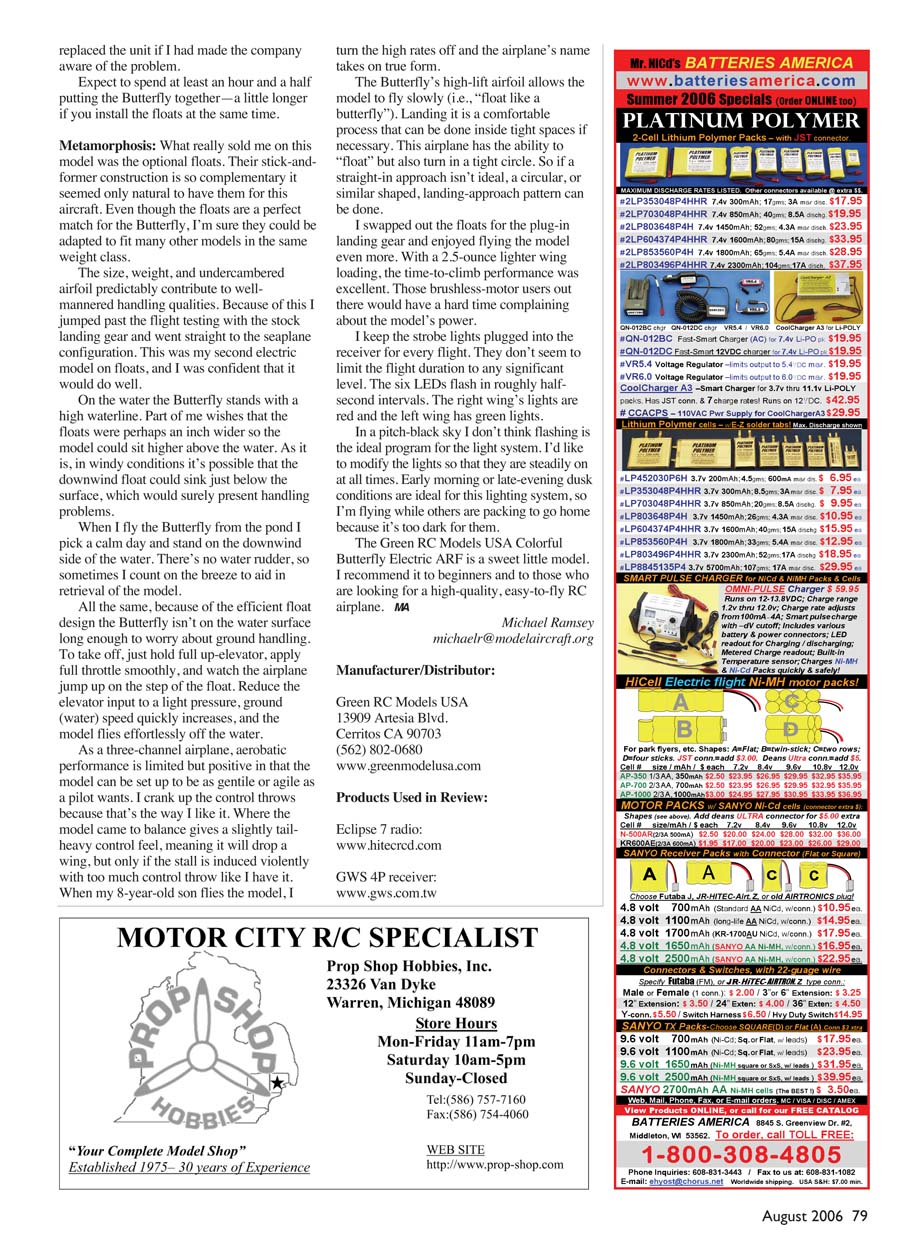
What really sold me on the model were the optional floats. Their stick-and-former construction complements the aircraft, and although the floats are a perfect match for the Butterfly, they could likely be adapted to other models in the same weight class.
The size, weight, and undercambered airfoil contribute to well-mannered handling. I skipped initial flight testing with the stock landing gear and went straight to the seaplane configuration. On the water the Butterfly sits with a relatively high waterline; I wished the floats were an inch wider so the model rode higher above the water. In windy conditions the downwind float can tuck below the surface, which can present handling problems.
Because there is no water rudder, I typically pick a calm day and stand on the downwind side of the pond. Still, the efficient float design means the airplane is not on the water long. To take off: hold full up elevator, apply full throttle smoothly, let the airplane jump onto the float step, then reduce elevator to light pressure as ground speed increases—she’ll fly off the water effortlessly.
As a three-channel airplane, advanced aerobatics are limited, but the model can be set up to be as gentle or as agile as a pilot wants. With my setup the Butterfly felt slightly tail-heavy and would drop a wing only if a violent stall were induced. For less experienced pilots I dial back the rates and the airplane becomes very docile—true to its name, it can "float like a butterfly."
The high-lift airfoil lets the model fly slowly and land in tight spaces. The airplane can float and also turn in a tight circle, which is useful when a straight-in approach isn't ideal.
Swapping the floats for the plug-in landing gear reduced wing loading by about 2.5 ounces and noticeably improved climb performance. Brushless-motor users would be very satisfied with the model's power potential.
I keep the strobe lights plugged in for every flight; they don't significantly limit duration. Six LEDs flash in roughly half-second intervals—red on the right wing, green on the left. In a pitch-black sky flashing isn't ideal; I would prefer a steady-on mode for night flying. Early-morning or late-evening dusk conditions are ideal for the current lighting system.
The Green RC Models USA Colorful Butterfly Electric ARF is a sweet little model. I recommend it to beginners and anyone looking for a high-quality, easy-to-fly RC airplane.
Michael Ramsey [email protected]
Manufacturer/Distributor
Green RC Models USA 13909 Artesia Blvd. Cerritos, CA 90703 (562) 802-0680 www.greenmodelusa.com
Products Used in Review
- Eclipse 7 radio: www.hitecrc.com
- GWS 4P receiver: www.gws.com.tw
Transcribed from original scans by AI. Minor OCR errors may remain.

