
Park View: Maxford USA Albatros D.III and Hughes H-1 ARFs
By Jay Smith and Michael Ramsey
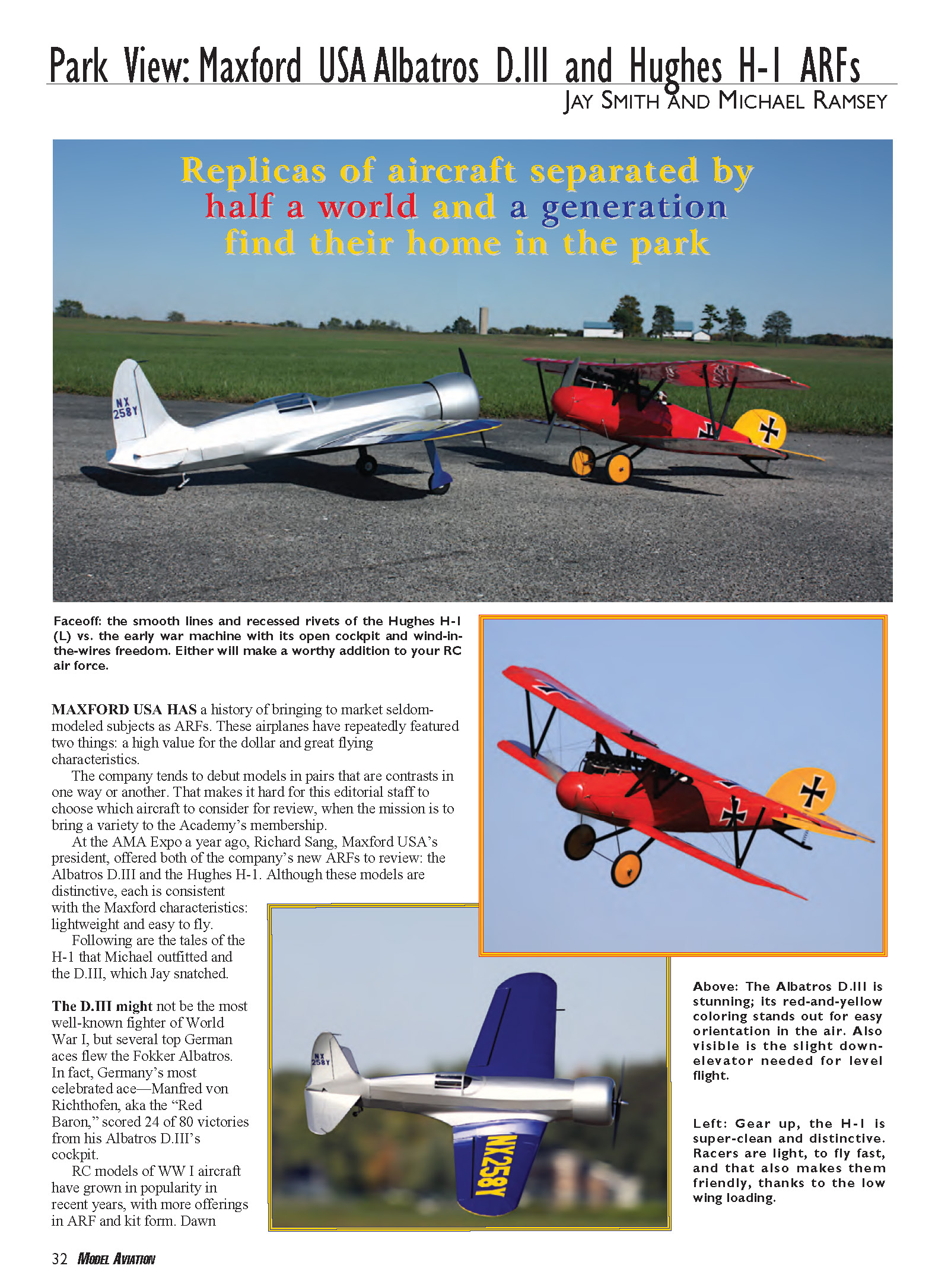
MAXFORD USA has a history of bringing to market seldom-modeled subjects as ARFs. These airplanes have repeatedly featured two things: a high value for the dollar and great flying characteristics.
The company tends to debut models in pairs that contrast in one way or another. That makes it hard for this editorial staff to choose which aircraft to consider for review, when the mission is to bring a variety to the Academy’s membership.
At the AMA Expo a year ago, Richard Sang, Maxford USA’s president, offered both of the company’s new ARFs to review: the Albatros D.III and the Hughes H-1. Although these models are distinctive, each is consistent with Maxford characteristics: lightweight and easy to fly.
Following are the tales of the H-1 that Michael outfitted and the D.III, which Jay snatched.
Albatros D.III (Jay Smith)
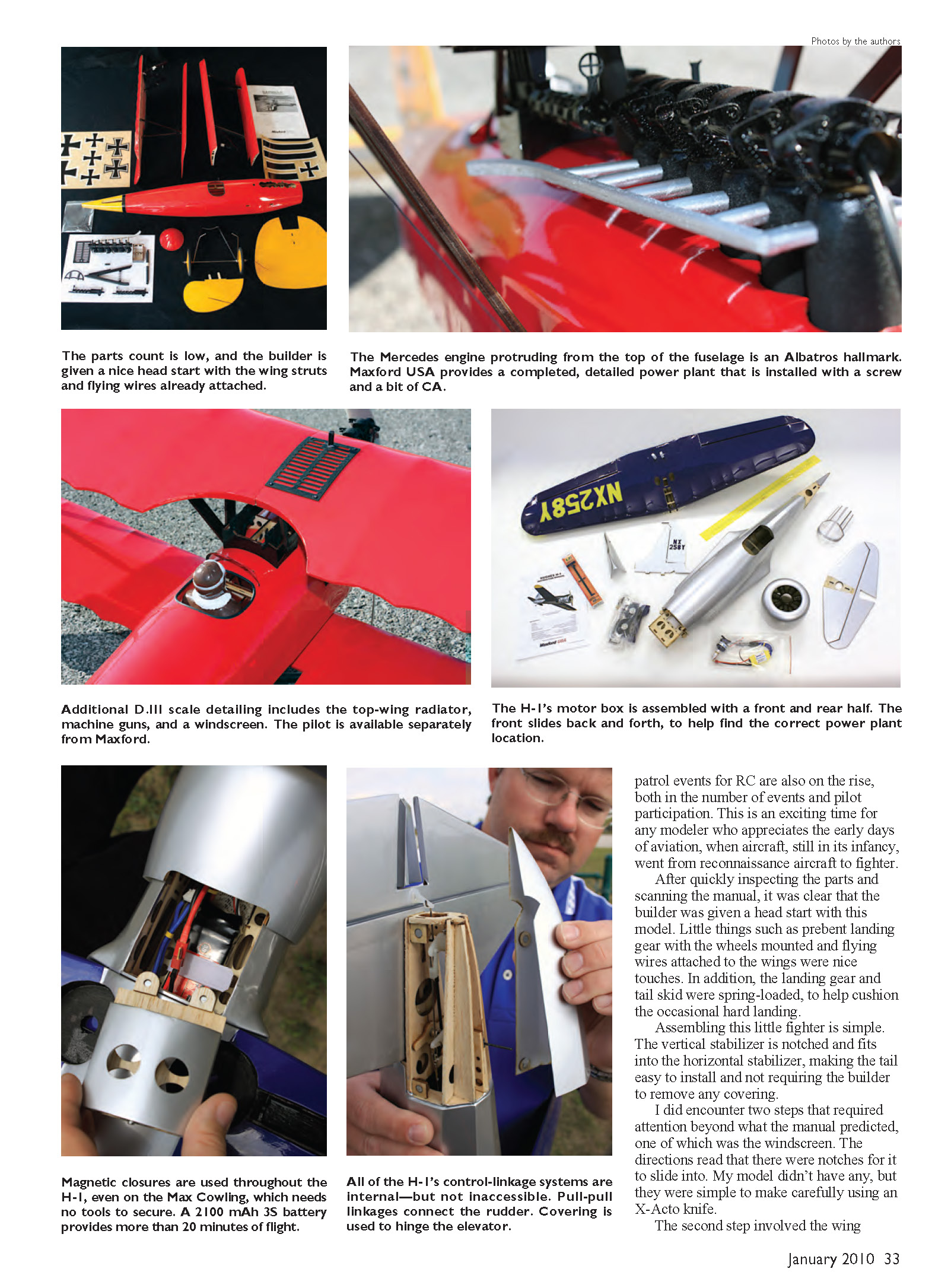
The D.III might not be the most well-known fighter of World War I, but several top German aces flew the Fokker Albatros. In fact, Germany’s most celebrated ace—Manfred von Richthofen, aka the “Red Baron”—scored 24 of his 80 victories from his Albatros D.III’s cockpit.
RC models of WW I aircraft have grown in popularity in recent years, with more offerings in ARF and kit form. Dawn-patrol events for RC are also on the rise, both in the number of events and pilot participation. This is an exciting time for any modeler who appreciates the early days of aviation, when aircraft—still in their infancy—went from reconnaissance ships to fighters.
After quickly inspecting the parts and scanning the manual, it was clear that the builder was given a head start with this model. Little things such as prebent landing gear with the wheels mounted and flying wires attached to the wings were nice touches. In addition, the landing gear and tail skid were spring-loaded to help cushion the occasional hard landing.
Assembling this little fighter is simple. The vertical stabilizer is notched and fits into the horizontal stabilizer, making the tail easy to install and not requiring the builder to remove any covering. I did encounter two steps that required attention beyond what the manual predicted.
The first was the windscreen. The directions read that there were notches for it to slide into; my model didn’t have any, but they were simple to make carefully using an X-Acto knife.
The second step involved the wing struts, which slide into the side of the fuselage. Once I slid them into place, there was no mention of how to attach them so they could not slide out or come loose in flight. I used a bit of thin CA to lock the struts in place.
The completed Albatros looks great and benefits from the detailed engine, radiator, and scale spinner. A sheeted fuselage would have added even more to the scale presentation; however, some liberties had to be taken to keep it light on the wing.
The D.III was a cinch to balance using the three-cell, 1300 mAh battery. The battery hatch on the bottom of the fuselage is easily accessible, which is thoughtful.
The recommended motor produced plenty of power with the recommended APC 9 x 6SF propeller. The model averaged eight-minute flights, and most flying was kept at half throttle, outside of some scale loops and wingovers. I found the roll rate to be slow with the low rates, but it is fine with more throw.
This airplane does a good job of handling rudder use. It's fully capable of turning with rudder only. Coordinated turns are also simple to do, but a 180° flat turn can be accomplished by coordinating slight opposite aileron and up-elevator with the rudder—great for getting the guns lined up on your simulated opponent.
Takeoffs and landings are easy from grass. With the help of the undercambered wings, full power makes the Albatros climb like a homesick angel. Even when trimmed for level flight, it will climb if you pour the coals to it.
On landing, it is recommended to keep slight power to allow air to flow over the control surfaces. Once on the ground, a bit of up-elevator helps keep the tail skid on the ground and prevents a possible nose-over. Fortunately, ending on either the wheels or the nose is considered a scale landing.
The review kit was an early version, and some improvements have been made to further enhance its scale appearance. Wing struts are now slightly narrower. The tail skid was made to incorporate a solid dorsal fin, and the spinner is now made from thicker plastic to enhance durability.
Hughes H-1 (Michael Ramsey)
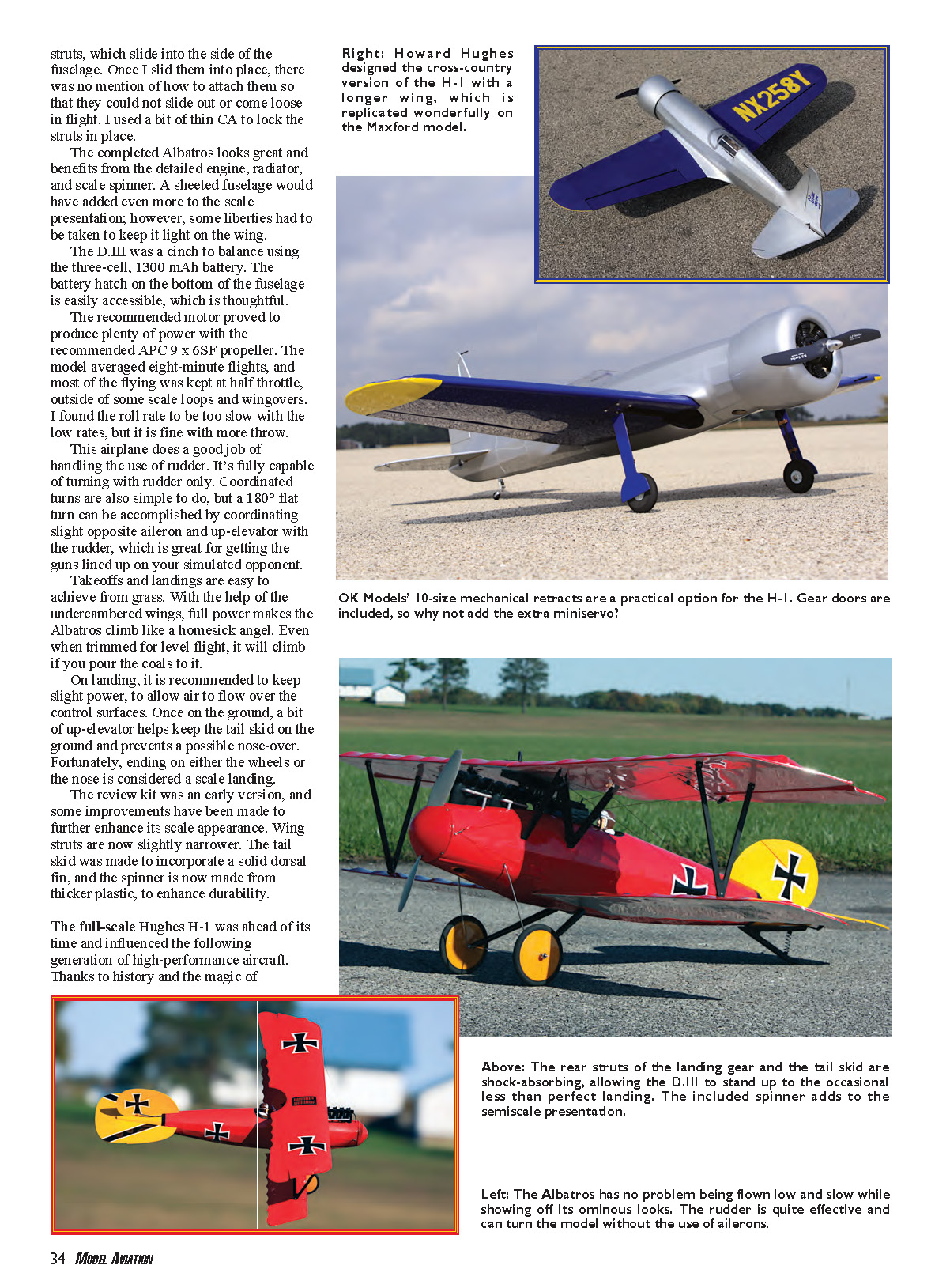
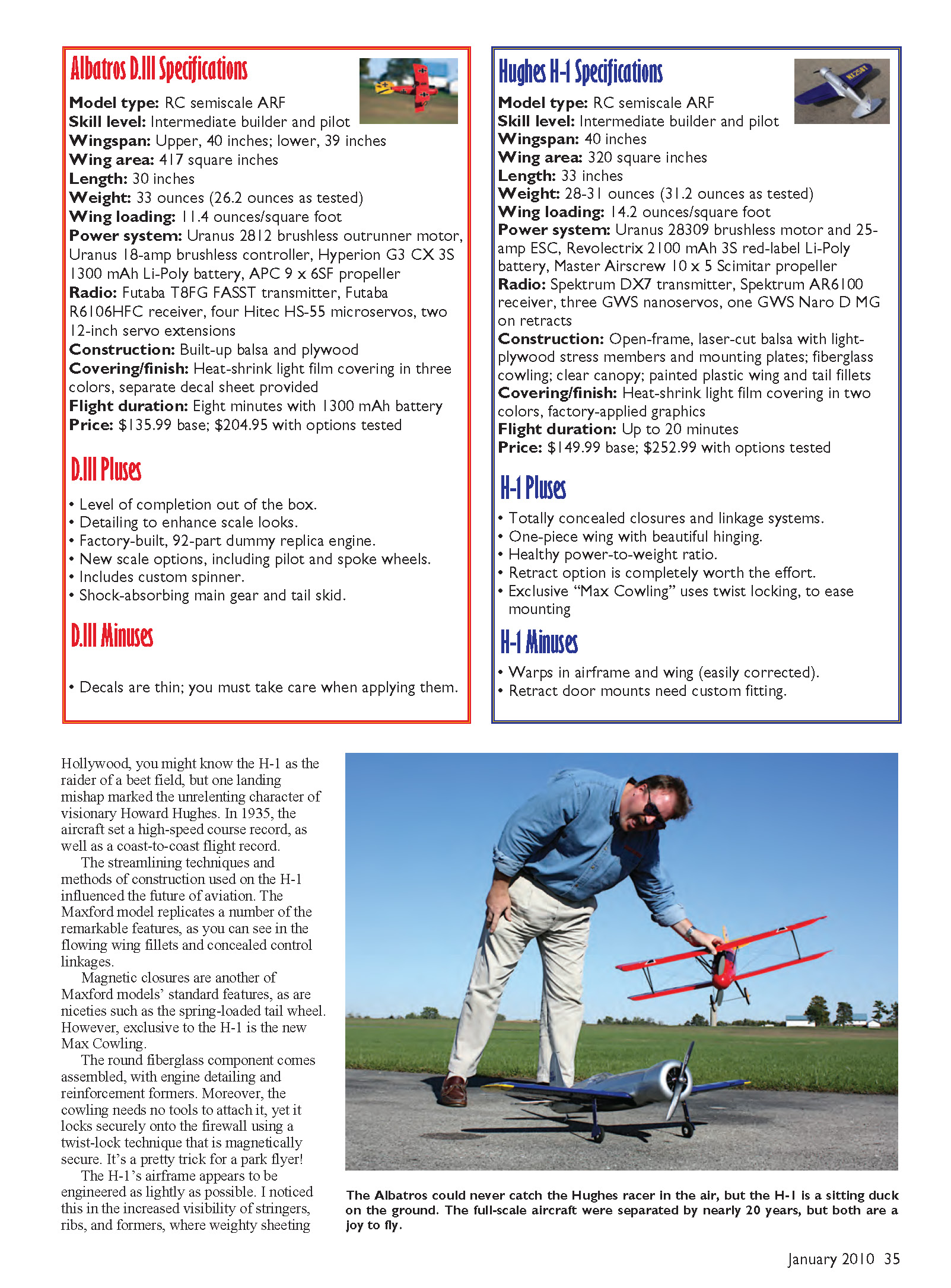
The full-scale Hughes H-1 was ahead of its time and influenced the following generation of high-performance aircraft. Thanks to history and the magic of Hollywood, you might know the H-1 as the raider of a beet field, but one landing mishap marked the unrelenting character of visionary Howard Hughes. In 1935, the aircraft set a high-speed course record, as well as a coast-to-coast flight record.
The streamlining techniques and methods of construction used on the H-1 influenced the future of aviation. The Maxford model replicates a number of the remarkable features, as seen in the flowing wing fillets and concealed control linkages.
Magnetic closures are another of Maxford’s standard features, as are niceties such as the spring-loaded tail wheel. However, exclusive to the H-1 is the new Max Cowling.
The round fiberglass component comes assembled, with engine detailing and reinforcement formers. Moreover, the cowling needs no tools to attach, yet it locks securely onto the firewall using a twist-lock technique that is magnetically secured. It’s a neat trick for a park flyer.
The H-1’s airframe appears to be engineered as lightly as possible. I noticed this in the increased visibility of stringers, ribs, and formers, where weighty sheeting would normally hide them. These and other tactics keep weight down.
The motor box is two pieces and slides in and out for easy balancing and attachment. Pull-pull linkages connect the rudder, and the elevator and aileron linkages are internal, eliminating exposed pushrods. The wing is a one-piece design, with the hinge made from covering material rather than the usual hinges that would otherwise be employed. Sheeting is minimal and consists of 1 mm balsa wood.
The airplane’s hardpoints and stress areas are constructed with light-plywood framework that has been reduced in materials to the point of fanaticism. Solid-wood blocks are used as seldom as possible; they appear only at the cowl-mount locations.
I noted that an adequate amount of adhesive was used throughout the model, but I applied a spot of thin CA wherever a screw went to give the hardware more bite.
Inspecting the main assemblies turned up a few issues that were painless to correct later with average hobby utilities. Because the framework is so light, it’s normal for any covering to stretch unequally or shrink to the structure. I noticed this on the fuselage when the stabilizer was mounted and shown not to align with the wing. I also detected a twist in the wing on the starboard panel where wash-in was observed.
I shimmed the stabilizer to align it with the wing, since twisting the fuselage didn’t appear to be the best option. Twisting and reheating the covering is the only option on the wing unless you are happy with an amateurish fix of merely trimming the ailerons.
When both wings are correct with the apparent designed amount of washout, the H-1’s slow-speed characteristics are reliable and comfortable. Likewise, this easy correction will result in minimal, if any, aileron-trim requirement.
An addendum has been released for the concealed tail linkage that conforms to the new hardware supplied in the kit. The current linkage system seems solid—good for someone who appreciates controls that have no slop whatsoever. The pull-pull rudder is fiddly for big hands to complete, and the elevator pushrod rubs on the rudder tiller rod, but it’s 99% perfect for the intended job.
If you choose the retractable option, don’t hurt yourself by overanalyzing the system. The perversely detailed instructions set forth wise steps, but I do have a couple of tips to share. Because the pushrods have Z-bends on both ends, attach them to the servo wheel first and then feed the three-piece assembly in as one unit.
Double-check the axle-bend location on the strut legs. On my model, the recommended length was short by approximately 3/16 inch. The pushrod lengths can be adjusted with V-bends near the servo.
Fiddling with the travel volume will get the gear locked up and down quickly without latent buzz that could overload the 3-amp BEC on the Maxford speed-control unit. The gear-door hardware will clear the sealed strut recesses when the brackets face each other; a short-handled driver helps.
The recommended package is good for sport-flying. Because the firewall can be custom-positioned, you can upgrade the power system with minimal hassle. Plus there’s room to move a 2100 mAh 3S Li-Poly battery and properly set the CG. The H-1 can be a sport flier or the wicked-fast racer that Mr. Hughes intended it to be.
Flight-testing has shown that the Maxford power system barely excites a good Li-Poly battery, but the trade is a long flight time with a friendly model. There’s enough power to climb the H-1 at a 45° angle almost indefinitely from takeoff, but a vertical climb can’t be held for long. This ARF flies gracefully when the exponential settings are dialed in to your taste.
The H-1’s stall habits are predictable, and the recommended CG is slightly positive. This airplane is lightly loaded enough to handle a slightly more aft CG if a neutral model is desired, but you will have to manage the elevator on landing. The tendency to pitch up in that condition can reveal itself and cause a premature stall.
Normal aerobatics are possible with the H-1, but it lacks rudder authority because of its top-end location. Enough rudder is there for yaw stability and corrections, but be sure to lead the desired direction early for stall turns; otherwise, the model will flop.
Knife-edge flight needs a good pitch-up on the entry. Inverted flight poses no problems but does tend to be more roll-sensitive because of the amount of dihedral.
A little wind actually helps the H-1 on approach. A 10 mph breeze will almost allow it to three-point with nearly no ground speed. On calm days, leaving roughly 10% power on approach keeps the elevator comfortably effective. Flying from smooth surfaces will ensure the retractable landing gear has a long life.
Michael Ramsey [email protected]
Jay Smith [email protected]
Manufacturer/Distributor
Green Models / Maxford USA 15247 Texaco Ave. Paramount, CA 90723 (866) 706-8288 www.maxfordusa.com
Sources
- GWS
(909) 594-4979 www.gws.com.tw
- Spektrum RC
(800) 338-4639 www.spektrumrc.com
- Revolectrix batteries: FMA Direct
(800) 343-2934 www.fmadirect.com
- Hitec
(858) 748-6948 www.hitecrcd.com
- Futaba FASST
(217) 398-3630 http://2.4gigahertz.com
- Hyperion batteries: Empire RC
(480) 982-0909 www.empirerc.com
- APC
(530) 661-0399 www.apcprop.com
Other published Albatros D.III reviews
- Fly RC: October 2009
- Park Pilot: Spring 2009
Other published Hughes H-1 reviews
- Fly RC: July 2009
- Flying Models: September 2009
Transcribed from original scans by AI. Minor OCR errors may remain.

