
Park View: Phase 3 Fidget 3D
Tom Sullivan [email protected]
First Impressions
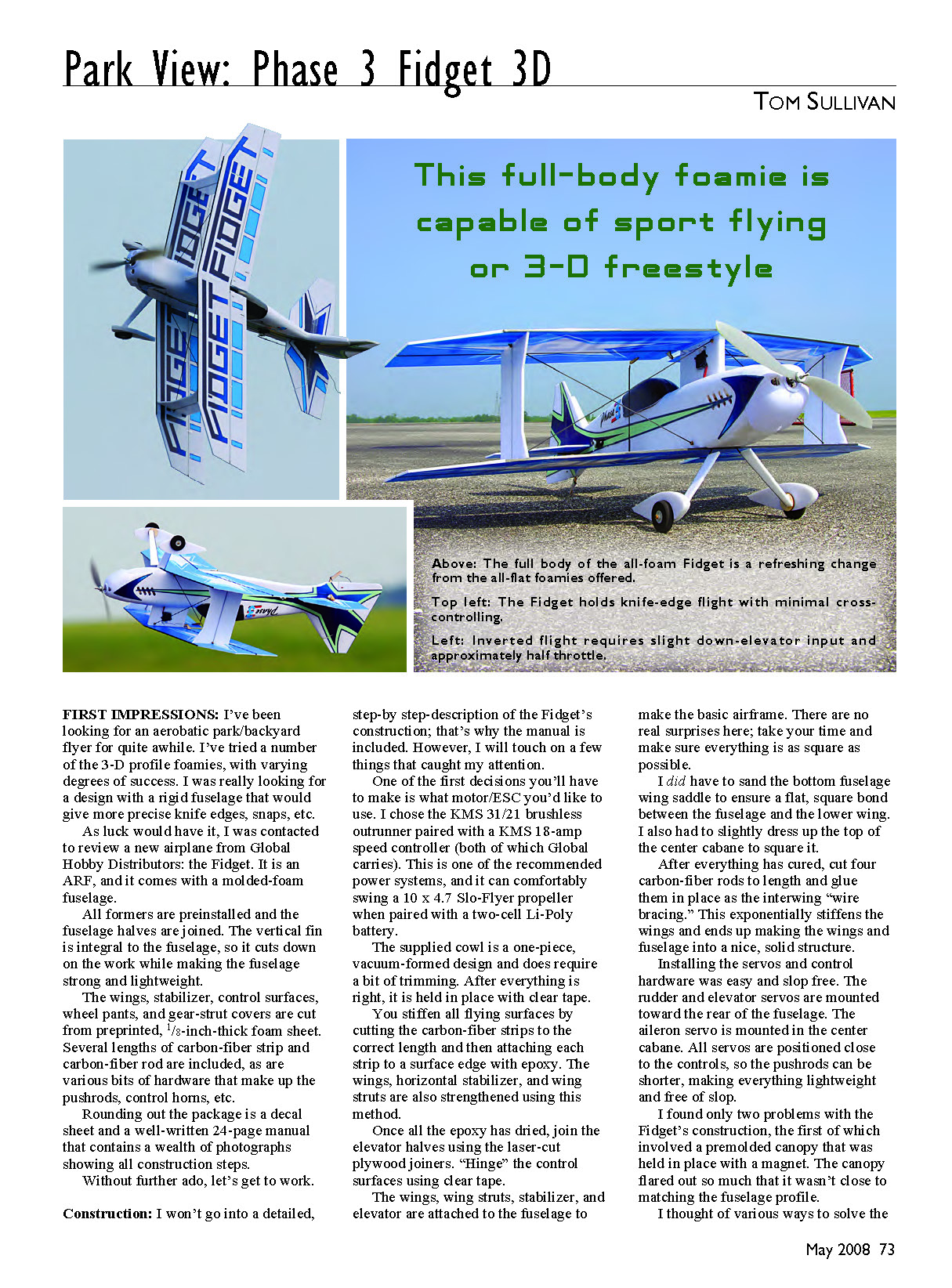
I’d been looking for an aerobatic park/backyard flyer for quite a while and had tried a number of 3-D profile foamies with mixed success. I wanted a design with a rigid fuselage for more precise knife edges, snaps, etc. Global Hobby Distributors asked me to review their new Fidget, an ARF that comes with a molded-foam fuselage.
The kit includes:
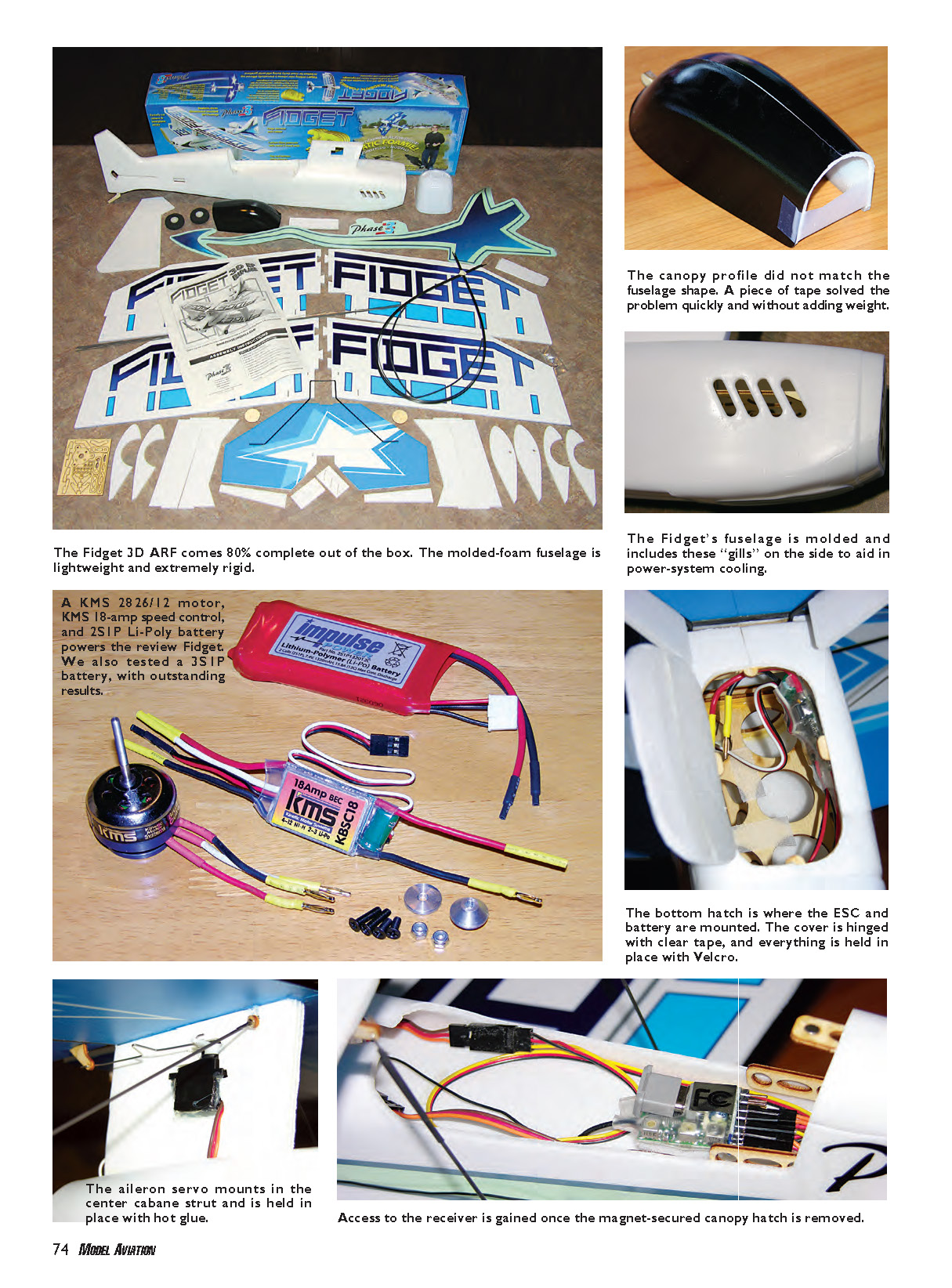
- Molded-foam fuselage with preinstalled formers and joined halves; the vertical fin is integral to the fuselage.
- Wings, stabilizer, control surfaces, wheel pants, and gear-strut covers cut from preprinted 1/8-inch foam sheet.
- Several lengths of carbon-fiber strip and carbon-fiber rod.
- Hardware for pushrods, control horns, etc.
- Decal sheet.
- A well-written, 24-page manual with many photographs showing all construction steps.
Without further ado, I got to work.
Construction
I won’t duplicate the manual’s step-by-step instructions, but I’ll highlight a few notable points.
Power system
- I chose the KMS 31/21 brushless outrunner with a KMS 18-amp ESC (both available from Global). This recommended system comfortably swings a 10 x 4.7 Slo-Flyer prop on a two-cell Li-Poly battery.
Cowl and finishing
- The supplied one-piece vacuum-formed cowl required trimming and is held in place with clear tape once fitted.
Reinforcement and assembly
- All flying surfaces are stiffened by cutting the carbon-fiber strips to length and epoxying them to surface edges; the wings, horizontal stabilizer, and wing struts are reinforced the same way.
- After epoxy cures, join elevator halves with laser-cut plywood joiners and “hinge” control surfaces with clear tape.
- Attach wings, wing struts, stabilizer, and elevator to the fuselage, taking care to square everything.
- I sanded the bottom fuselage wing saddle to ensure a flat, square bond with the lower wing and dressed the top of the center cabane slightly to square it.
- Cut and glue four carbon-fiber rods as interwing bracing; this greatly stiffens the wings and ties the wings and fuselage into a solid structure.
Radio installation
- Installing servos and control hardware was easy and slop-free. Rudder and elevator servos mount toward the rear of the fuselage; the aileron servo mounts in the center cabane. Short pushrods keep weight down and reduce slop.
Issues encountered
- Canopy fit: The premolded canopy, held in place with a magnet, flared out and didn’t match the fuselage profile. A small piece of tape cured the fit problem quickly without adding weight.
- Landing-gear covers: The foam covers that dress up the main gear were about 1/2 inch too short where they met the fuselage. I left the small gap; it was only a minor annoyance and did not affect flying or landing.
Notes on access and cooling
- The Fidget’s molded fuselage includes side “gills” to aid power-system cooling.
- The bottom hatch houses the ESC and battery; the cover is hinged with clear tape and components are secured with Velcro.
- Receiver access is gained by removing the magnet-secured canopy hatch.
Setup, Weight, and Build Time
- After decals and radio installation, the test aircraft weighed 11.5 ounces and the CG was right on.
- I set control throws to the manual’s low- and high-rate recommendations and used 50% exponential for 3-D flying (35% recommended for sport flying).
- Because this was a review model (with careful attention to detail), assembly took about three evenings. An average modeler could probably finish the plane in four to six hours.
Flying
- First flights were from my driveway. Takeoff was effortless—about 5 feet—and the Fidget climbed with authority. It cruises comfortably at just over half throttle.
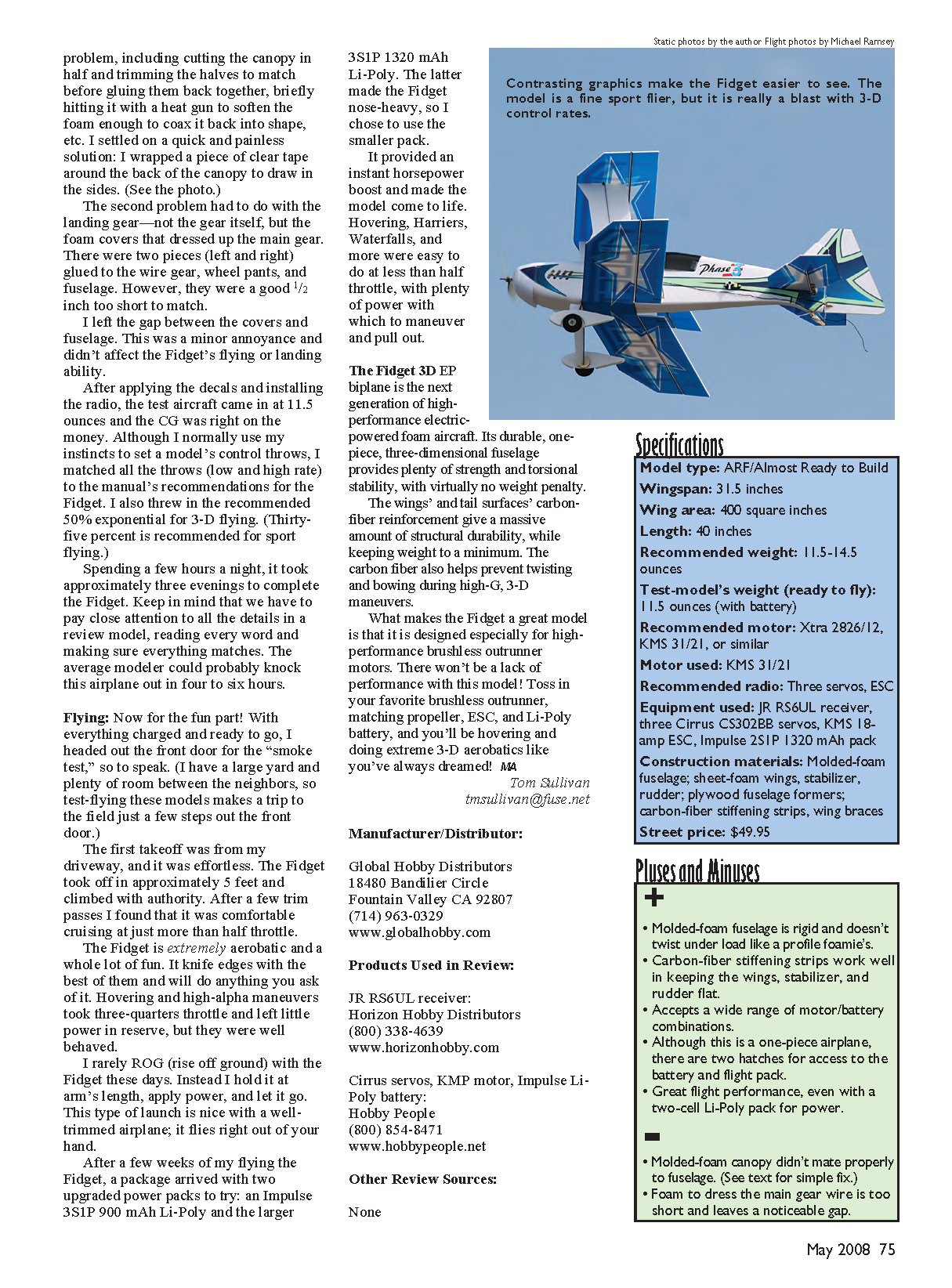
- The Fidget is extremely aerobatic and fun. It knives with the best of them and will perform a full range of maneuvers. Hovering and high-alpha maneuvers required around three-quarters throttle with little reserve but remained well behaved.
- Hand launches are straightforward: hold at arm’s length, apply power, and it flies out of your hand when well trimmed.
Extended power tests
- Later I tested two Impulse power packs: a 3S1P 900 mAh Li-Poly and a 3S1P 1320 mAh Li-Poly. The 1320 made the model nose-heavy, so I used the smaller 900 mAh pack.
- The 3S 900 mAh pack gave an instant horsepower boost and revitalized the model. Hovering, Harriers, Waterfalls, and similar maneuvers were easy at less than half throttle with plenty of power to maneuver and pull out.
Design Notes / Features
- The Fidget 3D EP biplane is a high-performance electric foam aircraft. Its durable, one-piece, three-dimensional fuselage provides strength and torsional stability with very little weight penalty.
- Carbon-fiber reinforcement in the wings and tail surfaces delivers significant structural durability while keeping weight low. The carbon fiber also helps prevent twisting and bowing during high-G, 3-D maneuvers.
- The model is designed for high-performance brushless outrunner motors; with a suitable motor, prop, ESC, and Li-Poly battery you can expect excellent 3-D performance.
Manufacturer / Distributor
Global Hobby Distributors 18480 Bandilier Circle Fountain Valley, CA 92807 (714) 963-0329 www.globalhobby.com
Products Used in Review
- JR RS6UL receiver — Horizon Hobby Distributors, (800) 338-4639, www.horizonhobby.com
- Cirrus servos, KMP motor, Impulse Li-Poly battery — Hobby People, (800) 854-8471, www.hobbypeople.net
Other Review Sources
- None
Tom Sullivan [email protected]
Transcribed from original scans by AI. Minor OCR errors may remain.

