
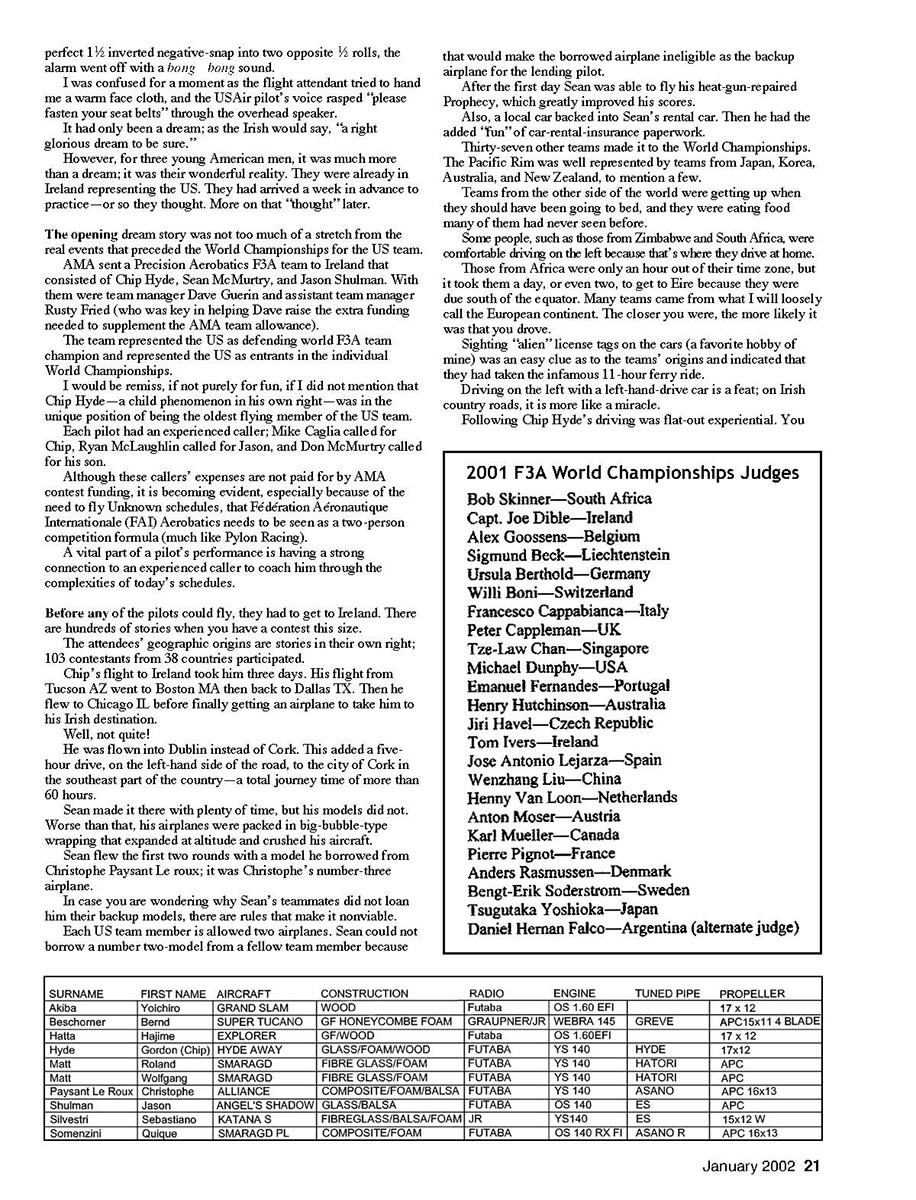
Pattern World Championships
Eric Henderson
As I drove to the first day of the 2001 F3A World Championships preliminaries, I had never imagined I would be in the situation where I had to fly for the US.
A series of unfortunate travel and entry-visa events had beset the world team and left them in a desperate position. One pilot was still stuck on the East Coast in the US.
As luck would have it, I had shipped over my Hydeout Pattern airplane so I could fly with friends and family in Ireland. My maternal Irish aunt was going to reach the grand, old age of 80, and her birthday coincided with the week of the F3A World Championships, August 24–September 2.
Before any of the pilots could fly, they had to get to Ireland. There are hundreds of stories when you have a contest this size. The attendees' geographic origins are stories in their own right; 103 contestants from 38 countries participated.
Chip's flight to Ireland took him three days. His flight from Tucson AZ went to Boston MA then back to Dallas TX. Then he flew to Chicago IL before finally getting an airplane to take him to his Irish destination.
Well, not quite!
He was flown into Dublin instead of Cork. This added a five-hour drive, on the left-hand side of the road, to the city of Cork in the southeast part of the country — a total journey time of more than 60 hours.
Sean made it there with plenty of time, but his models did not. Worse than that, his airplanes were packed in big-bubble-type wrapping that expanded at altitude and crushed his aircraft.
Sean flew the first two rounds with a model he borrowed from Christophe Paysant Le Roux; it was Christophe's number-three airplane.
In case you are wondering why Sean's teammates did not loan him their backup models, there are rules that make it nonviable. Each US team member is allowed two airplanes. Sean could not borrow a number two-model from a fellow team member because that would make the borrowed airplane ineligible as the backup airplane for the lending pilot.
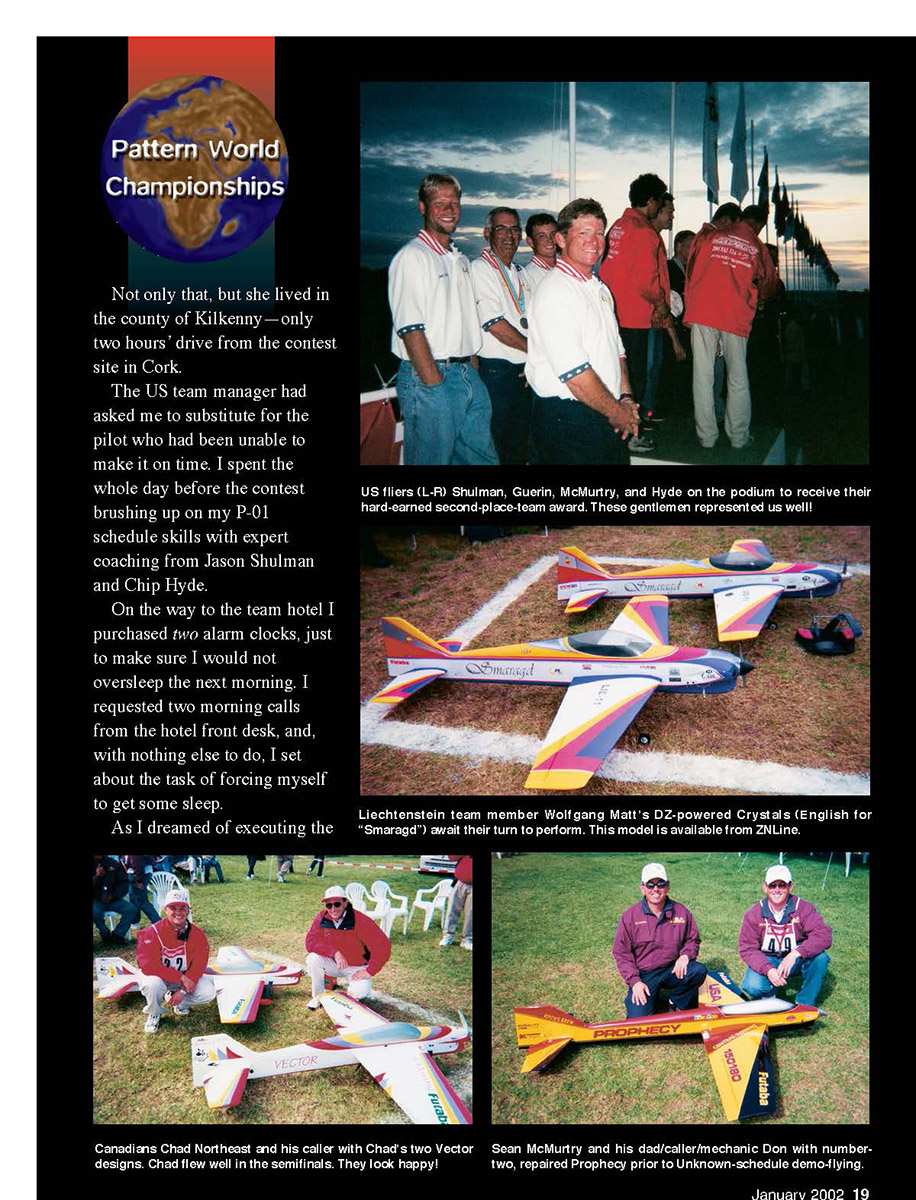
After the first day Sean was able to fly his heat-gun-repaired Prophecy, which greatly improved his scores.
Also, a local car backed into Sean's rental car. Then he had the added "fun" of car-rental-insurance paperwork.
Thirty-seven other teams made it to the World Championships. The Pacific Rim was well represented by teams from Japan, Korea, Australia, and New Zealand, to mention a few.
Teams from the other side of the world were getting up when they should have been going to bed, and they were eating food many of them had never seen before.
Some people, such as those from Zimbabwe and South Africa, were comfortable driving on the left because that's where they drive at home.
Those from Africa were only an hour out of their time zone, but it took them a day, or even two, to get to Eire because they were due south of the equator. Many teams came from what I will loosely call the European continent. The closer you were, the more likely it was that you drove.
Sighting "alien" license tags on the cars (a favorite hobby of mine) was an easy clue as to the teams' origins and indicated that they had taken the infamous 11-hour ferry ride.
Driving on the left with a left-hand-drive car is a feat; on Irish country roads, it is more like a miracle.
Following Chip Hyde's driving was flat-out experiential. You haven't lived until you have followed Chip to a roundabout (rotary or circle in the US) where he pulls a figure nine to make a left!
In an interview with the Japanese team, they politely said that the Irish food was interesting, and driving was no problem as long as they didn't follow Chip.
Zimbabwe had a team of enthusiasts who got together and paid their own way just for the experience.
The teams from Australia and New Zealand were more focused on beating each other than on the contest. These extremely competitive, but friendly, people showered us with hats, badges, and national memorabilia. A team hat with the New Zealand silver fern was an easy trade for one of my JR hats.
David Stodart and Mark Mendonca, the Trinidad and Tobago pilots, came for the pure pleasure of being there. They thought that island was beautiful, when many of us see their island as a paradise!
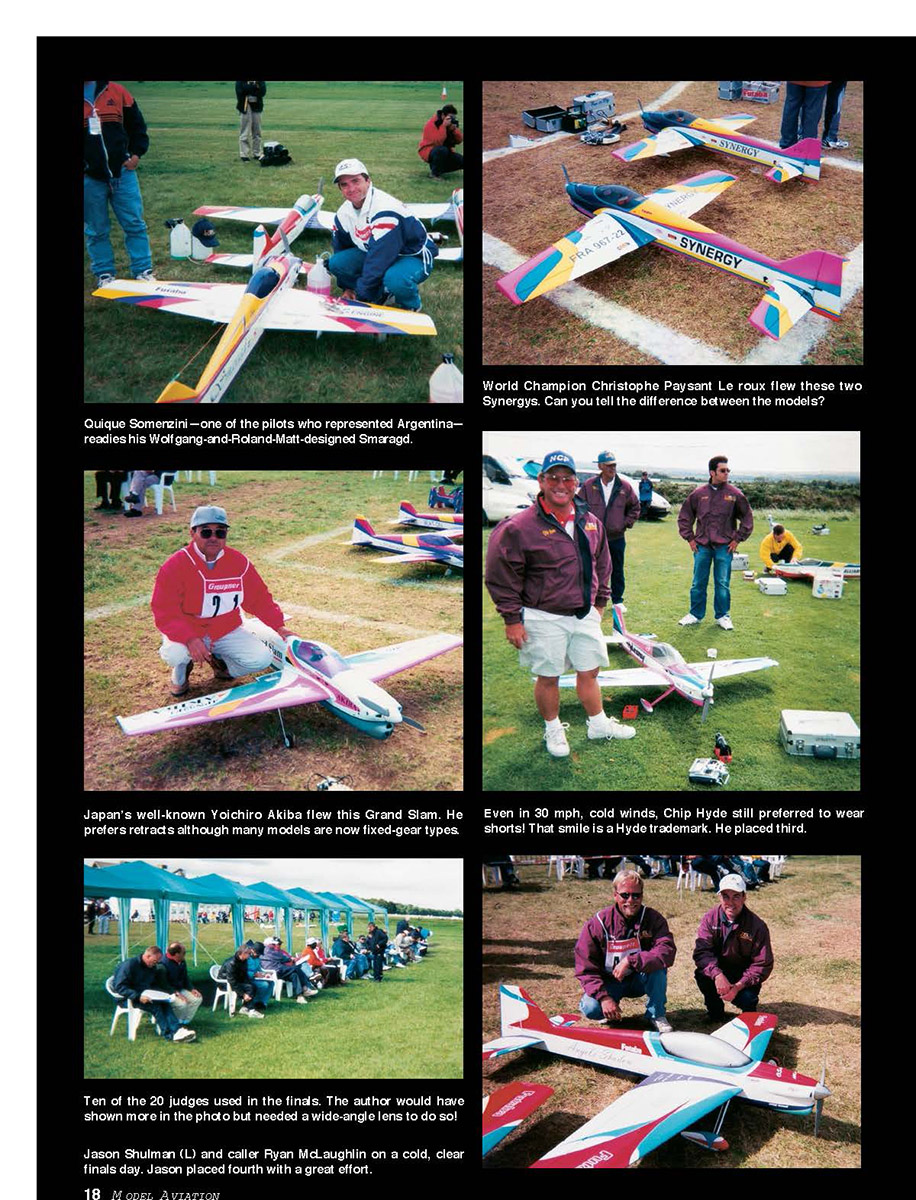
Two of the Argentinian pilots are very well-known to us in America as F3A pilots; Marcello Colombo travelled 24 hours from Argentina, and Quique Semenzini had a much shorter trip from North Carolina. Both are regular competitors at the AMA Nationals.
In contrast to the Argentinians, the Norwegian team — Kjell Tore Pettersen, Ola Fremming, and Knut Widar Frantzen — put all their models in one box, strapped it on top of their Renault, and drove through Europe. They caught a ferry to England then took another ferry to Ireland.
The more famous team from Liechtenstein boasted 14-time contestant Wolfgang Matt and his son Roland. They flew to the contest while Wolfgang's brother Helmut and team manager Adolph Keutschgber drove the airplanes via a similar route as the Norwegians.
After 14 times, you get the hang of the logistics!
It was a special pleasure to see the familiar faces of young Canadian team members Chad Northeast and Mike Siddall, with their veteran leader Dezso Vaghy — a three-time Canadian-world-team member.
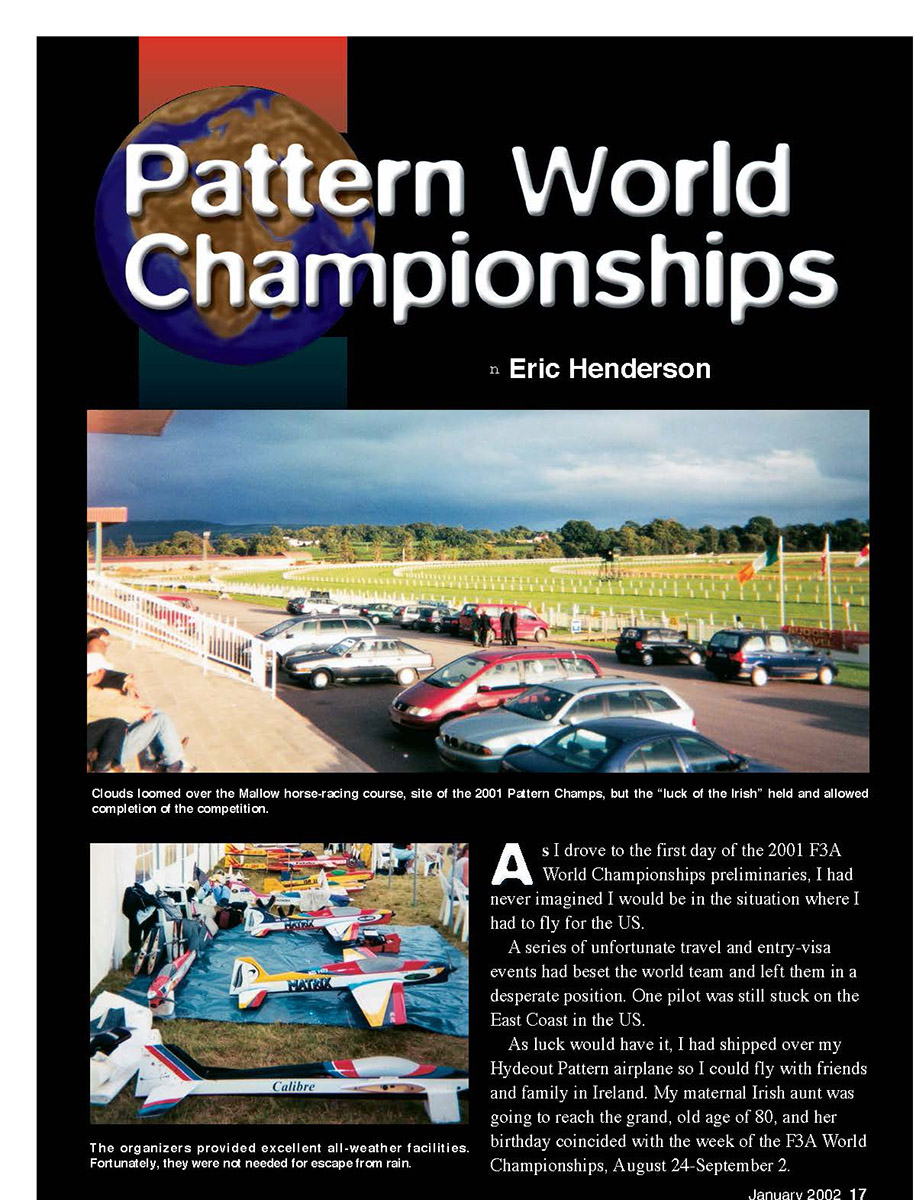
The site for the World Championships was Mallow horse-racing course, which is 30 minutes of scenic driving from Cork. The two flightlines were laid out in the center of the large, one-mile, oval course.
The flightlines were so far apart that "in-the-box" flying did not, and could not, interact.
The racecourse's excellent communications systems allowed the pilots' scores to be immediately displayed on overhead monitors.
Initial reservations about flying from grass were proven to have no foundation. According to contestants, the runways were like putting greens.
How you get selected to go to the World Championships as a competitor depends entirely upon what country you represent.
Some countries, such as the US, use one national contest to select the team. Others, such as England, use a best of four results during two years, in a sort of "league" system.
The selection process is much simpler if you are the only one flying FAI in your country. The number of FAI fliers per country is disproportionate to the number of contestants it can send. The US has roughly 20 pilots who could fly but is limited to three. Many countries have one or even none.
It may be worth considering to have more than one team from the larger countries, with perhaps private as well as selected entrants.
The formula used for an F3A World Championships contest is as follows.
Four rounds are run using the schedule known as P-01. (The code system for FAI schedules uses a "P" for preliminaries and "F" for finals schedules. The number is the last year in which scheduled will be used.) This is used to bring the number of contestants down from, in this case, 103 to 30.
The contestants are divided into groups. The 20 international judges are broken down into four panels of five. Two panels judge in the morning, and the other two judge in the afternoon.
The contest breaks for one day after the preliminaries if the rain day is not required to make up any lost preliminary rounds.
Wednesday night was an evening of festivities hosted in McGuires — an obviously Irish pub. Many languages echoed through the bar to the strains of a genuine Irish band, complete with bohran (the Irish hand drum) and fiddle.
Music is music the world over, and beer has the same effect no matter where you are.
For 73 pilots and many more callers and team managers, the contest was over. The trading of badges and hats was not. They would be memorable keepsakes 'til, perhaps, the next time.
The indefatigable Finbar Constatin himself organized a tour of Southern Eire for the next day and informed us that we all had to go to kiss the Blarney stone, for had he not kissed it himself every two weeks, to charge it up for them!
Friday's semifinals for the lucky 30 pilots used the schedule F-01. The contestants carried normalized positional scores from the preliminaries and executed two F-01 flights in front
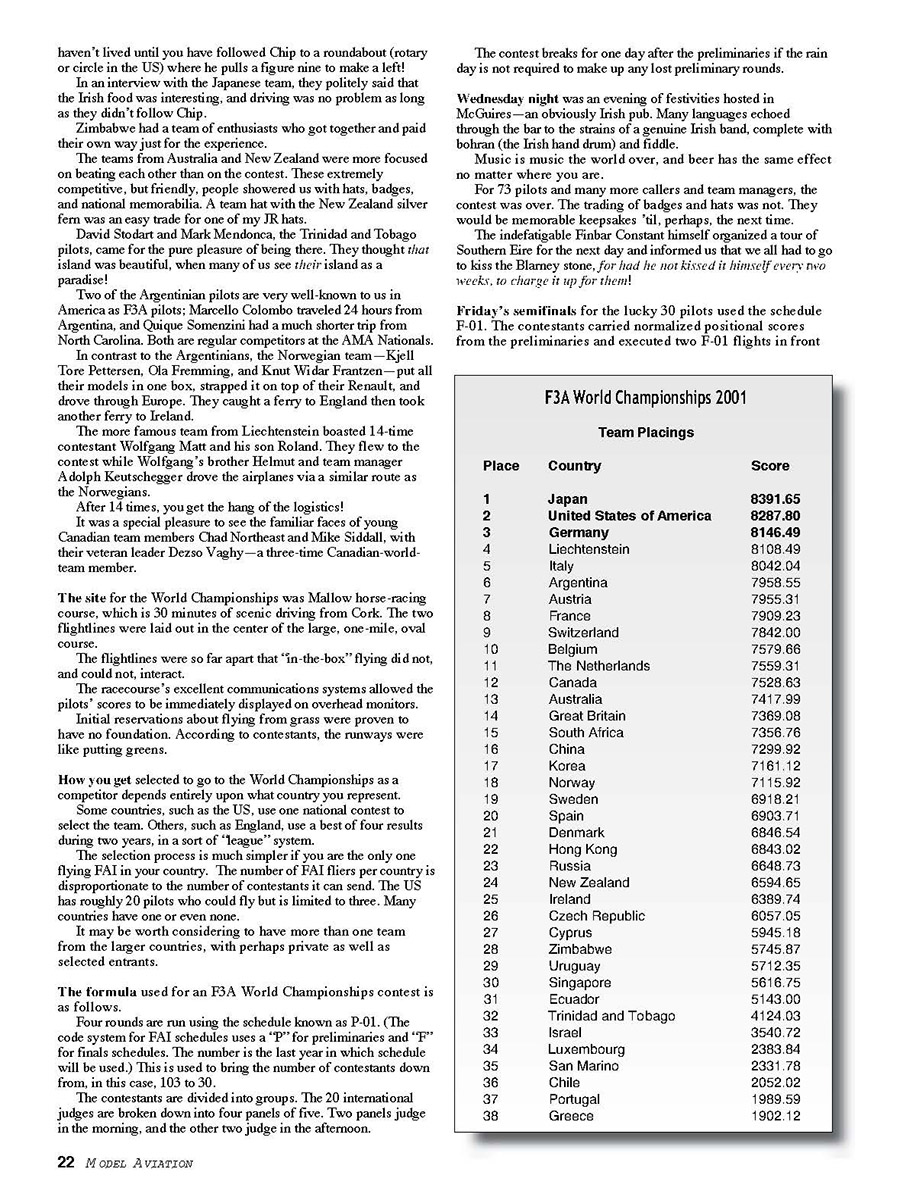
F3A World Championships 2001 Team Placings
Place Country Score 1 Japan 8391.65 2 United States of America 8287.80 3 Germany 8146.49 4 Liechtenstein 8108.49 5 Italy 8042.04 6 Argentina 7958.55 7 Austria 7955.31 8 France 7909.23 9 Switzerland 7842.20 10 Belgium 7579.66 11 The Netherlands 7559.31 12 Canada 7528.63 13 Australia 7417.99 14 Great Britain 7369.08 15 South Africa 7356.76 16 China 7299.92 17 Korea 7161.12 18 Norway 715.92 19 Sweden 6918.21 20 Spain 6903.71 21 Denmark 6846.54 22 Hong Kong 6843.02 23 Russia 6648.73 24 New Zealand 6594.65 25 Ireland 6389.74 26 Czech Republic 6057.05 27 Cyprus 5945.18 28 Zimbabwe 5745.87 29 Uruguay 5712.35 30 Singapore 5616.75 31 Ecuador 5143.00 32 Trinidad and Tobago 4124.03 33 Israel 3540.72 34 Luxembourg 2383.84 35 San Marino 2331.78 36 Chile 2052.02 37 Portugal 1989.59 38 Greece 1902.12
of these judges. Those flights reduce the number from 30 semifinalists to 10 finalists.
Then the 10 pilots flew four times in the finals on Saturday. They flew the F-01 schedule followed by the first Unknown schedule, then another F-01 followed by the second Unknown schedule.
No scores are carried through to the finals from previous rounds.
Sean McMurtry missed the finals by four normalized points. In no way should the salute to him take away from the achievement of Sebastiano Silvestri — the 10th-place finalist — but Sean did a Herculean job of pulling up his position.
He had no airplanes for a week then damaged airplanes. He flew a borrowed model then his repaired number-two airplane. Not once did he lose his cool or give up. It was motivational to see this young man carry himself through it all with a smile.
The scene was set. Chip and Jason were through.
The finals featured two US pilots, two Japanese pilots, and a father and son from Liechtenstein. Argentina, Germany, and Italy were strongly positioned.
The playing field was level, and we all waited for the next day to see if anyone could beat the man from France: Christophe Paysant Le Roux.
The judges were organized into three
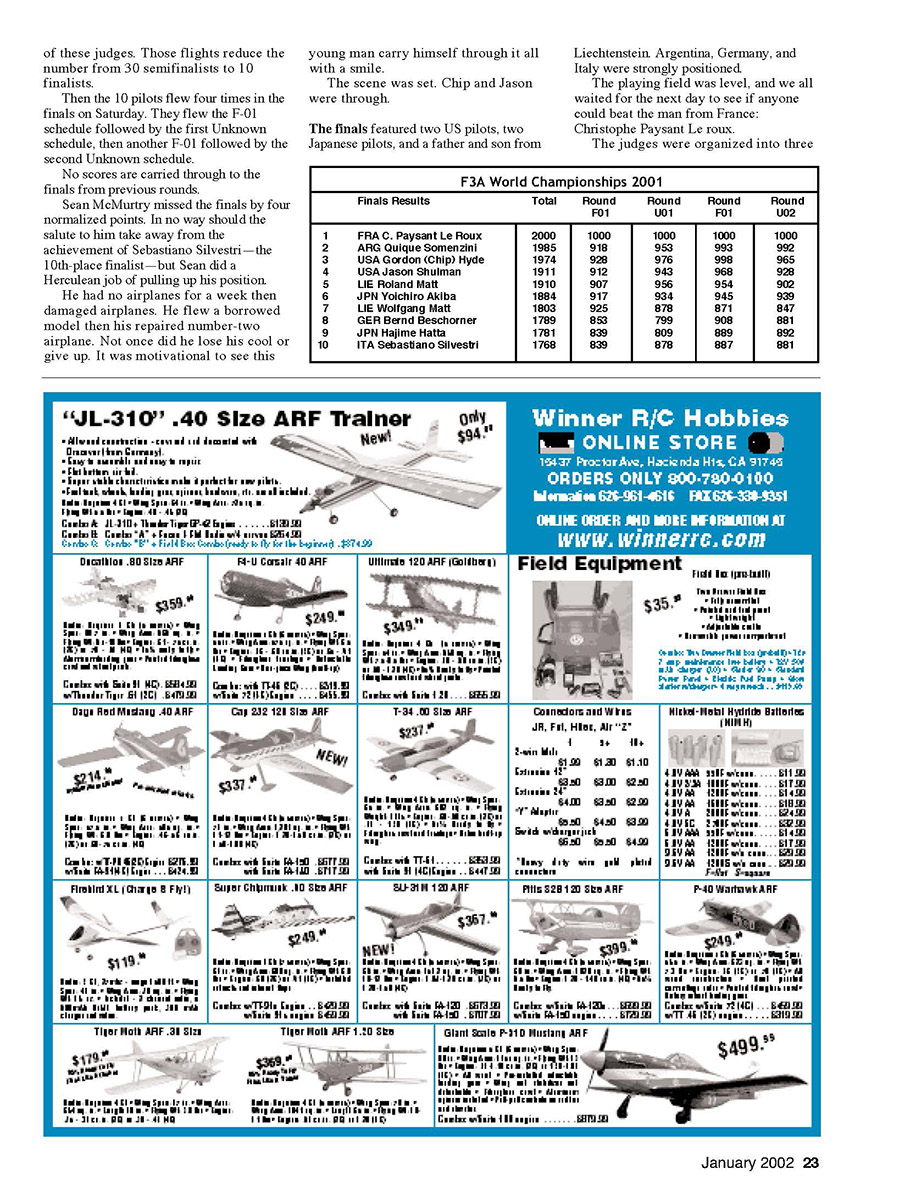
F3A World Championships 2001
Finals Results
Total Round F01 U01 F01 U02
1 FRA C. Paysant Le Roux 2000 1000 1000 1000 1000 2 ARG Quique Somenzini 1985 918 953 993 992 3 USA Gordon (Chip) Hyde 1974 928 976 998 965 4 USA Jason Shulman 1911 912 943 968 922 5 LIE Roland Matt 1910 907 956 954 902 6 JPN Yoichiro Akiba 1884 917 934 945 939 7 LIE Wolfgang Matt 1883 925 878 871 847 8 GER Bernd Beschorner 1789 853 799 908 881 9 JPN Hajime Hatta 1781 839 809 889 892 10 ITA Sebastiano Silvestri 1768 839 878 887 881
highest round would be used to select the Champion.
Finals day drew a very big crowd. Chairs were at a premium; no one carried any with them on the airplane trip (VBG). The flying was so good that crowds of local people and the 93 runners-up applauded every flight.
The positions did change — especially for Jason, who put his heart and soul into the last four rounds. Gone was the familiar easygoing countenance that fools many of us; he knuckled down and earned a very respectable fourth place.
Jason only had to beat three multiple World and Tournament of Champions champions — no problem, right?
Watching these pilots is a treat. There is often not much differentiation during the preliminaries — especially to the casual observer — but as the degree of difficulty increases, the skill becomes more evident.
The rolling circle in F-01 soon distinguished the higher-skilled pilots. It was windy for most of the semifinals, and some pilots just seemed to make the wind “go away”!
The first Unknown began with a single rolling loop. Unknown number two, the last round, began with a two-roll rolling circle.
Sean put in both demo flights for the Unknown schedules. Many mentioned that if he had made it to the finals, he could have won those rounds. We will never know, but it will be a great hypothetical situation that can and will be debated over a beer or two.
After one week and 11 rounds of flying, the Champion was, once again, Christophe Paysant Le Roux. Chip and Jason had mounted a concerted effort but were both marginally beaten by Quique for second place. Chip had second place locked up all day, beating Quique in the first three rounds of the final.
An unusual thing occurred before the fourth round: one judge had to leave, so an alternate from Argentina was substituted. This judge had not judged all week and, as such, had no TBL history.
The effect this move had on the final result will be another topic of much barroom debate.
The awards ceremony was held in front of the racecourse grandstand. All the countries gathered under their flags as the podium was filled by the team champions — Japan, followed by the US then Germany.
Each country had its anthem played as its flag was magically raised behind the members. To satisfy my curiosity, I peeked behind the fence and saw two young Irish men slowly pulling the cords to raise each flag. Not a very high-tech method but a wonderful effect.
These young men sat at our table during the banquet and were an absolute delight, with their lovely brogue and enthusiasm for FAI flying.
The individual winners were called to the podium in reverse order. Chip stood tall and alone as they raised the American flag for his third place. He fought well, and many hearts felt for him as he raised his head and eyes to the flag.
Quique shook Chip’s hand, then did the same thing. No matter how controversial the result, it will stand in the record books without qualification. They both listened to the strains of the Argentinian anthem as it wafted from the speakers in the stands.
Christophe took his familiar position on the top of the podium and began his third year as the F3A individual World Champion.
The speeches at the banquet were short, and it was particularly enjoyable to see Quique saluted his new bride, Sandra, as part of his reason for success. I am sure she liked what she said as well as the exquisite, world-famous Waterford crystal glassware that was given to all the winners.
"They say you never get a second chance to make a first impression. These World Championships will impress me for a very long time.
"One of my great-grandchildren will probably look quizzical at a treasured photo of myself kneeling with our world team as his mom says, 'Look it up on the genealogy DVD, honey!'
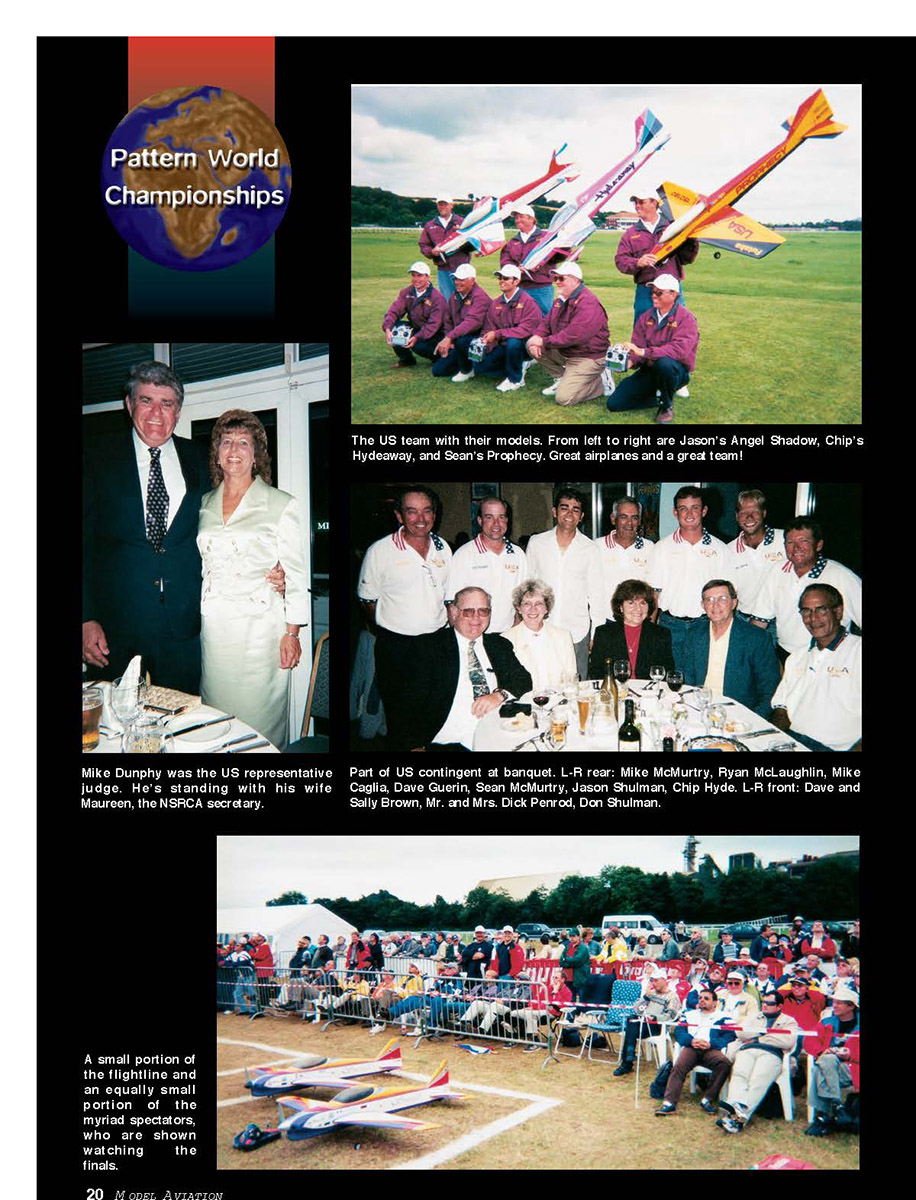
There was that first impression, as we walked into Mallow racecourse, of meeting Maureen Dunphy, NSRCA (National Society of Radio Controlled Aerobatics) secretary, working in the F3A Headquarters information center while her husband Mike Dunphy judged all day.
The AMA president, Dave Brown, and his wife Sally ran flightlines and scored events all week.
The thought remained of the team manager getting up at 4 a.m., which is before most Americans were going to bed, to get radios to the team meter impound before 6:30 a.m.
Never underestimate the physical drain involved in operating out of your time zones or after traveling great distances and managing many languages.
We should be very proud of our national team members. They practiced hard and perfected their equipment—there wasn't a single technical failure. They battled jetlag, foreign food bacteria, and strange, small cars. They never gave up trying to win.
The US team considered that if it had to be second, it was an honor to be second to the Japanese team; its members are technical leaders.
The Japanese won the team prize this time before the US won it the back-and-forth rivalry and sportsmanship is part of an international Pattern competition.
There has been, so it is very strongly agreed between the US and Japanese teams, that in much common language, but in every way that will stay with me forever took place on practice day before the semifinals.
It was an extremely windy day, and only two flyers stayed at the Cork Radiofliers' practice site in Aherla. Akiba of Japan would set up and perform a selection of Unknowns and basically throw down the gauntlet to Chip. Then Mr. Hyde would do the same with different maneuvers.
Each was trying to outdo the other. As privileged spectators, we ate it all up. It was like having our own private air show!
Akiba performed a perfect fight, then left a consecutive horizontal snap. We all applauded, but the voice that Akiba heard was Chip's. He had made it loudly clear that he approved of the maneuver, and Akiba turned to acknowledge the praise.
The Japanese team host facilitated this exchange between Chip and Akiba. The translations took time. Meanwhile, Akiba's caller was frantically trying to get him to remember that his model was flying away, out over the very green Irish countryside.
Translated praise flew back and forth until the caller finally got his way and managed to get Akiba to remember that he was still flying the receding dot in the sky. It was worth the trip to be there for that moment.
Jason Shulman and his caller Ryan McLaughlin had a plug die on the O.S. 1.40 EFI engine as Jason's model was approaching the sound-test pad before his semifinal flight. As calm as you like, they put down his number-one model, started his number-two airplane, and took the sound test and flew the round with no change of pace.
They were so calm and slick, you would have thought they did that every day. Most of us would have been running around in a sweat, but not Jason. It was very memorable.
For the second World Championships in a row, Christophe never lost a round—an outstanding feat of competition flying.
The US team worked very hard trying to wrest this title from Christophe. They battled fatigue and early mornings. They worked extremely well with and for each other. They conducted themselves with class and honor in battle and defeat.
These young men, and their manager, appreciated every dollar that was donated and how it facilitated their ability to compete for their country. To all of you who contributed, you got your money's worth.
The event was masterminded and managed by an extraordinary gentleman with the lovely Irish name of Finbar Conastin. What made his feat more extraordinary was that, a week before, his contest director had been hospitalized and was unable to complete his duties. Finbar had help, of course; his whole family and a small band of very dedicated Irish F3A enthusiasts worked 18-hour days to make it all happen.
However, Finbar was magnificent. He solved problems that ranged from parking passes to import restrictions and the issue of entry visas. He always had time for you as an individual and was still able to cater to the majority.
Contestants said this was the most enjoyable World Championships they'd ever attended. Well done to Finbar and his team.
If you want to mix a vacation with a purpose, look no further than combining a scenic tour with the next F3A World Championships.
Eric Henderson 303 Shady Ln. Marlton NJ 08053 [email protected]
Transcribed from original scans by AI. Minor OCR errors may remain.

