
Phoenix Q-40 Classic
The SpeedWorld R/C Flyers hosts an AMA-class Pylon Racing season opener
by Jim Allen [email protected]
The last weekend in February each year, a Pylon Racing–community tradition continues on the outskirts of Phoenix, Arizona. The SpeedWorld R/C Flyers club has built its Quarter 40 Classic into the premier Pylon race in addition to the F3D Pylon Racing World Championships and the US Nationals.
History and venue
The Classic started in 1986 as a Formula 1 (F1) event at a field on the east side of the Phoenix area. The Arizona Model Aviators and the Phoenix Pylon Racing Association hosted it for two years. In 1988 the race moved to the northwest side of Phoenix, to a new flying field targeted at Pylon Racing, with a permanent racecourse. The site was Phoenix Raceway Park, which had a 1/4-mile drag strip. The club that flew at the field was the Pro-Flyers.
In the late 1990s the facility changed hands, became SpeedWorld Raceway Park, and part of that change required that a new club be formed with a name to go with the facility. That was when the SpeedWorld R/C Flyers was created. The new raceway owners planned to expand the property into a facility for all kinds of motorsports, so it was important that the club retain its racing roots.
Today SpeedWorld Raceway Park features:
- Drag racing and motocross
- A 1/4-mile dirt oval and a 1/8-mile high-banked dirt oval
- A 100-yard sand drag track and a BMX track
- A 1/4-scale asphalt oval track and a world-class off-road car track
- A flying field with two runways and a Pylon Racing course
The facility has even hosted the hit SPEEDtv show "Pinks" several times.
Event format and history of classes
The SpeedWorld R/C Flyers hosts three AMA-class Pylon races and two RCPRO warbird races each year. F1 was the event of choice for the February race until the mid-1990s, when the relatively new Quarter 40 (Q-40) event became more popular than the more complex F1.
The 1996 event was the last at which the Phoenix Classic consisted only of F1. In 1997 and 1998, F1 and Q-40 were both flown, with a half day of each class contested on each day of the weekend. By 1999 F1 entries were mostly older equipment, so the Classic was changed to Q-40 only, as it continues to be today.
The ideal February climate in Phoenix and the SpeedWorld club's reputation for first-class events have driven the contest's growth. The club runs well-organized, fair, and efficient competitions that bring pilots back year after year.
2008 entries and participants
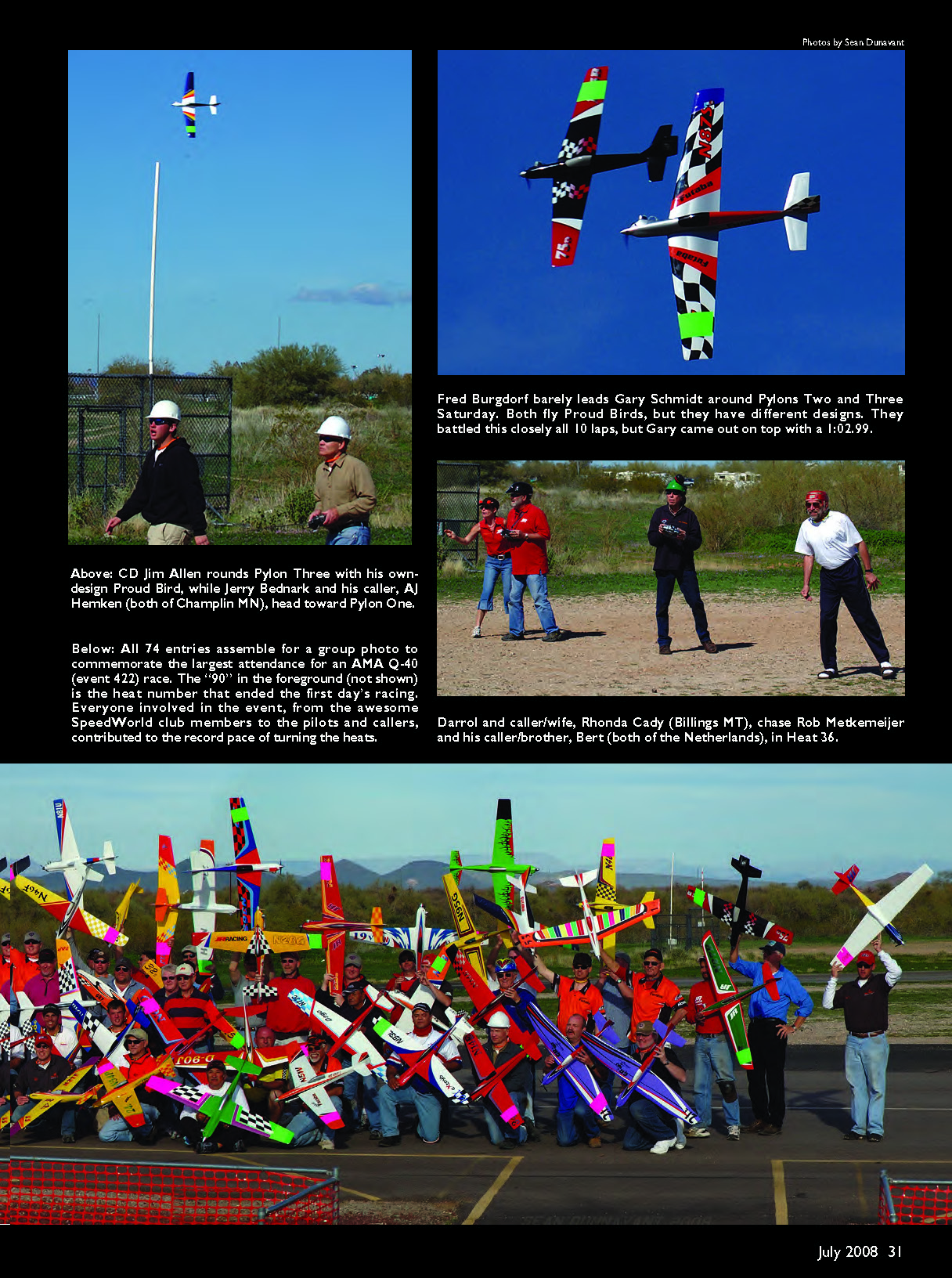
The 2008 event proved to be the largest and best yet. By the first of February pre-entries had reached the mid-60s. As of the cutoff date of February 13, the entry total was 74.
The roster included pilots from seven countries and 16 states, as well as a majority of the best Q-40 racers in the US, including three world champions and numerous AMA National champions.
International representation:
- Mexico: 9 pilots
- Canada: 6 pilots
- Netherlands: 3 pilots
- Italy: 1 pilot
- Germany: 1 pilot
- Venezuela: 1 pilot
Practice and pre-race activity
Pilots began arriving the Monday before the event, especially those escaping snow-covered parts of the world. Entrants shared flying time with the club's sport fliers until Friday, when the field was dedicated to practice flying.
Friday practice: models were lined up on the main runway in a circle, waiting for a chance to fly; only four aircraft at a time were allowed on the course during practice. This line could be up to 75 airplanes long, with waits over two hours for a flight. Rain dampened practice much of Friday, but a few pilots flew between showers to prepare for Saturday.
Saturday practice was stopped at 8 a.m. for a pilots' meeting, with racing hoped to start by 8:30. Engines were running for the first heat a few minutes after that time. Starting on schedule is critical with 19 heats per round.
Saturday racing
Racing was intense and fast-paced from the start. By lunch at 12:30, 50 heats had been flown. The last heat that day was the 90th, most of the way through the fifth round—exceeding the club's prior record of 80 heats in a day. The operation averaged five minutes per heat all day.
Notable Saturday heats:
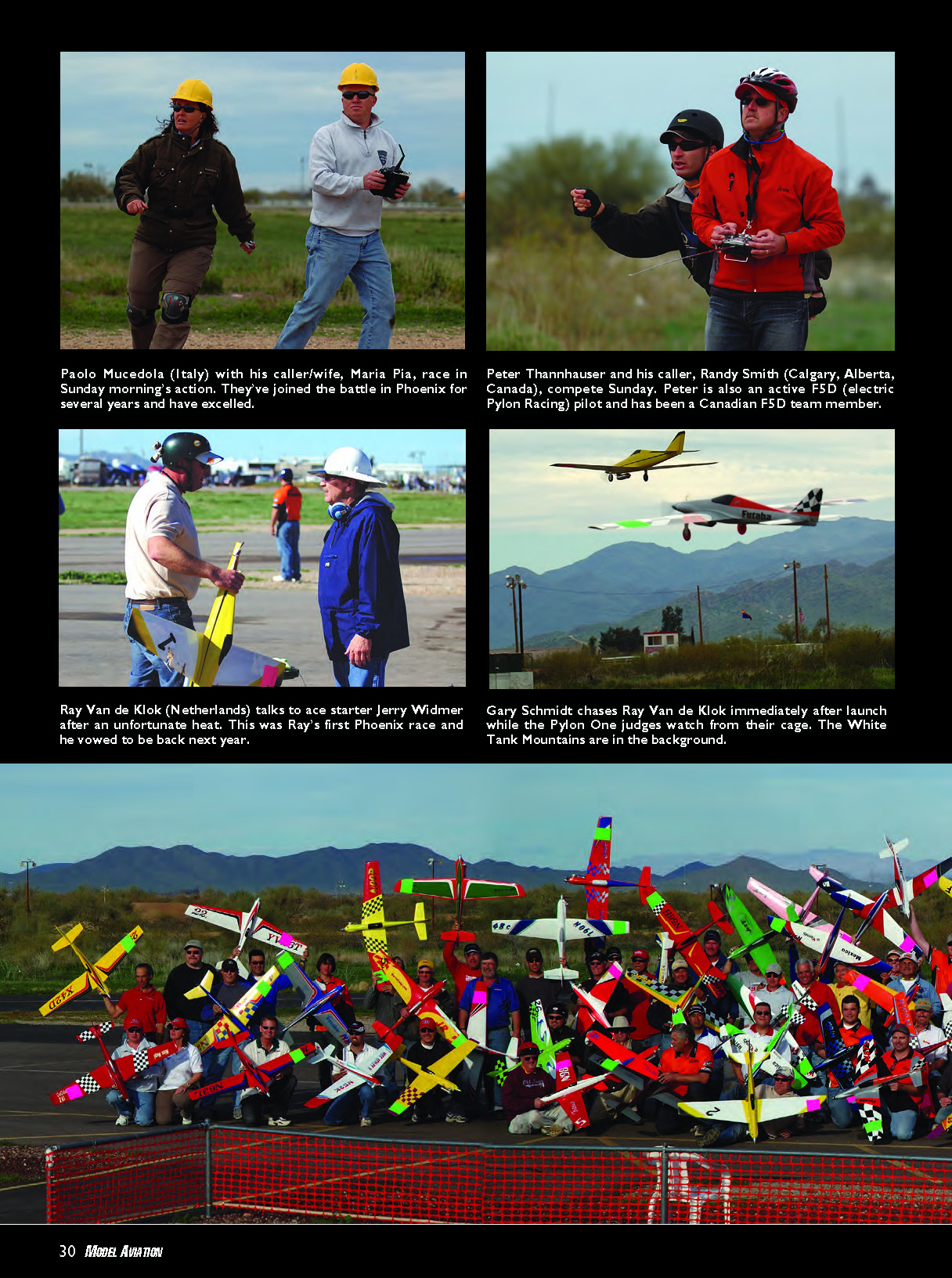
- Heat 22: Javier Gonzalez (Guadalajara, Mexico), Bruce Coffey (Newman, California), Clark Leaderbetter (Agua Dulce, California), Paolo Mucedola (Milan, Italy). No cuts; Paolo won in 1:06.01, Javier fourth, with only 1.28 seconds separating first and fourth.
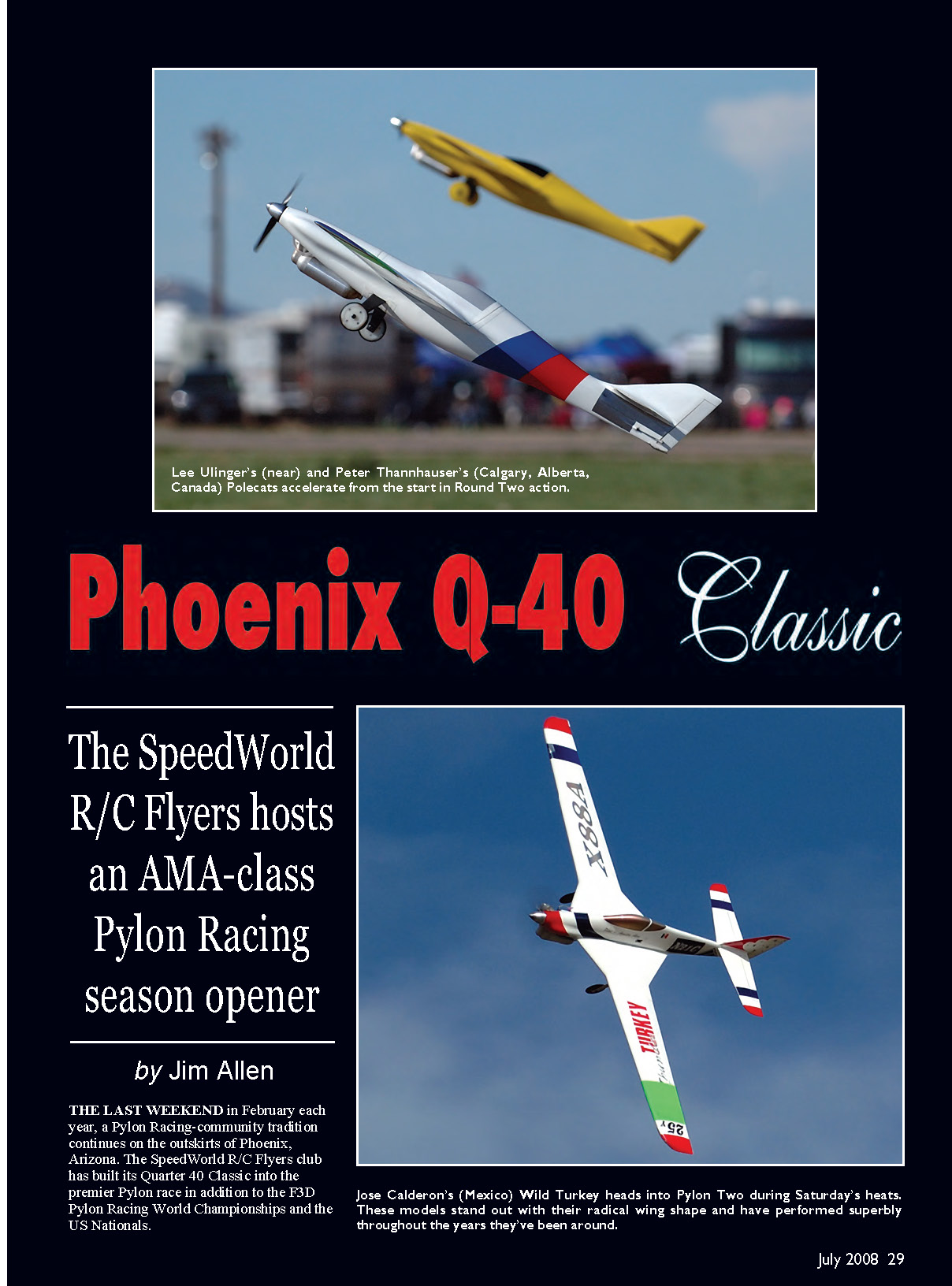
- Heat 64: Lee Ulinger (Goodyear, Arizona), Doug Killebrew (Palmdale, California), World Champion Randy Bridge (Apopka, Florida), Tom Strom (Burien, Washington). No cuts; Randy 1:01.93 (second), Tom 1:01.50 (first), Lee 1:04.11 (fourth).
- Heat 66: Lyle Larson (Piedmont, South Dakota), Travis Flynn (Burbank, California), Mark Parker (Grapevine, Texas). No cuts; Lyle won with 1:01.80, Travis third with 1:02.20.
The club hosted a barbecue Saturday evening for attendees.
Sunday racing and flyoffs
Sunday dawned with light winds and some cloud cover. Racing resumed where it left off and finished Round 5 quickly; engines were running early for the first heat. The event pressed through eight full rounds and was ready for flyoffs at about 2:30 p.m.
At the end of Round 8 there were three ties for positions in the top seven and two required flyoffs. Gary Schmidt (San Diego, California) and I were tied for seventh; fast times were used as the tiebreaker and Gary was awarded seventh.
Flyoffs:
- Fifth-place flyoff: AJ Seaholm (Lees Summit, Missouri) vs. Tom Strom. AJ had starting trouble and was not running when the heat launched; Tom took fifth.
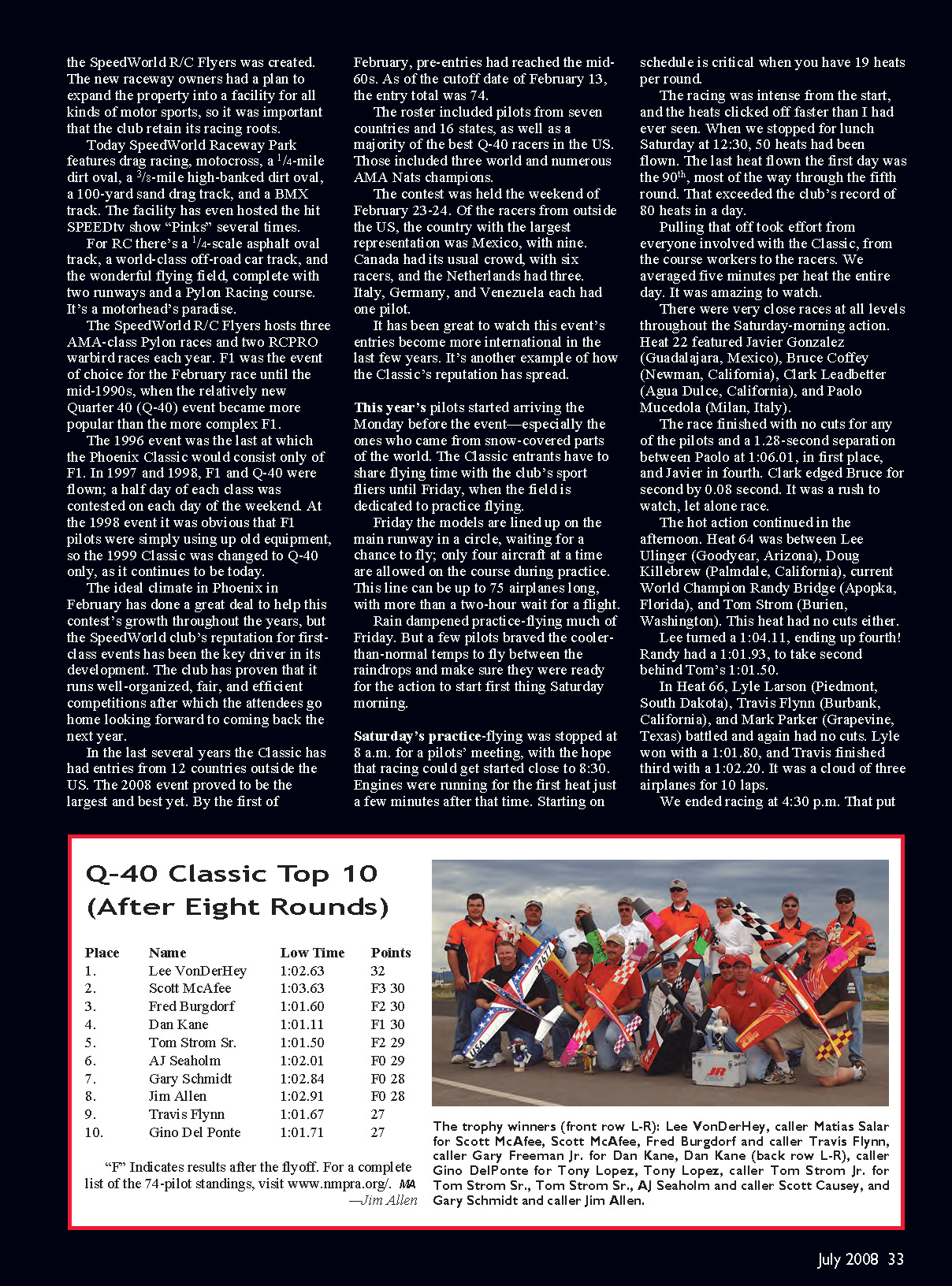
- Three-way flyoff for second: Scott McAfee (Corona Del Mar, California), Fred Burgdorf (Woodland, California), Dan Kane (Arlington Heights, Illinois). Dan and Fred earned cuts midrace; Scott stayed clean to win the flyoff and the second-place trophy.
Tony Lopez (Phoenix, Arizona) recorded the fast time of the weekend with a 1:00.84—the only flight faster than 1:01. Matias Salar (Northridge, California) was close with a 1:01.00. In total, nine racers had fast times in the 1:01s and nine in the 1:02s. Of the 74 racers, 42 had best times faster than 1:06.
Trophies and traditions
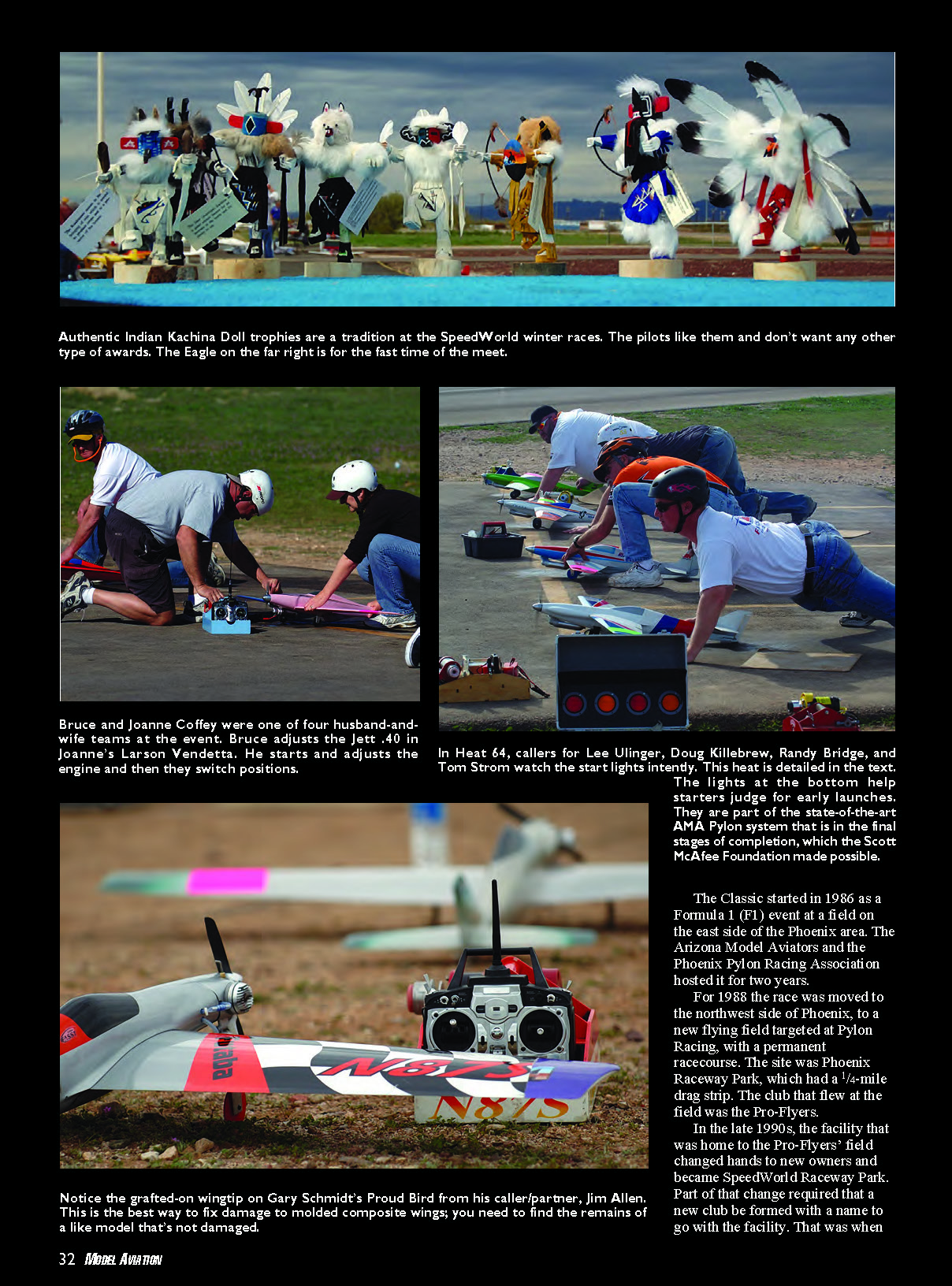
Authentic Indian Kachina Doll trophies are a tradition at the SpeedWorld winter races. Pilots favor them and the Eagle Kachina Doll is awarded for fast time of the meet.
Photos and notes from the event:
- In Heat 64, callers for Lee Ulinger, Doug Killebrew, Randy Bridge, and Tom Strom watch the start lights intently. The lights at the bottom help starters judge early launches; they are part of the AMA Pylon system completed with support from the Scott McAfee Foundation.
- Bruce and Joanne Coffey were one of four husband-and-wife teams. Bruce adjusts the Jett .40 in Joanne’s Larson Vendetta; he starts and adjusts the engine and then they switch positions.
- A grafted-on wingtip on Gary Schmidt’s Proud Bird from his caller/partner, Jim Allen, illustrates a common fix for damage to molded composite wings—find the remains of a like model to repair from.
Closing
As the contest director and participant, I look forward to this race each year, and it’s a relief when it’s over. After catching up for about a month, I can’t wait until the end of February 2009 to do it again.
The sport of AMA Pylon Racing is intense fun, and the friendships made along the way are the icing on the cake. If you haven't seen one of these races, it's worth a trip to check it out. More information is available from the National Miniature Pylon Racing Association.
MA
Sources:
- National Miniature Pylon Racing Association — www.nmpra.org
Transcribed from original scans by AI. Minor OCR errors may remain.

