
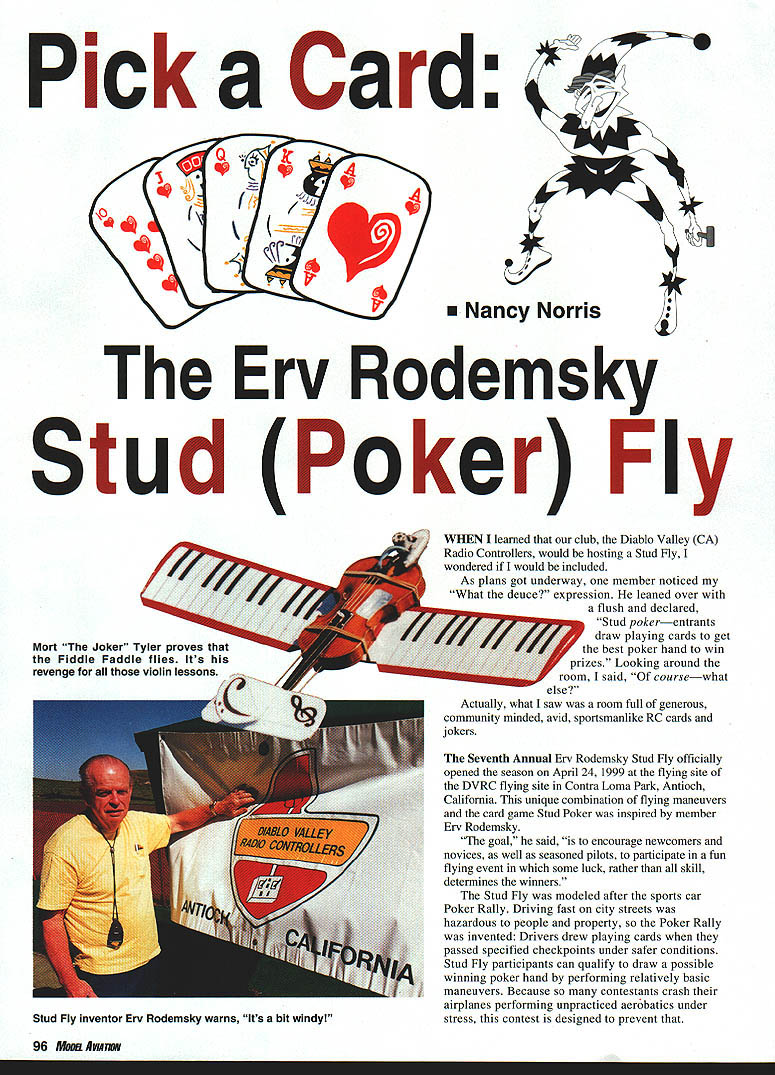
Pick a Card: The Erv Rodemsky Stud (Poker) Fly
Nancy Norris
WHEN I learned that our club, the Diablo Valley (CA) Radio Controllers, would be hosting a Stud Fly, I wondered if I would be included.
As plans got underway, one member noticed my "What the deuce?" expression. He leaned over with a flush and declared, "Stud poker—entrants draw playing cards to get the best poker hand to win prizes." Looking around the room, I said, "Of course—what else?"
Actually, what I saw was a room full of generous, community-minded, avid, sportsmanlike RC cards and jokers.
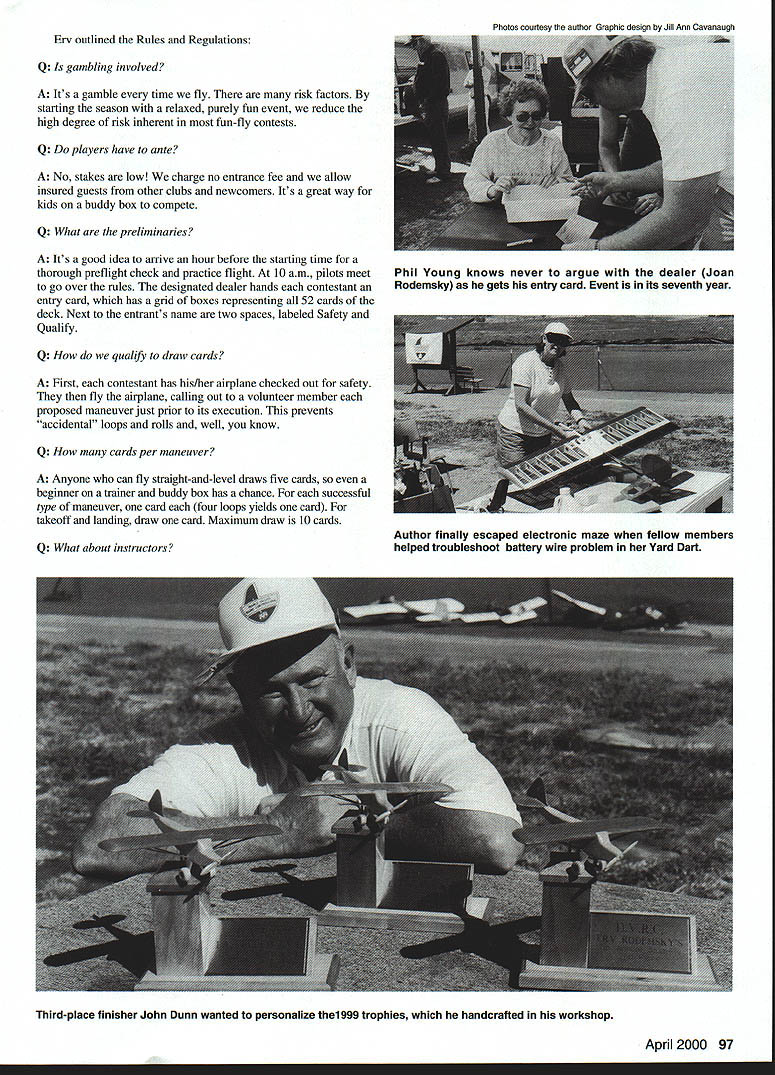
The Seventh Annual Erv Rodemsky Stud Fly officially opened the season on April 24, 1999, at the DVRC flying site in Contra Loma Park, Antioch, California. This unique combination of flying maneuvers and the card game Stud Poker was inspired by member Erv Rodemsky.
"The goal," he said, "is to encourage newcomers and novices, as well as seasoned pilots, to participate in a fun flying event in which some luck, rather than all skill, determines the winners."
The Stud Fly was modeled after the sports car Poker Rally. Driving fast on city streets was hazardous to people and property, so the Poker Rally was invented: drivers drew playing cards when they passed specified checkpoints under safer conditions. Stud Fly participants can qualify to draw a possible winning poker hand by performing relatively basic maneuvers. Because so many contestants crash their airplanes performing unpracticed aerobatics under stress, this contest is designed to prevent that.
Erv outlined the Rules and Regulations:
Q: Is gambling involved?
A: It's a gamble every time we fly. There are many risk factors. By starting the season with a relaxed, purely fun event, we reduce the high degree of risk inherent in most fun-fly contests.
Q: Do players have to ante?
A: No, stakes are low! We charge no entrance fee and we allow insured guests from other clubs and newcomers. It's a great way for kids on a buddy box to compete.
Q: What are the preliminaries?
A: It's a good idea to arrive an hour before the starting time for a thorough preflight check and practice flight. At 10 a.m., pilots meet to go over the rules. The designated dealer hands each contestant an entry card, which has a grid of boxes representing all 52 cards of the deck. Next to the entrant's name are two spaces, labeled Safety and Qualify.
Q: How do we qualify to draw cards?
A: First, each contestant has his or her airplane checked out for safety. They then fly the airplane, calling out to a volunteer member each proposed maneuver just prior to its execution. This prevents "accidental" loops and rolls.
Q: How many cards per maneuver?
A:
- Anyone who can fly straight-and-level draws five cards, so even a beginner on a trainer and buddy box has a chance.
- For each successful type of maneuver, one card each (four loops yields one card).
- For takeoff and landing, draw one card.
- Maximum draw is 10 cards.
Q: What about instructors?
A: We figure, if you’re getting other people up to fly, you automatically get 10 cards.
Q: When do we draw our cards?
A: First, land the airplane! Bring your entry card, which has been marked for the qualified number of cards by the volunteer, to the dealer. You draw that number of cards from the full 52-card deck (face down). The dealer blacks in the five boxes on your entry-card grid that you choose to represent your best poker hand.
Q: Are wild cards allowed? One-eyed, mustached jacks, maybe?
A: Well, every year we change the rules a little. We used to allow the same maneuver five times, but when they put a dog on the transmitter, we drew the line.
Q: What happens at the showdown?
A: At the end of the contest, we gather around. In auction style, the contest director calls out, "Who has a straight flush?" And if no one responds (although we often have bluffers), "Who has four of a kind?" then, "Who has a full house? A flush? A straight? Three of a kind? Two pair? One pair?" in that order, until we run out of prizes.
Q: What’s in the kitty?
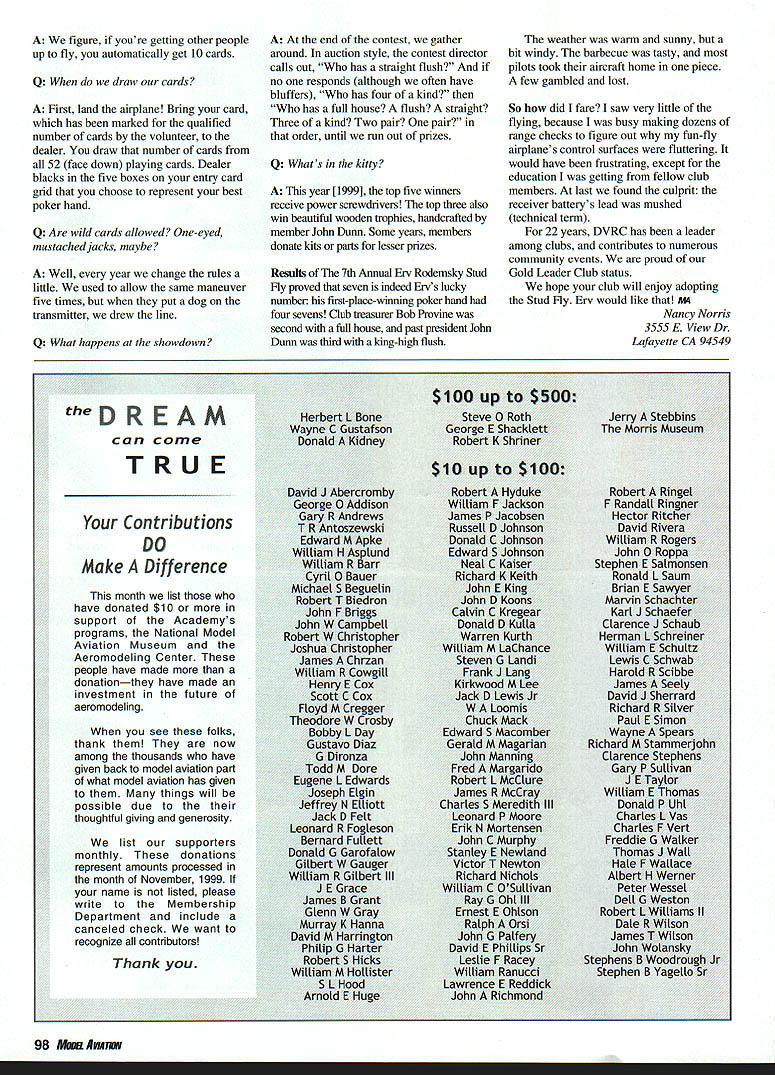
A: This year (1999), the top five winners receive power screwdrivers! The top three also win beautiful wooden trophies, handcrafted by member John Dunn. Some years, members donate kits or parts for lesser prizes.
Results
The results of the 7th Annual Erv Rodemsky Stud Fly proved that seven is indeed Erv’s lucky number: his first-place-winning poker hand had four sevens! Club treasurer Bob Provine was second with a full house, and past president John Dunn was third with a king-high flush.
The weather was warm and sunny, but a bit windy. The barbecue was tasty, and most pilots took their aircraft home in one piece. A few gambled and lost.
So how did I fare? I saw very little of the flying, because I was busy making dozens of range checks to figure out why my fun-fly airplane’s control surfaces were fluttering. It would have been frustrating, except for the education I was getting from fellow club members. At last we found the culprit: the receiver battery’s lead was mushed (technical term).
For 22 years, DVRC has been a leader among clubs, and contributes to numerous community events. We are proud of our Gold Leader Club status.
We hope your club will enjoy adopting the Stud Fly. Erv would like that!
Nancy Norris 3555 E. View Dr. Lafayette, CA 94549
Transcribed from original scans by AI. Minor OCR errors may remain.

