
Plane Talk: 3D Hobby Shop Osiris ARF
Joe and Chris Hass
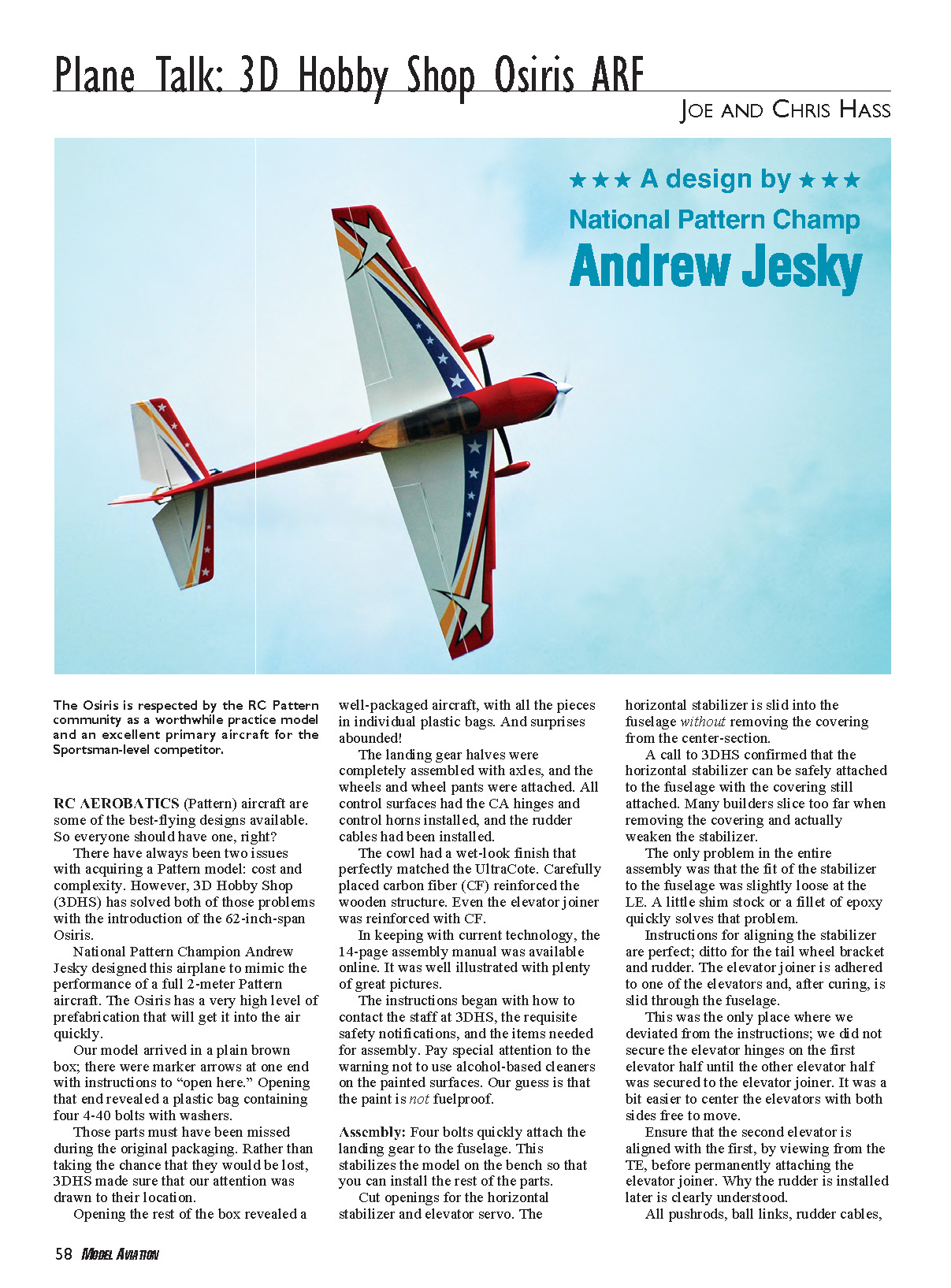
RC aerobatics (Pattern) aircraft are some of the best-flying designs available — so everyone should have one, right? There have always been two issues with acquiring a Pattern model: cost and complexity. 3D Hobby Shop (3DHS) addressed both problems with the introduction of the 62-inch-span Osiris.
National Pattern Champion Andrew Jesky designed this airplane to mimic the performance of a full 2-meter Pattern aircraft. The Osiris features a high level of prefabrication that gets it into the air quickly.
Our model arrived in a plain brown box; marker arrows at one end directed us to "open here." A plastic bag containing four 4-40 bolts with washers was tucked into that end — parts likely missed during original packaging. 3DHS made sure our attention was drawn to their location instead of letting them be lost.
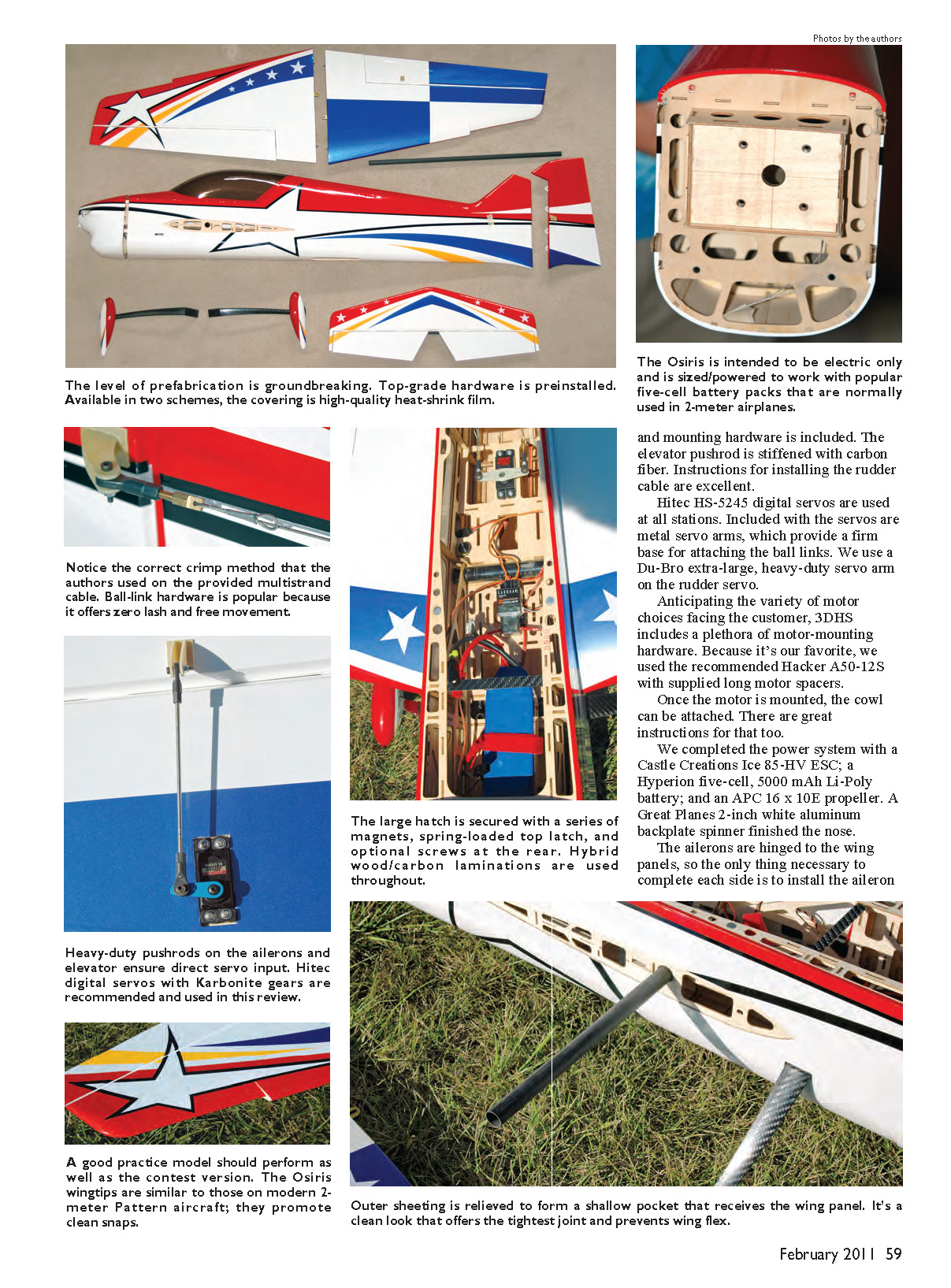
Opening the rest of the box revealed a well-packaged aircraft, with all pieces in individual plastic bags. Surprises abounded: the landing-gear halves were completely assembled with axles, wheels, and wheel pants attached; all control surfaces had CA hinges and control horns installed; and the rudder cables were already installed. The cowl had a wet-look finish that perfectly matched the UltraCote covering. Carefully placed carbon-fiber (CF) reinforced the wooden structure — even the elevator joiner was reinforced with CF.
The 14-page assembly manual was available online and was well illustrated with plenty of great pictures. It begins with how to contact 3DHS staff, safety notifications, and the items needed for assembly. Pay special attention to the warning not to use alcohol-based cleaners on the painted surfaces — our guess is the paint is not fuelproof.
Assembly
- Four bolts quickly attach the landing gear to the fuselage, stabilizing the model on the bench so you can install the rest of the parts.
- Cut openings for the horizontal stabilizer and elevator servo. The horizontal stabilizer is slid into the fuselage without removing the covering from the center section. A call to 3DHS confirmed this is safe; many builders slice too far when removing the covering and actually weaken the stabilizer.
- The only assembly issue we encountered was a slightly loose fit of the stabilizer to the fuselage at the leading edge. A little shim stock or a fillet of epoxy quickly solves that problem.
- Instructions for aligning the stabilizer are excellent; the same goes for the tail-wheel bracket and rudder. The elevator joiner is adhered to one elevator half and, after curing, is slid through the fuselage.
- We deviated slightly from the instructions: we did not secure the elevator hinges on the first elevator half until the other elevator half was secured to the elevator joiner. It’s easier to center the elevators with both sides free to move. Ensure the second elevator aligns with the first by viewing from the trailing edge before permanently attaching the elevator joiner.
- The Osiris is intended to be electric only and is sized/powered to work with popular five-cell battery packs normally used in 2-meter airplanes.
- All pushrods, ball links, rudder cables, and mounting hardware are included. The elevator pushrod is stiffened with carbon fiber, and the instructions for installing the rudder cable are excellent.
- Hitec HS-5245 digital servos are used at all stations. Metal servo arms are included and provide a firm base for attaching the ball links. We used a Du-Bro extra-large, heavy-duty servo arm on the rudder servo.
- Anticipating varied motor choices, 3DHS includes a plethora of motor-mounting hardware. We used the recommended Hacker A50-12S with the supplied long motor spacers.
- Once the motor is mounted, the cowl can be attached — and there are great instructions for that as well.
- Our completed power system: Castle Creations Ice 85-HV ESC; Hyperion five-cell 5000 mAh Li-Poly battery; APC 16 x 10E propeller; Great Planes 2-inch white aluminum backplate spinner.
- The ailerons are pre-hinged to the wing panels, so the only work to finish each side is to install the aileron servos and linkages. The ball-link hardware included is exactly the type we would have selected.
- The wings attach to the fuselage with a combination of a CF wing tube, CF antirotation pins, a plywood locking tab, and a nylon bolt. The wing is neatly recessed into the fuselage for a crisp fit.
- The canopy is held in place with a snap latch mounted on the turtledeck and a nylon bolt on each side of the fuselage, making battery access extremely easy.
How It's Done
Andrew Jesky has been performing RC aerobatics (Pattern) at the top level and has made a measurable impression on the AMA and international precision RC community with both outdoor and indoor models. He occasionally flies helicopters as well. His ability to cross-pollinate skills from multiple RC disciplines has influenced peers and judges. Teaming Andrew with 3D Hobby Shop owner Ben Fisher seemed like a natural blend of resources and talent.
In all sizes offered, the 3DHS AJ Slick shocked IMAC pilots with easy handling, high performance, and the ability to fly on rails directly out of the box. That allowed the RC flier to focus less on trimming the model and more on honing proficiency and maneuver geometry.
The Osiris has made a profound impression on members of the Pattern community, who can be very picky. They demand aircraft built to be as light as possible, as strong as possible, and as accurate as possible — capable of performing a complex list of maneuvers. 3DHS looked at what the Pattern community had been offered and saw products that left room for improvement. Ben and Andrew set out to test some theories with the 62-inch Osiris.
It does fall short of the 2-meter-span airplanes normally flown in Pattern events, but it proved that an airframe can be light and have a power-to-weight ratio that leaves nothing to be desired. The pair settled on electric power because it helps achieve a lighter airframe. The Osiris is large enough to match any .90-glow-powered offering, yet light enough to use only half of a 10S pack — gaining appeal to pilots transitioning to electric F3A-style power systems. If you’re new to this type of model, the packs you buy for the Osiris will gear you up for progression.
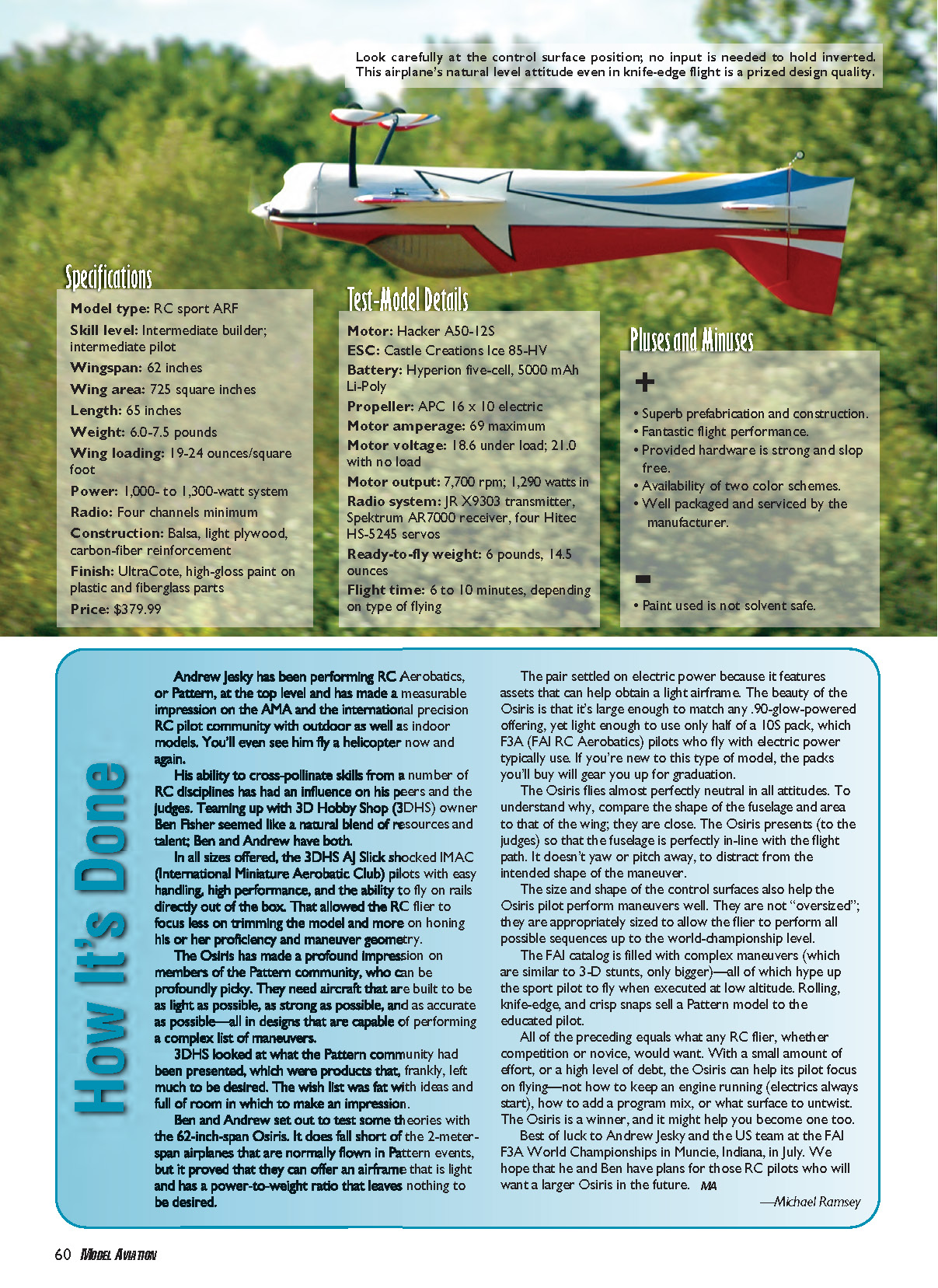
The Osiris flies almost perfectly neutral in all attitudes. Compare the fuselage shape and area to that of the wing — they are close. The Osiris presents to judges with the fuselage perfectly in line with the flight path; it doesn’t yaw or pitch away to distract from the intended shape of a maneuver. The size and shape of the control surfaces are appropriately sized — not oversized — allowing the flier to perform sequences up to world-championship level.
The FAI catalog is filled with complex maneuvers (similar to larger 3-D stunts), and the Osiris handles rolling, knife-edge, and crisp snaps at low altitude with authority. All of this equals what any RC flier, competitive or novice, would want: with a small amount of effort you can focus on flying rather than engine management, complicated radio programming, or surface unraveling.
The Osiris is a winner and might help you become one too. Best of luck to Andrew Jesky and the U.S. team at the FAI F3A World Championships in Muncie, Indiana.
—Michael Ramsey
Flying
- The recommended control throws and CG are excellent starting points. The first flight revealed precisely how well the Osiris was designed and constructed — no trim was required.
- Vertical performance is excellent. Maneuvers are crisp and tight when needed and large and powerful when desired. Snaps have a locked-in look.
- No rudder-to-elevator mixing is required for perfect knife-edge flight. Slow flight is steady. Takeoffs and landings are solid and predictable. The model tracks like it is on rails.
- If you plan on flying aggressively, invest in high-quality batteries with a high discharge rate.
- Thanks to its engineering, you can get the model into the air quickly and require fewer flights to trim and adjust radio programming.
3DHS has made it easy to get into Pattern. Give the Osiris a try — you will be glad to have it in your fleet.
Joe Hass [email protected]
Chris Hass [email protected]
Manufacturer/Distributor:
3D Hobby Shop 603 FM 2093 Suite 1303 Fredericksburg, TX 78624 (830) 990-6978 www.3dhobbyshop.com
Sources:
- Hacker — www.hacker-motor.com
- Castle Creations — (913) 390-6939, www.castlecreations.com
- APC — (530) 661-0399, www.apcprop.com
- JR — (800) 338-4639, http://jrradios.com
- Spektrum — (800) 338-4639, www.spektrumrc.com
- Hyperion — www.hyperion-world.com
- Du-Bro — (800) 848-9411, www.dubro.com
- Hitec RCD — (858) 748-6948, www.hitecrcd.com
- Great Planes — (800) 637-7660, www.greatplanes.com
Transcribed from original scans by AI. Minor OCR errors may remain.

