
Plane Talk: E-flite J-3 Cub 25 ARF on Floats
Michael Ramsey
This good-size scale model is versatile and practical for electric power.
Affordable electric-powered models are getting bigger every season. We're fortunate to be able to take advantage of new technology while prices keep coming down.
These days the 25-size model (or helicopter) is practical to set up for electric because it can typically be equipped with two identical packs used to power the smaller 10- and 15-size aircraft. As we would buy the same fuel to power more than one engine, we can select batteries in the same practical manner.
E-flite is expanding its line of models—literally. The company started with foamies and park flyers. Now its lineup of 25-size airplanes is increasing, and it began with the release of the J-3 Cub 25.
An all-time favorite, many will recognize the Cub as a remarkable model to fly regardless of what size it's scaled to represent. This version is no different; I found it to be beautifully engineered and finished.
But having produced a fair number of Cub-like products in their time, E-flite's designers kicked this Cub up a notch and released it at the same time as a matching set of floats. Not only is this Cub a classic, but it's versatile.
Cub (Specifications)
- Model type: Sport scale (1/7) ARF
- Pilot skill level: Intermediate
- Wingspan: 62 inches
- Wing area: 552 square inches
- Length: 35.5 inches
- Weight (with battery): 4.0–4.25 pounds; 5.3 pounds with floats
- Wing loading: 17.8 ounces/square foot
- Power (recommended): 500-watt motor, 40-amp ESC, 12-volt battery
- Radio: Four channels (minimum), four miniservos
- Construction: Balsa and light plywood with painted fiberglass cowl, clear plastic windows
- Covering/finish: UltraCote film, polyurethane paint
- Price: $154.99
Floats (Specifications)
- Type: 25-size set
- Intended for: 4- to 5-pound models
- Length: 28 inches
- Weight: 1.3 pounds (complete)
- Construction: Internal wood frame, fiberglass shell
- Finish: Silver polyurethane paint
- Included: Required hardware and linkages, subfin (for Cub), water rudder, heavy-duty chrome-plated wire struts
- Price: $49.99
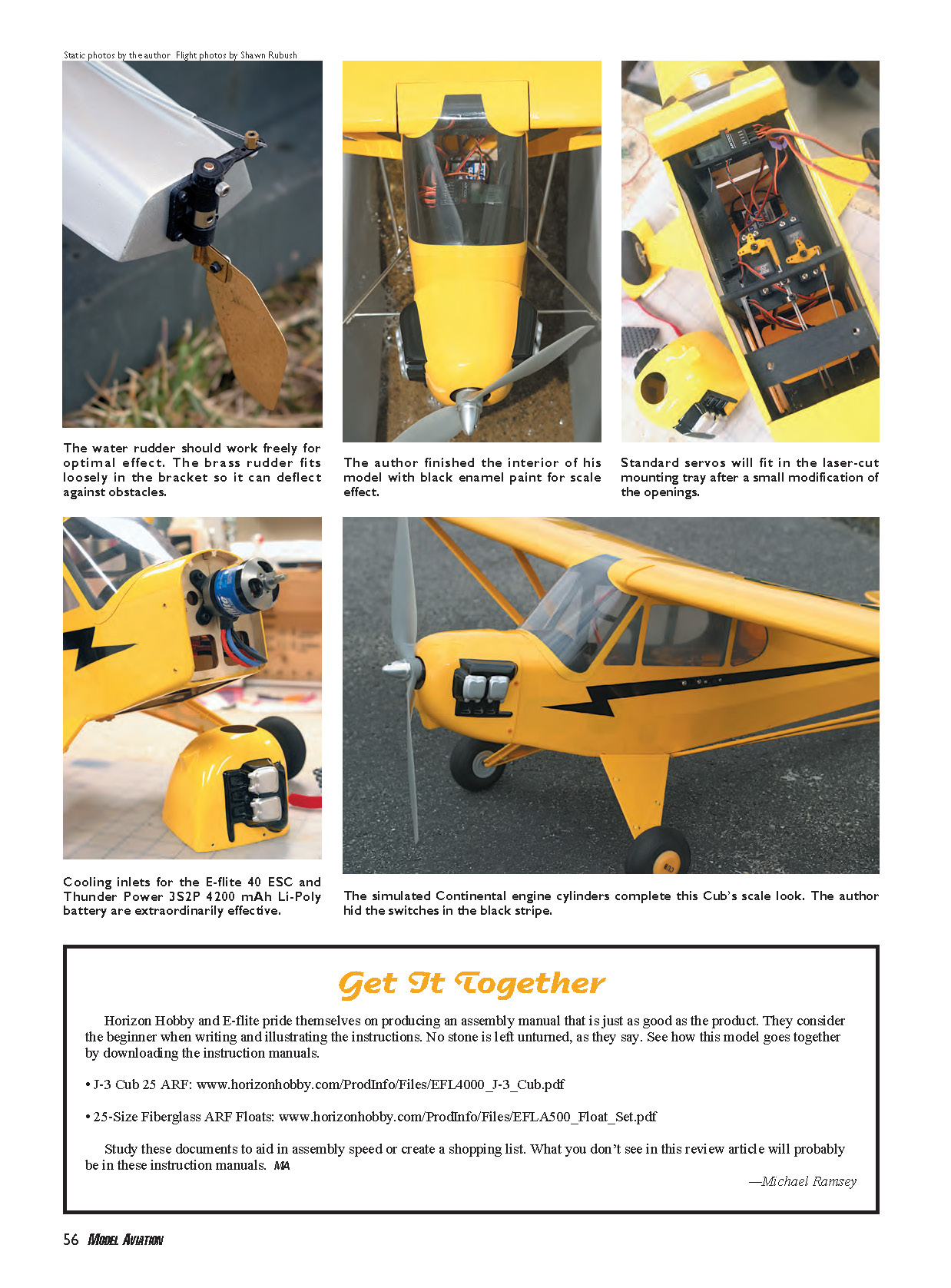
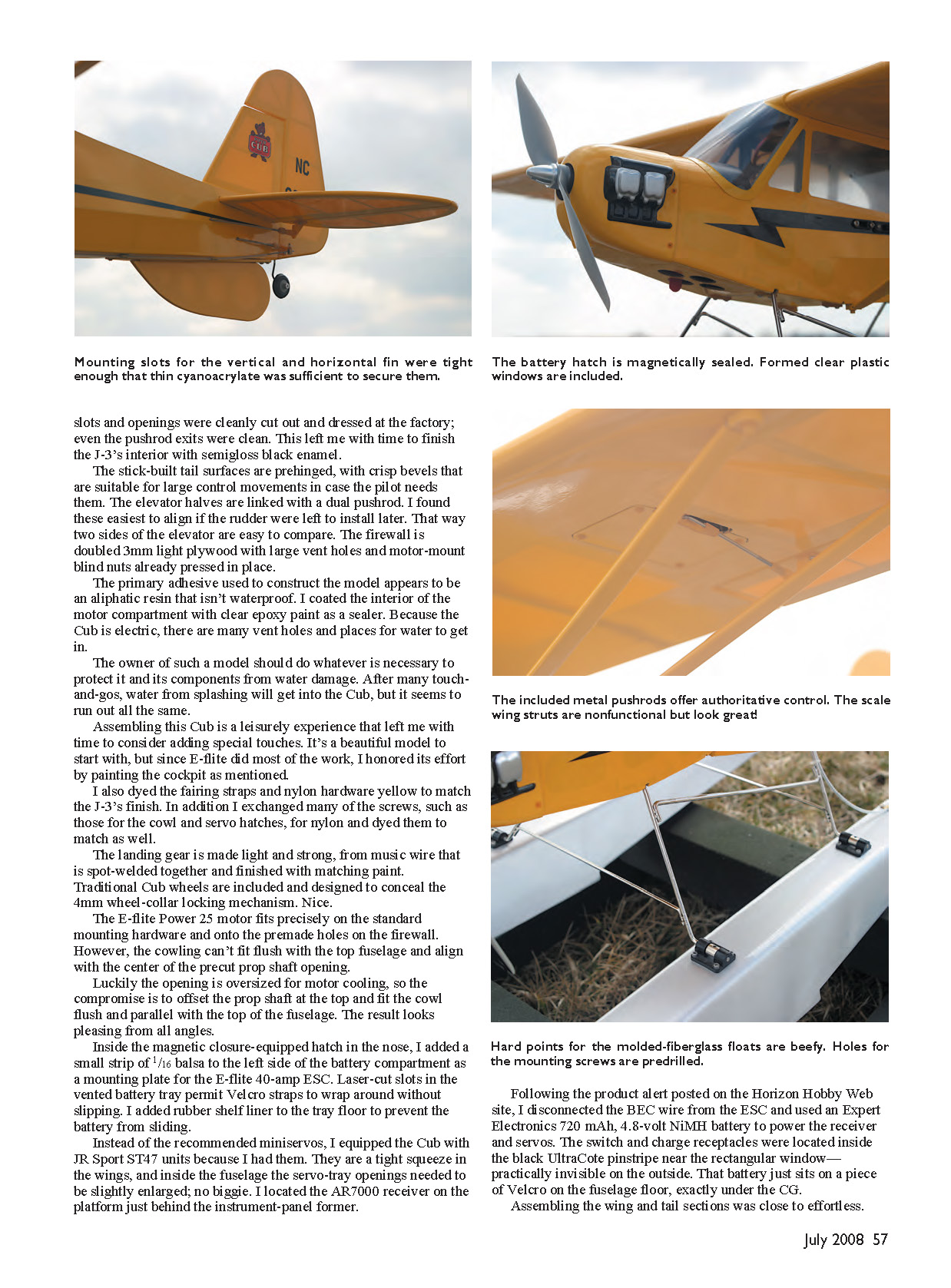
The model cruises at a good clip even under the burden of the floats. The recommended Power 25 motor system is well matched. Factory-included details such as scale wheels, graphics, and painted trim greatly increase this ARF's value. The E-flite Cub float kit includes chrome-plated wire gear and a subfin. All mounting points on the fuselage are laser-cut.
- Motor: E-flite Power 25 outrunner
- Battery: Thunder Power 3S 4200 mAh Li-Poly or E-flite 10-cell, 12-volt, 1800 mAh NiMH
- Propeller: APC 12 x 6E
- ESC: E-flite 40-amp brushless
- Motor output: 550 watts maximum
- Radio system: Spektrum DX7 transmitter; AR7000 receiver; four JR Sport ST47 servos; Expert Electronics 4.8-volt, 720 mAh receiver battery; standard switch; four servo extensions
- Ready-to-fly weight: 3.94 pounds; 5.84 pounds with floats
- Flight duration: 15 minutes; 10 minutes with floats
Pluses and Minuses
+ Outstanding construction and finish. + Continental engine detail on cowling. + Well designed to keep power-system components cool. + Easy five-minute conversion from land to sea.
- Factory motor location too low to center in cowling.
- Some hardware and screws stripped or were inadequate.
Construction
The J-3's contents include a typical ARF list of major assemblies and materials. Laser-cut parts are standard with this model, which is a huge plus these days. I thought it was a nice touch that all the slots and openings were cleanly cut out and dressed at the factory; even the pushrod exits were clean. This left me time to finish the J-3's interior with semigloss black enamel.
The wings are provided in halves, with all the aileron hinge slots made with the cyanoacrylate-type hinges dry-fitted in place. The airfoil is similar to a Clark Y—flat aft of the main spar with only a shallow curved entry at the leading edge. The full-scale Cub has a similar airfoil that accounts for its favorable high-lift and slow-speed handling characteristics.
The model's fuselage is constructed from light plywood with balsa stringers and sheeting. The stick-built tail surfaces are prehinged, with crisp bevels that are suitable for large control movements in case the pilot needs them. The elevator halves are linked with a dual pushrod. I found these easiest to align if the rudder was left to install later; that way both sides of the elevator are easy to compare. The firewall is doubled 3mm light plywood with large vent holes and motor-mount blind nuts already pressed in place.
The primary adhesive used to construct the model appears to be an aliphatic resin that isn't waterproof. I coated the interior of the motor compartment with clear epoxy paint as a sealer. Because the Cub is electric, there are many vent holes and places for water to get in. The owner of such a model should do whatever is necessary to protect it and its components from water damage. After many touch-and-gos, water from splashing will get into the Cub, but it seems to run out just the same.
Assembling this Cub is a leisurely experience that left me time to consider adding special touches. It's a beautiful model to start with, but since E-flite did most of the work, I honored its effort by painting the cockpit as mentioned. I also dyed the fairing straps and nylon hardware yellow to match the J-3's finish. In addition, I exchanged many of the screws, such as those for the cowl and servo hatches, for nylon and dyed them to match.
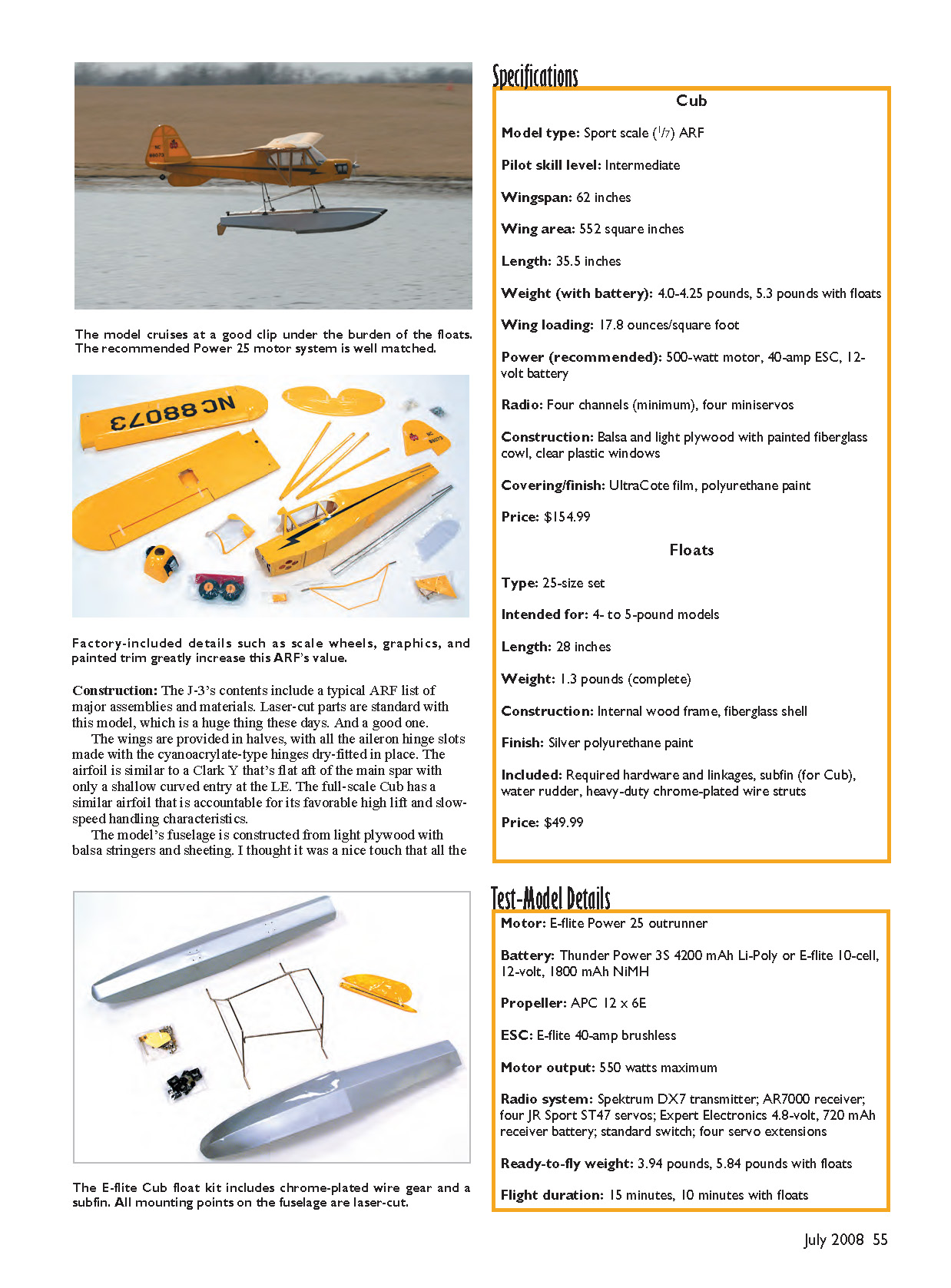
The landing gear is made light and strong from music wire that is spot-welded together and finished with matching paint. Traditional Cub wheels are included and designed to conceal the 4mm wheel-collar locking mechanism.
The E-flite Power 25 motor fits precisely on the standard mounting hardware and onto the premade holes on the firewall. However, the cowling can't fit flush with the top fuselage and align with the center of the precut prop shaft opening. Luckily the opening is oversized for motor cooling, so the compromise is to offset the prop shaft at the top and fit the cowl flush with the top of the fuselage. The result looks pleasing from all angles.
Inside the magnetic-closure hatch in the nose, I added a small strip of 1/16" balsa to the back side of the battery compartment as a mounting plate for the E-flite 40-amp ESC. Laser-cut slots in the vented battery tray permit Velcro straps to wrap around without slipping. I added rubber shelf liner to the tray floor to prevent the battery from sliding.
Instead of the recommended miniservos, I equipped the Cub with JR Sport ST47 units because I had them. They are a tight squeeze in the wings, and inside the fuselage the servo-tray openings need to be slightly enlarged; no big deal. I located the AR7000 receiver on the platform just behind the instrument-panel former.
Following the product alert posted on the Horizon Hobby website, I disconnected the BEC wire from the ESC and used an Expert Electronics 720 mAh, 4.8-volt NiMH battery to power the receiver and servos. The switch and charge receptacles were located inside the black UltraCote pinstripe near the rectangular window—practically invisible on the outside. That battery just sits on a piece of Velcro on the fuselage floor, exactly under the CG.
Assembling the wing and tail sections was nearly effortless. The built wing dropped into place and aligned perfectly. The tail surfaces aligned with no correction to the mounting slots. The joints for the stabilizer and fin were so tight and precise that I used only thin cyanoacrylate instead of epoxy to lock them into position.
The pushrods are my favorite: solid 2-56 metal wire. The two elevator rods join in the cockpit with two 4mm wheel collars. The setscrews in the collars were too short to tightly bind the wires to my preference, so I substituted longer screws. To be on the safe side, I smeared J.B. Weld epoxy on the collar-and-wire joints.
To make the recommended CG, the 3S 4200 mAh Thunder Power pack sits in the front of the compartment. A 10-cell, 1800 NiMH pack has to sit back farther. I also tested a 20C 3200 mAh 3S pack, which met the power and aft-CG limit with no problem. I prefer the lighter pack for flying from water.
Get It Together
Horizon Hobby and E-flite pride themselves on producing an assembly manual that is just as good as the product. They consider the beginner when writing and illustrating the instructions. No stone is left unturned. See how this model goes together by downloading the instruction manuals:
- J-3 Cub 25 ARF: www.horizonhobby.com/ProdInfo/Files/EFL4000_J-3_Cub.pdf
- 25-Size Fiberglass ARF Floats: www.horizonhobby.com/ProdInfo/Files/EFLA500_Float_Set.pdf
Study these documents to aid in assembly speed or create a shopping list. What you don't see in this review article will probably be in these instruction manuals. MA
—Michael Ramsey
Flying
This J-3 Cub on wheels leaps from the runway like a classic Cub—it wants to fly. The wheels are a little small to cut through heavy grass, so I recommend the soft-field takeoff technique.
The Power 25 motor and APC 12 x 6E propeller blast tons of air over the control surfaces, making them effective enough to counter torque and crosswinds. The recommended control throws are perfect for scale handling, but I like more rudder authority with a Cub, so I prefer the high rate with approximately 30% exponential mixed in.
The Cub stalls straight ahead with a steady breeze but might drop a wingtip if the winds are light; all stalls are predictable. Turns require coordination of the aileron and rudder. This can be done manually or mixed with the radio. My DX7 uses a 60% aileron-to-rudder mix I can turn off with the gear switch.
Rolling the Cub isn't the easiest thing to do with grace, nor is inverted flight. It will do those maneuvers, but they look wobbly and out of place. Have at it, though! I'd like to see Farmer Brown do an outside loop in his J-3 the way this model can do it. Just kidding.
Landings on grass are best done in the three-point style to avoid nosing over or ground loops. This airplane can touch down on the mains on a smooth surface, just as the full-scale J-3 can.
In a crosswind the Cub loves to crab and slip into the current; approximately a 20° angle is easy to hold until touchdown, where the attitude can be changed to an upwind wing-low position until the wheels are down. In calm air this airplane can be slipped all the way down to the numbers and touch the ground one wheel at a time if the pilot wants. This model is fun!
Time to Get Wet
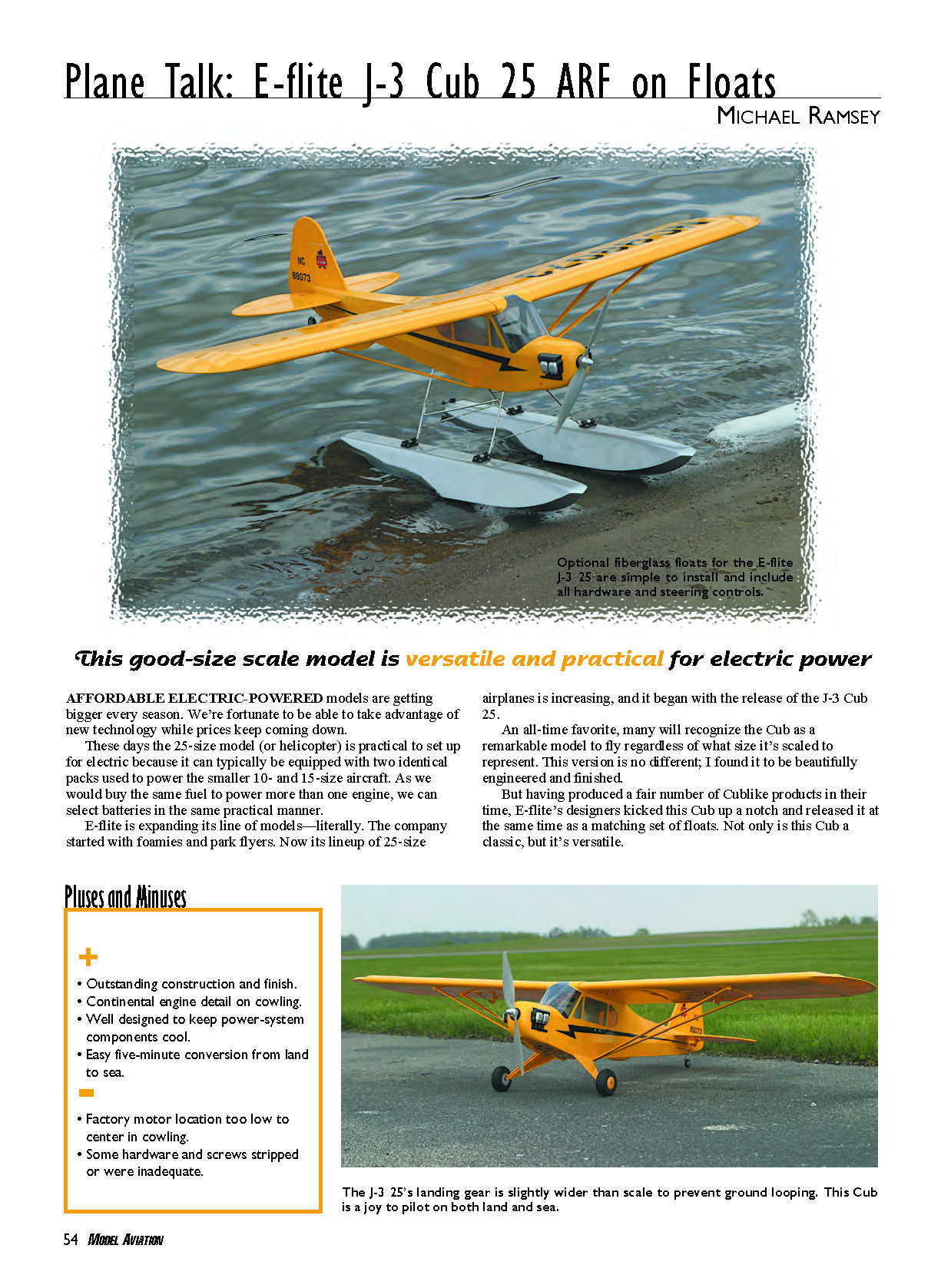
The E-flite 25-size float set emulates the look of Edo-style floats used on the full-scale J-3. The float exterior is fiberglass, watertight, and finished with silver polyurethane paint to look like aluminum. Internally there is a wooden structure with a keel and formers (visible through ripples in the fiberglass), which is linked to hard points for the struts and water rudder.
The float kit can be ordered to suit this Cub or the Ultra Stick 25; different landing-gear and water-rudder locations set the two apart. The struts for the Cub are made from heavy-duty music wire and come prebent and spot-welded together (in lieu of wire wrap and silver solder). Chrome plating protects the strut assembly from rust and corrosion.
After two of the mounting screws snapped off while securing them in the predrilled holes, I decided to substitute my own screws for both the gear legs and water rudder. The hard-point material is suitable for threading, so I ran a 4-40 tap in every hole and attached everything with socket-head screws.
With the exception of the water rudder, which tended to bind easily, assembling the float system on the J-3 Cub 25 was duck soup. (Ducks float almost as well as this airplane.) Once the rudder bracket was carefully reamed, smooth operation of the synchronous steering linkages ensued.
The brass water rudder naturally retracts or bobs if it interacts with debris or an obstacle in the water. It also lifts out of the water on takeoff, which naturally reduces its sensitivity—a good thing.
My Cub balanced perfectly with the floats mounted. I've seen some that needed roughly an ounce of lead on the front of the floats. The model sits correctly, with the bow of the floats raised out of the water slightly. Approximately 60% of the floats is visible above the water line, which is what I like to see; otherwise, they look like they're sinking. The floats' wide spread makes the water rudder essential, but a crosswind will have a hard time flipping this model over.
When flying from the water, remember that the pilot isn't finished flying until the motor is off and the airplane is beached. The model is as susceptible to the wind in the water as in the air, plus it has waves and water current to manage. This J-3 on floats can handle those elements.
The water rudder makes steering a joy, even in the wind, but be sure to mix the elevator and aileron controls to keep any wind from digging the floats into the water. Once into the wind, the Cub can be managed similar to as if it were on wheels, but a smooth acceleration procedure is essential. Once the model is on the step, it quickly gains airspeed and can be rotated smoothly from the water.
It's best to keep the climb rate fairly shallow until the feel of the float-laden Cub is appreciated. Use smooth control inputs and keep the flying scale-like. With 1.3 extra pounds and a ton of drag added, this J-3 isn't as sprightly as it was before with just wheels.
Now more than before, a pilot will appreciate the DX7 aileron/rudder mixing. Only a small amount of up-trim was required, and a more gingerly touch to the controls was a talent the model appreciated.
With the floats the Cub will loop and roll, but inverted flight is naturally a struggle. Rolls are much quicker with the aileron/rudder mix turned on. Okay, they look like snaps. (Farmer Brown says "Ouch!")
Stall turns are a thing of beauty. Where on wheels the Cub could cruise at half power, with the floats roughly two-thirds throttle is needed unless there's a strong head wind; then full power will be used often.
Landing approaches appreciate the pendulum effect the floats add to the model. Even with the higher wing loading, the Cub has a comfortable glide and naturally finds its approach glide slope to landing. As with the grass landing on wheels, go for the three-point landing, keeping the floats' tips as far from the water as possible.
As the pilot's comfort level increases, this J-3 can grow. I found the aft-CG point to be stable, which made the flare for landing much more stable. The limit was found during spin testing, where the Cub would depart and stick in a spin, especially when burdened with the floats. Mindful of this condition, the Cub is still a joy to fly. But that is a reminder that experimentation with the flight envelope should be done with a great deal of air between the wings and ground/water.
I like this Cub very much. I catch myself peeking at it in the shop, admiring the tight covering and close-fitting joinery that is faintly visible. Thank goodness E-flite didn't skimp on the cowling detail; a Cub without Continental valve covers protruding proudly just isn't finished.
On wheels, this Cub is so light that it could be flown from small fields. From water I like having a wide-open space; avoid the local pond that is surrounded by trees.
For power I favored the lighter 3200 mAh 3S pack, but the Thunder Power 4200 mAh 3S Li-Poly battery provided the longest flight time and could easily be shifted to achieve the CG I liked.
I wasn't at all happy with the 12-volt NiMH performance. For a short flight from land it's an economical option, but it added a sense of struggle that this fine model didn't deserve.
A practical alternative to economy would be to use two 2100 mAh 3S Li-Poly batteries in series. The power and weight would be identical to that of the 3S 4200 mAh battery, and the two 2100 packs are great to use with smaller park-flyer models as well. MA
Michael Ramsey [email protected]
Manufacturer/Distributor
E-flite / Horizon Hobby Distributors 4105 Fieldstone Rd. Champaign, IL 61822 (800) 338-4639 www.horizonhobby.com
Products Used in Review
- DX7, AR7000: Spektrum; (800) 338-4639; www.spektrumrc.com
- Batteries: Thunder Power RC; (702) 228-8883; www.thunderpowerrc.com
- Receiver, servo batteries: Expert Electronics; (800) 338-4639; www.horizonhobby.com
- APC Propeller: Landing Products; (530) 661-0399; www.apcprop.com
Other Review Articles
- Quiet Flyer: July 2006
Transcribed from original scans by AI. Minor OCR errors may remain.

