
Plane Talk: Fliton Icon 312 ARF
David Adams
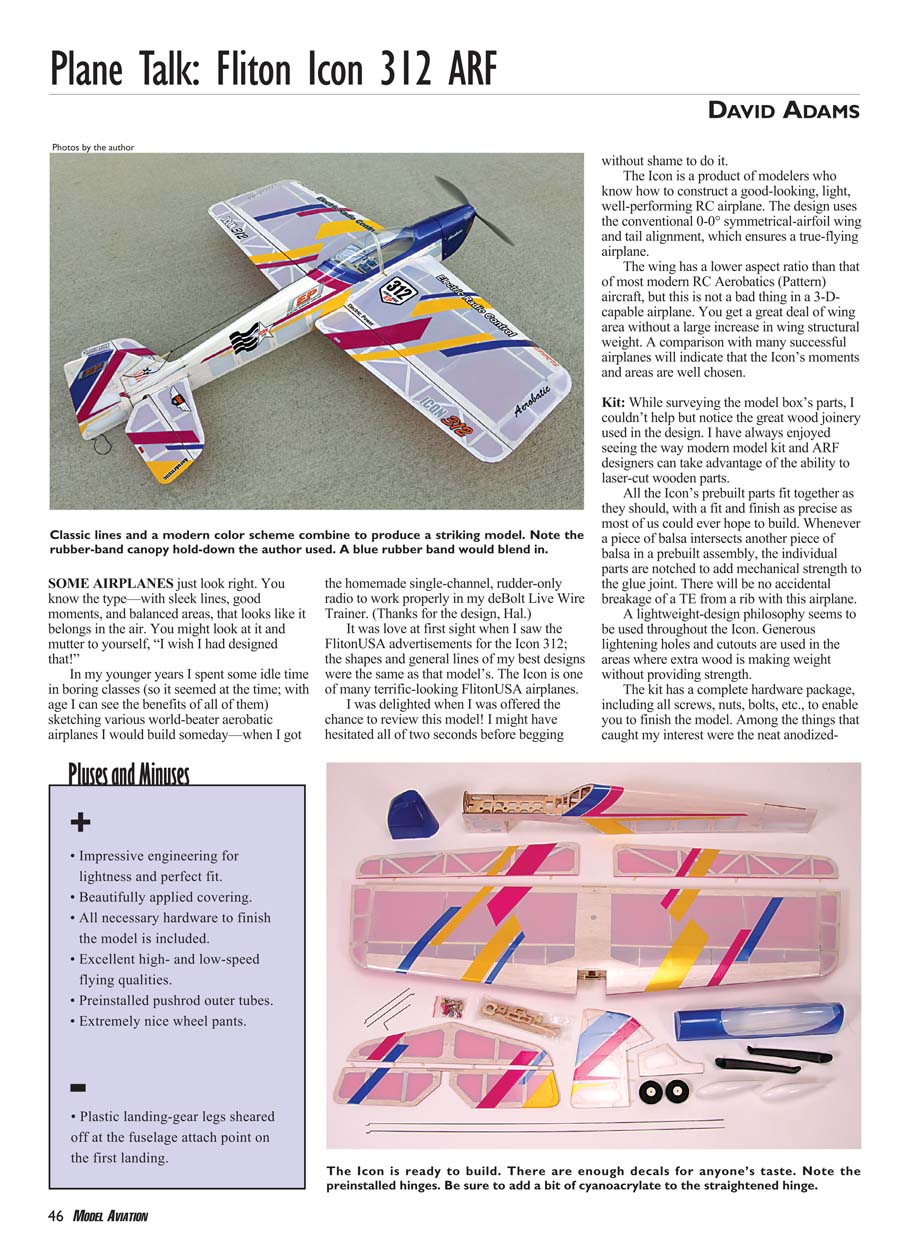
SOME AIRPLANES just look right. You know the type—with sleek lines, good moments, and balanced areas that look like they belong in the air. You might look at one and mutter to yourself, “I wish I had designed that!”
In my younger years I spent some idle time in boring classes (so it seemed at the time; with age I can see the benefits of all of them) sketching various world-beater aerobatic airplanes I would build someday—when I got the homemade single-channel, rudder-only radio to work properly in my deBolt Live Wire Trainer. (Thanks for the design, Hal.)
It was love at first sight when I saw the FlitonUSA advertisements for the Icon 312; the shapes and general lines of my best designs were the same as that model’s. The Icon is one of many terrific-looking FlitonUSA airplanes. I was delighted when I was offered the chance to review this model! I might have hesitated all of two seconds before begging without shame to do it.
The Icon is a product of modelers who know how to construct a good-looking, light, well-performing RC airplane. The design uses a conventional 0°–0° symmetrical-airfoil wing and tail alignment, which ensures a true-flying airplane.
The wing has a lower aspect ratio than that of most modern RC aerobatics (Pattern) aircraft, but this is not a bad thing in a 3-D-capable airplane. You get a great deal of wing area without a large increase in wing structural weight. A comparison with many successful airplanes will indicate that the Icon’s moments and areas are well chosen.
Kit
While surveying the model box’s parts, I couldn’t help but notice the great wood joinery used in the design. I have always enjoyed seeing the way modern model kit and ARF designers can take advantage of laser-cut wooden parts.
All the Icon’s prebuilt parts fit together as they should, with a fit and finish as precise as most of us could ever hope to build. Whenever a piece of balsa intersects another piece of balsa in a prebuilt assembly, the individual parts are notched to add mechanical strength to the glue joint. There will be no accidental breakage of a trailing edge from a rib with this airplane.
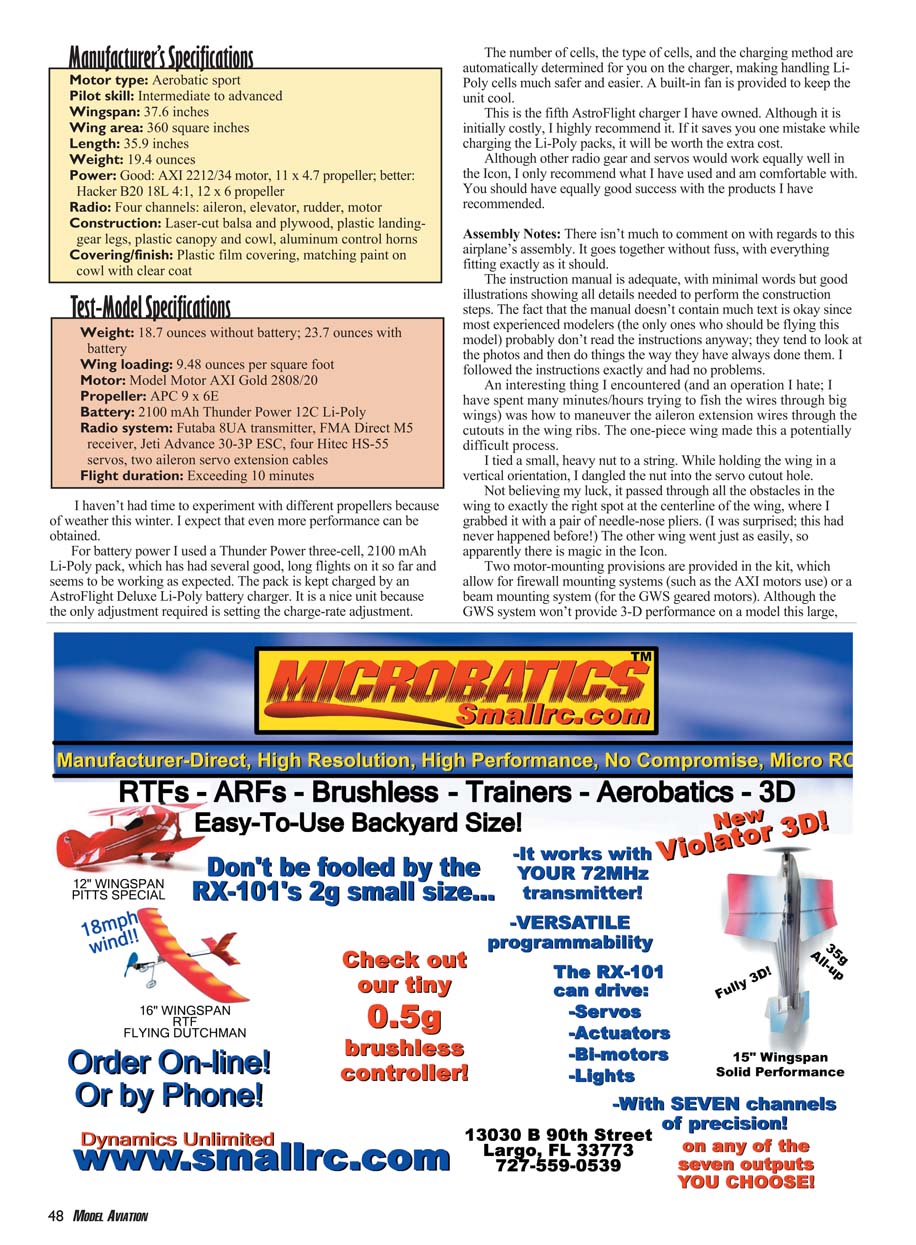
A lightweight-design philosophy seems to be used throughout the Icon. Generous lightening holes and cutouts are used where extra wood would add weight without providing strength.
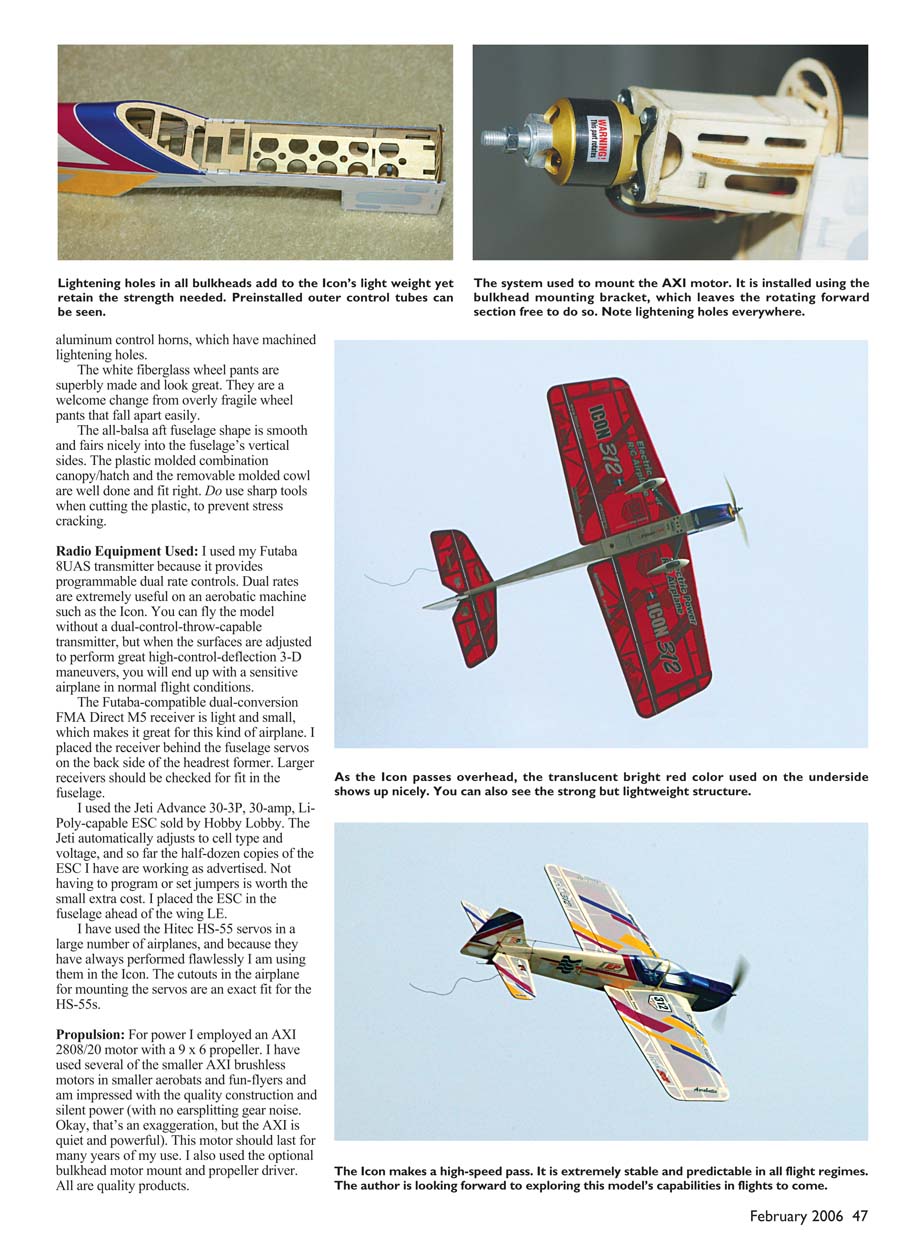
The kit has a complete hardware package, including all screws, nuts, bolts, etc., to enable you to finish the model. Among the things that caught my interest were the neat anodized-aluminum control horns, which have machined lightening holes. The white fiberglass wheel pants are superbly made and look great. They are a welcome change from overly fragile wheel pants that fall apart easily. The all-balsa aft fuselage shape is smooth and fairs nicely into the fuselage’s vertical sides. The plastic-molded combination canopy/hatch and the removable molded cowl are well done and fit right. Do use sharp tools when cutting the plastic to prevent stress cracking.
Radio Equipment Used
I used my Futaba 8UAS transmitter because it provides programmable dual-rate controls. Dual rates are extremely useful on an aerobatic machine such as the Icon. You can fly the model without a dual-control-throw-capable transmitter, but when the surfaces are adjusted to perform large high-control-deflection 3-D maneuvers, you will end up with a sensitive airplane in normal flight conditions.
The Futaba-compatible dual-conversion FMA Direct M5 receiver is light and small, which makes it great for this kind of airplane. I placed the receiver behind the fuselage servos on the back side of the headrest former. Larger receivers should be checked for fit in the fuselage.
I used the Jeti Advance 30-3P, a 30-amp, Li-Poly-capable ESC sold by Hobby Lobby. The Jeti automatically adjusts to cell type and voltage; so far the half-dozen copies of the ESC I have are working as advertised. Not having to program or set jumpers is worth the small extra cost. I placed the ESC in the fuselage ahead of the wing leading edge.
I have used the Hitec HS-55 servos in a large number of airplanes, and because they have always performed flawlessly I used them in the Icon. The cutouts in the airplane for mounting the servos are an exact fit for the HS-55s.
Propulsion
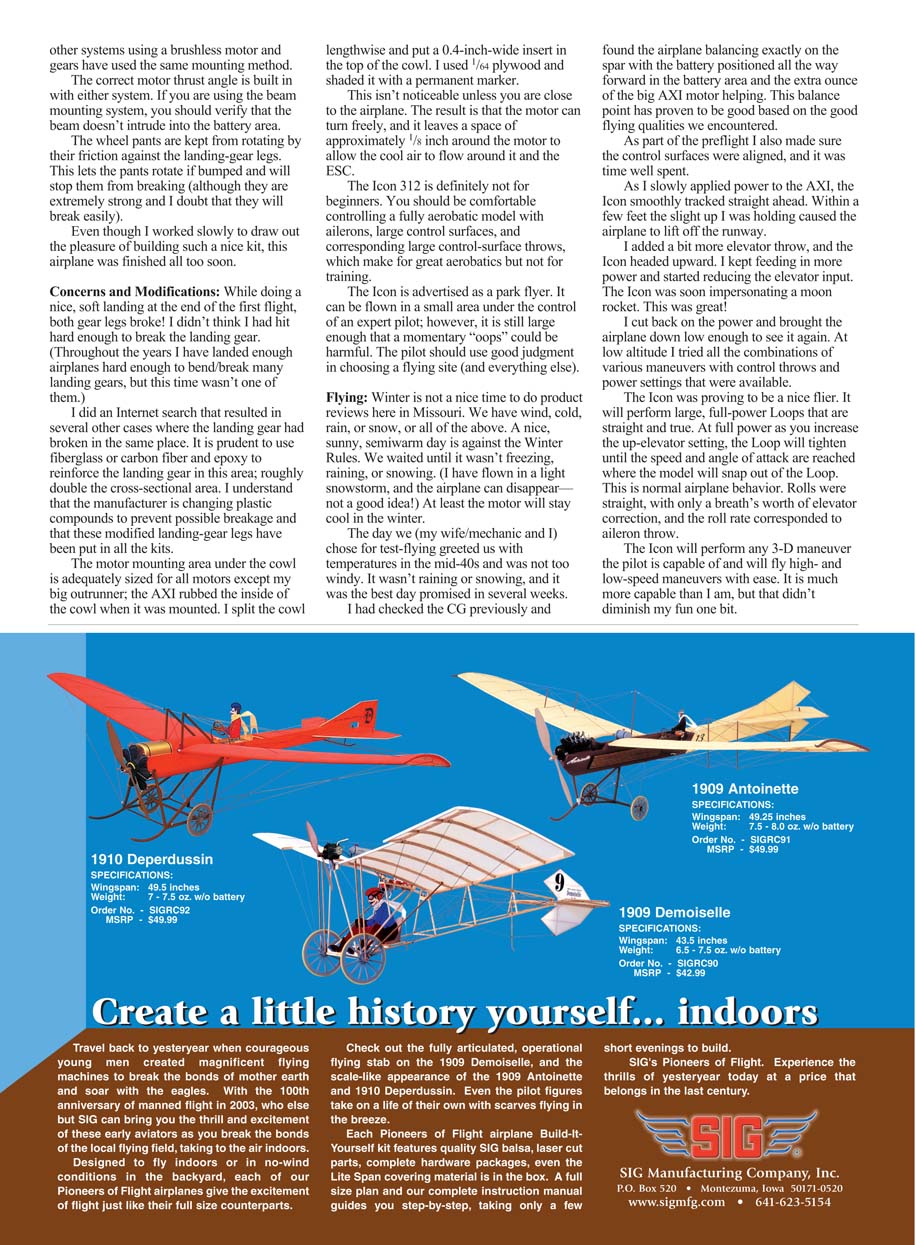
For power I employed an AXI 2808/20 motor with a 9 x 6 propeller. I have used several of the smaller AXI brushless motors in smaller aerobats and fun-flyers and am impressed with the quality construction and quiet, powerful operation. This motor should last for many years of use. I also used the optional bulkhead motor mount and propeller driver. All are quality products.
Pluses and Minuses
- Impressive engineering for lightness and perfect fit.
- Beautifully applied covering.
- All necessary hardware to finish the model is included.
- Excellent high- and low-speed flying qualities.
- Preinstalled pushrod outer tubes.
- Extremely nice wheel pants.
- Plastic landing-gear legs sheared off at the fuselage attach point on the first landing.
Manufacturer's Specifications
- Motor type: Aerobatic sport
- Pilot skill: Intermediate to advanced
- Wingspan: 37.6 inches
- Wing area: 360 square inches
- Length: 35.9 inches
- Weight: 19.4 ounces
- Power: Good: AXI 2212/34 motor, 11 x 4.7 propeller; Better: Hacker B20 18L 4:1, 12 x 6 propeller
- Radio: Four channels: aileron, elevator, rudder, motor
- Construction: Laser-cut balsa and plywood, plastic landing-gear legs, plastic canopy and cowl, aluminum control horns
- Covering/finish: Plastic film covering, matching paint on cowl with clear coat
Test-Model Specifications
- Weight: 18.7 ounces without battery; 23.7 ounces with battery
- Wing loading: 9.48 ounces per square foot
- Motor: Model Motor AXI Gold 2808/20
- Propeller: APC 9 x 6E
- Battery: 2100 mAh Thunder Power 12C Li-Poly
- Radio system: Futaba 8UAS transmitter, FMA Direct M5 receiver, Jeti Advance 30-3P ESC, four Hitec HS-55 servos, two aileron servo extension cables
- Flight duration: Exceeding 10 minutes
I haven't had time to experiment with different propellers because of winter weather. I expect even more performance can be obtained.
Battery and Charger
For battery power I used a Thunder Power three-cell, 2100 mAh Li-Poly pack, which has produced several good, long flights so far and seems to be working as expected. The pack is kept charged by an AstroFlight Deluxe Li-Poly battery charger. It is a nice unit because the only adjustment required is setting the charge-rate.
The charger automatically determines the number of cells, cell type, and charging method, making handling Li-Poly cells much safer and easier. A built-in fan keeps the unit cool.
This is the fifth AstroFlight charger I have owned. Although it is initially costly, I highly recommend it. If it saves you one mistake while charging Li-Poly packs, it will be worth the extra cost.
Although other radio gear and servos would work equally well in the Icon, I only recommend what I have used and am comfortable with. You should have equally good success with the products I have recommended.
Assembly Notes
There isn't much to comment on regarding this airplane's assembly. It goes together without fuss, with everything fitting exactly as it should.
The instruction manual is adequate, with minimal words but good illustrations showing all details needed to perform the construction steps. The fact that the manual doesn't contain much text is okay since most experienced modelers (the only ones who should be flying this model) probably don't read the instructions anyway; they tend to look at the photos and then do things the way they have always done them. I followed the instructions exactly and had no problems.
An interesting operation I hate is fishing wires through big wings. Maneuvering the aileron extension wires through the cutouts in the wing ribs could have been difficult because of the one-piece wing.
I tied a small, heavy nut to a string. While holding the wing in a vertical orientation, I dangled the nut into the servo cutout hole. Not believing my luck, it passed through all the obstacles in the wing to exactly the right spot at the centerline of the wing, where I grabbed it with a pair of needle-nose pliers. (I was surprised; this had never happened before!) The other wing went just as easily, so apparently there is magic in the Icon.
Two motor-mounting provisions are provided in the kit, which allow for firewall mounting systems (such as the AXI motors) or a beam mounting system (for the GWS geared motors). Although the GWS system won't provide 3-D performance on a model this large, other systems using a brushless motor and gears have used the same mounting method.
The correct motor thrust angle is built in with either system. If you are using the beam mounting system, verify that the beam doesn't intrude into the battery area.
The wheel pants are kept from rotating by their friction against the landing-gear legs. This lets the pants rotate if bumped and will stop them from breaking (although they are extremely strong and I doubt that they will break easily).
Even though I worked slowly to draw out the pleasure of building such a nice kit, this airplane was finished all too soon.
Concerns and Modifications
While doing a nice, soft landing at the end of the first flight, both gear legs broke. I didn't think I had hit hard enough to break the landing gear. (Throughout the years I have landed enough airplanes hard enough to bend/break many landing gears, but this time wasn't one of them.)
I did an Internet search that resulted in several other cases where the landing gear had broken in the same place. It is prudent to reinforce the landing gear in this area with fiberglass or carbon fiber and epoxy, roughly doubling the cross-sectional area. I understand that the manufacturer is changing plastic compounds to prevent possible breakage and that these modified landing-gear legs have been put in all the kits.
The motor mounting area under the cowl is adequately sized for all motors except my big outrunner; the AXI rubbed the inside of the cowl when it was mounted. I split the cowl lengthwise and put a 0.4-inch-wide insert in the top of the cowl. I used 1/64-inch plywood and shaded it with a permanent marker.
This isn't noticeable unless you are close to the airplane. The result is that the motor can turn freely and there is approximately 1/8 inch of clearance around the motor to allow cool air to flow around it and the ESC.
The Icon 312 is definitely not for beginners. You should be comfortable controlling a fully aerobatic model with ailerons, large control surfaces, and corresponding large control-surface throws, which make for great aerobatics but are not suitable for primary training.
The Icon is advertised as a park flyer. It can be flown in a small area under the control of an expert pilot; however, it is still large enough that a momentary "oops" could be harmful. The pilot should use good judgment in choosing a flying site (and everything else).
Flying
Winter is not a nice time to do product reviews here in Missouri. We have wind, cold, rain, or snow, or all of the above. A nice, sunny, semiwarm day is against the Winter Rules. We waited until it wasn't freezing, raining, or snowing. (I have flown in a light snowstorm, and the airplane can disappear—not a good idea!) At least the motor will stay cool in the winter.
The day we (my wife/mechanic and I) chose for test-flying greeted us with temperatures in the mid-40s and was not too windy. It wasn't raining or snowing, and it was the best day promised in several weeks.
I had checked the CG previously and found the airplane balancing exactly on the spar with the battery positioned all the way forward in the battery area and the extra ounce of the big AXI motor helping. This balance point has proven to be good based on the flying qualities we encountered.
As part of the preflight I also made sure the control surfaces were aligned, and it was time well spent.
As I slowly applied power to the AXI, the Icon smoothly tracked straight ahead. Within a few feet the slight up I was holding caused the airplane to lift off the runway.
I added a bit more elevator throw, and the Icon headed upward. I kept feeding in more power and started reducing the elevator input. The Icon was soon impersonating a rocket. This was great!
I cut back on the power and brought the airplane down low enough to see it again. At low altitude I tried all the combinations of various maneuvers with control throws and power settings that were available.
The Icon proved to be a nice flier. It will perform large, full-power loops that are straight and true. At full power, as you increase the up-elevator setting, the loop will tighten until the speed and angle of attack are reached where the model will snap out of the loop. This is normal airframe behavior. Rolls were straight, with only a breath's worth of elevator correction, and the roll rate corresponded to aileron throw.
The Icon will perform any 3-D maneuver the pilot is capable of and will fly high- and low-speed maneuvers with ease. It is much more capable than I am, but that didn't diminish my fun one bit.
The only downer of the day was the breakage of the landing-gear struts; everything else was terrific. I am having a difficult time waiting for the next good day.
Conclusion
The Icon 312 is good-looking and well constructed. The well-proven aerodynamic configuration ensures that it will be a winner with modelers everywhere.
With reduced control throws the Icon can be flown comfortably by almost anyone with aileron experience. The more experienced pilot can take advantage of the aerodynamic performance the Icon delivers in its smooth, predictable manner.
I highly recommend the Icon, and it has found a permanent home in my model-airplane hangar.
MA
David Adams [email protected]
Manufacturer
FlitonUSA 4790 Irvine Blvd., Suite 105/229 Irvine, CA 92620 (888) 473-0856 www.fliton.com
Products used in review
- Futaba 8UAS transmitter: Great Planes Model Distributors, Box 9021, Champaign, IL 61826, (217) 398-8970, www.futaba-rc.com/radios/
- M5 receiver: FMA Direct, 5716A Industry Ln., Frederick, MD 21704, (800) 343-2934, www.fmadirect.com
- HS-55 servos: Hitec RCD USA, Inc., 12115 Paine St., Poway, CA 92064, (858) 748-6948, www.hitecrcd.com
- Jeti Advance 30-3P ESC: Hobby Lobby, 5614 Franklin Pike Cir., Brentwood, TN 37027, (615) 373-1444, www.hobby-lobby.com/jetiblue.htm
Transcribed from original scans by AI. Minor OCR errors may remain.

