
Plane Talk: Hangar 9 F-22 Raptor PTS ARF
Michael Ramsey
MY FIRST REAL RC model was basically a box with wings. And I loved it, although I knew it wouldn’t be the airplane I’d be flying forever. Before that particular model’s maiden flight, I was already looking ahead to the next model—and the one after that.
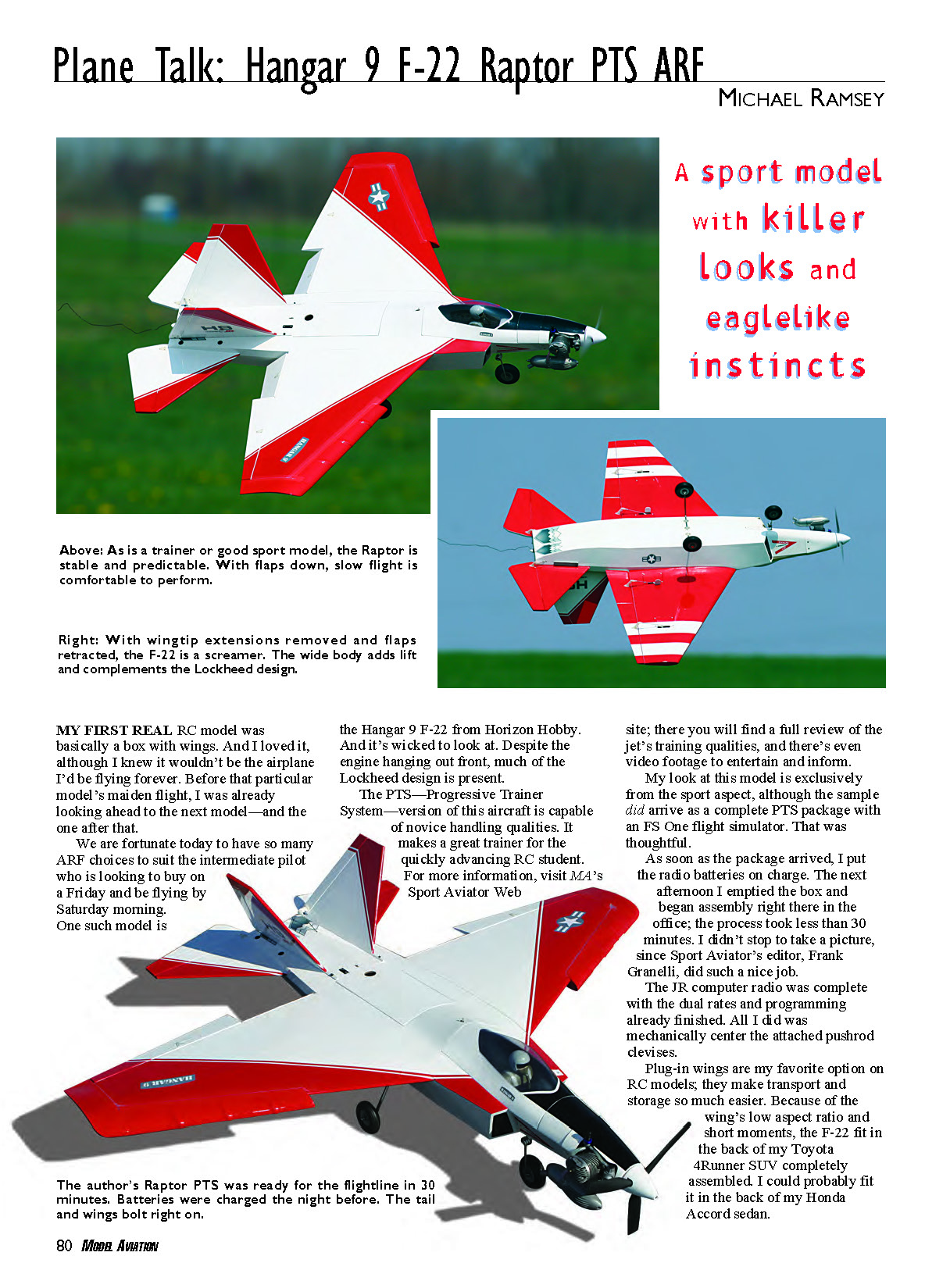
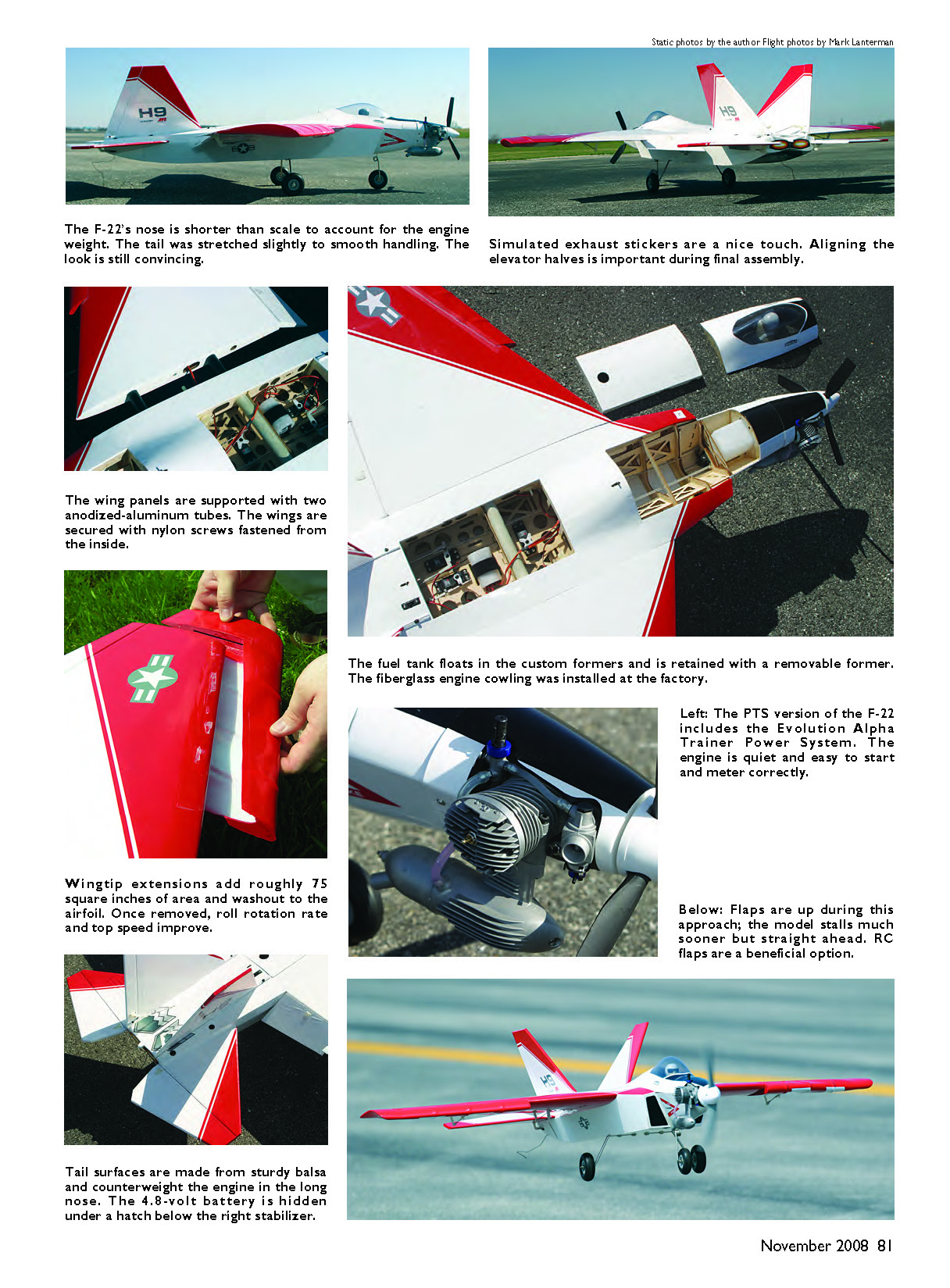
We are fortunate today to have so many ARF choices to suit the intermediate pilot who is looking to buy on a Friday and be flying by Saturday morning. One such model is the Hangar 9 F-22 from Horizon Hobby. And it’s wicked to look at. Despite the engine hanging out front, much of the Lockheed design is present.
The PTS—Progressive Trainer System—version of this aircraft is capable of novice handling qualities. It makes a great trainer for the quickly advancing RC student. For more information, visit MA’s Sport Aviator Web site; there you will find a full review of the jet’s training qualities, and there’s even video footage to entertain and inform.
My look at this model is exclusively from the sport aspect, although the sample did arrive as a complete PTS package with an FS One flight simulator. That was thoughtful.
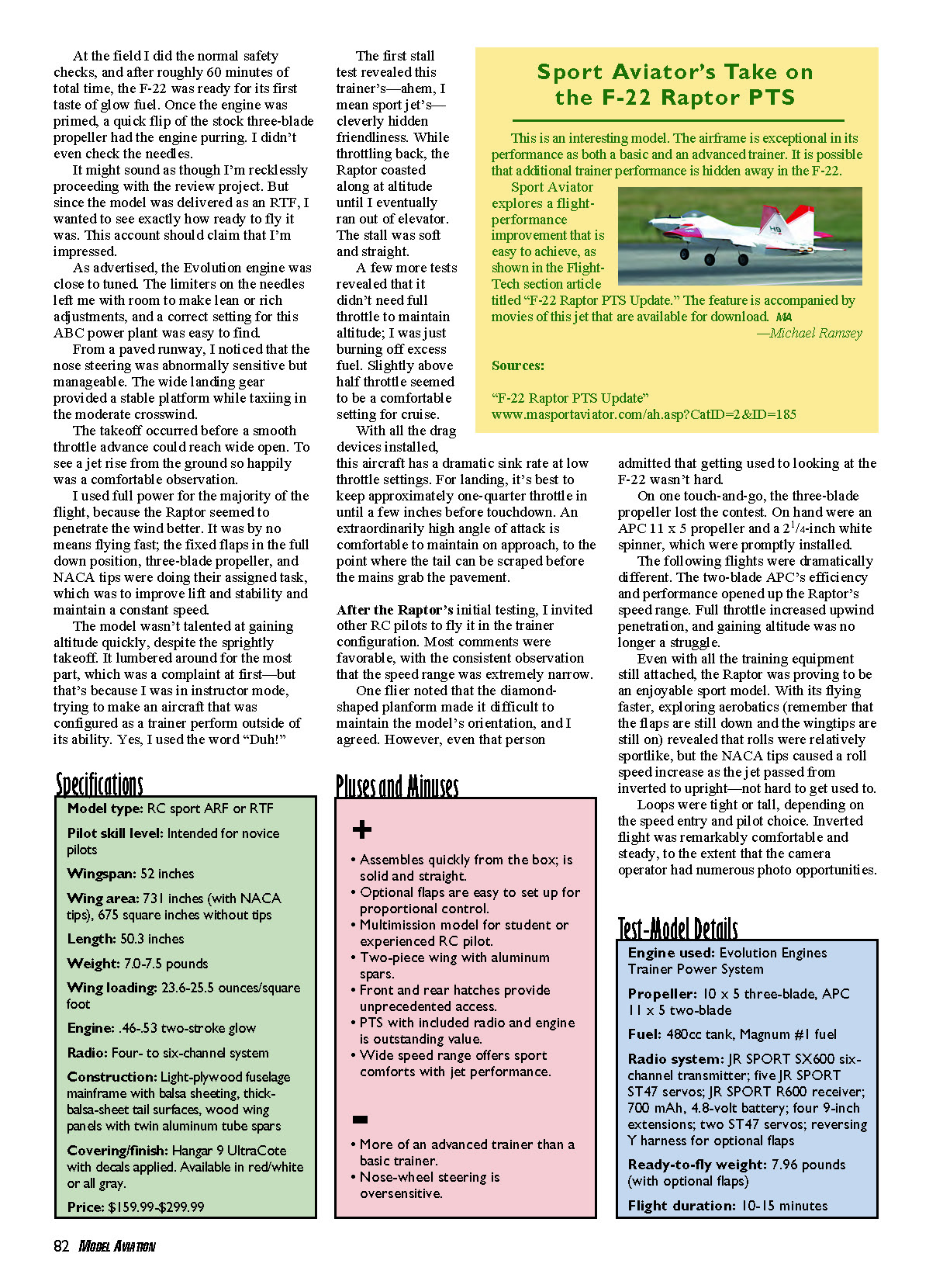
As soon as the package arrived, I put the radio batteries on charge. The next afternoon I emptied the box and began assembly right there in the office; the process took less than 30 minutes. I didn’t stop to take a picture, since Sport Aviator’s editor, Frank Granelli, did such a nice job.
The JR computer radio was complete with the dual rates and programming already finished. All I did was mechanically center the attached pushrod clevises.
Plug-in wings are my favorite option on RC models; they make transport and storage so much easier. Because of the wing’s low aspect ratio and short moment, the F-22 fit in the back of my Toyota 4Runner SUV completely assembled. I could probably fit it in the back of my Honda Accord sedan.
The F-22's nose is shorter than scale to account for the engine weight. The tail was stretched slightly to smooth handling. The look is still convincing.
Simulated exhaust stickers are a nice touch. Aligning the elevator halves is important during final assembly.
The wing panels are supported with two anodized-aluminum tubes. The wings are secured with nylon screws fastened from the inside.
The fuel tank floats in the custom formers and is retained with a removable former. The fiberglass engine cowling was installed at the factory.
Wingtip extensions add roughly 75 square inches of area and washout to the airfoil. Once removed, roll rotation rate and top speed improve.
Left: The PTS version of the F-22 includes the Evolution Alpha Trainer Power System. The engine is quiet and easy to start and meter correctly.
Below: Flaps are up during this approach; the model stalls much sooner but straight ahead. RC flaps are a beneficial option.
Tail surfaces are made from sturdy balsa and counterweight the engine in the long nose. The 4.8-volt battery is hidden under a hatch below the right stabilizer.
At the field I did the normal safety checks, and after roughly 60 minutes of total time, the F-22 was ready for its first taste of glow fuel. Once the engine was primed, a quick flip of the stock three-blade propeller had the engine purring. I didn’t even check the needles.
It might sound as though I’m recklessly proceeding with the review project. But since the model was delivered as an RTF, I wanted to see exactly how ready to fly it was. This account should claim that I’m impressed.
As advertised, the Evolution engine was close to tuned. The limiters on the needles left me with room to make lean or rich adjustments, and a correct setting for this ABC power plant was easy to find.
From a paved runway, I noticed that the nose steering was abnormally sensitive but manageable. The wide landing gear provided a stable platform while taxiing in the moderate crosswind.
The takeoff occurred before a smooth throttle advance could reach wide open. To see a jet rise from the ground so happily was a comfortable observation.
I used full power for the majority of the flight, because the Raptor seemed to penetrate the wind better. It was by no means flying fast; the fixed flaps in the full down position, three-blade propeller, and NACA tips were doing their assigned task, which was to improve lift and stability and maintain a constant speed.
The model wasn’t talented at gaining altitude quickly, despite the sprightly takeoff. It lumbered around for the most part, which was a complaint at first—but that’s because I was in instructor mode, trying to make an aircraft that was configured as a trainer perform outside of its ability. Yes, I used the word “Duh!”
The first stall test revealed this trainer’s—ahem, I mean sport jet’s—cleverly hidden friendliness. While throttling back, the Raptor coasted along at altitude until I eventually ran out of elevator. The stall was soft and straight.
A few more tests revealed that it didn’t need full throttle to maintain altitude; I was just burning off excess fuel. Slightly above half throttle seemed to be a comfortable setting for cruise.
With all the drag devices installed, this aircraft has a dramatic sink rate at low throttle settings. For landing, it’s best to keep approximately one-quarter throttle in until a few inches before touchdown. An extraordinarily high angle of attack is comfortable to maintain on approach, to the point where the tail can be scraped before the mains grab the pavement.
After the Raptor’s initial testing, I invited other RC pilots to fly it in the trainer configuration. Most comments were favorable, with the consistent observation that the speed range was extremely narrow.
One flier noted that the diamond-shaped planform made it difficult to maintain the model’s orientation, and I agreed. However, even that person admitted that getting used to looking at the F-22 wasn’t hard.
On one touch-and-go, the three-blade propeller lost the contest. On hand were an APC 11 x 5 propeller and a 2-1/4-inch white spinner, which were promptly installed.
The following flights were dramatically different. The two-blade APC’s efficiency and performance opened up the Raptor’s speed range. Full throttle increased upwind penetration, and gaining altitude was no longer a struggle.
Even with all the training equipment still attached, the Raptor was proving to be an enjoyable sport model. With its flying faster, exploring aerobatics (remember that the flaps are still down and the wingtips are still on) revealed that rolls were relatively sportlike, but the NACA tips caused a roll speed increase as the jet passed from inverted to upright—not hard to get used to.
Loops were tight or tall, depending on the speed entry and pilot choice. Inverted flight was remarkably comfortable and steady, to the extent that the camera operator had numerous photo opportunities.
Yes, you read that right: inverted low passes with the flaps fully deployed. Cool!
Two months of testing passed, and the Raptor’s wood structure fully acclimated to the Indiana weather. The wrinkles in the covering were enormous, but the seams were still tight.
Another thing I like very much about this model is that it has a completely bolt-together structure. The tail sections are held on with 4-40 socket screws, and the rest of the fasteners are #2 JIS (Japanese Industrial Standards) Phillips self-tapping screws.
To touch up and inspect the model, I tore it down to the components as it was delivered. The Hangar 9 UltraCote tightened easily; there is not a wrinkle anywhere, even now after a year.
While the jet was apart, I reinforced the nose area with light plywood, as Horizon Hobby recommended in a product bulletin. I also installed a longer steering arm in the nose to desensitize the control.
It was high time to stop pretending to fly the F-22 like a sport aircraft and start removing the stability enhancers. Flap servos were installed on the factory-provided hatches, along with the required reversing Y harness. The JR SPORT 600 permits two flap positions, but I use full throw the most.
Back at the field, I put the model’s pieces back together—this time with thread locker on the screws for peace of mind. I added an ounce of lead to the tail to put the balance point on the aft point of the CG range. Without fuel, the model barely sits on the mains; it wants to fall back on the simulated exhaust ports.
With the aft CG and operational flaps, I flew the jet for a tank solely to feel it out. Loops could be flown significantly tighter, and suddenly the slivers on the vertical fins, called rudders, had more effect.
Stall turns could be accomplished, but I witnessed a tendency to tuck and spin inverted—not nice. Stall turns with full throttle didn’t have the tuck/spin maneuver exit. Landings were as pleasant as before; full flap was preferred.
Raising the flaps naturally permitted a significant speed increase. My first thought after putting the flaps away was, “Rock and roll!” The Raptor had claws and zoomed about the sky as a sport model should.
With a head of steam, loops could be performed in a jetlike fashion; they were large and round. Tight turning was still comfortable, probably because the NACA tips effectively kept the wingtips in good air, and the roll performance was faster because of the increased airspeed capability.
With the wingtips removed and more than 70 square inches of area, I put up the aircraft again, completely clean. For shorter takeoffs, it’s better to have the flaps down; they are unnecessary with a long runway. From the way I’ve seen model jets perform, this one now resembled them more respectably.
Without the tips, tight turn handling is less steady at slow speed, but it has the feel of a Pylon Racing model with wide-open throttle. That whipping action during a roll disappeared with the tips gone.
Point rolls and rolling circles can be performed smoothly. High-speed passes become this model’s instinctive maneuver. Landing clean (flaps up) needs to be performed at a much higher speed and a much shallower flare than with the benefit of the additional area and stability that the NACA tips provide.
The experience is excellent practice for the “real” jet models I hope to pilot one day. The airframe, as I’ve learned, is overbuilt and can take stern punishment. I’ve tweaked the nose-gear former, but a healthy dose of epoxy permanently erased that bruise.
I wanted the Raptor because it was the “cool” model I wish was available when I started flying. Call it an RC modeler’s cure for a midlife crisis. Now I have something that flies like a jet when I want, or I can tame it by putting the wingtips back on or dropping the flaps.
The F-22’s Edwards Air Force Base test colors are highly visible. Hangar 9 also has an all-gray version, similar to the aircraft that frontline squadrons operated.
MA Michael Ramsey [email protected]
Manufacturer/Distributor:
Hangar 9/Horizon Hobby Inc. 4105 Fieldstone Rd. Champaign IL 61822 (800) 338-4639 www.hangar-9.com
Sources:
Sport Aviator www.masportaviator.com
Other Printed Reviews:
- Fly RC: September 2007
- Flying Models: October 2007, February 2008
- Model Airplane News: July 2007
- Radio Control Model World: October 2007
- RC Report: September 2007
- Sport Flyer: November 2007
Transcribed from original scans by AI. Minor OCR errors may remain.

