
Plane Talk: Hangar 9 Mustang PTS
Frank Granelli
The date is February 22, 1944. The skies over Europe are again aflame. It is Tuesday of "Big Week": the American air offensive to destroy the Luftwaffe. American B-17 and B-24 bombers of the 15th Air Force are nearing Regensburg to destroy German aircraft factories.
Suddenly, black dots appear on their noses. "German fighters, 4 o'clock" echoes over hundreds of intercoms. Closing speeds approach 500 mph as the dots become Me 109 fighters starting head-on attacks.
Crew members crouch behind tiny armor plates, knowing to expect the worst. Then, high in the western sky, the sun flashes brightly off of bare aluminum as silver wings bank 90° and roll into their dives. At more than 450 mph, the Mustangs of the yellow-tailed 52nd Fighter Group race in front of the bombers, making the airways ahead safe.
The Mustang legend continues. The date is June 4, 2005. It is Saturday and a 30-something-year-old man appears at the RC field with his young son. He has been here before. Even he is not sure why he has come back.
His imagination has been captured by the aerobatic airplanes that seem to rotate the sky itself, while Scale models subtly link the two aviation worlds. He has always had a "passing" interest in aviation, but today the field has given his interest concrete form.
He finally starts to talk to a few pilots—especially the one with the model of the North American P-51 Mustang, which was the hero of so many airplane movies he grew up with. He has wanted to fly one since he saw his first "airplane movie." However, this man quickly learns that you can't learn to fly model aircraft with a Mustang. At least two years of flying one of those boxy, Cessna-looking typical trainers and then an advanced trainer is the minimum experience required before he can even think about buying the Mustang. He is disappointed but still not totally lost to us. Then his son says, "I want to fly the fighter—not one of those stupid, old things." They walk away and we lose two potential new modelers.
How many times have RC instructors seen the sad disappointment on potential model pilots' faces when they have discovered the facts about learning to fly? Many understand it and buy that high-wing trainer. But that doesn't mean they are happy about it! Many others walk away, usually believing that the difficulties are being exaggerated or that three airplanes are too much, or they are let down because they can't "have it all" now.
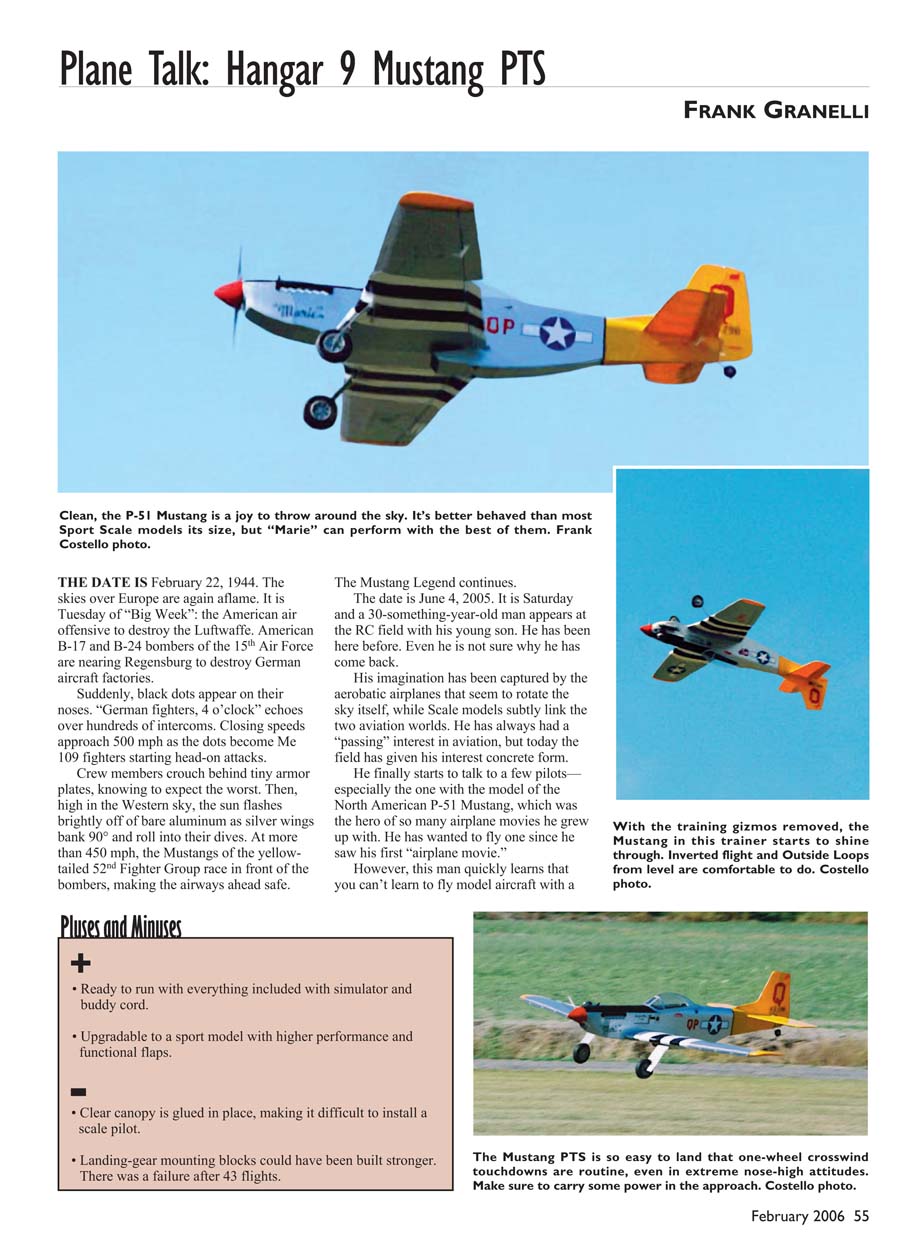
If the date had been September 4, 2005, the outcome of that visit to the RC field might have been vastly better. You want to learn to fly with a Mustang? Great! Not only can you learn with one, but that same Mustang can teach you advanced piloting techniques while becoming one of the best-performing Sport Scale aircraft available. It is three airplanes in one.
Even better, this Mustang is an RTF. No building skills or special equipment are required. If you can spare 30 minutes to assemble the model, you can learn everything about RC piloting.
The cost is less than $400 for the airplane, radio, engine, and all airframe accessories, all factory installed. You save even more money since you will not need to buy that follow-up "advanced trainer" or Mustang kit; all three are in the Mustang PTS. There is definitely potential to grow our sport with this model.
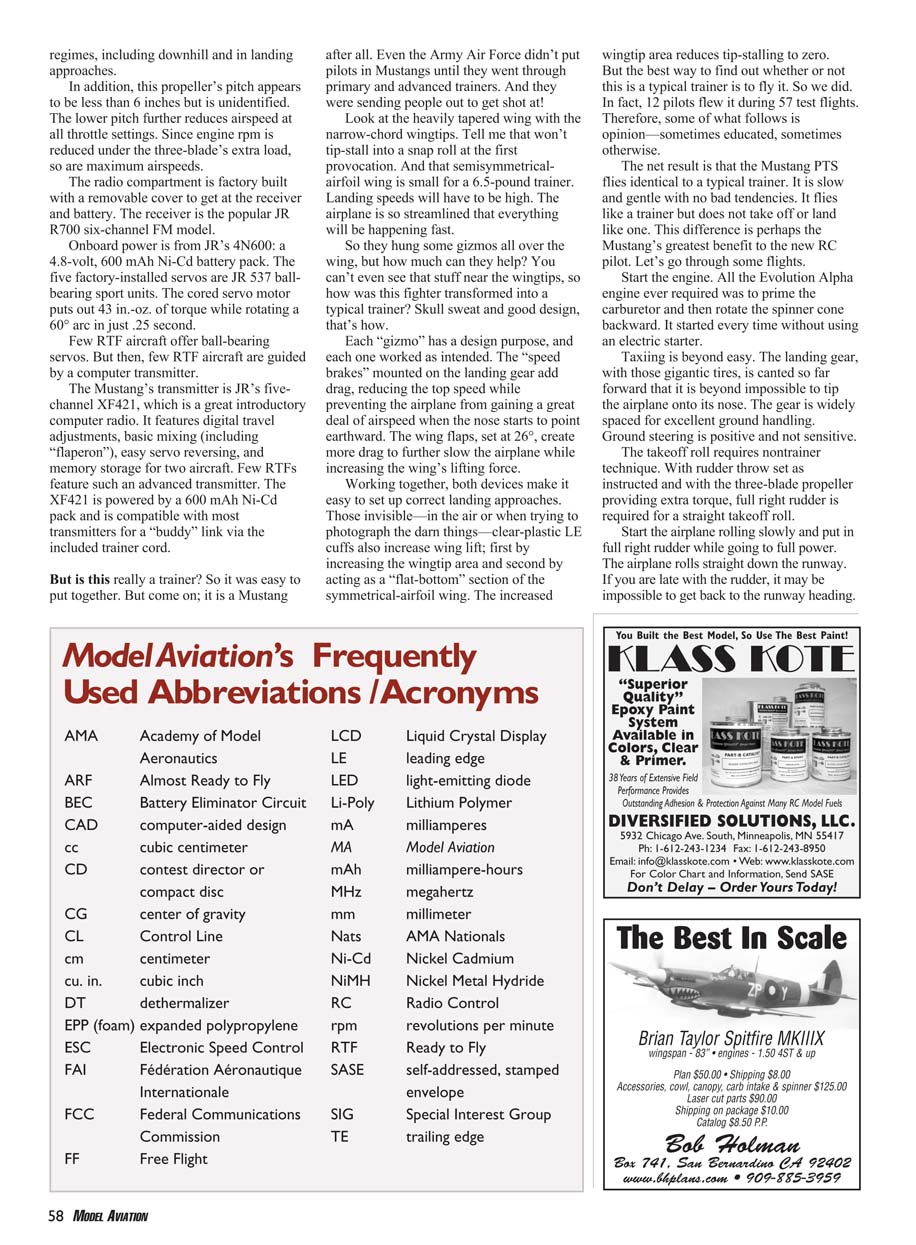
Everything with the Mustang is prebuilt, and even a flight simulator is included. Unfortunately my computer does not have the right connection for the simulator cord, and an adapter has not been located yet. This part of the review will have to be included on Model Aviation's Sport Aviator online magazine (www.masportaviator.com).
Specifications
- Model type: RC trainer/sport aerobatic RTF
- Pilot skill level: Beginner
- Wingspan: 58.25 inches
- Wing area (with droops): 627 square inches
- Length: 50 inches
- Weight: 6.5–7.0 pounds
- Wing loading: 24.8 ounces per square foot
- Engine (included): Evolution Engines Trainer Power System (installed)
- Propeller: Evolution 10.5 x 4 three-blade (installed)
- Radio (included): JR XF421EX five-channel system (installed)
- Construction: Laser-cut balsa and light plywood, steel-wire landing gear, clear plastic canopy, fiberglass cowl
- Covering/finish: Hangar 9 UltraCote, fuelproof paint on canopy frame, cowl, and landing-gear covers
- Flight duration: Exceeds 10 minutes at full throttle
- Price: $399.99
Assembly
Assembly time really is less than 30 minutes. I finished the aircraft in 21 minutes using just a screwdriver and pliers. (I did use a wrench to make sure the propeller was tight.)
Complete Assembly:
- Wing: Flaps, speed brakes, ailerons, bolt-on wing-mounting system, radiator scoop, and leading-edge (LE) cuffs are part of the main wing, yet assembly time is only about 10 minutes.
- Each wing half slides onto an aluminum tube with an alignment pin to ensure true alignment.
- The entire wing is held together by a single nylon strap.
- After joining the wing panels:
- Bolt the landing gear in place.
- Use the factory-made flap linkage rod to connect the flaps. The flaps use independent aileron-style torque tubes and are connected to a fixed wing tab.
- Clear-plastic wing droops are installed at the factory.
- Install the flap servo before the first flight—the mount is already there and installation takes roughly five minutes.
- Fuselage: Bolt on the tail feathers. Control surfaces and control horns are already installed. Use the two lock nuts provided to bolt everything firmly in place.
- Connect the two control rods to the middle hole on the control horns.
- Bolt the exhaust stacks onto the fuselage.
Everything fit well; stabilizer bolt holes are reinforced at the factory.
Power and Control
No, there isn't a scaled-down V-1650-7 Packard-built Merlin under the cowl. This model is powered by a factory-installed Evolution Engines Trainer Power System.
- Engine: A reliable ball-bearing two-stroke glow .45 cu. in. engine with mixture limiters to prevent damaging lean runs.
- It will turn an APC 10 x 6 prop at 13,600 rpm and an 11 x 5 at 13,000 rpm on 15% nitromethane sport fuel.
- Supplied propeller is a three-blade composite prop that the engine turns at 11,400 rpm. The three-blade design and relatively low pitch help keep airspeeds moderate.
- Radio compartment: Factory-built with a removable cover to access the receiver and battery.
- Receiver: JR R700 six-channel FM model.
- Onboard battery: JR 4N600 (4.8V, 600 mAh Ni-Cd).
- Servos: Five factory-installed JR 537 ball-bearing sport units (43 in.-oz. torque, 60° arc in 0.25 s).
- Transmitter: JR XF421 five-channel computer radio (digital travel adjustments, basic mixing including flaperon, servo reversing, memory for two aircraft). XF421 uses a 600 mAh Ni-Cd pack and supports buddy-box via included trainer cord.
Yes, it's a Mustang, but is it really a trainer? The design incorporates several features to make it forgiving for beginners while teaching advanced skills.
Flight Impressions
Twelve pilots flew it in 57 test flights, so some impressions are collective opinion and experience.
- Engine start: Prime the carb and rotate the spinner one click backward; the Evolution Alpha started reliably without an electric starter.
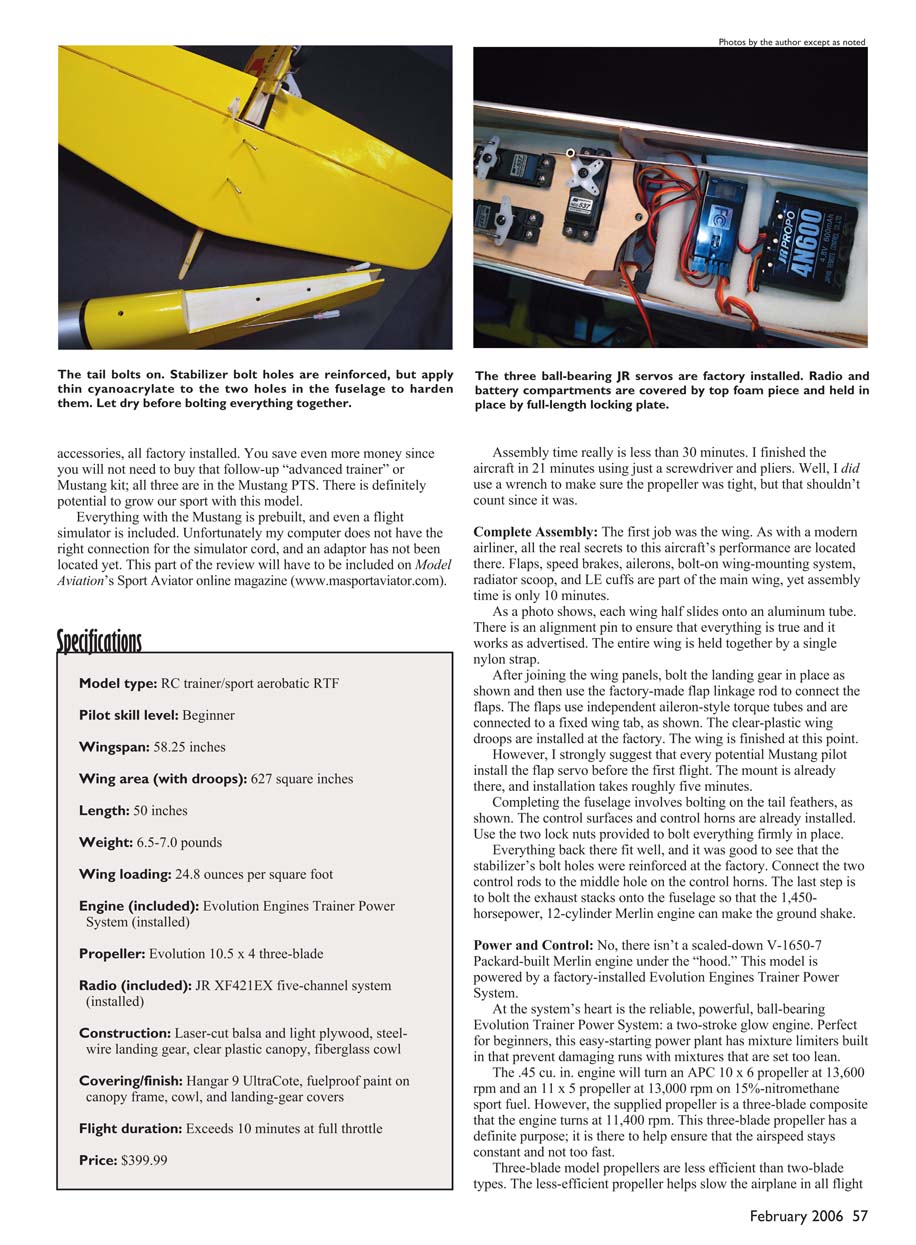
- Taxiing: Very easy. The landing gear, with large tires, is canted forward to prevent nose-overs and is widely spaced for excellent ground handling. Ground steering is positive and not sensitive.
- Takeoff: Requires non-trainer technique. With recommended rudder throw and the three-blade prop (extra torque), full right rudder is required for a straight takeoff roll.
- Start rolling slowly, apply full right rudder, then full power. If you are late with rudder, it may be impossible to get back to heading. This trains good rudder management during takeoffs.
- Climbout: Gentle and noncritical. Mismanage elevator—even to the point of stalling—and the Mustang tends to mush upward slightly with each oscillation; no tip-stalling or nose drop. Release full up and it returns to flight.
- Cruise: Approximately 60% throttle. Straight flight is stable. Turns up to ~45° bank require minimal up-elevator; steeper banks need about 30% up-elevator to maintain altitude.
- Letting the nose drop in a turn produces little speed increase and there is no tendency to "balloon" during level-off.
- No tip-stall tendency even in tight turns at slow speeds. The Mustang remains tolerant of control abuse—even full crossed-control stalls.
- Spins and snap rolls: Spins are difficult and require power; rotation stops when power or elevator is reduced. Snap rolls are more like large barrel rolls (~3 seconds).
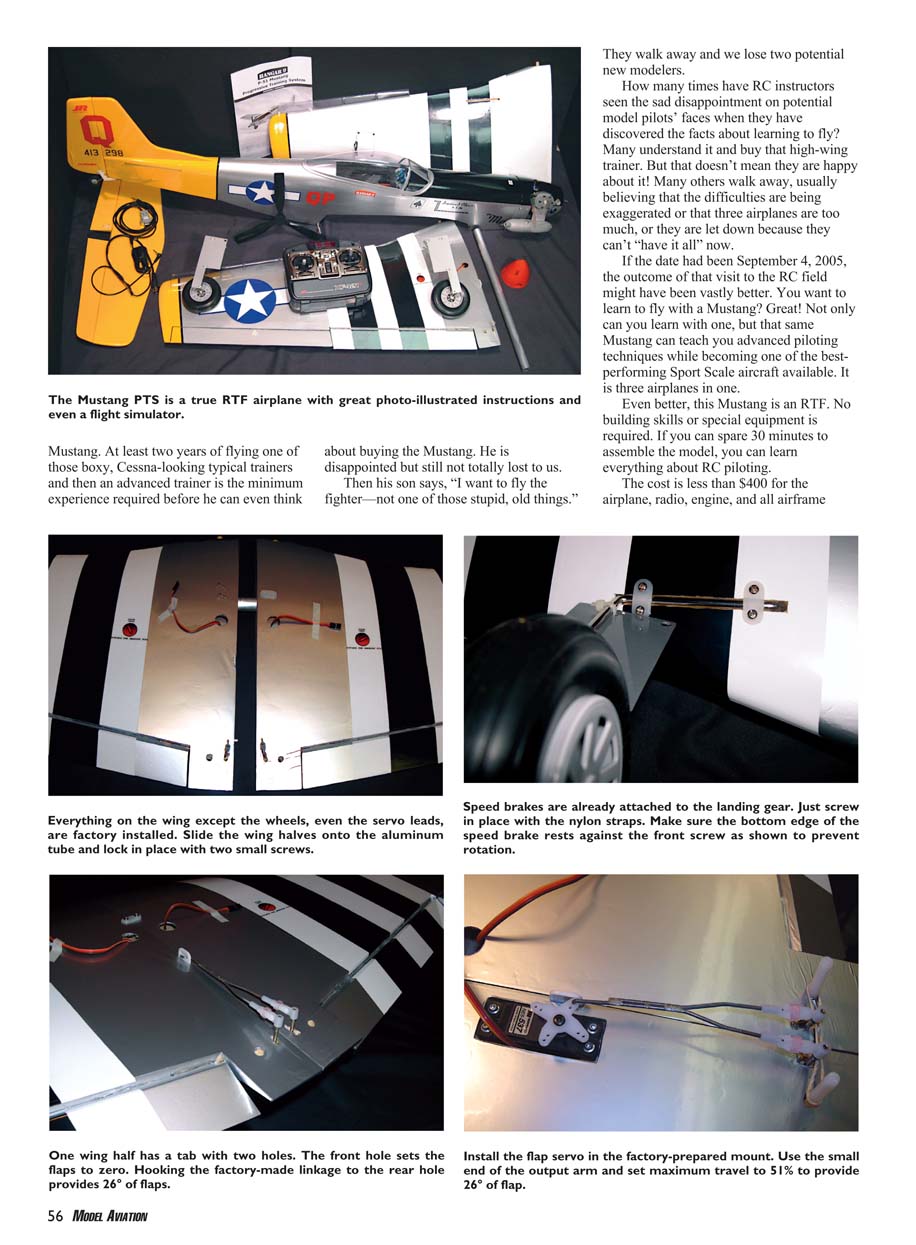
- Inverted flight: Straight inverted flight is barely possible; level inverted turns are not (the airplane runs out of down-elevator). Rudder effectiveness is limited, so knife-edge is impossible in the basic setup.
- Power-off stalls: Remarkable. Wings stay level, aileron control remains, and the model "floats" down very slowly—maybe 200 ft/min or less. From ~400 ft with engine at high idle and full up-elevator, the Mustang can float nearly the full field length.
- This is not a recommended landing technique; add power and reduce elevator for a normal approach.
- Landing: Different from a typical trainer. The Mustang PTS uses its speed brakes, flaps, and LE droops to create drag; it is flown to land using engine power.
- Approach and touchdown are at trainer-like airspeeds, but approximately 30% engine power is needed to "glide" to the runway.
- The Mustang teaches power landings early, so a pilot masters power-for-altitude and elevator-for-airspeed techniques useful for high-performance sport and Scale aircraft.
- Flaps: Installing operating flaps is recommended. Without flaps and with engine failure, gliding distance is limited; raising flaps extends glide enough to "make the field" in some situations.
- Suggested transmitter settings: Channel 5 (flaps) travel to 51% to match the 26° flap deployment of the fixed mounting point.
Pilot feedback:
- Three student pilots not yet soloed used the buddy-box; two flew without instructor intervention and the third needed minimal help. All felt the Mustang PTS would be a great trainer.
- Five newly soloed pilots and four club instructors also affirmed it is an easy trainer and that they could teach new pilots with it.
Conclusion: Yes, it behaves like a typical trainer, but with a twist—extra performance and different landing technique teach the student advanced skills early.
Beyond Training: Progressive Training System (PTS)
The PTS concept lets you reconfigure the airplane progressively for more advanced performance as the pilot’s skills grow.
Step progression (recommended):
- Initial PTS setup (trainer):
- Increase elevator travel to 105% up and 120% down.
- Set rudder movement to 150%.
- Set ailerons to 100% (factory 75%).
- Effects: More critical of elevator inputs, may drop nose in stall, ground handling more sensitive, less right rudder needed for takeoff, slightly quicker roll rate. Spins possible without engine power.
- Remove landing-gear speed brakes:
- Speed brakes are held by two plastic tie wraps—cut carefully to remove.
- Effect: Airspeed increases ~15%, loop diameter increases, controls feel more pitch-related and slightly more sensitive. Good intermediate stage toward Sport Scale performance.
- Reduce or remove flap settings (mechanical adjustment or transmitter switch):
- Effect: Airspeed increases ~50% over original; roll rate and control sensitivity increase. Without flaps and speed brakes, throttle control during landing is more critical, and takeoffs need longer ground runs. Knife-edge and slow rolls become more manageable.
- Remove leading-edge (LE) droops:
- LE droops are taped in place; peel tape away to remove them.
- Effect: The Mustang sheds much of its trainer forgivingness and becomes a P-51 Mustang fighter in handling. The safety net is gone—tight turns with excessive up-elevator can cause the bottom wing to drop and rotate into the turn. Spins become faster; recovery is immediate when controls are neutralized. Performance increases dramatically: smaller loops, faster rolls, better aerobatics.
- Propeller change (final step):
- Replace the three-blade prop with a two-blade performance propeller (APC 10 x 6 or 11 x 5 recommended; the author prefers 11 x 5).
- Effect: Top speed and acceleration increase significantly. Loops top ~150 ft diameter; rolls and other maneuvers become much faster. Approaches require a reliable idle near 2,300 rpm for manageable landings or use flaps. Increased performance makes field management and throttle control more critical.
Notes on upgrades:
- Each step increases performance and sensitivity predictably. The airplane remains controllable and docile through the intermediate stages but becomes a true Sport Scale performer when all training aids are removed.
- Knife-edge flight remains rudder-limited even after upgrades. Outside loops and advanced maneuvers are possible with small rudder inputs.
- Consider retractable landing gear as a future upgrade for realism and performance—this will require engineering.
For further details and additional flight performance numbers in various PTS configurations, see the Sport Aviator web site and Michael Ramsey’s Mustang PTS review in Sport Aviator.
Frank Granelli [email protected]
Distributor:
- Horizon Hobby, Inc.
4105 Fieldstone Rd. Champaign, IL 61822 (877) 504-0233 www.hangar-9.com
Transcribed from original scans by AI. Minor OCR errors may remain.

