
Plane Talk: Hangar 9 ShowTime 4D 90 ARF
Michael Ramsey
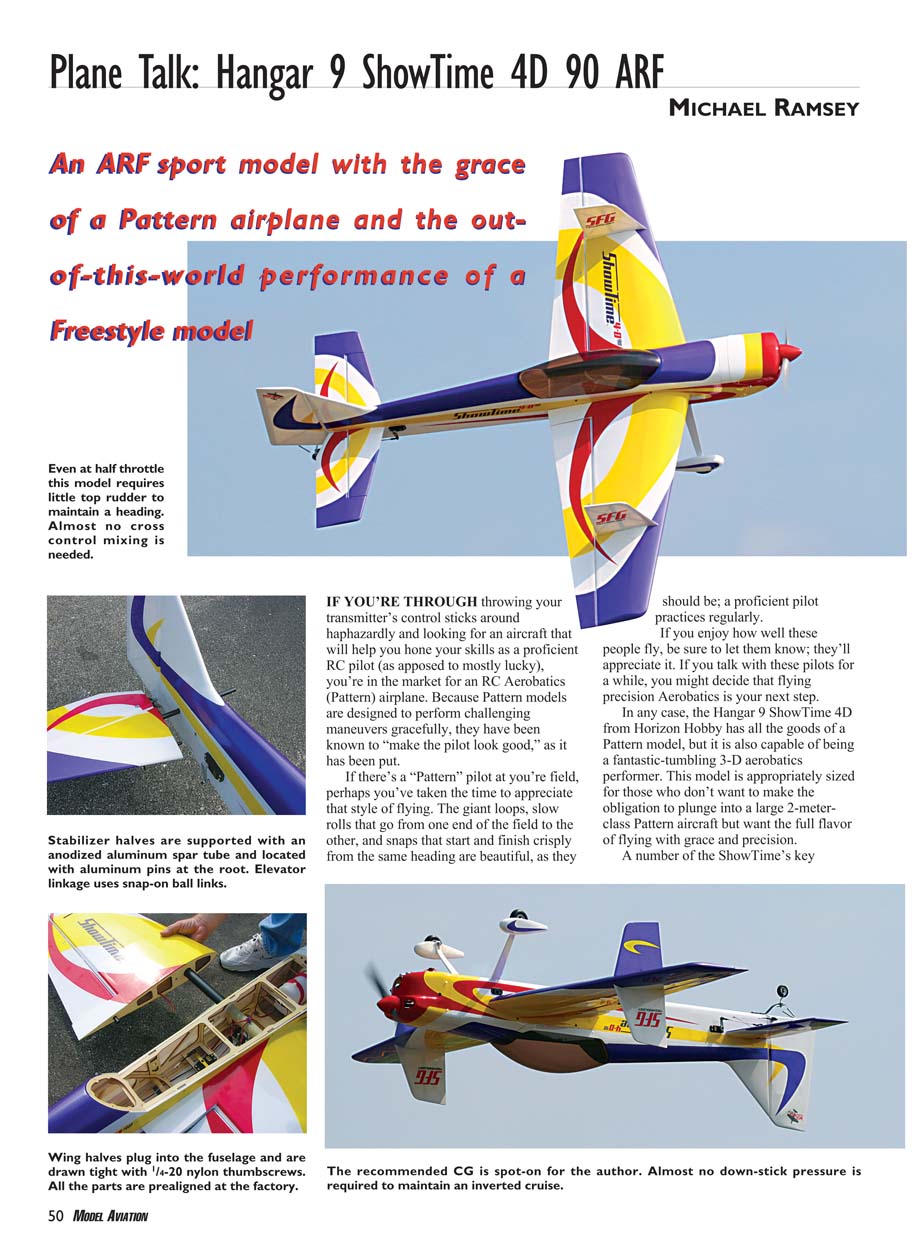
An ARF sport model with the grace of a Pattern airplane and the out-of-this-world performance of a Freestyle model
If you're through throwing your transmitter's control sticks around haphazardly and are looking for an aircraft that will help you hone your skills as a proficient RC pilot (as opposed to mostly lucky), you're in the market for an RC Aerobatics (Pattern) airplane. Because Pattern models are designed to perform challenging maneuvers gracefully, they have been known to "make the pilot look good."
If there's a Pattern pilot at your field, you may have taken the time to appreciate that style of flying. The giant loops, slow rolls that travel from one end of the field to the other, and snaps that start and finish crisply on the same heading are beautiful, as they should be; a proficient pilot practices regularly. If you enjoy that flying, let them know—they'll appreciate it. If you talk with these pilots for a while, you might decide that precision aerobatics is your next step.
The Hangar 9 ShowTime 4D from Horizon Hobby has all the goods of a Pattern model, but it is also capable of being a fantastic 3-D aerobatics performer. This model is appropriately sized for those who don't want the obligation of a large 2-meter-class Pattern airplane but want the full flavor of graceful, precise flying with the ability to go extreme when desired.
Design and features
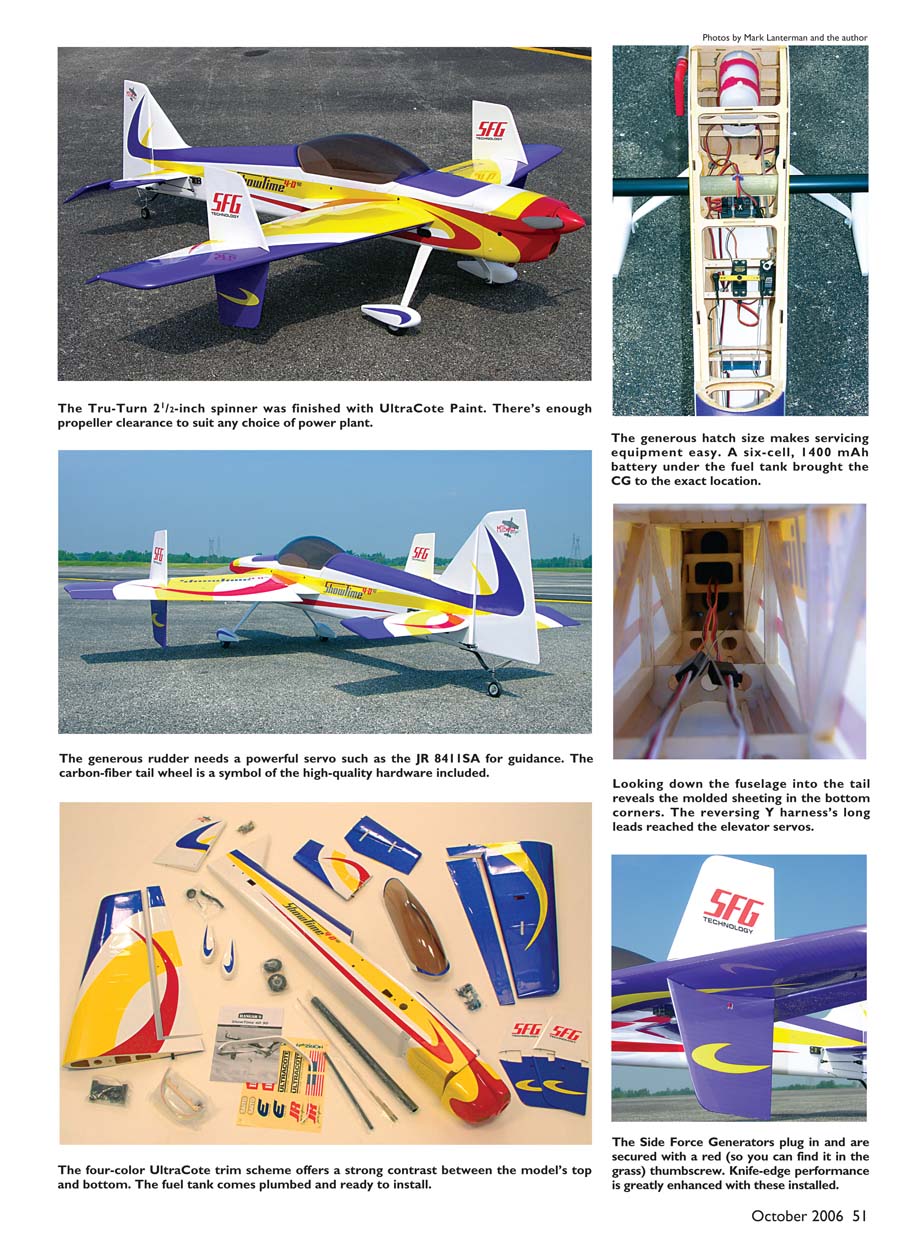
- Stabilizer halves are supported with an anodized aluminum spar tube and located with aluminum pins at the root.
- Elevator linkage uses snap-on ball links.
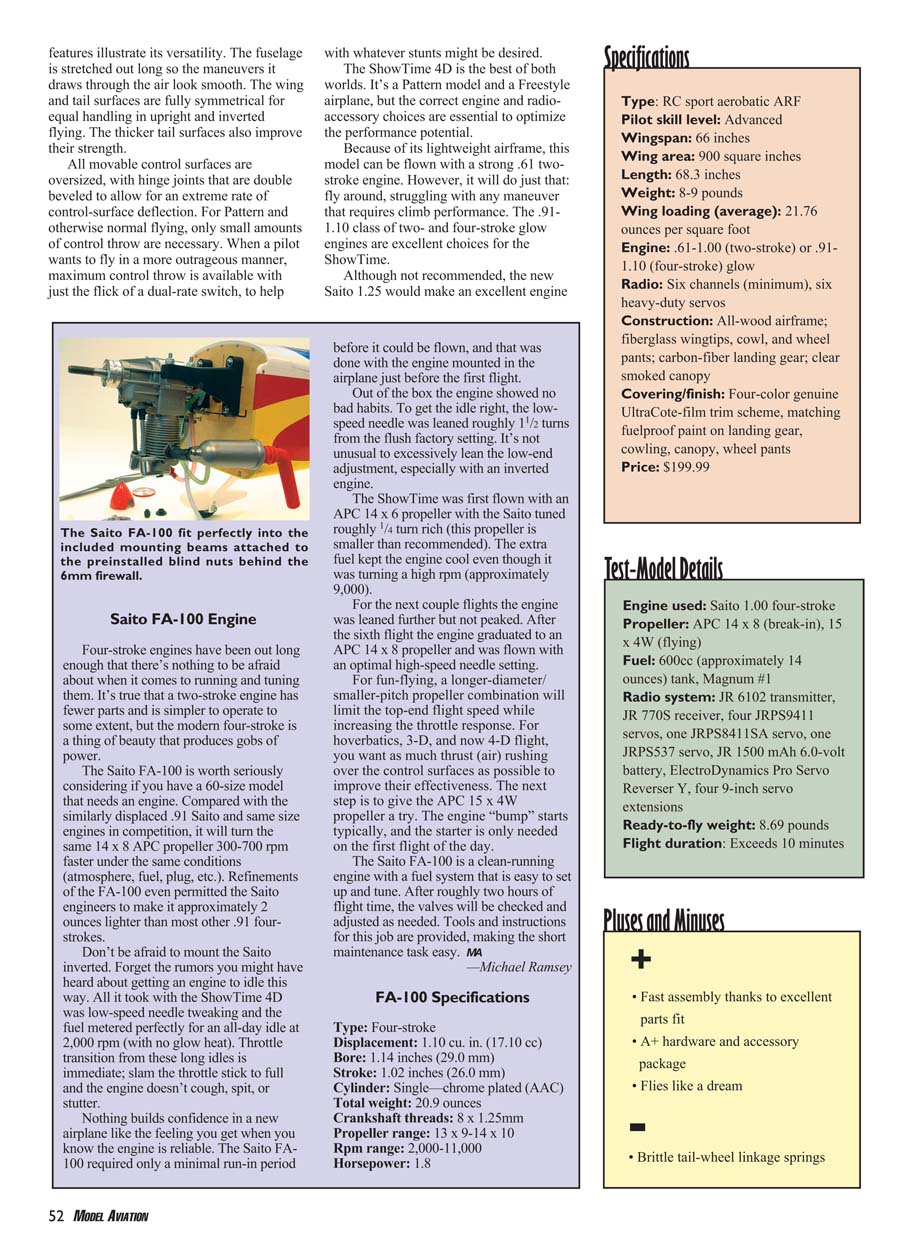
- Wing halves plug into the fuselage and are drawn tight with 1/4-20 nylon thumbscrews.
- All critical parts are prealigned at the factory; alignment between wing and stabilizer was accurate within 1/16 inch.
- Surfaces are fully symmetrical for equal upright and inverted handling; tail surfaces are thicker for improved strength.
- All movable control surfaces are oversized, with double-beveled hinge joints to allow extreme control-surface deflection.
- Side Force Generators (SFGs) are built from hard balsa, rigid and easy to install; they improve lateral stability, knife-edge performance, and rudder authority.
- Construction includes all-wood airframe with fiberglass wingtips, cowl, and wheel pants; carbon-fiber landing gear; clear smoked canopy.
- Covering/finish: Four-color genuine UltraCote-film trim scheme with matching fuelproof paint on landing gear, cowl, canopy, and wheel pants.
- Price: $199.99
The fuselage is long to give maneuvers a smooth look through the sky. For Pattern and normal flying, only small control throws are necessary; when you want to fly more outrageously, maximum throw is available via a dual-rate switch. The ShowTime is the best of both worlds—Pattern precision and Freestyle 3-D capability—but correct engine and radio-accessory choices are essential to optimize performance.
Power and propulsion
Because of its lightweight airframe, the ShowTime can be flown with a strong .61 two-stroke engine, but that will only allow modest climb performance. The .91–1.10 class of two- and four-stroke glow engines are excellent choices for balanced performance. Although not recommended for everyone, the new Saito 1.25 would make an excellent choice for a Masters or FAI-class competitor looking for a smaller practice model; it would give the ShowTime extra power for long vertical lines, snaps, and rolling maneuvers. If you choose larger-than-recommended power, good throttle management is essential to avoid overstressing the airframe and inducing flutter.
The ShowTime is also an excellent candidate for electric conversion. Weight distribution and servo-location options make installation straightforward. The large cockpit hatch makes servicing easy; you would want at least a 900–1,500 watt power system. The stock carbon-fiber landing gear is long enough to support up to an 18-inch propeller, so either direct drive or gearbox systems could be used.
Servos and radio
The manufacturer-recommended servos are high-quality and worth using. Because of the oversized control surfaces and high rates of deflection, powerful and smooth servos make a distinct difference. While the model is basically .60-size (where 50 in-oz servos might typically suffice), the ShowTime benefits from stronger digital servos. If budget-conscious, choose similar-power-output servos with coreless motors if not digital. High-quality servos determine how well this model can be controlled—this is more evident here than on typical .60-size models.
ShowTime on the bench (assembly)
Assembling the ShowTime was enjoyable thanks to quality construction and thoughtful engineering. Critical alignment areas were prepared at the factory: the vertical fin is built into the fuselage; stabilizer and elevators are mirror assemblies that plug into the tail using aluminum tube spars and alignment pins into fiberglass sockets. The wings attach similarly, secured by 1/4-20 nylon thumbscrews through the fuselage into each wing root. Little glue is required—cyanoacrylate for hinges and RC/56 for the canopy were the only adhesives used. The reviewer mounted the prepainted canopy with 4-40 nylon screws to facilitate later touch-ups or adding a pilot figure.
The included hardware package was exceptional: slop-free ball links, steel-bearing-supported clevises, carbon-fiber tail-wheel, socket-head screws, rubber wheels, and a preassembled seamless fuel tank. The firewall was predrilled and the illustrated manual was detailed and helpful, making engine mounting and cowl fitting straightforward. Cowl cutouts for muffler, cylinder head, and cooling exits were easy to size and locate following the manual.
Radio installation: the JR 6102 transmitter proved more than adequate. To mix dual elevator servos the reviewer used an ElectroDynamics servo-reversing Y harness; its heavy-duty leads were long enough for the tail servos. The rudder servo was mounted between the wings and connected with the provided pull-pull cable system; the flight pack and rudder servo helped achieve the recommended CG, with the battery locating under the fuel tank.
Power switch location required a small modification: a cutout was made in the fuselage behind the fuel tank and hidden under the wing leading edge to keep the switch away from the exhaust.
Pushrods were supplied at the correct length and machined with right-hand threads on one end and left-hand threads on the other, allowing fine-tuning. Following the recommended mechanical linkage setup, full travel on the channel's travel volume provided the recommended high-rate deflections. The reviewer used 50–75% exponential in high rates and reduced low rates to 20% (no exponential on low rates). The digital servos' precision helped mitigate the reduced resolution at low rates.
The SFGs plug in and are secured with a red thumbscrew for easy location in grass. Knife-edge performance is greatly enhanced with the SFGs installed.
Flying impressions
The ShowTime is as long as most quarter-scale models but is significantly easier to transport. Removing stabilizer halves and wing panels allows the fuselage to slide into a trunk or hatchback. On the ground, the oversized tail wheel keeps the model close to level, producing a subtle takeoff rotation.
With a Saito 1.00 four-stroke installed, liftoff occurs at approximately half-throttle; climb-out performance is respectable at roughly half throttle as well. The model flew right off the bench with only minor trim adjustments.
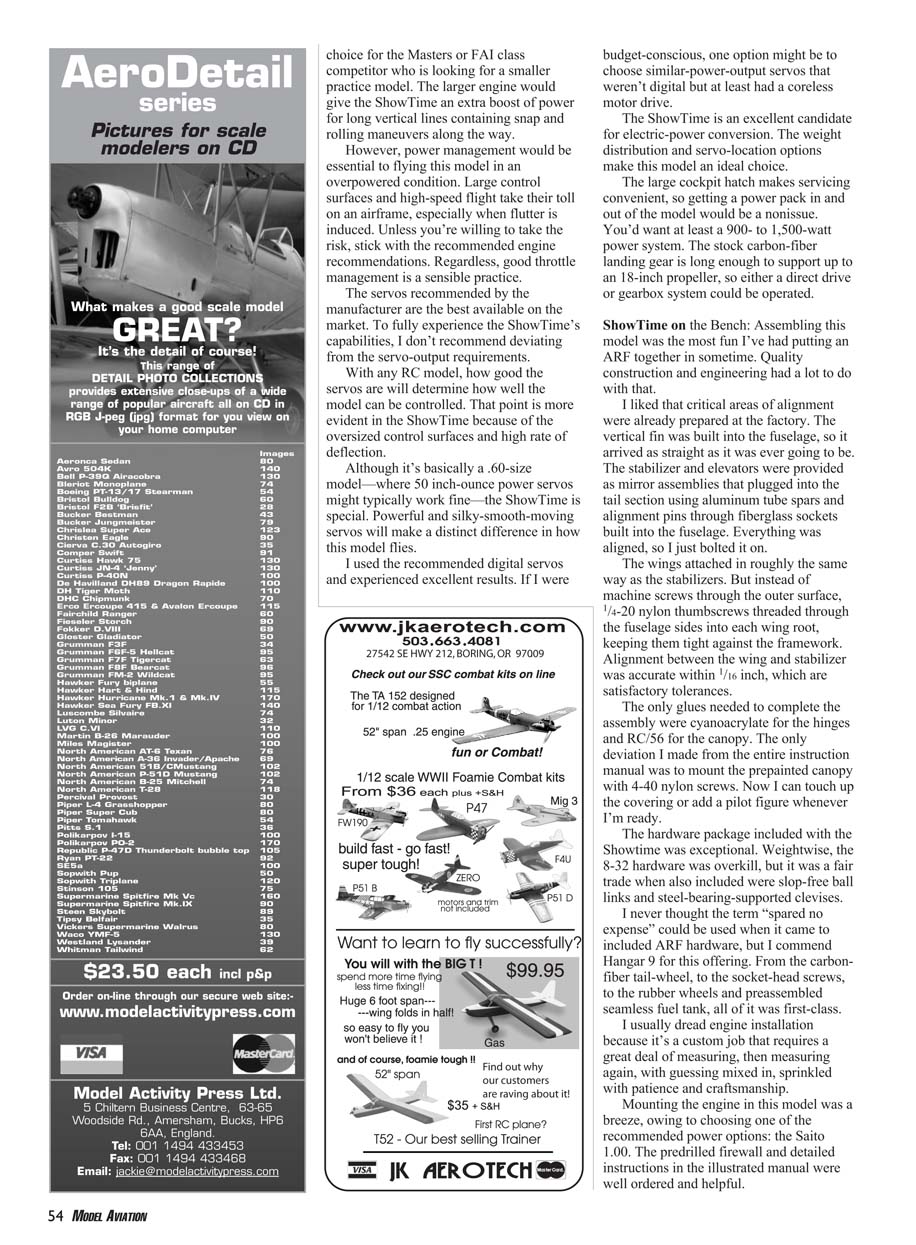
Level cruise can be performed with power at half and pitch neutral. The recommended CG is spot-on: almost no down-stick pressure is required to maintain inverted cruise, and even at half throttle the model needs little top rudder to maintain heading. Almost no cross-control mixing is needed. The generous hatch size makes servicing equipment easy. There's ample propeller clearance for a variety of power plants. Knife-edge and rudder authority require a strong rudder servo such as the JR PS8411SA.
Appearance and finish: the four-color UltraCote trim scheme offers strong contrast between top and bottom. The Tru-Turn 2-1/2-inch spinner was finished with UltraCote paint. The preplumbed fuel tank is ready to install.
Pluses and Minuses
- Exceptional hardware package, preassembled tank, and quality fittings
- Excellent factory alignment and fit
- Oversized control surfaces with high-rate capability
- Versatile: Pattern precision and 3-D Freestyle performance
- Good candidate for electric conversion
- Brittle tail-wheel linkage springs
Test-Model Details
- Engine used: Saito 1.00 four-stroke
- Propeller: APC 14 x 8 (break-in), 15 x 4W (flying)
- Fuel: 600 cc (approximately 14 ounces) tank, Magnum #1 fuel line/fittings
- Radio system: JR 6102 transmitter, JR 770S receiver, four JR PS9411 servos, one JR PS8411SA servo, one JR PS537 servo, JR 1500 mAh 6.0-volt battery, ElectroDynamics Pro Servo Reverser Y, four 9-inch servo extensions
- Ready-to-fly weight: 8.69 pounds
- Flight duration: Exceeds 10 minutes
Specifications
- Type: RC sport aerobatic ARF
- Pilot skill level: Advanced
- Wingspan: 66 inches
- Wing area: 900 square inches
- Length: 68.3 inches
- Weight: 8–9 pounds
- Wing loading (average): 21.76 ounces per square foot
- Engine: .61–1.00 (two-stroke) or .91–1.10 (four-stroke) glow recommended (Saito 1.25 not recommended for general use but an option for experienced competitors)
- Radio: Six channels (minimum), six heavy-duty servos recommended
- Construction: All-wood airframe; fiberglass wingtips, cowl, and wheel pants; carbon-fiber landing gear; clear smoked canopy
- Covering/finish: Four-color genuine UltraCote-film trim scheme with matching fuelproof paint on landing gear, cowl, canopy, and wheel pants
- Price: $199.99
Transcribed from original scans by AI. Minor OCR errors may remain.

