
Plane Talk: League Models Extra 330 ARF
By Michael Ramsey [email protected]
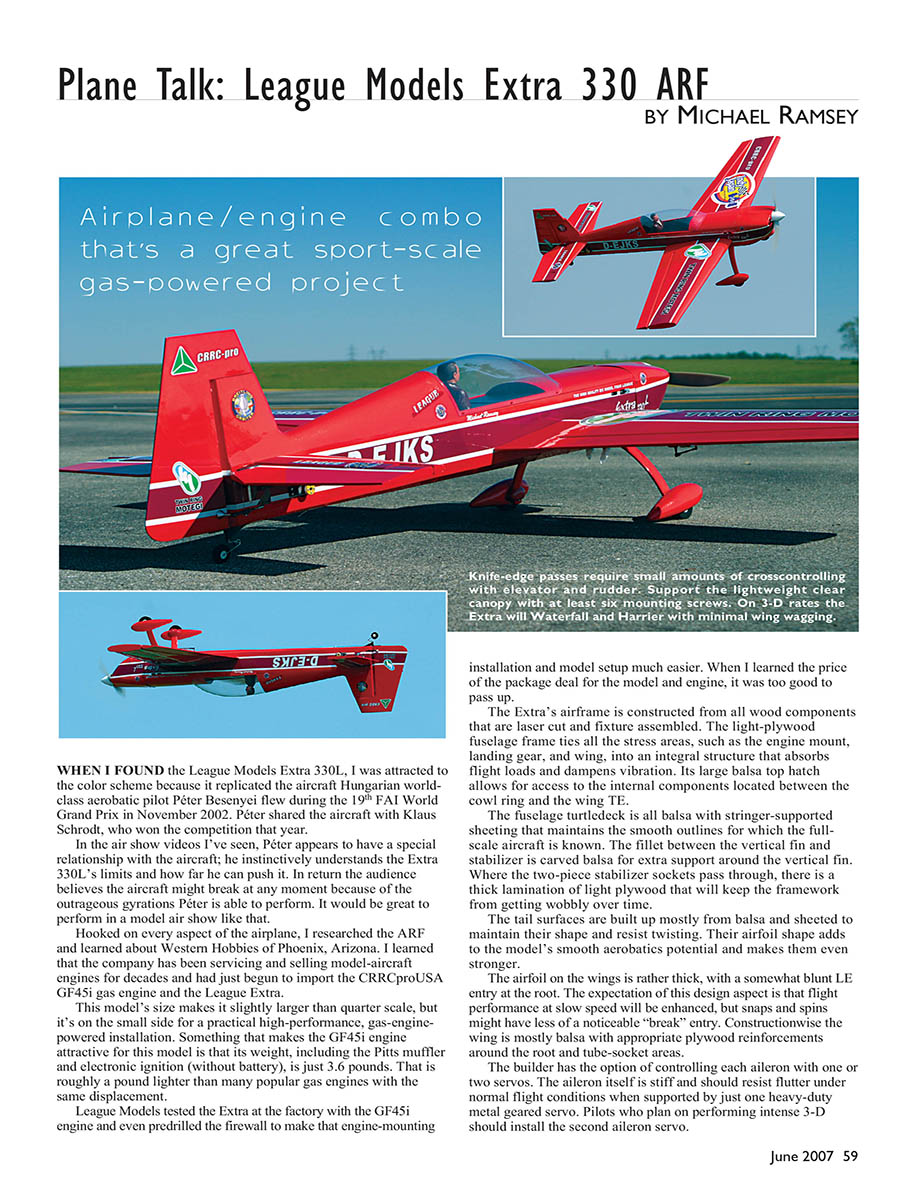
When I found the League Models Extra 330L, I was attracted to the color scheme because it replicated the aircraft flown by Hungarian world-class aerobatic pilot Péter Besenyei during the 19th FAI World Grand Prix in November 2002. Péter shared the aircraft with Klaus Schrodt, who won the competition that year. In the air-show videos I’ve seen, Péter appears to have a special relationship with the aircraft; he instinctively understands the Extra 330L’s limits and how far he can push it. In return the audience believes the aircraft might break at any moment because of the outrageous gyrations Péter performs. It would be great to perform in a model air show like that.
Hooked on every aspect of the airplane, I researched the ARF and learned about Western Hobbies of Phoenix, Arizona. The company has been servicing and selling model-aircraft engines for decades and had just begun to import the CRRCpro GF45i gas engine and the League Extra. This model’s size is slightly larger than quarter scale but on the small side for a practical high-performance gas installation. The GF45i engine is attractive because its weight, including the Pitts muffler and electronic ignition (without battery), is just 3.6 pounds—roughly a pound lighter than many popular gas engines with similar displacement. League Models tested the Extra at the factory with the GF45i engine and even predrilled the firewall to simplify engine mounting and setup. When I learned the package price for the model and engine, it was too good to pass up.
Construction
The Extra’s airframe is constructed from all-wood components that are laser cut and fixture assembled. The light-plywood fuselage frame ties all the stress areas—engine mount, landing gear, and wing—into an integral structure that absorbs flight loads and dampens vibration. A large balsa top hatch provides access to internal components located between the cowl ring and the wing trailing edge. The fuselage turtledeck is all balsa with stringer-supported sheeting that maintains the smooth outlines of the full-scale aircraft. The fillet between the vertical fin and stabilizer is carved balsa for extra support around the vertical fin. Where the two-piece stabilizer sockets pass through, there is a thick lamination of light plywood to keep the framework from getting wobbly over time.
The tail surfaces are built up mostly from balsa and sheeted to maintain shape and resist twisting. Their airfoil shape enhances smooth aerobatic potential and increases strength.
The wing airfoil is rather thick, with a somewhat blunt leading-edge entry at the root. This design improves slow-speed performance, though snaps and spins might have a less noticeable “break” entry. Construction-wise the wing is mostly balsa with plywood reinforcements around the root and tube-socket areas. The builder can control each aileron with one or two servos. The aileron itself is stiff and should resist flutter under normal flight conditions when supported by one heavy-duty metal-geared servo. Pilots planning intense 3-D should install the optional second aileron servo.
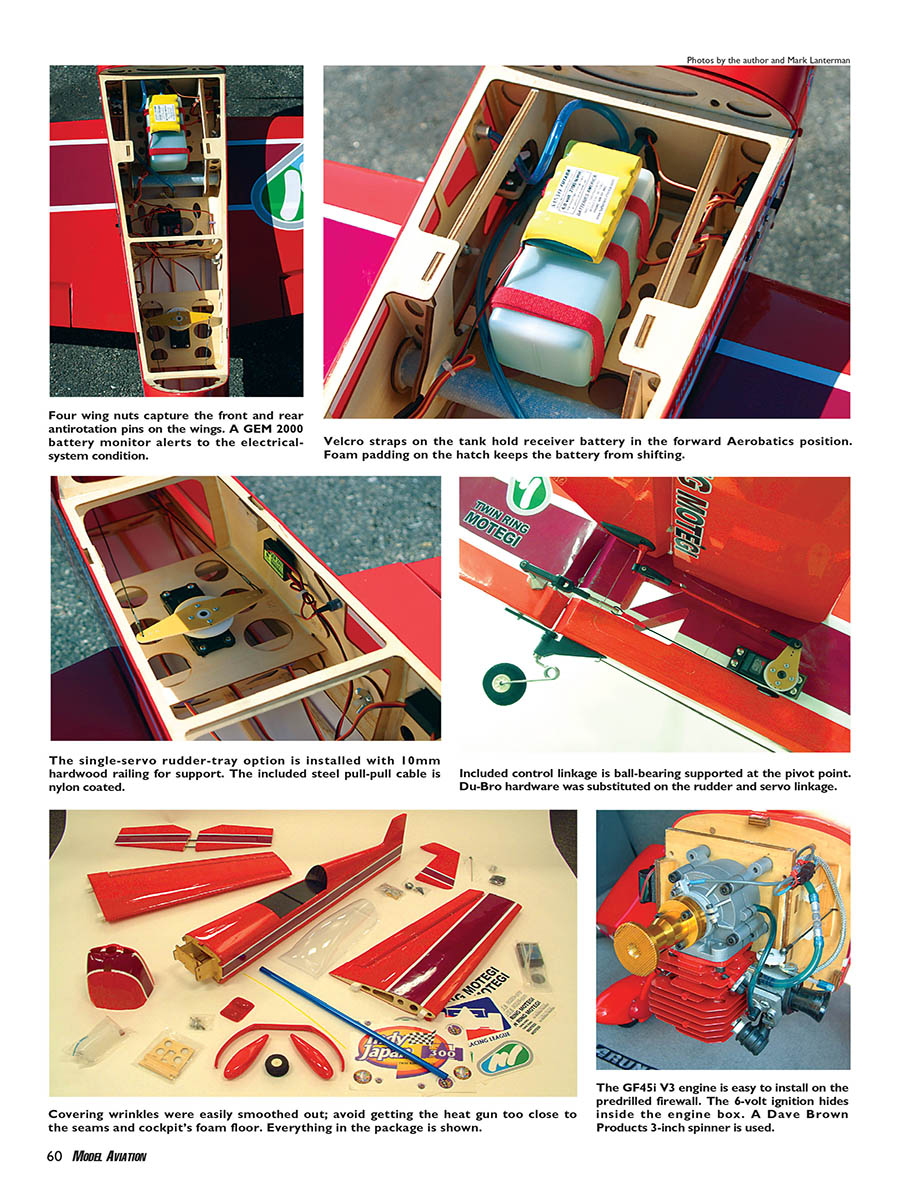
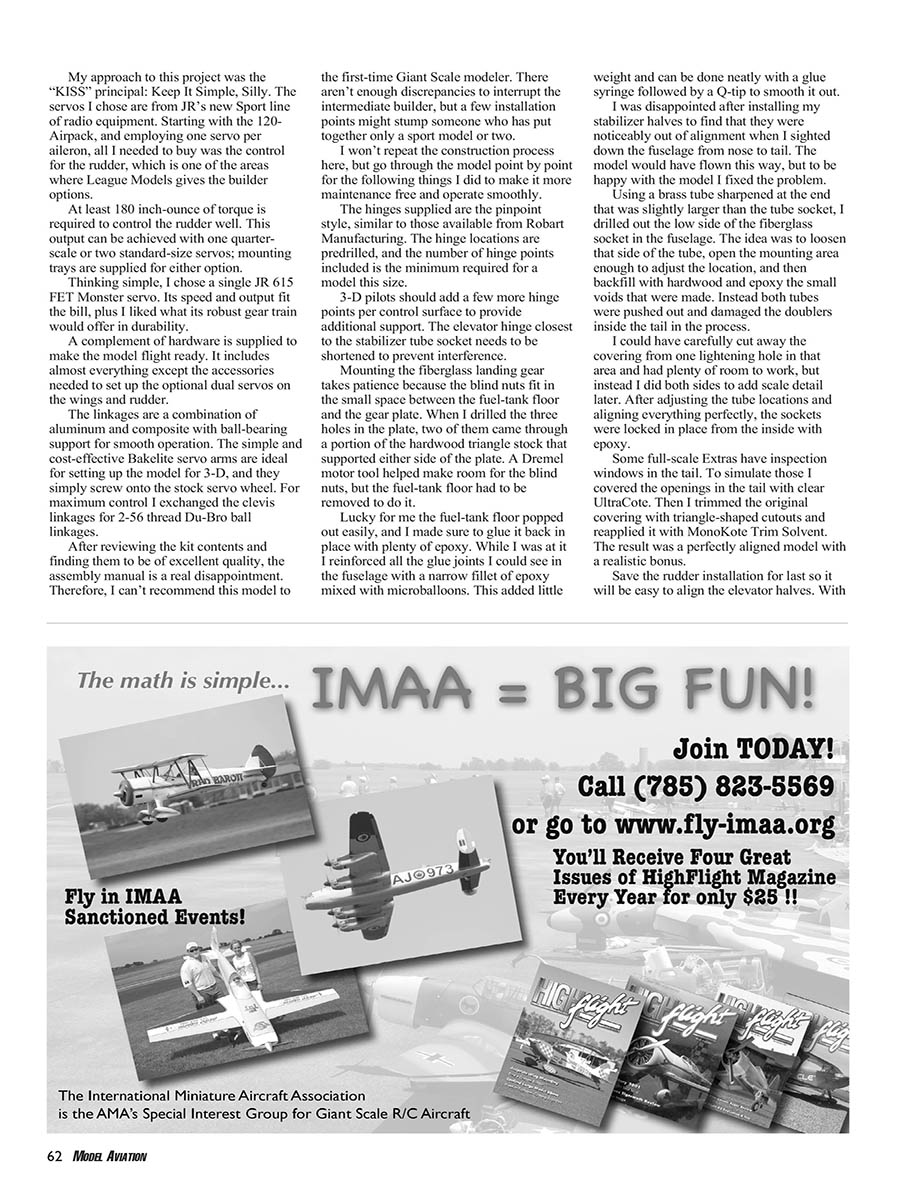
Knife-edge passes require small amounts of cross-controlling with elevator and rudder. Support the lightweight clear canopy with at least six mounting screws. In 3-D flight the Extra will waterfall and Harrier with minimal wing wagging.
Specifications
- Model type: Scale aerobatic ARF
- Pilot skill level: Intermediate
- Wingspan: 78 inches
- Wing area: 1,210 square inches
- Length: 70 inches
- Weight: 15 pounds
- Wing loading: 30 ounces per square foot
- Engine: 1.80–2.10 (two-stroke), 1.80–2.20 (four-stroke), or .40–.50 cu in (gas)
- Radio: Four channels (minimum), six to nine servos
- Construction: Balsa, light plywood
- Covering/finish: Three-color heat-shrink film
- Price: $329
Test-Model Details
- Engine used: CRRCpro GF45i V3 SuperSport
- Propeller: APC 20 x 8W
- Fuel: Premium gasoline with 50:1 fuel/oil ratio
- Radio system: Futaba 9CII transmitter, Futaba 12RDP receiver
- Servos: four JR Sport ST125MG, one JR Sport ST47, one JR 615 FET Monster
- Batteries: 2700 mAh NiMH receiver battery, 1250 mAh NiMH ignition battery
- Accessories: four 6-inch extensions, two 24-inch extensions, two power switches
- Ready-to-fly weight: 15.75 pounds
- Flight duration: 15 minutes
Pluses and Minuses
Pluses
- Excellent airplane/engine combo value.
- Convenient two-piece wing and stabilizer.
- Easy to assemble and inexpensive to equip.
- Outstanding flying qualities with gentle stall tendencies.
- Predictable, well-mannered 3-D capabilities.
Minuses
- Minimal instructions with poor language.
- Requires attention to fabrication and glue joints.
- Misaligned stabilizer sockets (may require correction).
Assembly and Setup
My approach to this project followed the "KISS" principle: Keep It Simple, Silly. I used JR's new Sport-line servos. Starting with the 120-Airpack and one servo per aileron, all I needed to add was the control for the rudder—one of the areas where League Models gives the builder options.
The rudder requires at least 180 in-oz of torque to be well controlled. This can be achieved with one quarter-scale servo or two standard-size servos; mounting trays are supplied for either option. I chose a single JR 615 FET Monster servo for its speed, torque, and robust gear train.
A complement of hardware is supplied to make the model flight-ready, including almost everything except the accessories needed for optional dual servos on the wings and rudder. The linkages are a combination of aluminum and composite with ball-bearing support for smooth operation. Cost-effective Bakelite servo arms screw onto the stock servo wheel and work well for 3-D setup. For maximum control I exchanged the clevis linkages for 2-56-thread Du-Bro ball linkages.
After reviewing the kit contents, I found them to be excellent quality, but the assembly manual is a real disappointment. I can't recommend this model to a first-time giant-scale builder—there aren't enough discrepancies to stop an intermediate builder, but some installation points may stump someone who has built only a sport model or two.
The supplied hinges are pinpoint style, similar to those from Robart. Hinge locations are predrilled and the number of hinge points included is the minimum for a model this size. 3-D pilots should add a few more hinge points per control surface for additional support. The elevator hinge closest to the stabilizer tube socket needs to be shortened to prevent interference.
Mounting the fiberglass landing gear takes patience because the blind nuts fit in the small space between the fuel-tank floor and the gear plate. When I drilled the three holes in the plate, two came through a portion of the hardwood triangle stock supporting either side of the plate. A Dremel tool helped make room for the blind nuts, but the fuel-tank floor had to be removed. It popped out easily, and I glued it back with plenty of epoxy. While there, I reinforced all visible glue joints in the fuselage with a narrow fillet of epoxy mixed with microballoons. This added little weight and can be done neatly with a glue syringe followed by a Q-tip to smooth it.
I was disappointed to find my stabilizer halves noticeably out of alignment when sighting down the fuselage. Although the model would have flown, I corrected it. Using a brass tube sharpened at the end slightly larger than the tube socket, I drilled out the low side of the fiberglass socket in the fuselage to loosen it and adjust the location, then backfilled voids with hardwood and epoxy. Both tubes were pushed out and damaged the doublers inside the tail during this work, so I cut away the covering from lightening holes to add room to work, adjusted tube locations, and locked the sockets from the inside with epoxy.
Some full-scale Extras have inspection windows in the tail. To simulate those, I covered the openings in the tail with clear UltraCote, trimmed the original covering with triangle-shaped cutouts, and reapplied it with MonoKote Trim Solvent. The result was a perfectly aligned model with a realistic detail.
Save rudder installation for last so it's easy to align the elevator halves.
Flight Testing
With the airplane at a safe altitude, stall testing showed that full low-rate control input produced clean stalls. Predictably, the Extra tended to break left with positive (up-elevator) input and right with negative (down-elevator) input. Each stall appeared to happen when all airspeed was gone, suggesting slow, easy landings.
I ran the engine in during flights; each flight seemed stronger than the last. I waited until the engine had at least an hour of flight time before testing 3-D aerobatics and spent that hour tweaking the model.
The Extra liked aileron differential; too much down throw caused rolls to bobble. Controls proved crisp and effective at all speeds. I softened low-rate controls further with 30% expo to avoid overcorrecting in slow rolls and point rolls. Stall testing indicated the CG was at a comfortable point for handling, suggesting the model is suitable for an intermediate pilot.
Inverted flight required little down-elevator pressure to maintain heading, and this held on 45° lines as well. Knife-edge showed little adverse roll coupling when rudder was applied. The balance point was spot-on even for precision flying.
Hands-off vertical lines, up or down, required down-elevator pressure. This could be mixed in for down-lines via a small down-elevator mix with low throttle. On up-lines, down-elevator trim needed to be held in or the CG could be moved slightly forward.
Slow rolls and point rolls needed little heading correction. Rolling circles and rolling loops were simple to perform. Corners on square maneuvers were crisp with little heading loss; the GF45i will make maneuvers as large as desired.
After run-in, the engine showed no bad habits and gave confidence to bring aerobatics lower and explore 3-D potential. High-rate settings were extreme compared to low rate; 50% expo wasn't enough for my taste in 3-D, so I increased to 65%. The roll rate was blinding and fun to fly.
The rudder authority at high rate was phenomenal; the Monster servo was the right choice. Flat turns were very tight. The Extra wanted to snap between 15° and 25° of elevator travel; flying through that range required the right rudder and aileron correction to stay on heading. Working the power on and off kept controls effective, and the engine gave confidence to recover from awkward positions.
Full high-rate elevator from inverted or upright at low power initiated the Elevator maneuver: the Extra maintained a nose-high attitude and could be guided down with rudder into a Harrier or Hover. Adding power allowed the nose to rise, slowing airspeed and arresting descent.
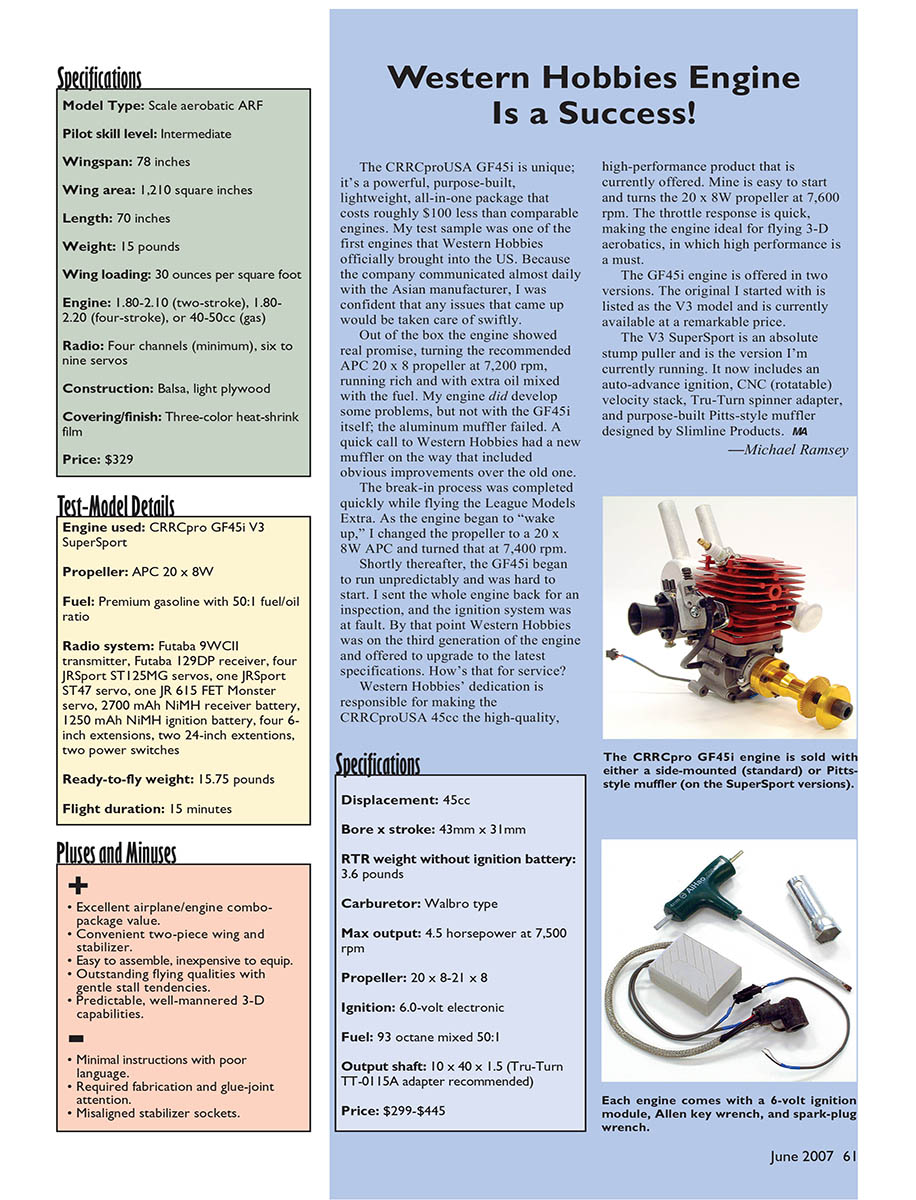
From altitude in Elevator or Harrier, adding power could flip the Extra end over end to perform the Waterfall. This maneuver is dramatic from inverted; only a small amount of aileron correction was needed.
Hover and Torque Roll maneuvers felt natural. Burping power kept the Extra rotating; like most well-designed 3-D models it tended to fall toward the landing gear, so holding up-elevator is intuitive. The GF45i held the 15.75-pound Extra in a hover at just a click or two above half throttle. Because of the throttle curve I programmed, the carburetor butterfly was likely open less than that, meaning a power-to-weight ratio near 1:1 at less than half power.
Landings were well-mannered. The clean lines and low drag called for an approach at a high angle of attack, making three-point landings almost natural. For short-field landings, slips are effective because strong control authority and lack of coupling allow corrections without fighting bad habits.
Long-Term Use and Modifications (Packing It In)
During several months of testing, the Extra has gone through revisions thanks to input from Western Hobbies. Quality control has been stepped up and some of my complaints have been resolved. I like a company willing to look back and improve; it speaks well of post-purchase service.
As of this writing I've logged more than 50 flights. Because the gas engine runs so clean, I have to force myself to perform regular maintenance. At roughly the 25th hour I noticed stabilizer tube sockets were loose, especially at the front where load is concentrated. The sockets were easy to reinforce with epoxy through the stabilizer-root lightening holes.
I've almost worn out the PVC wheel-pant cuffs; they are purely cosmetic but a scale touch I'd like to keep. The fiberglass landing gear is holding up great with no sign of stress.
While keeping engine-mounting screws tight I noticed the spinner-to-cowl clearance closing—firewall wood was being compressed. Adding a couple of washers behind the four mounting points brought the engine forward to the correct position. I also added a cover for the opening between the firewall and the #1 fuselage former to keep exhaust and dirt out and to reduce airflow that could lift covering.
I'm happy with the JR Sport servos. Upgrading to digital servos would improve snap maneuvers and allow the model to stop on a dime, but it's not required.
If you crave a fun gas-powered model for sport or aerobatics, take a look at this Extra. It's a "big" airplane you'll want to take to the field every weekend.
— Michael Ramsey
Manufacturer/Distributor
- League Models / Western Hobbies
12105 S. 43rd Ave. Laveen, AZ 85339 (602) 647-0165 www.westernhobbies.com
Products Used in Review
- Futaba transmitter/receiver: Great Planes Model Distributors
Box 9021, Champaign, IL 61826 (217) 398-3630 www.futaba-rc.com
- Servos/pilot equipment: JR / Hangar 9 — Horizon Hobby, Inc.
4105 Fieldstone Rd., Champaign, IL 61822 (800) 338-4639 www.horizonhobby.com
- Spinner: Dave Brown Products
4560 Lanyigh Rd., Hamilton, OH 45013 (513) 738-1576 www.davebrownproducts.com
- GEM 2000 battery monitor: Electrotek R/C
14667 Lafayette Cir., Magalia, CA 95954 (888) 567-2862 www.electrotekrc.net
- Power system batteries: Batteries America
8845 S. Greenview Dr., Suite 2, Middleton, WI 53562 (800) 308-4805 www.batteriesamerica.com
- Hardware/linkages: Du-Bro Products, Inc.
Box 815, Wauconda, IL 60084 www.dubro.com
Transcribed from original scans by AI. Minor OCR errors may remain.

