
Plane Talk: ParkZone F-27C Stryker RTF
Bob Aberle
Overview
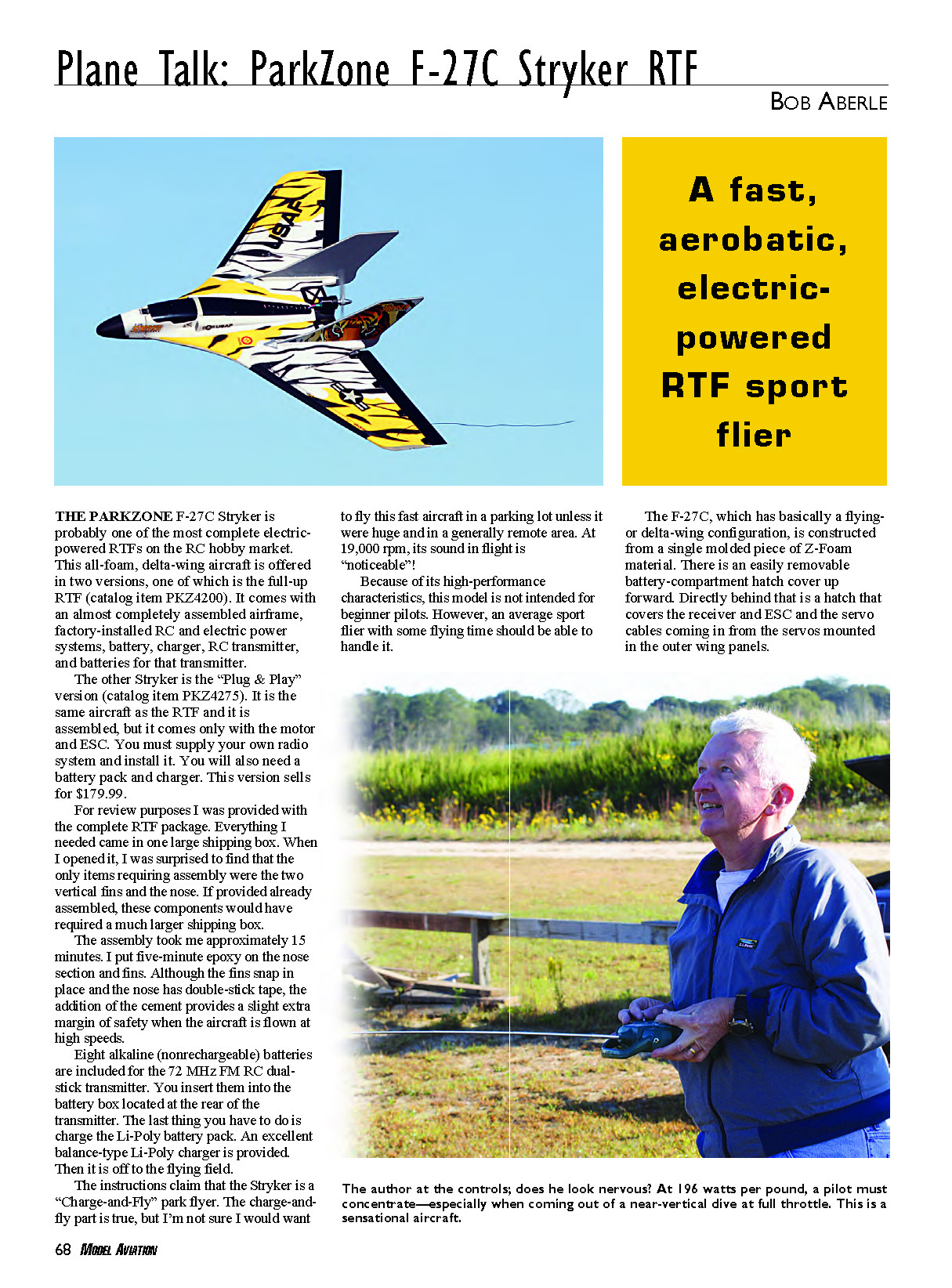
The ParkZone F-27C Stryker is one of the most complete electric-powered RTFs on the RC hobby market. This all-foam, delta-wing aircraft is offered in two versions:
- RTF (catalog item PKZ4200): almost completely assembled airframe, factory-installed RC and electric power systems, battery, charger, RC transmitter, and batteries for the transmitter.
- Plug & Play (catalog item PKZ4275): same assembled airframe but only motor and ESC included; you must supply and install your own radio system, battery pack, and charger. This version sells for $179.99.
For this review I was provided with the complete RTF package.
Assembly and out-of-box experience
Everything required came in one large shipping box. Only the two vertical fins and the nose required assembly; if these had been shipped already attached, a much larger box would have been needed. Assembly took approximately 15 minutes.
- I used five-minute epoxy on the nose section and fins. Although the fins snap in place and the nose has double-stick tape, epoxy adds a margin of safety at high speeds.
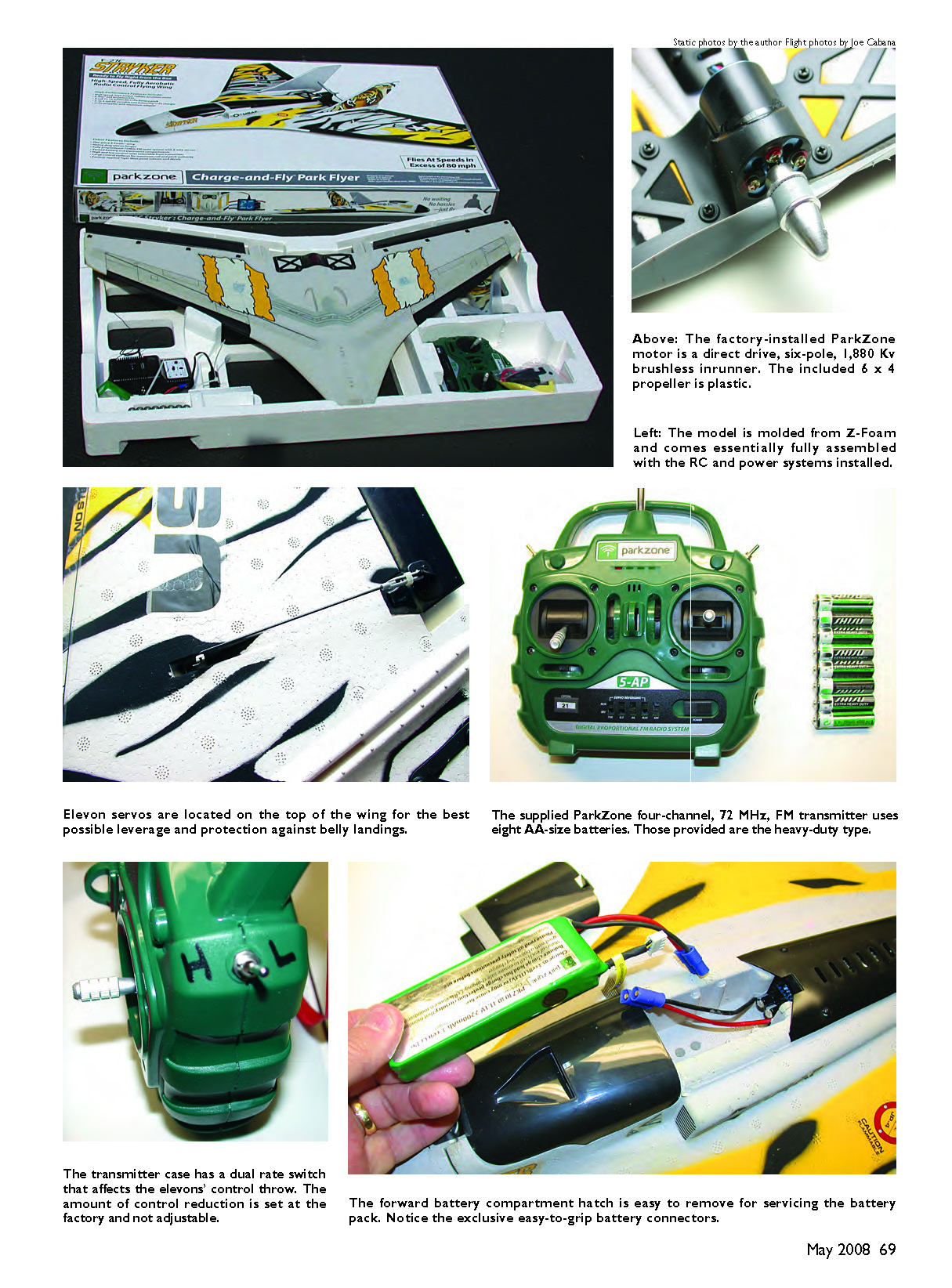
- Eight alkaline (nonrechargeable) AA batteries are included for the 72 MHz FM dual-stick transmitter; they insert into the battery box at the rear of the transmitter.
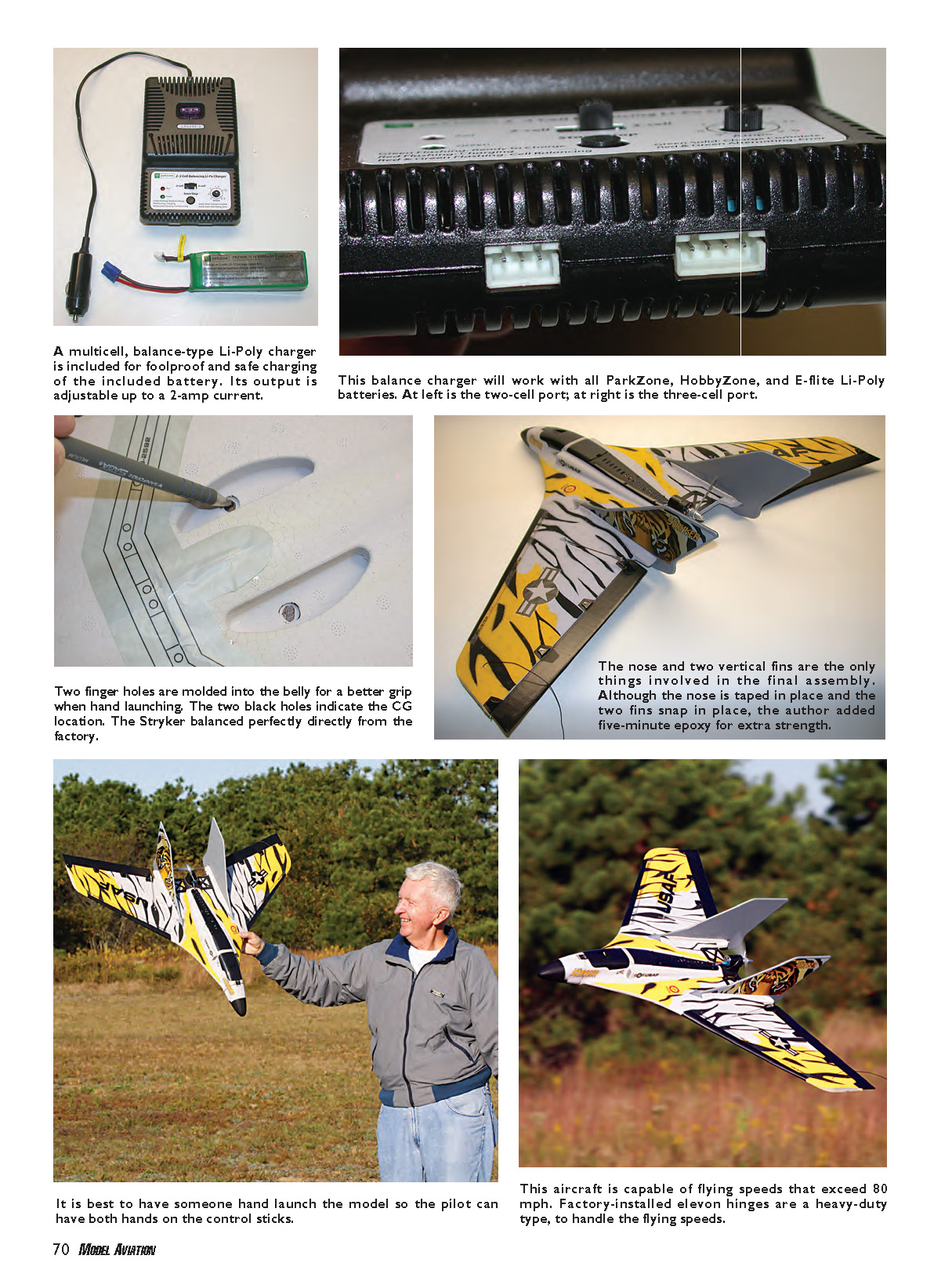
- A three-cell Li-Poly battery pack and a balance-type Li-Poly charger are included; charge the flight pack before flying.
The instructions claim the Stryker is a "Charge-and-Fly" park flyer. That is true, but this is a fast aircraft and not ideal for small parking-lot flying unless the area is very large and remote. At 19,000 rpm, its sound in flight is very noticeable.
Who it's for
Because of its high-performance characteristics, the model is not intended for beginner pilots. An average sport flier with some experience should be able to handle it.
Airframe and ergonomics
- The F-27C is basically a flying- or delta-wing configuration, constructed from a single molded piece of Z-Foam.
- There is a removable battery-compartment hatch cover up front and another hatch behind it that covers the receiver, ESC, and servo cables from the servos mounted in the outer wing panels. This second hatch is pinned in place and normally need not be removed.
- Both hatch covers contain plenty of airholes to dissipate heat generated during flight.
- The entire aircraft is prepainted in a racy color scheme and arrives with decals applied.
- Elevon hinges are heavy-duty to handle air loads.
- The foam material is resilient to damage, even on hot landings; replacement parts are readily available.
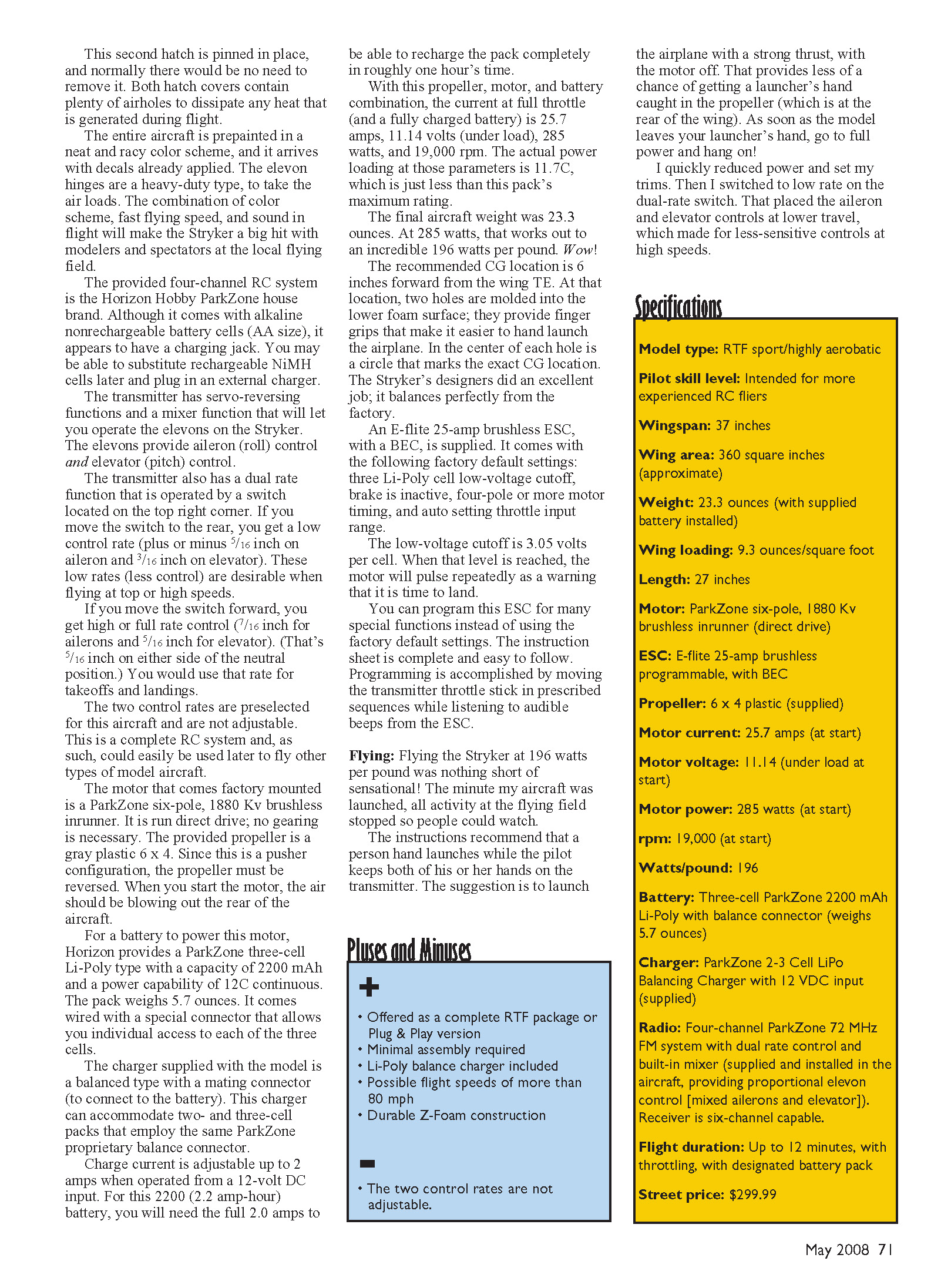
- Two molded holes in the lower foam surface (6 inches forward from the wing trailing edge) provide finger grips for hand launches. A circle in each hole marks the exact recommended CG location; the model balances perfectly from the factory.
Radio and transmitter
The provided four-channel RC system is Horizon Hobby's ParkZone house brand.
- Transmitter features:
- Uses alkaline AA cells (but appears to have a charging jack—NiMH cells may be substituted later and an external charger used).
- Servo-reversing functions.
- Mixer function to operate elevons (ailerons + elevator).
- Dual-rate function via a switch on the top right corner:
- Low rate (switch rear): ±5/16" aileron, ±3/16" elevator — desirable at top or high speeds.
- High/full rate (switch forward): ±7/16" aileron, ±5/16" elevator — use for takeoffs and landings.
- The two control rates are preselected for the aircraft and are not adjustable.
- The complete RC system could be used later for other models.
Motor, propeller, and battery
- Motor: ParkZone six-pole, 1880 Kv brushless inrunner, factory-mounted; direct drive (no gearing).
- Propeller: Gray plastic 6x4. Because this is a pusher configuration, the propeller must be reversed so the air blows out the rear of the aircraft.
- Battery: ParkZone three-cell (3S) Li-Poly, 2200 mAh capacity, 12C continuous rating, weighs 5.7 oz. The pack is wired with a special connector that allows access to each cell individually.
- Charger: Balanced charger supplied with proprietary ParkZone balance connector; adjustable output up to 2 A from a 12 V DC input. It will work with two- and three-cell packs using the same connector.
- To fully recharge the 2200 mAh (2.2 Ah) battery in roughly one hour, use the full 2.0 A charge current.
Performance with the supplied setup:
- Full-throttle current (fully charged battery): 25.7 A
- Voltage under load: 11.14 V
- Power: 285 W
- Motor speed: 19,000 rpm
- Power loading of the battery during this run: 11.7C (just under the pack's 12C rating)
- Final aircraft weight: 23.3 oz (1.456 lb)
- Power-to-weight: 285 W → 196 W per pound
ESC and electronics
An E-flite 25 A brushless ESC with BEC is supplied. Factory default settings:
- Low-voltage cutoff: three Li-Poly cells at 3.05 V per cell (when reached, the motor will pulse repeatedly as a warning to land)
- Brake: inactive
- Motor timing: four-pole or more
- Throttle input range: auto
The ESC is programmable for many functions via prescribed throttle-stick sequences while listening to audible beeps; the instruction sheet is complete and easy to follow.
Flying
Flying the Stryker at 196 W/lb is sensational. The minute the aircraft was launched, it drew attention at the flying field.
- Launch: Instructions recommend a hand launch while the pilot keeps both hands on the transmitter. Launch with a strong throw and the motor off to reduce the chance of the launcher’s hand contacting the rear-mounted prop; go to full power as soon as the model leaves the hand.
- Initial trimming: Reduce power, set trims, and switch to low rate to reduce control sensitivity at high speeds.
- Low-speed handling: At about one-quarter throttle, a stall is nearly impossible; maneuvering is smooth and easy.
- High-speed performance: At full power in a dive, speed builds close to 100 mph. Rolls are fast and positive; inverted flight requires little elevator correction. Loops can be wide or tight as desired.
- Landing: Make a long approach and bleed a lot of speed. Shut off the motor completely just before touchdown to reduce the chance of breaking the propeller or stalling the motor on the ground.
- Endurance: With some throttling, I achieved approximately 12 minutes of flight, although I used full power often. Immediately after landing the battery pack and motor were essentially cool.
Summary impressions
- The Stryker is a sensational, high-performance park flyer that will be a hit with modelers and spectators due to its color scheme, speed, and sound.
- It is not for beginners but very manageable for an experienced sport pilot.
- Durable foam construction, solid instructions, readily available replacement parts, and a complete out-of-box package make it an excellent offering.
- For pilots who find the F-27C too hot, Horizon Hobby offers an F-27B Stryker RTF with a Speed 480/NiMH battery and a three-channel RC system for $169.95.
Bob Aberle [email protected]
Manufacturer/Distributor
Horizon Hobby, Inc. 4105 Fieldstone Rd. Champaign, IL 61822 (877) 504-0233 www.horizonhobby.com/Products/Support.aspx?ProdID=PKZ4200 (includes a PDF of the instruction manual and videos of the model in flight)
Other Review Sources
- Quiet Flyer, June 2005
- Fly RC, April 2005 and January 2007
- Quiet & Electric Flight, June 2006
- R/C Report, July 2007
Transcribed from original scans by AI. Minor OCR errors may remain.

