
Plane Talk: Plane Insane Models Thorn
DAVE GARWOOD
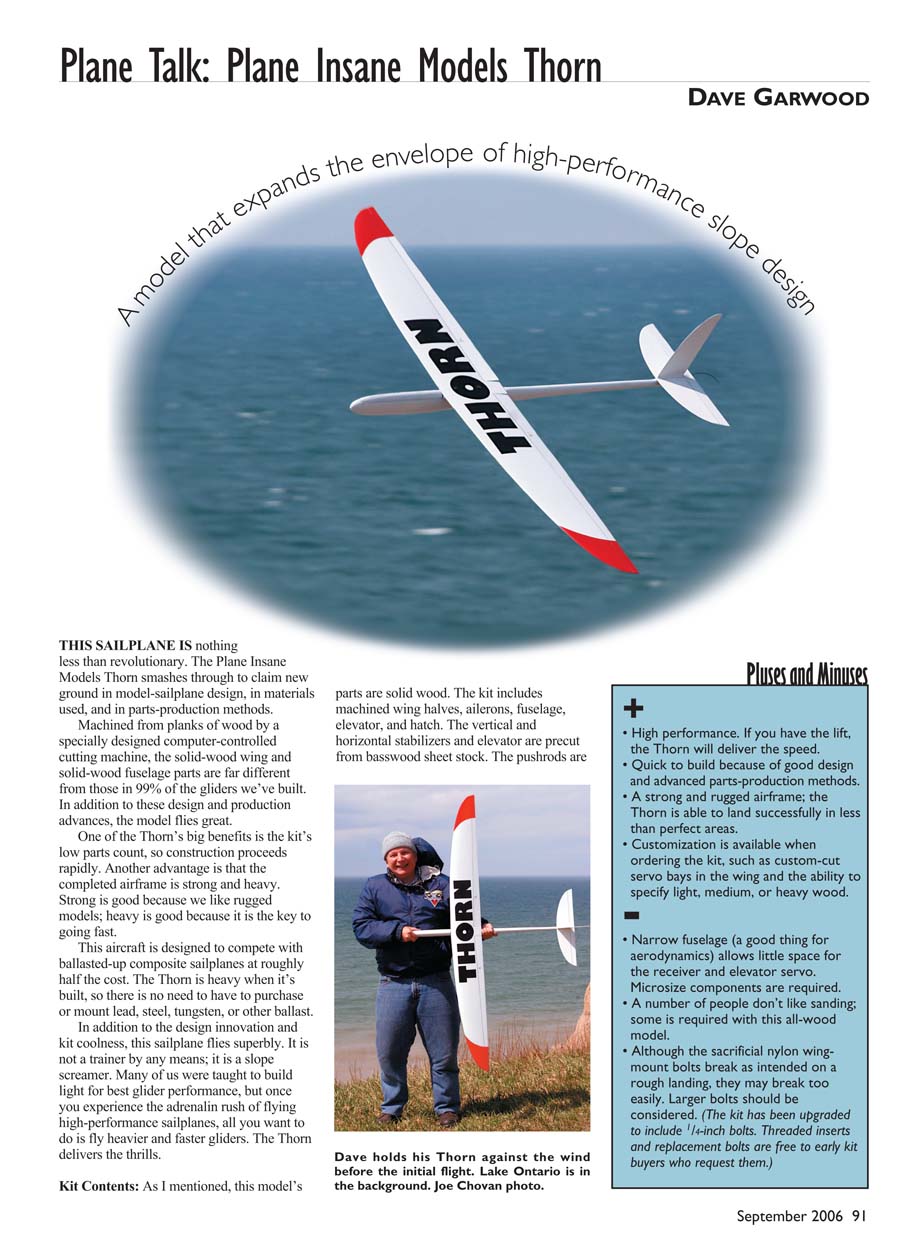
This sailplane is nothing less than revolutionary. The Plane Insane Models Thorn breaks new ground in model-sailplane design, materials used, and parts-production methods.
Machined from planks of wood by a specially designed computer-controlled cutting machine, the solid-wood wing and solid-wood fuselage parts are far different from those in 99% of the gliders we've built. In addition to these design and production advances, the model flies great.
One of the Thorn's big benefits is the kit's low parts count, so construction proceeds rapidly. Another advantage is that the completed airframe is strong and heavy. Strong is good because we like rugged models; heavy is good because it is the key to going fast.
This aircraft is designed to compete with ballasted-up composite sailplanes at roughly half the cost. The Thorn is heavy when it's built, so there is no need to purchase or mount lead, steel, tungsten, or other ballast.
Many of us were taught to build light for best glider performance, but once you experience the adrenaline rush of flying high-performance sailplanes, all you want to do is fly heavier and faster gliders. The Thorn delivers the thrills. It is not a trainer; it is a slope screamer.
Kit Contents
- Machined solid-wood wing halves and ailerons
- Machined solid-wood fuselage, elevator, and hatch
- Precut vertical and horizontal stabilizers and elevator from basswood sheet stock
- Pushrods installed in the fuselage at the factory
- A bag of small wood parts, all necessary hardware, and an instruction manual
The kit is complete, containing everything except adhesives, radio components, and finishing materials. The 13-page instruction manual is thorough and features six drawings and 10 photographs to amplify the text. It is detailed and complete, and experienced modelers will have no trouble building the kit using it. The manual is downloadable from the Plane Insane Models website.
Owing partially to the fact that software runs the computer-controlled machine processes and mostly because of Plane Insane Models' Andreas Mergner's meticulous production planning, you can order wing servo cutouts to accurately fit your choice of servos, and you can specify light or heavy wood parts to match the model to your anticipated lift conditions.
Pluses and Minuses
- High performance. If you have the lift, the Thorn will deliver the speed.
- Quick to build because of good design and advanced parts-production methods.
- Strong and rugged airframe; the Thorn is able to land successfully in less-than-perfect areas.
- Customization is available when ordering the kit, such as custom-cut servo bays in the wing and the ability to specify light, medium, or heavy wood.
- Narrow fuselage (good for aerodynamics) allows little space for the receiver and elevator servo; microsize components are required.
- Some sanding is required with this all-wood model; a number of people don't like sanding.
- The sacrificial nylon wing-mount bolts break as intended on a rough landing, but they may break too easily. Larger bolts should be considered. (The kit has been upgraded to include 1/4-inch bolts. Threaded inserts and replacement bolts are free to early kit buyers who request them.)
Specifications
- Type: High-performance slope-soaring glider
- Pilot skill level: Experienced slope-soaring pilots
- Wingspan: 60 inches
- Wing area: 336 square inches
- Length: 37.5 inches
- Ready-to-fly weight: 58.7 ounces (review model finished at 59 ounces)
- Wing loading: 25.2 ounces per square foot (review model ~25 oz/ft²)
- Airfoil: RG-15 (modified and thinned to 7% thickness)
- Recommended radio: Two channels minimum with exponential
- Construction: Solid-wood parts—different from most other kits but goes together quickly
- Covering/finish: Paint on review model; could be stain or iron-on covering depending on builder preference
- Price: $160 (shipping included)
Test-Model Details
- Radio system: Airtronics VG6000 transmitter, JR 610M receiver, Hitec HS-125 thin metal gear aileron servos, JR NES-341 elevator servo, Airtronics 97020 Y cable, Electrodynamics 600 mAh 4.8-volt battery
- Flight duration: As long as the wind blows and until the onboard battery capacity is exhausted. Two hours is a practical limit.
Construction
My four building sessions, each ranging from a half hour to two hours, went as follows:
- Sand the fuselage and wing halves, join the wing halves, and set them aside for the epoxy to cure. Glue the hatch hold-down magnets into the hatch and the fuselage, and attach the hatch rear wire with epoxy and fiberglass cloth. I decided removable tail parts would make storage and transportation easier, so I fitted a plywood plate to mount the horizontal and vertical stabilizers with bolts.
- Sand the now-cured center section of the wing. Glue the wing trailing-edge pieces with polyurethane glue.
- Trim and sand the ailerons and the elevator. Final-sand the tail parts.
- Build a modified vertical-stabilizer mounting mechanism for easier transportation and storage. I installed blind nuts (T-nuts) on the top side of a plywood plate at the bottom of the fin that receive a pair of bolts inserted from the bottom. Skip this step if you don’t need compact storage and glue the tail parts on as instructed.
You can stain, paint, or cover your Thorn with heat-shrink film covering, but to my mind real slope soarers are painted—not covered. To finish all airframe surfaces I did final sanding and applied Minwax Water-Based Polycrylic Protective Finish. After one coat I sanded with 240-grit paper, applied another coat of Polycrylic, and sanded again in preparation for primer paint, which I wet-sanded with 400-grit paper.
I used Krylon spray-can paints: primer (no. 1381), Gloss White (no. 1501) for the fuselage and upper sides, Regal Blue (no. 1901) for the underside of the wing and stabilizer, and Banner Red (no. 2108) for the wingtips. The “THORN” lettering is cut vinyl from a local truck-lettering shop.
After painting I applied Goop hinges for the ailerons and elevator, as described in the instructions. The manual outlines a top-notch method for installing Goop hinges, which are similar to but tougher than silicone hinges.
My ready-to-fly model weighed 59 ounces, a wing loading of approximately 25 ounces per square foot. My Thorn took 7.5 hours to build (including a couple hours engineering and building the removable tail parts), 4.25 hours to finish with paint, and 3.5 hours to install and test the radio gear—for a total of 15.25 hours of workbench time, spread over two weeks.
Radio Installation and Balance
I used an Airtronics VG6000 transmitter for this project. Although a two-channel rig will suffice for the 60-inch-span Thorn, I prefer having rates and exponential on slope sailplanes. The designer recommends exponential, and the VG6000 delivers this in a computer transmitter with functions shown on the LCD screen.
I installed a diminutive JR 610M receiver. The thin Hitec HS-125 servos for the ailerons fit snugly into the precut wing pockets ordered to fit this servo, making installation quick using only the screws provided by the servo maker. There’s plenty of room in the fuselage for the JR NES-341 elevator servo, the microreceiver, and the Electrodynamics battery pack.
I added 3 ounces of nose weight in the battery compartment to balance my Thorn at the extreme rear of the recommended balance-point range. I set the control-surface throws as instructed in the manual, including specs for high and low rates and approximately 85% exponential on ailerons and elevator.
Flying
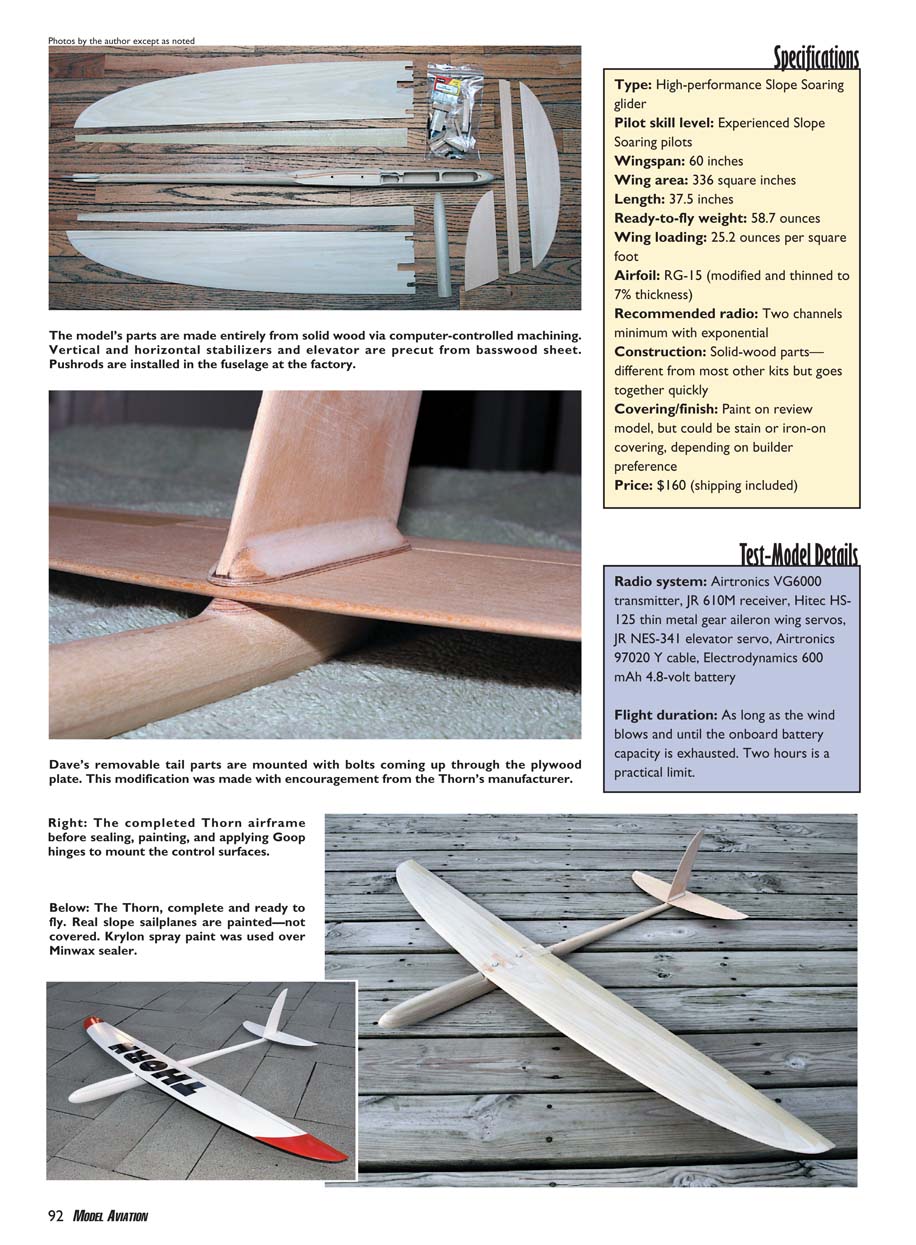
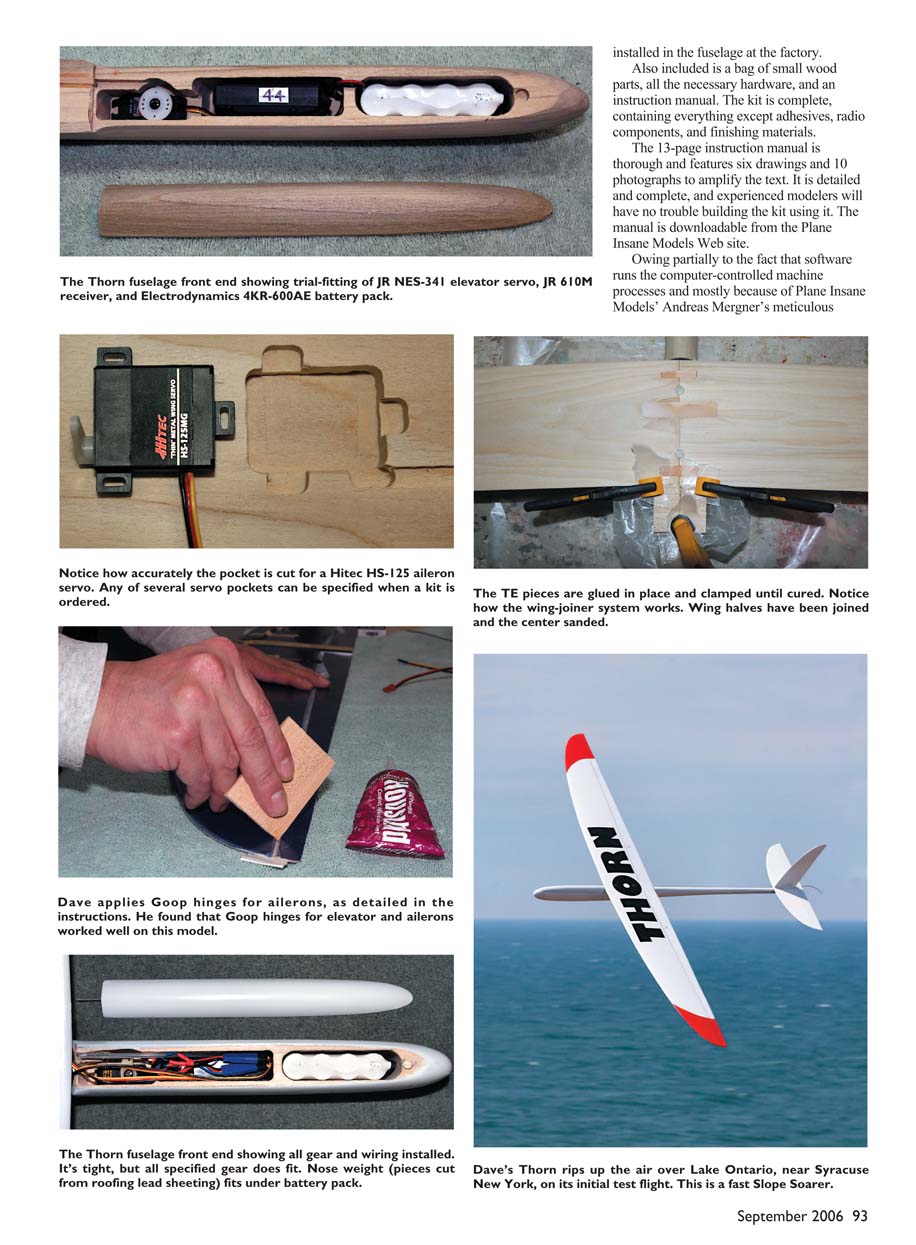
For test-flying we had an early-spring day with fine slope-flying conditions over Lake Ontario near Syracuse, New York. We fly from a 115-foot escarpment, and that day we had a 15–20 mph wind blowing into the hill from approximately 10° left of perpendicular.
After a final radio check we heaved the Thorn off the ridge toward the lake. After letting it dive for a few long seconds to gather speed, I leveled it out and began the classic figure-eight slope pattern. The first turn went smoothly, and, still accelerating, it came on step by the time it crossed in front of me. The Thorn climbed quickly and easily, and controls were smooth, with no sign of twitchiness.
The heavy Thorn reveled in the windy, slightly cross conditions. Other pilots put down foam sailplanes after a minute or two because they could not penetrate; the Thorn was in its element. Joe Chovan and I logged a one-hour flight, passing the transmitter twice. Control throws were set up according to the instructions, and we did not use high rates.
Conclusions from the flight tests:
- It penetrates extremely well in vigorous wind, including crosswinds and gusty conditions.
- It exhibits smooth control movements, with no evidence of twitchiness or overcontrol.
- It performs moderately fast axial rolls—more than one per second.
- It hangs in with inverted flight adequately, though it’s not optimized for prolonged inverted flight.
- It loves the Cuban Eight. Hammerhead stall turns and half-pipe maneuvers are competent for an aircraft without a working rudder. Inside loops are solid, with no aileron correction needed.
- An intentional forward stall produced a fairly dramatic drop of 20–30 feet before recovery. This is not surprising for a sailplane with a wing loading exceeding 20 ounces per square foot; it is a reminder to fly heavy sailplanes smoothly and avoid stalls.
Throughout the flying session we did not worry about lift coming and going. Keep this model moving, and it flies fine in momentary varying lift conditions.
I landed it back on top, shiny-side up in grass. The landing broke one nylon wing-mount bolt (as designed), and the tailplane incurred no other damage. I’m fully pleased with the Thorn’s flight performance. Many thanks to Joe Chovan for flying for the camera.
Given the uncommon construction materials, the unusual solid-wood wing design, and the advanced computer-controlled machining used in production, owning a Thorn kit puts you in the forefront of slope-soaring glider technology.
Spend the pleasant 7.5 hours building (5.5 hours if you skip custom tail work) and the satisfying 4.25 hours finishing and painting the model, and you’ll have a slope speedster that impresses you and your friends. The kit is sold at a righteous price. If you like fast and unusual sailplanes, it’s hard to see how you can go wrong with a Thorn.
There is even better news: I have already flown a prototype of the 100-inch-span, six-servo version, and that was a real fun time; the 2.5-meter version covers a great deal of sky in a short time. Customer requests for four-servo wings to incorporate flaps in addition to ailerons have been fulfilled, and 60- and 80-inch-span wings have been shipped. Plane Insane Models is one maker to watch.
Manufacturer
Plane Insane Models, Andreas Mergner 366 Hamilton St. Albany, NY 12210 (518) 542-9527 [email protected] www.planeinsanemodels.com
Products Used in Review
- Airtronics VG6000 transmitter — www.airtronics.net
- JR 610M receiver — www.horizonhobby.com
- Hitec HS-125 aileron servos — www.hitecrc.com
- JR NES-341 elevator servo — www.horizonhobby.com
- Electrodynamics battery pack — www.electrodynam.com
- Minwax Polycrylic sanding sealer — www.minwax.com
- Krylon rattle-can spray paint — www.krylon.com
Transcribed from original scans by AI. Minor OCR errors may remain.

