
A CL Scale model that was more than 20 years in the making
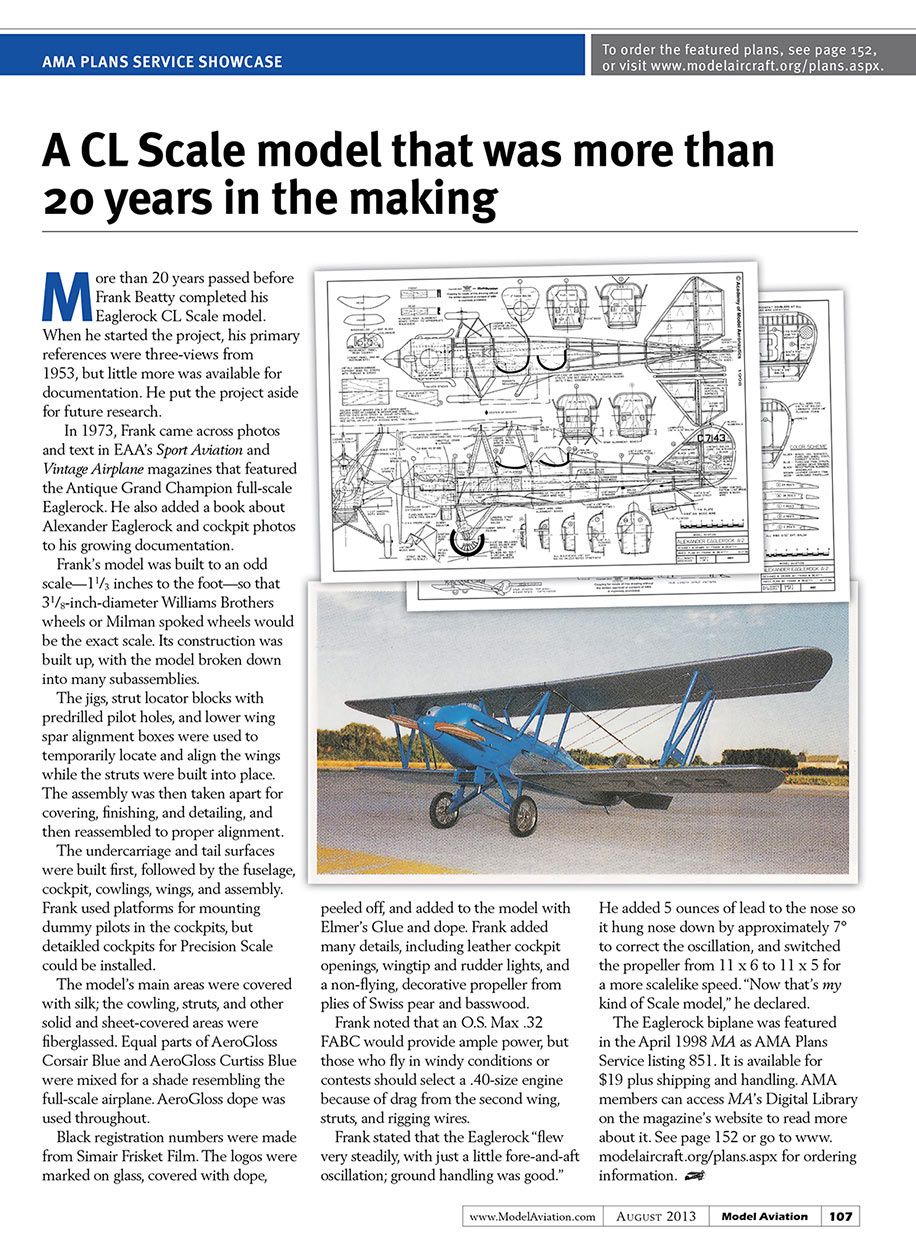
More than 20 years passed before Frank Beatty completed his Eaglerock CL Scale model. When he started the project, his primary references were three-views from 1953, but little more was available for documentation. He put the project aside for future research.
In 1973, Frank came across photos and text in EAA's Sport Aviation and Vintage Airplane magazines that featured the Antique Grand Champion full-scale Eaglerock. He also added a book about Alexander Eaglerock and cockpit photos to his growing documentation.
Frank's model was built to an odd scale—1 1/3 inches to the foot—so that 3 1/8-inch-diameter Williams Brothers wheels or Milman spoked wheels would be the exact scale. Its construction was built up, with the model broken down into many subassemblies.
The jigs, strut locator blocks with predrilled pilot holes, and lower wing spar alignment boxes were used to temporarily locate and align the wings while the struts were built into place. The assembly was then taken apart for covering, finishing, and detailing, and then reassembled to proper alignment.
The undercarriage and tail surfaces were built first, followed by the fuselage, cockpit, cowlings, wings, and assembly. Frank used platforms for mounting dummy pilots in the cockpits, but detailed cockpits for Precision Scale could be installed.
The model's main areas were covered with silk; the cowling, struts, and other solid and sheet-covered areas were fiberglassed. Equal parts of AeroGloss Corsair Blue and AeroGloss Curtiss Blue were mixed for a shade resembling the full-scale airplane. AeroGloss dope was used throughout.
Black registration numbers were made from Simair Frisket Film. The logos were marked on glass, covered with dope, peeled off, and added to the model with Elmer's Glue and dope. Frank added many details, including leather cockpit openings, wingtip and rudder lights, and a non-flying, decorative propeller from plies of Swiss pear and basswood.
Frank noted that an O.S. Max .32 FABC would provide ample power, but those who fly in windy conditions or contests should select a .40-size engine because of drag from the second wing, struts, and rigging wires.
Frank stated that the Eaglerock "flew very steadily, with just a little fore-and-aft oscillation; ground handling was good."
He added 5 ounces of lead to the nose so it hung nose down by approximately 7° to correct the oscillation, and switched the propeller from 11 x 6 to 11 x 5 for a more scale-like speed. "Now that's my kind of Scale model," he declared.
The Eaglerock biplane was featured in the April 1998 MA as AMA Plans Service listing 851. It is available for $19 plus shipping and handling. AMA members can access MA's Digital Library on the magazine's website to read more about it. See page 152 or go to www.modelaircraft.org/plans.aspx for ordering information.
Transcribed from original scans by AI. Minor OCR errors may remain.

