
Electric power brings ease and beauty to FF
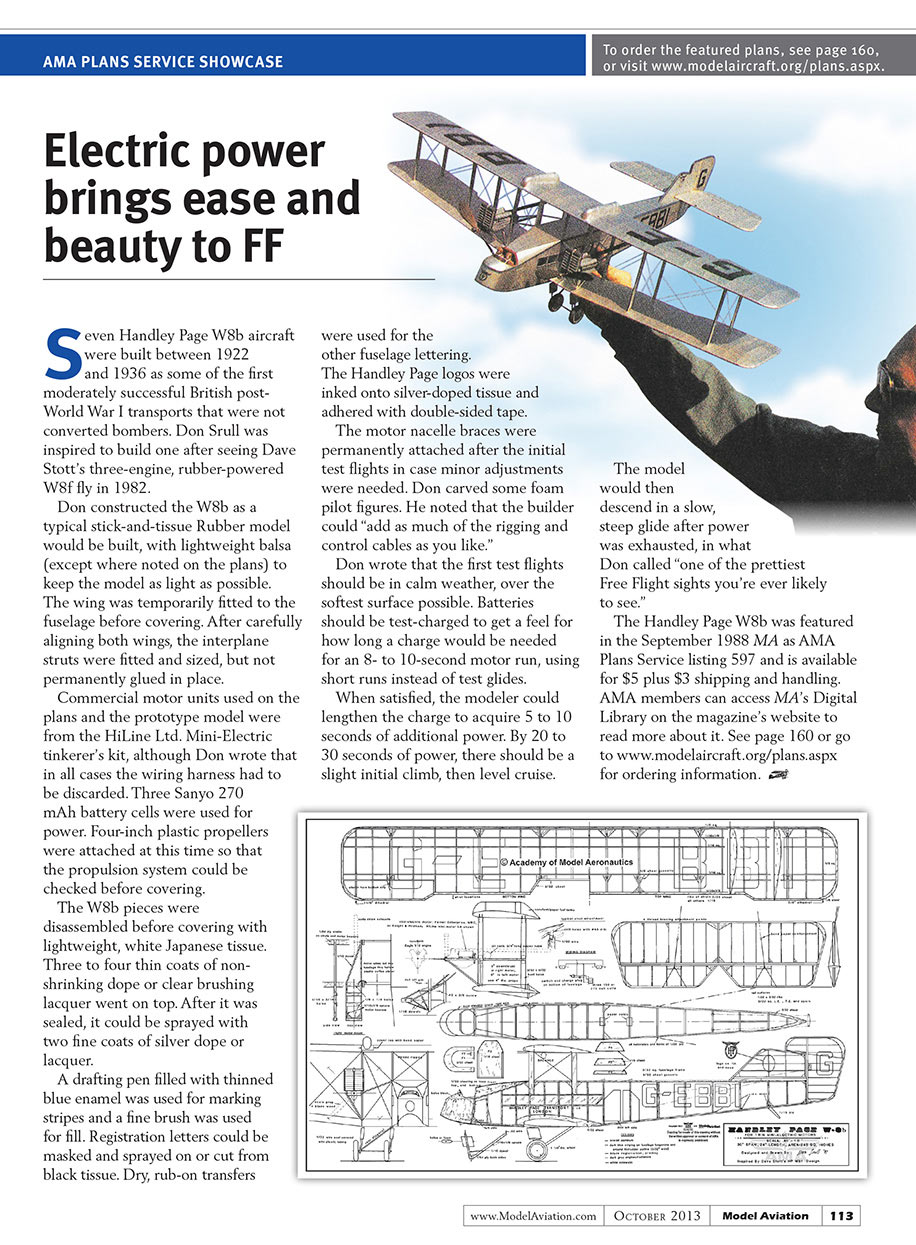
Seven Handley Page W8b aircraft were built between 1922 and 1936 as some of the first moderately successful British post-World War I transports that were not converted bombers. Don Srull was inspired to build one after seeing Dave Stott’s three-engine, rubber-powered W8f fly in 1982.
Don constructed the W8b as a typical stick-and-tissue Rubber model would be built, with lightweight balsa (except where noted on the plans) to keep the model as light as possible. The wing was temporarily fitted to the fuselage before covering. After carefully aligning both wings, the interplane struts were fitted and sized, but not permanently glued in place.
Commercial motor units used on the plans and the prototype model were from the HiLine Ltd. Mini-Electric tinkerer’s kit, although Don wrote that in all cases the wiring harness had to be discarded. Three Sanyo 270 mAh battery cells were used for power. Four-inch plastic propellers were attached at this time so that the propulsion system could be checked before covering.
The W8b pieces were disassembled before covering with lightweight, white Japanese tissue. Three to four thin coats of nonshrinking dope or clear brushing lacquer went on top. After it was sealed, it could be sprayed with two fine coats of silver dope or lacquer.
A drafting pen filled with thinned blue enamel was used for marking stripes and a fine brush was used for fill. Registration letters could be masked and sprayed on or cut from black tissue. Dry, rub-on transfers were used for the other fuselage lettering. The Handley Page logos were inked onto silver-doped tissue and adhered with double-sided tape.
The motor nacelle braces were permanently attached after the initial test flights in case minor adjustments were needed. Don carved some foam pilot figures. He noted that the builder could “add as much of the rigging and control cables as you like.”
Don wrote that the first test flights should be in calm weather, over the softest surface possible. Batteries should be test-charged to get a feel for how long a charge would be needed for an 8- to 10-second motor run, using short runs instead of test glides.
When satisfied, the modeler could lengthen the charge to acquire 5 to 10 seconds of additional power. By 20 to 30 seconds of power, there should be a slight initial climb, then level cruise.
The model would then descend in a slow, steep glide after power was exhausted, in what Don called “one of the prettiest Free Flight sights you’re ever likely to see.”
The Handley Page W8b was featured in the September 1988 MA as an AMA Plans Service listing 597 and is available for $5 plus $3 shipping and handling. AMA members can access MA’s Digital Library on the magazine’s website to read more about it. See page 160 or go to www.modelaircraft.org/plans.aspx for ordering information.
Transcribed from original scans by AI. Minor OCR errors may remain.

