
Plans Service Showcase
The Ten Penny makes “cents” for beginner CL Speed competitors
Glenn Lee’s Ten Penny Speed Trainer appeared in a special issue of MA aimed at youth. What would be a better way to compete as a beginner in CL than with a simple .21 Sport Speed model? Glenn emphasized that it didn’t need to be fancy. All that it needed was a good engine.
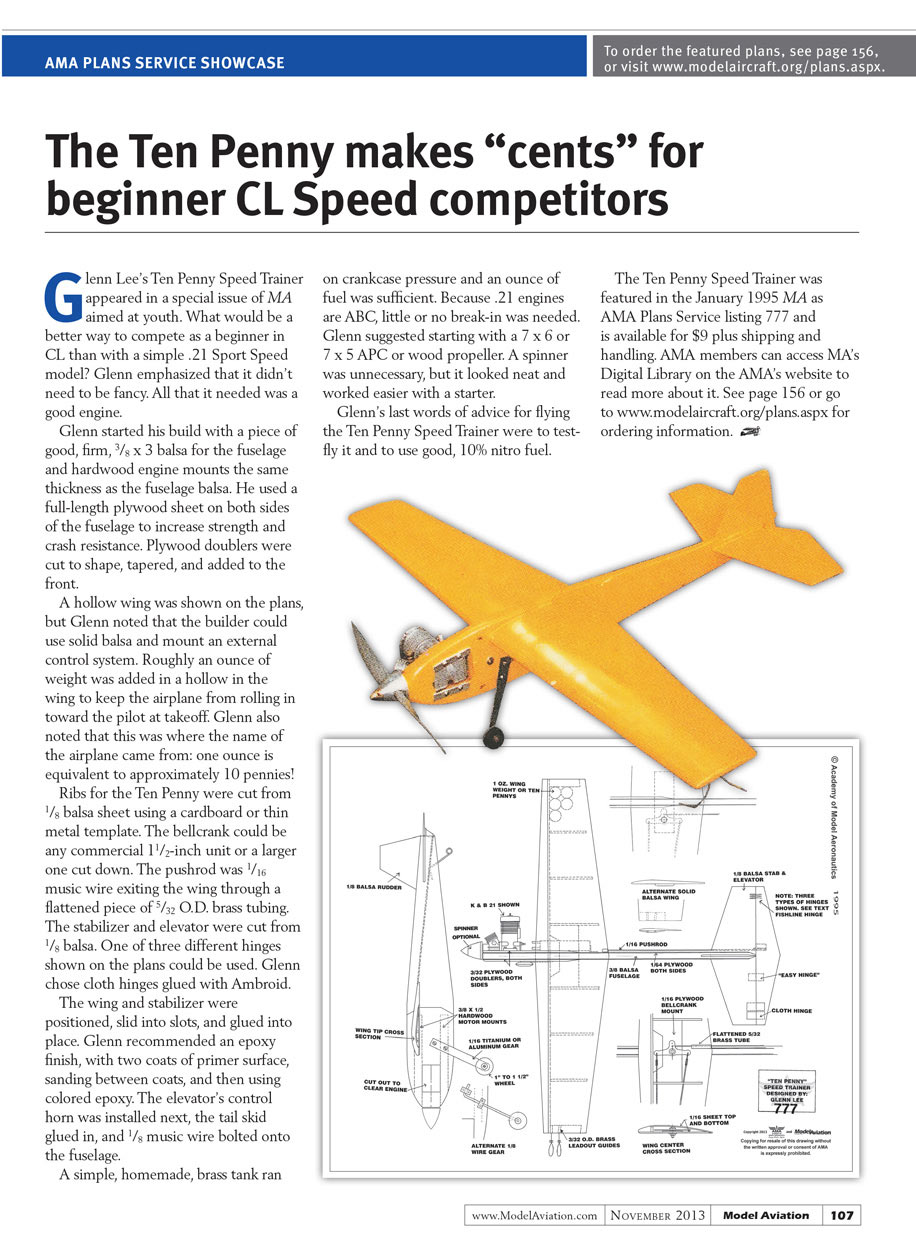
Glenn started his build with a piece of good, firm, 3/8 x 3 balsa for the fuselage and hardwood engine mounts the same thickness as the fuselage balsa. He used a full-length plywood sheet on both sides of the fuselage to increase strength and crash resistance. Plywood doublers were cut to shape, tapered, and added to the front.
A hollow wing was shown on the plans, but Glenn noted that the builder could use solid balsa and mount an external control system. Roughly an ounce of weight was added in a hollow in the wing to keep the airplane from rolling in toward the pilot at takeoff. Glenn also noted that this was where the name of the airplane came from: one ounce is equivalent to approximately 10 pennies!
Ribs for the Ten Penny were cut from 1/8 balsa sheet using a cardboard or thin metal template. The bellcrank could be any commercial 1 1/2-inch unit or a larger one cut down. The pushrod was 1/16 music wire exiting the wing through a flattened piece of 5/32 O.D. brass tubing. The stabilizer and elevator were cut from 1/8 balsa. One of three different hinges shown on the plans could be used. Glenn chose cloth hinges glued with Ambroid.
The wing and stabilizer were positioned, slid into slots, and glued into place. Glenn recommended an epoxy finish, with two coats of primer surface, sanding between coats, and then using colored epoxy. The elevator’s control horn was installed next, the tail skid glued in, and 1/8 music wire bolted onto the fuselage.
A simple, homemade, brass tank ran on crankcase pressure and an ounce of fuel was sufficient. Because .21 engines are ABC, little or no break-in was needed. Glenn suggested starting with a 7 x 6 or 7 x 5 APC or wood propeller. A spinner was unnecessary, but it looked neat and worked easier with a starter.
Glenn’s last words of advice for flying the Ten Penny Speed Trainer were to test-fly it and to use good, 10% nitro fuel.
The Ten Penny Speed Trainer was featured in the January 1995 MA as AMA Plans Service listing 777 and is available for $9 plus shipping and handling. AMA members can access MA’s Digital Library on the AMA’s website to read more about it. See page 156 or go to www.modelaircraft.org/plans.aspx for ordering information.
Transcribed from original scans by AI. Minor OCR errors may remain.

