
Power Switch: Airtronics RDS8000
By Bob Aberle
A solid, full-range digital spread spectrum RC system that's easy to use.
Overview
Although digital spread spectrum (DSS) radio transmission had been known and used for many years, this technology was introduced to the RC hobby segment only about three years ago. Since then, DSS has won over many RC fliers who enjoy its advantages.
The principal benefit of DSS is safe operation without local channel or frequency control. Operating on the 2.4 GHz band, there is no need for frequency clips, pins, flags, or local flying-site frequency boards. The chances of interference are extremely remote, the cost is reasonable, and much existing equipment (servos, batteries) remains usable. Using DSS is voluntary; the existing 50 channels on 72 MHz will be available indefinitely.
I will concentrate on the differences associated with DSS technology as implemented in the Airtronics RDS8000.
Transmitter and Receiver
Transmitter
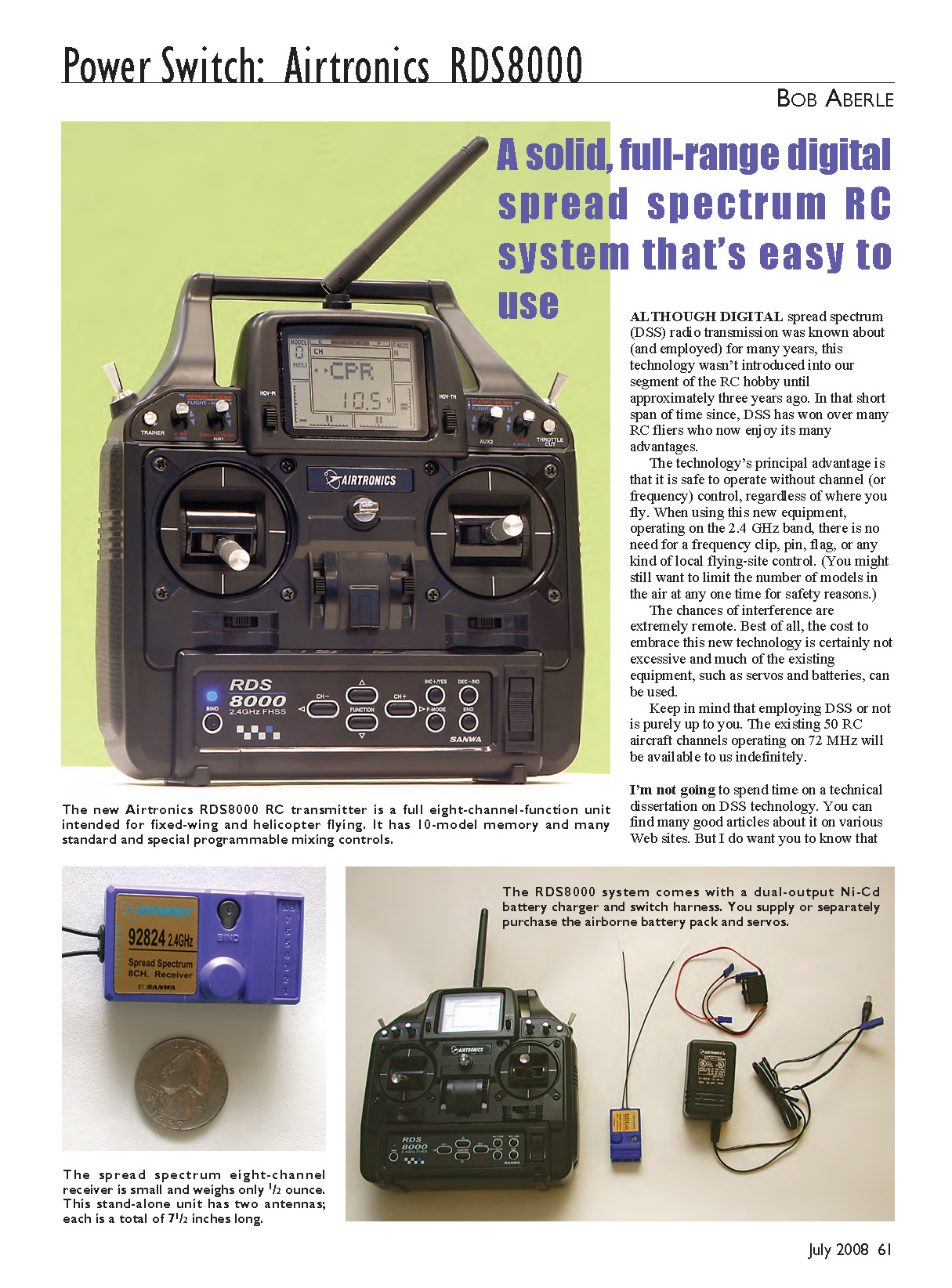
- The RDS8000 transmitter control panel is essentially identical to the RD8000 72 MHz system and uses the unique "Channel Priority Menu System."
- Power is supplied by an eight-cell, 700 mAh Ni-Cd rechargeable battery pack.
- Transmitter current drain is about 180 mA, so expect up to three hours of operation per charge.
- A large LCD displays model memory position, battery capacity (bar), and battery voltage on power-up.
- Controls:
- Bind LED and Bind push-button (lower left front panel).
- Trainer push-button switch.
- Top-left switch for aircraft retracts.
- Center switch usable as elevator dual-rate (aero) or gyro control (helicopter).
- Throttle Cut push-button pulls throttle trim fully closed when depressed.
- Top-right flap switch (aero mode).
- The transmitter antenna is very short (3.5 inches). Do not point it directly at the aircraft—hold it off to one side for optimal signal clarity.
Receiver
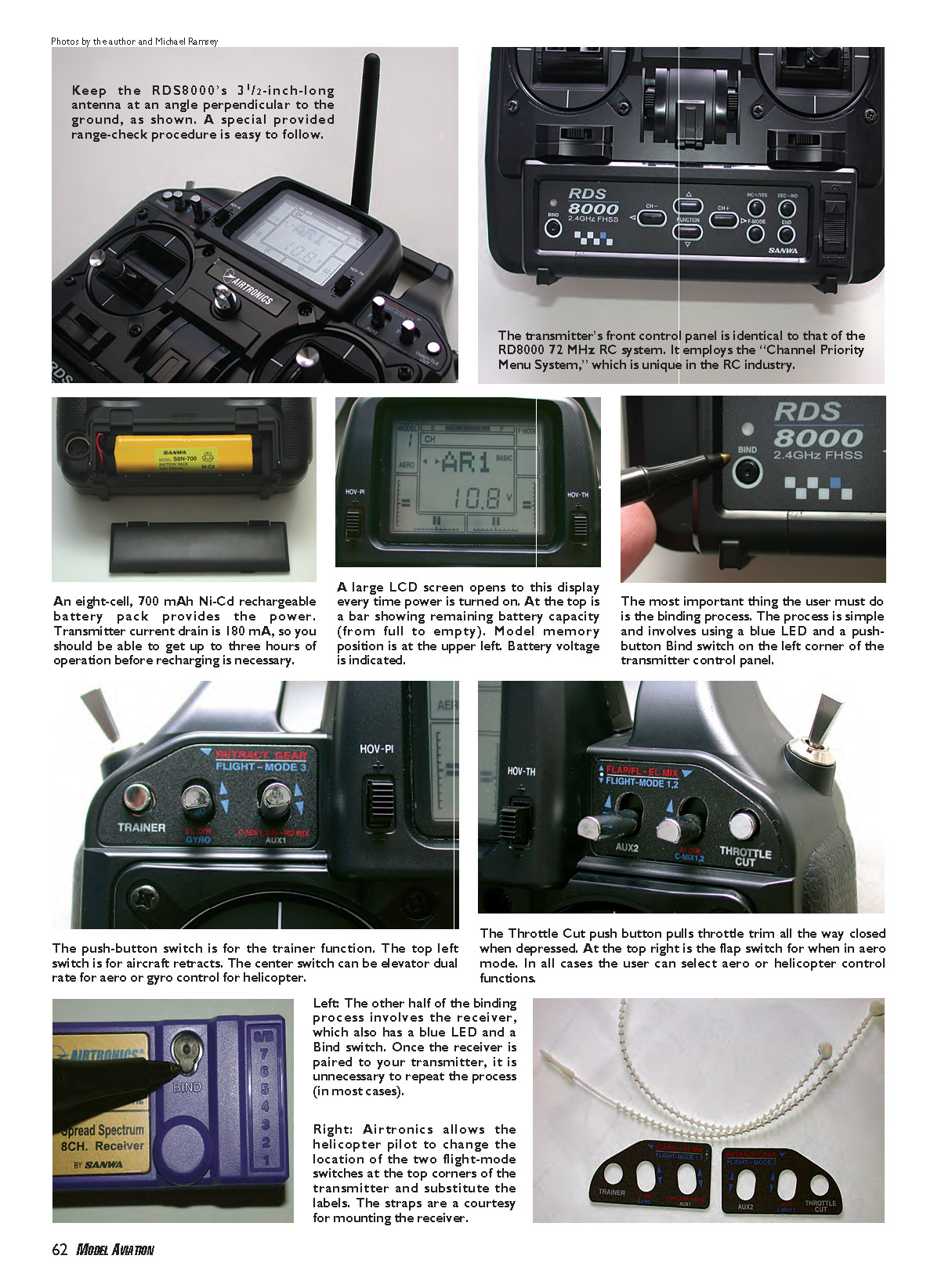
- The companion eight-channel DSS receiver (model 92824) measures approximately 1 7/8 inches long x 1 inch wide x 9/16 inch thick and weighs only 1/2 ounce—suitable for park flyers.
- It is a single receiver unit (some manufacturers require two units joined by cable).
- Two antennas exit the receiver; each is 7.5 inches long.
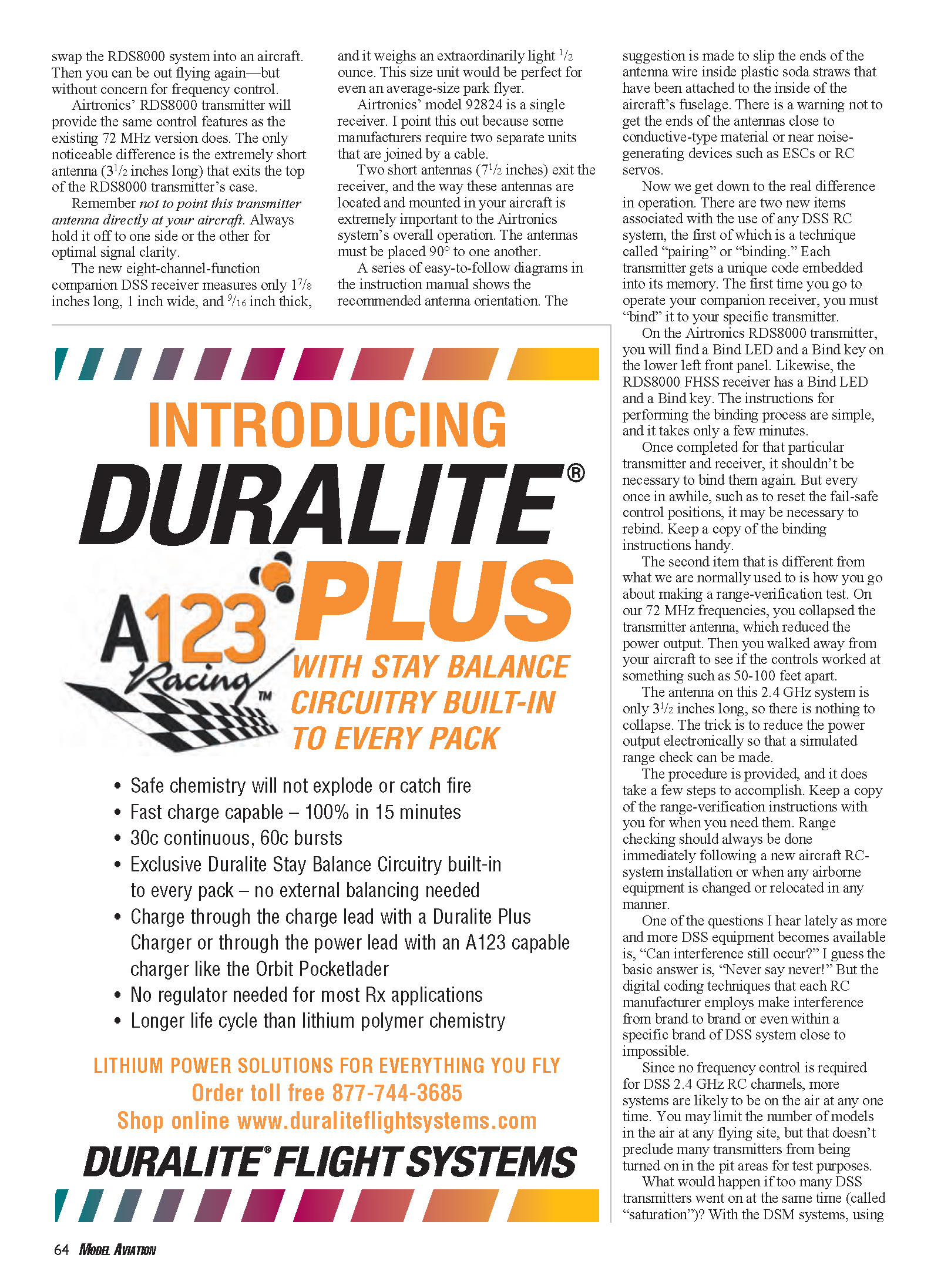
- Antenna placement and orientation are critical: antennas must be positioned 90° to one another.
- The receiver includes a Bind LED and a Bind key for the binding process.
Spread Spectrum Technologies
More than one type of spread spectrum technology is available in RC. Common approaches include:
- Spektrum (Horizon Hobby) — DSM/DSM2:
- Assigns a pair of channels at start-up from a series of 40 pairs; the two channels can switch during flight for robust control.
- Xtreme Power Systems:
- Released transmitter modules that adapt to several radio brands plus companion spread-spectrum receivers.
- Futaba — FASST (Futaba Advanced Spread Spectrum Technology):
- Available as complete systems or adaptable modules for some existing Futaba radios.
- Airtronics — RDS8000:
- Uses frequency-hopping spread spectrum (FHSS), similar in concept to cellular systems.
Each manufacturer employs discrete digital coding methods, so transmitters and receivers are brand-specific and not interchangeable. FCC certification requires that each system not interfere with existing systems.
Airtronics RDS8000: Features, Pricing and Marketing
- The RDS8000 is Airtronics' first DSS system, derived from the popular RD8000 72 MHz transmitter (control-wise identical aside from frequency/modulation).
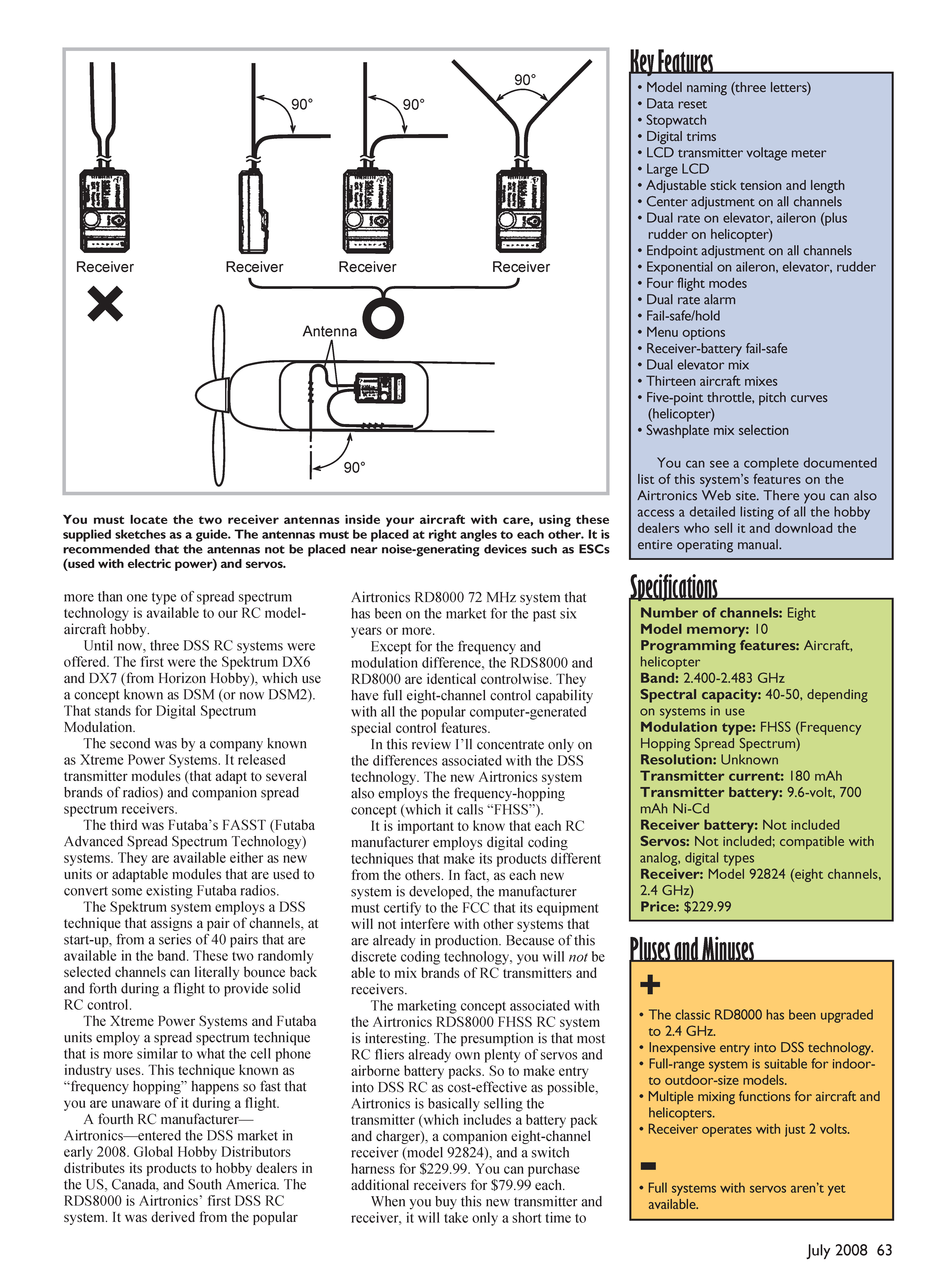
- Airtronics/Global Hobby Distributors market the RDS8000 as an economical entry: the transmitter (with battery pack and charger), one eight-channel receiver (model 92824), and a switch harness are sold together for $229.99. Additional receivers are $79.99 each.
- The system supports full eight-channel control and all common computer-generated special control features.
- Airtronics refers to its spread spectrum technique as FHSS (frequency-hopping spread spectrum).
Antenna Installation and Mounting
- Antenna orientation is critical to reliable operation: install the two receiver antennas at 90° to each other.
- The manual includes diagrams and recommends slipping antenna wire ends inside plastic soda straws and attaching them to the fuselage interior.
- Keep antenna ends away from conductive materials and noise-generating devices (e.g., ESCs, servo motors).
- Proper mounting ensures best range and minimizes noise pickup.
Binding and Range-Verification
Binding (Pairing)
- Each transmitter has a unique code. The first time you operate a receiver, you must "bind" it to your transmitter.
- Both transmitter and receiver have a Bind LED and Bind key. The process is simple and takes only a few minutes.
- Binding is generally a one-time procedure for a given transmitter/receiver pair, though you may rebind occasionally (e.g., to reset failsafe positions). Keep the binding instructions handy.
Range-Verification
- Traditional 72 MHz range checks involved collapsing the transmitter antenna to reduce power. With 2.4 GHz, the short 3.5-inch antenna cannot be collapsed.
- The RDS8000 provides an electronic procedure to reduce power output for a simulated range check. The procedure requires several steps—retain the range-verification instructions and perform a range check after any new RC-system installation or airborne equipment change.
Interference, Saturation and Low-Voltage Behavior
- Can interference occur? In short: never say never. However, discrete digital coding makes cross-brand interference highly unlikely.
- Saturation (many DSS transmitters turned on simultaneously):
- DSM-style systems (pair-of-channels model): if all available channel pairs are in use, an additional transmitter attempting to link will fail to bind until a pair frees up. This condition occurs safely on the ground.
- FHSS systems: many simultaneous transmitters can eventually slow control response time (not a drastic slowdown), which may prompt you to land and wait for traffic to subside.
- Neither approach appears likely to cause outright interference that would make a model drop from the sky.
- Low-voltage (brownout) concerns:
- The RDS8000 receiver operates down to about 2.0 volts. Servos will fail at higher voltages, so the receiver is unlikely to reboot in flight due to low voltage before servos quit. Brownout-induced receiver reboots causing crashes are therefore unlikely.
Practical Use and Final Thoughts
- The RDS8000 is a full-range system capable of flying everything from park flyers to Giant Scale aircraft, jets, helicopters, and thermal sailplanes. If you can see it, you can control it.
- Operating on 2.4 GHz also reduces noise issues associated with gasoline/ignition engines; users of replica Old-Timer ignition systems have reported excellent performance.
- If you have questions or concerns about switching to DSS, resources such as Mike Greenshields' "Mike's I Fly R/C Blog" can be helpful.
- DSS technology offers many advantages and is an attractive, voluntary option for modelers. Many have already switched; many more will join. If you prefer 72 MHz, it remains available.
Bob Aberle [email protected]
Manufacturer/Distributor
Airtronics / Global Hobby Distributors 18480 Bandilier Cir. Fountain Valley, CA 92807 (800) 262-1178 www.airtronics.net
Other Review Articles
- Hobby Merchandiser: February 2008
- Model Airplane News: May 2008
- Park Pilot: Winter 2008
- RC Heli: May 2008
Sources
- Mike's I Fly R/C Blog
http://mikegoesflying.wordpress.com/
Transcribed from original scans by AI. Minor OCR errors may remain.

