
Power Switch: Hobby Lobby Atlas Outrunner Brushless Motors
BY GREG GIMLICK
A practical look at a promising line of new electric motors
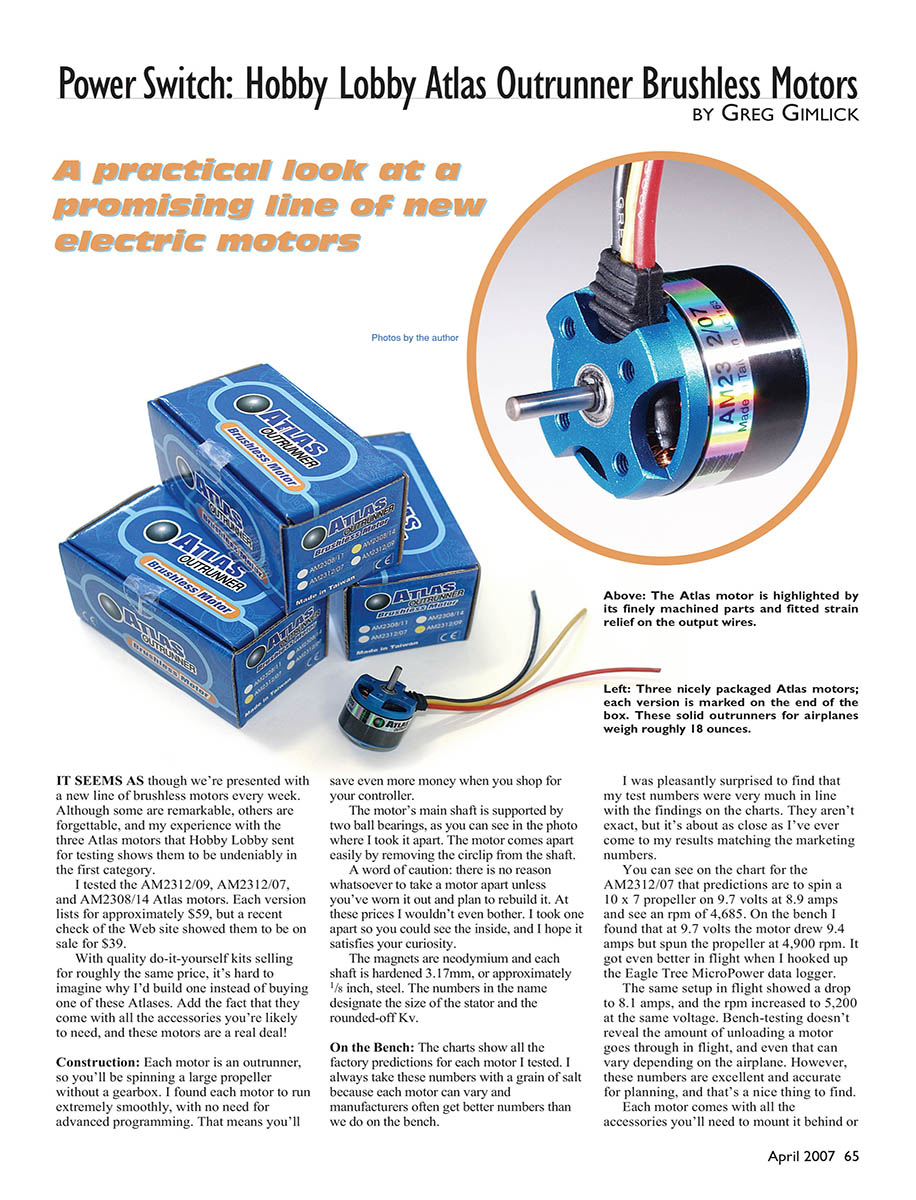
I tested the AM2312/09, AM2312/07, and AM2308/14 Atlas motors. Each version lists for approximately $59, but a recent check of the Hobby Lobby website showed them on sale for $39. With quality do-it-yourself kits selling for roughly the same price, it's hard to imagine why I'd build one instead of buying one of these Atlases. Add the fact that they come with all the accessories you're likely to need, and these motors are a real deal!
- AM2312/09
- AM2312/07
- AM2308/14
Construction
Each motor is an outrunner, so you'll be spinning a large propeller without a gearbox. I found each motor to run extremely smoothly, with no need for advanced programming. That means you'll save even more money when you shop for your controller.
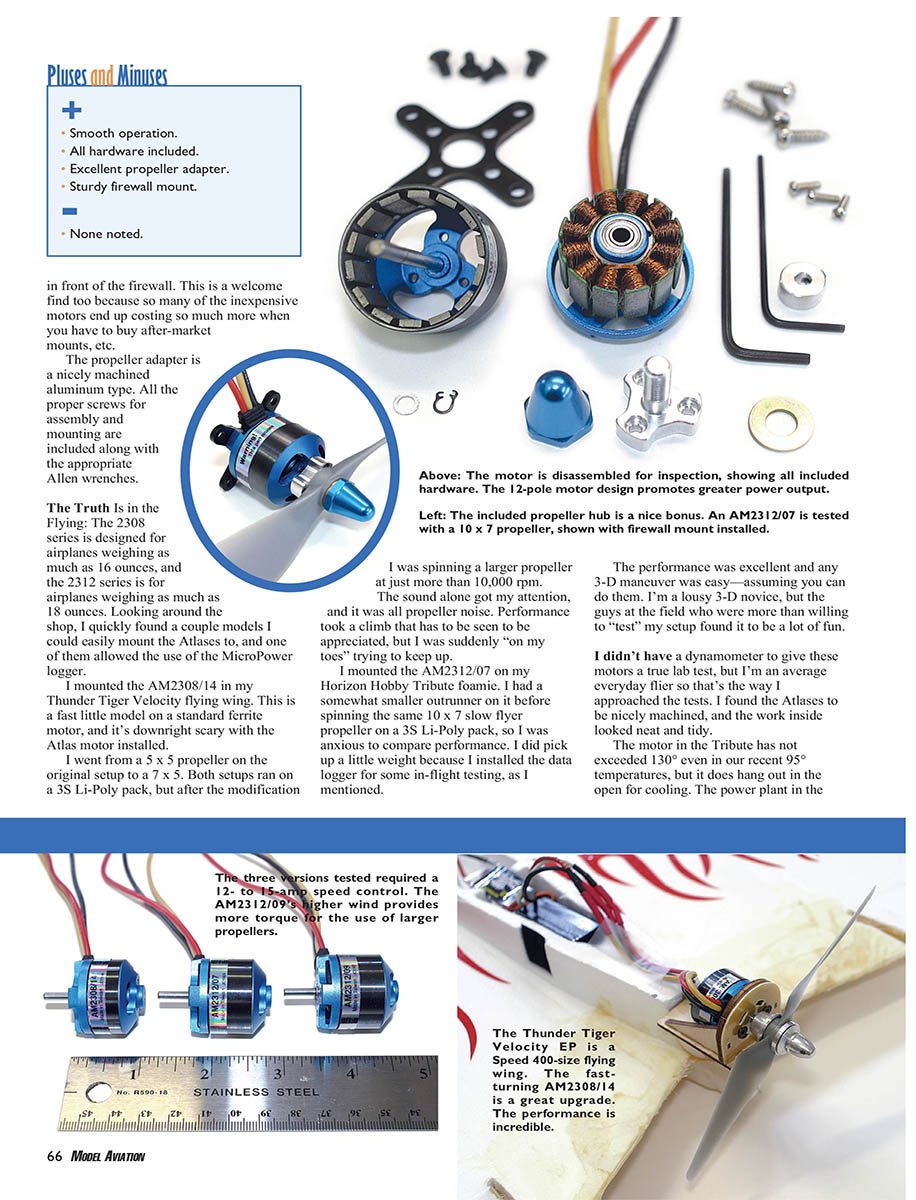
The motor's main shaft is supported by two ball bearings. The motor comes apart easily by removing the circlip from the shaft. A word of caution: there is no reason whatsoever to take a motor apart unless you've worn it out and plan to rebuild it. At these prices I wouldn't even bother. I took one apart so you could see the inside, and I hope it satisfies your curiosity.
The magnets are neodymium and each shaft is hardened 3.17 mm (approximately 1/8 inch) steel. The numbers in the name designate the size of the stator and the rounded-off Kv.
On the Bench
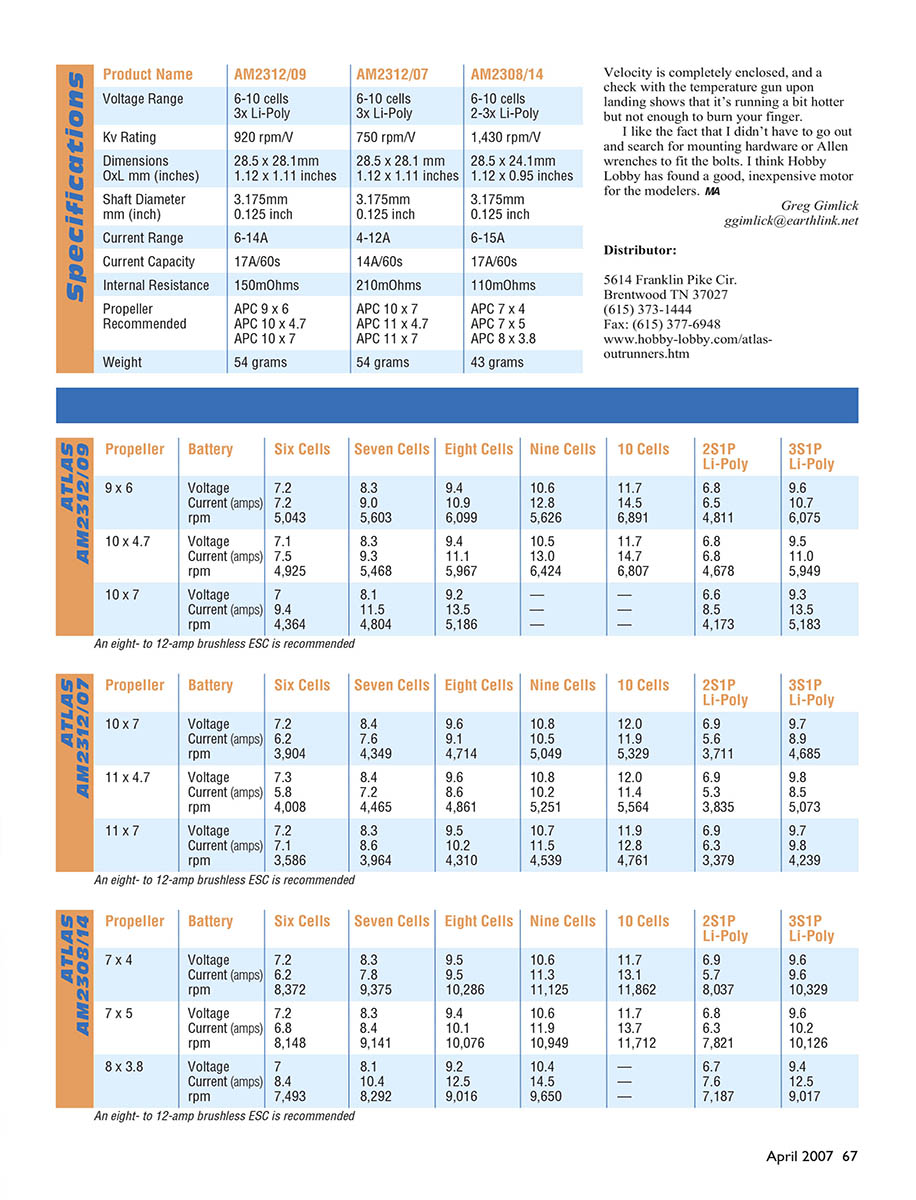
The factory charts list predicted performance for each motor I tested. I always take these numbers with a grain of salt because each motor can vary and manufacturers often post the best-case numbers. I was pleasantly surprised to find that my test numbers were very much in line with the marketing figures. They aren't exact, but it's about as close as I've ever come to my results matching the marketing numbers.
For example, the chart for the AM2312/07 predicts spinning a 10 x 7 propeller on 9.7 volts at 8.9 amps for an rpm of 4,685. On the bench I found that at 9.7 volts the motor drew 9.4 amps and spun the propeller at 4,900 rpm. It got even better in flight when I hooked up the Eagle Tree MicroPower data logger: the same setup in flight showed a drop to 8.1 amps and the rpm increased to 5,200 at the same voltage. Bench-testing doesn't reveal the amount of unloading a motor goes through in flight, and that unloading can vary depending on the airplane. However, these numbers are excellent and accurate enough for planning, and that's a nice thing to find.
Each motor comes with all the accessories you'll need to mount it behind or in front of the firewall. This is a welcome find because many inexpensive motors end up costing much more when you have to buy aftermarket mounts and hardware. The propeller adapter is a nicely machined aluminum type. All the proper screws for assembly and mounting are included along with the appropriate Allen wrenches.
The Truth Is in the Flying
The 2308 series is designed for airplanes weighing as much as 16 ounces, and the 2312 series for airplanes weighing as much as 18 ounces. Looking around the shop, I quickly found a couple models I could easily mount the Atlases to, and one of them allowed the use of the MicroPower logger.
I mounted the AM2308/14 in my Thunder Tiger Velocity flying wing. This is a fast little model on a standard ferrite motor, and it's downright scary with the Atlas motor installed. I went from a 5 x 5 propeller on the original setup to a 7 x 5. Both setups ran on a 3S Li-Poly pack, but after the modification I was spinning a larger propeller at just over 10,000 rpm. The sound alone got my attention, and it was all propeller noise. Performance improved dramatically; it was a handful to keep up with.
I mounted the AM2312/07 on my Horizon Hobby Tribute foamie. I had a somewhat smaller outrunner on it before, spinning the same 10 x 7 slow-flyer propeller on a 3S Li-Poly pack, so I was eager to compare performance. I did add a little weight because I installed the data logger for some in-flight testing.
The performance was excellent and any 3-D maneuver was easy—assuming you can do them. I'm a lousy 3-D novice, but the guys at the field who were more than willing to "test" my setup found it to be a lot of fun.
I didn't have a dynamometer to give these motors a true lab test, but I'm an average everyday flier so that's the way I approached the tests. I found the Atlases to be nicely machined, and the work inside looked neat and tidy.
The motor in the Tribute has not exceeded 130° even in our recent 95° temperatures, but it does hang out in the open for cooling. The power plant in the Velocity is completely enclosed, and a check with the temperature gun upon landing shows that it’s running a bit hotter but not enough to burn your finger.
I like the fact that I didn’t have to go out and search for mounting hardware or Allen wrenches to fit the bolts. I think Hobby Lobby has found a good, inexpensive motor for modelers.
Greg Gimlick [email protected]
Distributor
5614 Franklin Pike Cir. Brentwood, TN 37027 (615) 373-1444 Fax: (615) 377-6948 www.hobby-lobby.com/atlas-outrunners.htm
Transcribed from original scans by AI. Minor OCR errors may remain.

