
PowerSwitch: AeroFly 5
Shawn Rubush
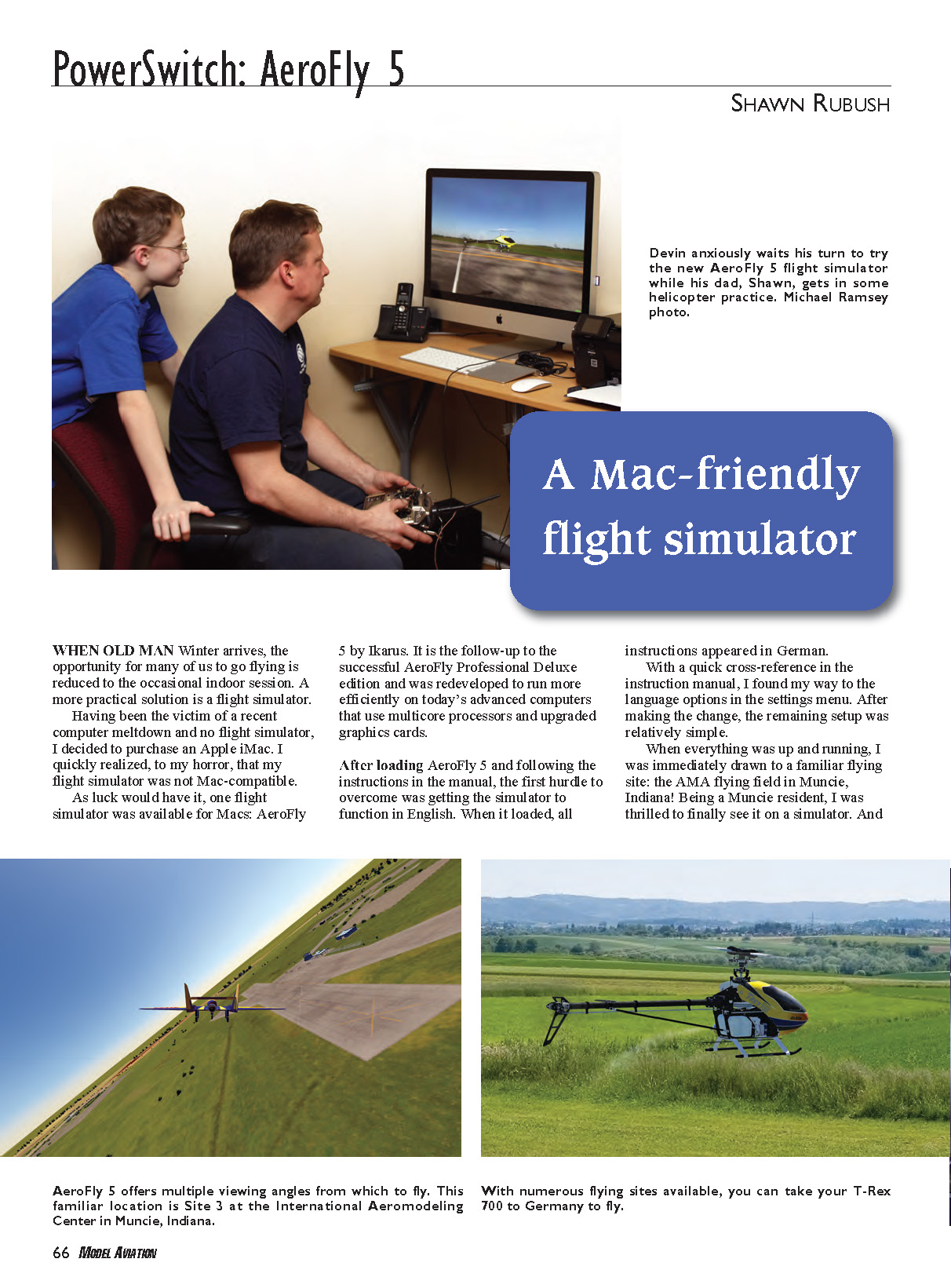
When Old Man Winter arrives, the opportunity for many of us to go flying is reduced to the occasional indoor session. A more practical solution is a flight simulator.
Having been the victim of a recent computer meltdown and left without a flight simulator, I decided to purchase an Apple iMac. I quickly realized, to my horror, that my flight simulator was not Mac-compatible.
As luck would have it, one flight simulator was available for Macs: AeroFly 5 by Ikarus. It is the follow-up to the successful AeroFly Professional Deluxe edition and was redeveloped to run more efficiently on today’s advanced computers that use multicore processors and upgraded graphics cards.
After loading AeroFly 5 and following the instructions in the manual, the first hurdle to overcome was getting the simulator to function in English. When it loaded, all instructions appeared in German. With a quick cross-reference in the manual, I found the language options in the settings menu. After making the change, the remaining setup was relatively simple.
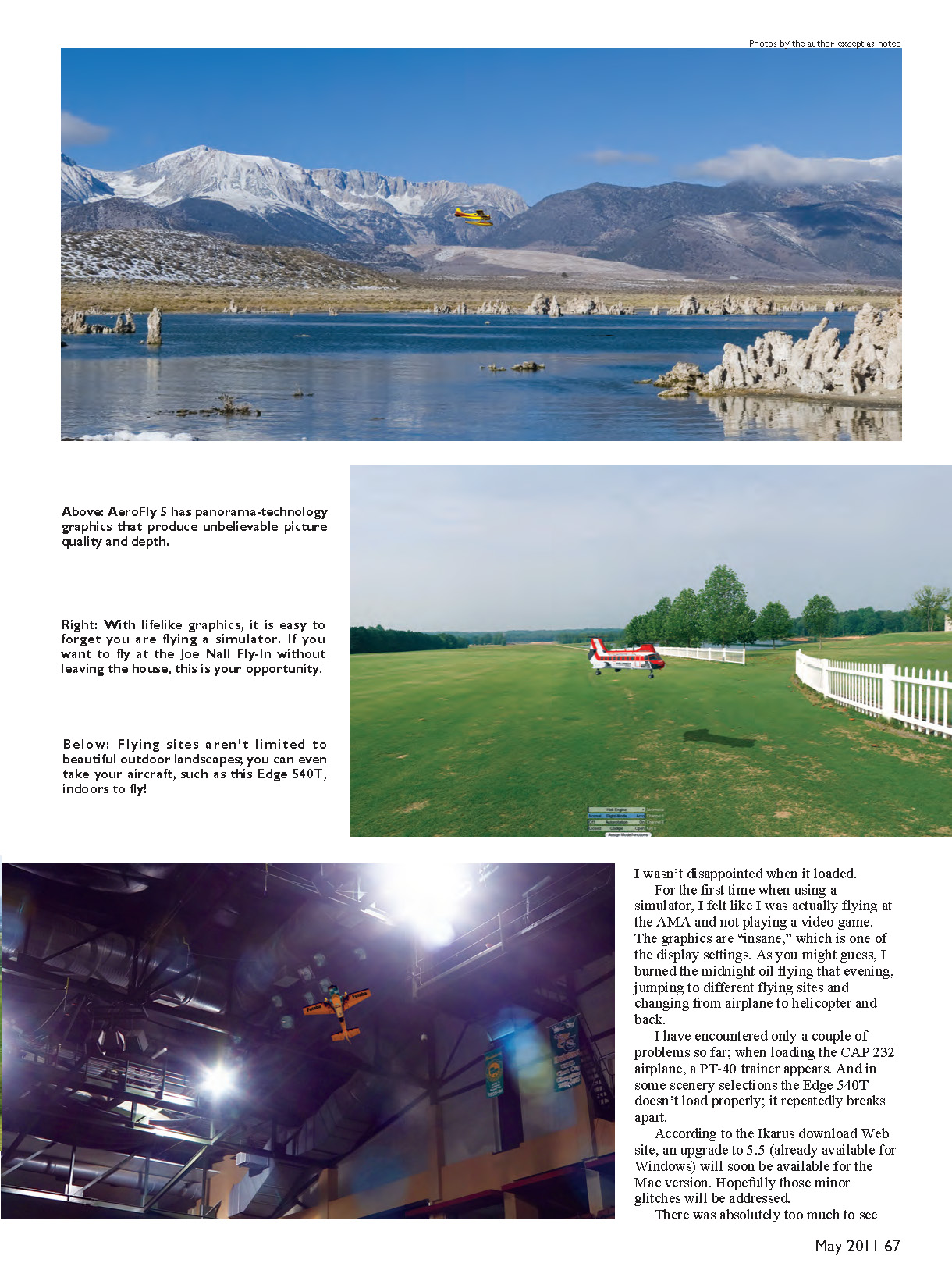
When everything was up and running, I was immediately drawn to a familiar flying site: the AMA flying field in Muncie, Indiana. Being a Muncie resident, I was thrilled to finally see it on a simulator, and I wasn't disappointed when it loaded.
For the first time when using a simulator, I felt like I was actually flying at the AMA and not playing a video game. The graphics are "insane," which is one of the display settings. As you might guess, I burned the midnight oil flying that evening, jumping to different flying sites and changing from airplane to helicopter and back.
I have encountered only a couple of problems so far. When loading the CAP 232 airplane, a PT-40 trainer appears. In some scenery selections the Edge 540T doesn't load properly; it repeatedly breaks apart.
According to the Ikarus download Web site, an upgrade to 5.5 (already available for Windows) would soon be available for the Mac version. Hopefully those minor glitches will be addressed.
There was absolutely too much to see and do in one evening. Having a more methodical approach was my goal for the second evening, with the intention of seeing all of the available options, functions, and parameters.
With a simple right-click of the mouse, a quick launch menu appears on the screen; it gives you the ability to choose any action your heart desires. Specific scenery has small symbols in the lower corner to show what contests are available at that particular flying site.
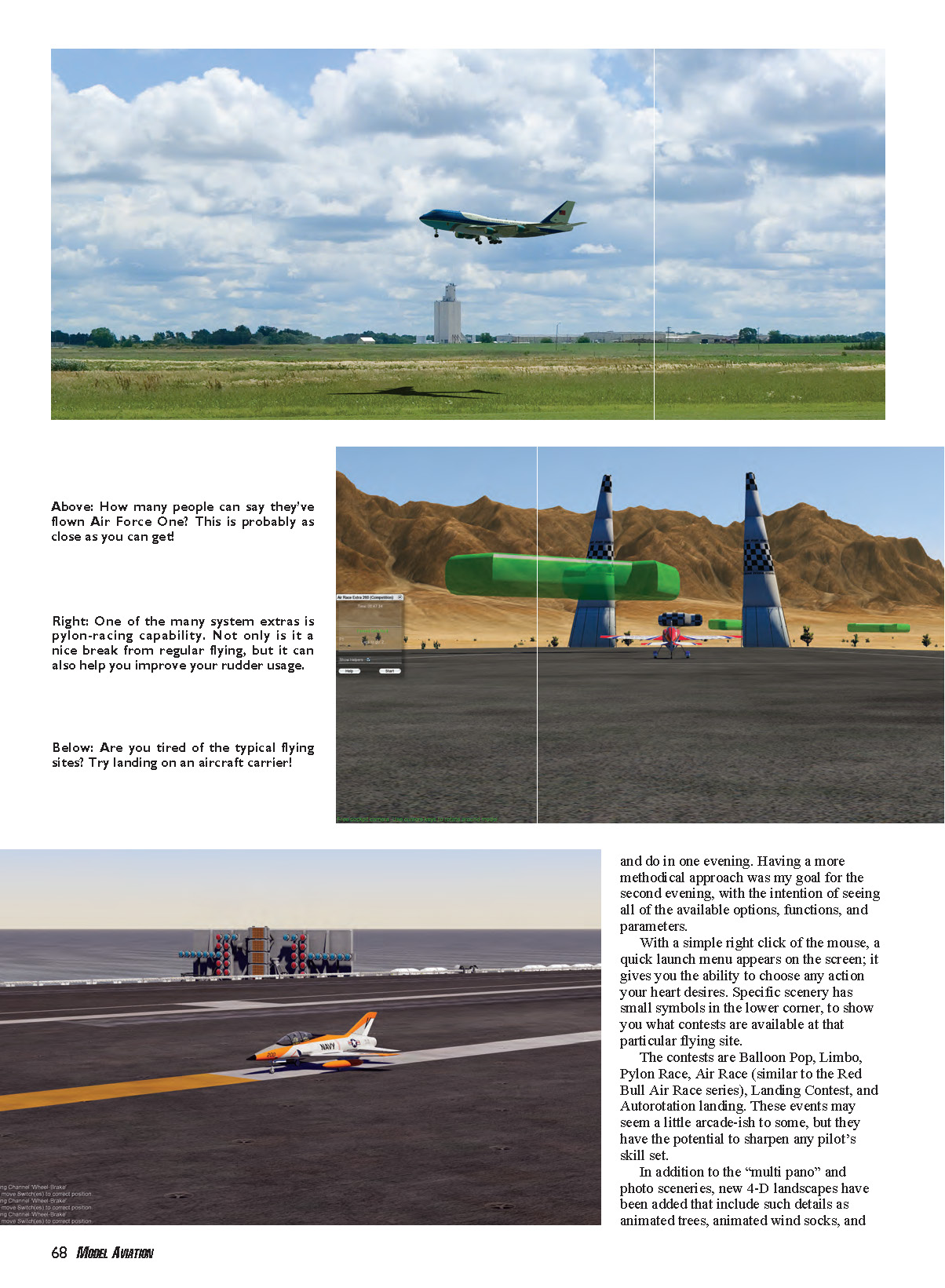
The contests are Balloon Pop, Limbo, Pylon Race, Air Race (similar to the Red Bull Air Race series), Landing Contest, and Autorotation Landing. These events may seem a little arcade-ish to some, but they have the potential to sharpen any pilot's skill set.
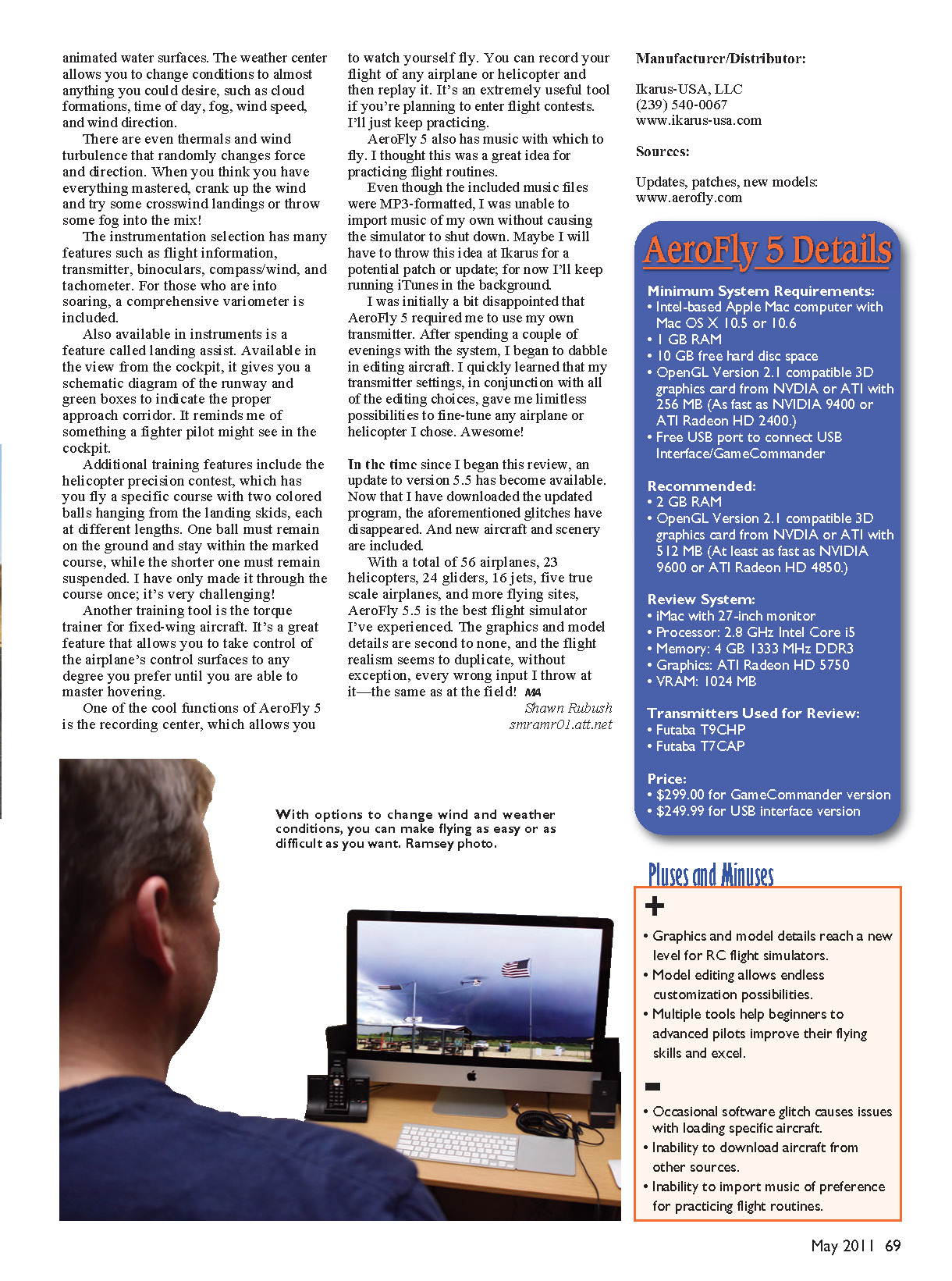
In addition to the "multi pano" and photo sceneries, new 4-D landscapes have been added that include such details as animated trees, animated windsocks, and animated water surfaces. The weather center allows you to change conditions to almost anything you could desire, such as cloud formations, time of day, fog, wind speed, and wind direction.
There are even thermals and wind turbulence that randomly change force and direction. When you think you have everything mastered, crank up the wind and try some crosswind landings or throw some fog into the mix!
The instrumentation selection has many features such as flight information, transmitter, binoculars, compass/wind, and tachometer. For those who are into soaring, a comprehensive variometer is included.
Also available in instruments is a feature called Landing Assist. Available in the cockpit view, it gives you a schematic diagram of the runway and green boxes to indicate the proper approach corridor. It reminds me of something a fighter pilot might see in the cockpit.
Additional training features include the helicopter precision contest, which has you fly a specific course with two colored balls hanging from the landing skids, each at different lengths. One ball must remain on the ground and stay within the marked course, while the shorter one must remain suspended. I have only made it through the course once; it's very challenging!
Another training tool is the torque trainer for fixed-wing aircraft. It's a great feature that allows you to take control of the airplane's control surfaces to any degree you prefer until you master hovering.
One of the cool functions of AeroFly 5 is the Recording Center, which allows you to watch yourself fly. You can record your flight of any airplane or helicopter and then replay it. It's an extremely useful tool if you're planning to enter flight contests.
AeroFly 5 also has music with which to fly. I thought this was a great idea for practicing flight routines. Even though the included music files were MP3-formatted, I was unable to import music of my own without causing the simulator to shut down. Maybe I will have to throw this idea at Ikarus for a potential patch or update; for now I'll keep running iTunes in the background.
I was initially a bit disappointed that AeroFly 5 required me to use my own transmitter. After spending a couple of evenings with the system, I began to dabble in editing aircraft. I quickly learned that my transmitter settings, in conjunction with all of the editing choices, gave me limitless possibilities to fine-tune any airplane or helicopter I chose. Awesome!
In the time since I began this review, an update to version 5.5 became available. Now that I have downloaded the updated program, the aforementioned glitches have disappeared. New aircraft and scenery are included.
With a total of 56 airplanes, 23 helicopters, 24 gliders, 16 jets, five true-scale airplanes, and more flying sites, AeroFly 5.5 is the best flight simulator I've experienced. The graphics and model details are second to none, and the flight realism seems to duplicate, without exception, every wrong input I throw at it—the same as at the field!
Shawn Rubush [email protected]
Manufacturer/Distributor
- Ikarus-USA, LLC
- Phone: (239) 540-0067
- Website: www.ikarus-usa.com
Sources
- Updates, patches, new models: www.aerofly.com
AeroFly 5 Details
- Minimum System Requirements:
- Intel-based Apple Mac computer with Mac OS X 10.5 or 10.6
- 1 GB RAM
- 10 GB free hard disk space
- OpenGL Version 2.1 compatible 3D graphics card from NVIDIA or ATI with 256 MB (as fast as NVIDIA 9400 or ATI Radeon HD 2400)
- Free USB port to connect USB Interface/GameCommander
- Recommended:
- 2 GB RAM
- OpenGL Version 2.1 compatible 3D graphics card from NVIDIA or ATI with 512 MB (at least as fast as NVIDIA 9600 or ATI Radeon HD 4850)
- Review System:
- iMac with 27-inch monitor
- Processor: 2.8 GHz Intel Core i5
- Memory: 4 GB 1333 MHz DDR3
- Graphics: ATI Radeon HD 5750
- VRAM: 1024 MB
- Transmitters Used for Review:
- Futaba T9CHP
- Futaba T7CAP
- Price:
- $299.00 for GameCommander version
- $249.99 for USB interface version
Pluses and Minuses
- Pluses:
- Graphics and model details reach a new level for RC flight simulators.
- Model editing allows endless customization possibilities.
- Multiple tools help beginners to advanced pilots improve their flying skills and excel.
- Minuses:
- Occasional software glitch causes issues with loading specific aircraft.
- Inability to download aircraft from other sources.
- Inability to import preferred music for practicing flight routines.
Transcribed from original scans by AI. Minor OCR errors may remain.

