
President’s Perspective
Dave Brown, AMA president
The National Aeromodeling Championships (Nats) is in progress as this is being written, and this year the Nats theme song should be “Row, Row, Row Your Boat!” I have seen a lot of Nats where we had problems with rain, but this one takes the cake. The amazing part of this saga is that it had little effect on the actual flying. All of the events have been flown pretty well on schedule.
On July 4, a monsoon started that resulted in central Indiana being declared a disaster area by the federal government. Amazingly, the modelers persevered, competed, won, lost, and generally did their thing.
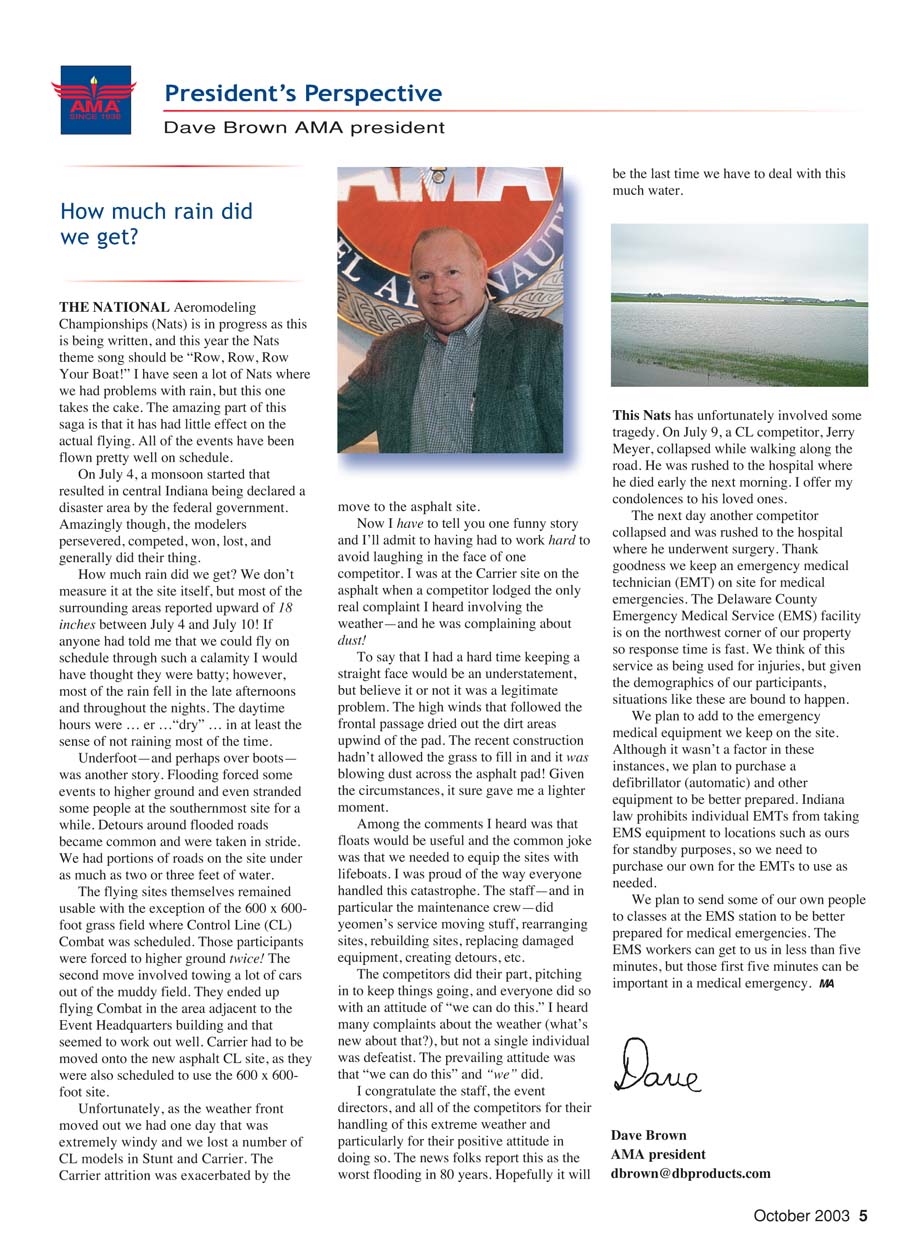
How much rain did we get? We don’t measure it at the site itself, but most of the surrounding areas reported upward of 18 inches between July 4 and July 10. If anyone had told me we could fly on schedule through such a calamity I would have thought they were batty; however, most of the rain fell in the late afternoons and throughout the nights. The daytime hours were, er, “dry” — at least in the sense of not raining most of the time.
Underfoot — and perhaps over boots — was another story. Flooding forced some events to higher ground and even stranded some people at the southernmost site for a while. Detours around flooded roads became common and were taken in stride. We had portions of roads on the site under as much as two or three feet of water.
The flying sites themselves remained usable with the exception of the 600 x 600-foot grass field where Control Line (CL) Combat was scheduled. Those participants were forced to higher ground twice. The second move involved towing a lot of cars out of the muddy field. They ended up flying Combat in the area adjacent to the Event Headquarters building, and that seemed to work out well. Carrier had to be moved onto the new asphalt CL site, as it was also scheduled to use the 600 x 600-foot site.
Unfortunately, as the weather front moved out we had one day that was extremely windy and we lost a number of CL models in Stunt and Carrier. The Carrier attrition was exacerbated by the move to the asphalt site.
Now I have to tell you one funny story, and I’ll admit to having had to work hard to avoid laughing in the face of one competitor. I was at the Carrier site on the asphalt when a competitor lodged the only real complaint I heard involving the weather — and he was complaining about dust! To say that I had a hard time keeping a straight face would be an understatement, but believe it or not it was a legitimate problem. The high winds that followed the frontal passage dried out the dirt areas upwind of the pad. The recent construction hadn’t allowed the grass to fill in and it was blowing dust across the asphalt pad. Given the circumstances, it sure gave me a lighter moment.
Among the comments I heard was that floats would be useful and the common joke was that we needed to equip the sites with lifeboats. I was proud of the way everyone handled this catastrophe. The staff — and in particular the maintenance crew — did yeoman’s service moving stuff, rearranging sites, rebuilding sites, replacing damaged equipment, creating detours, etc. The competitors did their part, pitching in to keep things going, and everyone did so with an attitude of “we can do this.” I heard many complaints about the weather (what’s new about that?), but not a single individual was defeatist. The prevailing attitude was that “we can do this,” and “we” did.
I congratulate the staff, the event directors, and all of the competitors for their handling of this extreme weather and particularly for their positive attitude in doing so. The news folks report this as the worst flooding in 80 years. Hopefully it will be the last time we have to deal with this much water.
This Nats has unfortunately involved some tragedy. On July 9, a CL competitor, Jerry Meyer, collapsed while walking along the road. He was rushed to the hospital where he died early the next morning. I offer my condolences to his loved ones.
The next day another competitor collapsed and was rushed to the hospital where he underwent surgery. Thank goodness we keep an emergency medical technician (EMT) on site for medical emergencies. The Delaware County Emergency Medical Service (EMS) facility is on the northwest corner of our property so response time is very fast. We think of this service as being one for injuries, but given the demographics of our participants, situations like these are bound to happen.
We plan to add to the emergency medical equipment we keep on site. Specifically:
- Purchase an automatic defibrillator and other equipment for the EMTs to use as needed.
- Send some of our own people to classes at the EMS station to be better prepared for medical emergencies.
Indiana law prohibits individual EMS units from taking such equipment to locations like ours for standby purposes, so we need to purchase our own equipment for the EMTs to use.
The EMS workers can get to us in less than five minutes, but those first five minutes can be important in a medical emergency.
Dave Brown AMA president [email protected]
Transcribed from original scans by AI. Minor OCR errors may remain.

