
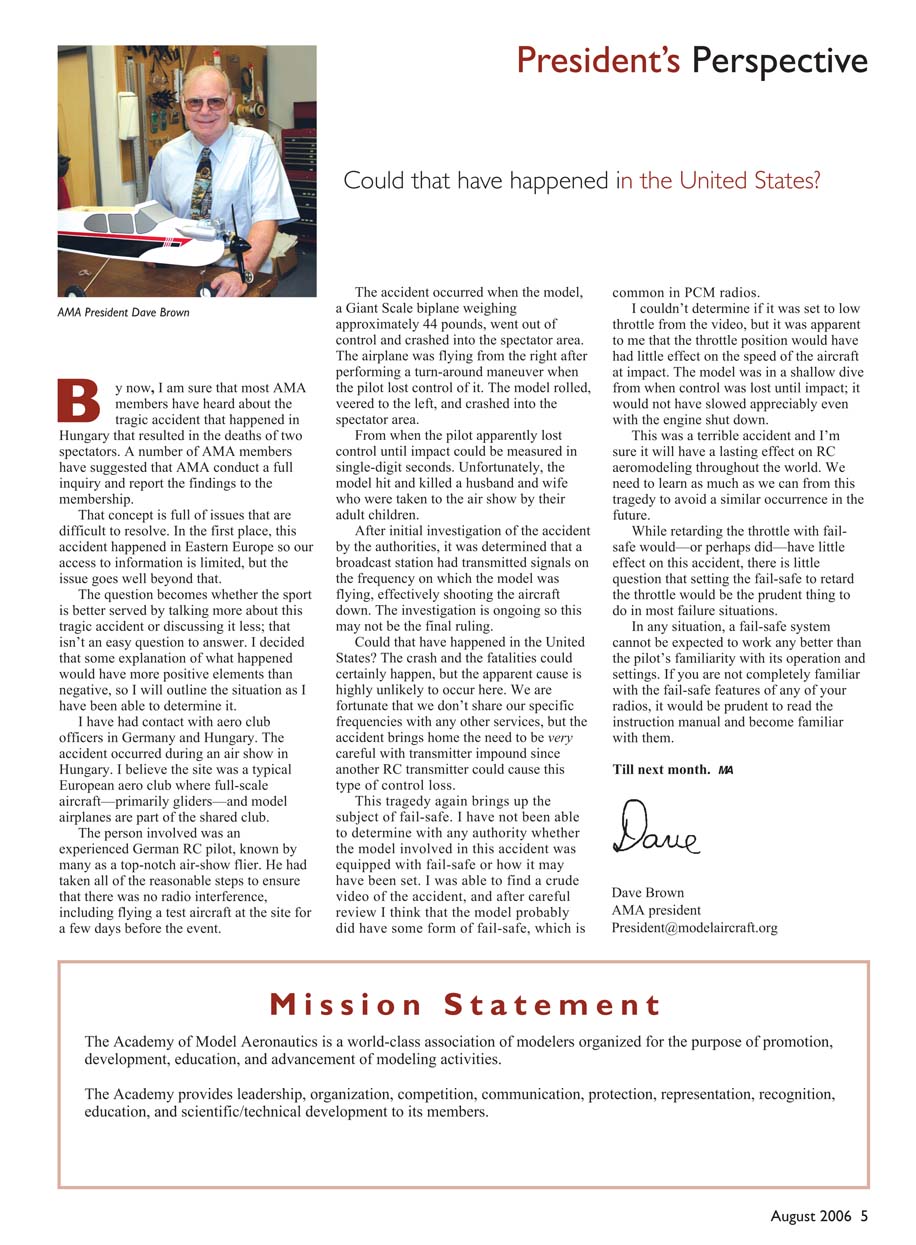
President’s Perspective - 2006/08
Could that have happened in the United States?
By now I am sure that most AMA members have heard about the tragic accident in Hungary that resulted in the deaths of two spectators. A number of AMA members have suggested that AMA conduct a full inquiry and report the findings to the membership.
That concept raises many difficult issues. First, the accident happened in Eastern Europe, so our access to information is limited. The issue goes well beyond that, however: the question becomes whether the sport is better served by talking more about this tragic accident or discussing it less. That isn't an easy question to answer. I decided that some explanation of what happened would have more positive elements than negative, so I will outline the situation as I have been able to determine it.
What happened
I have had contact with aero club officers in Germany and Hungary. The accident occurred during an air show in Hungary at a typical European aero club where full-scale aircraft—primarily gliders—and model airplanes share the site.
The pilot involved was an experienced German RC pilot, known by many as a top-notch air-show flier. He had taken reasonable steps to guard against radio interference, including flying a test aircraft at the site for a few days before the event.
The accident occurred when the model, a giant-scale biplane weighing approximately 44 pounds, went out of control and crashed into the spectator area. The airplane was flying in from the right after performing a turnaround maneuver when the pilot lost control. The model rolled, veered left, and crashed into the spectators.
From the moment the pilot apparently lost control until impact was only a matter of single-digit seconds. Unfortunately, the model hit and killed a husband and wife who had been taken to the air show by their adult children.
Investigation and apparent cause
After an initial investigation by the authorities, it was determined that a broadcast station had transmitted signals on the frequency the model was using, effectively shooting the aircraft down. The investigation is ongoing, so this may not be the final ruling.
Could that have happened in the United States? The crash and the resulting fatalities could certainly happen here, but the apparent cause is highly unlikely. We are fortunate that we do not share our specific RC frequencies with other services. Still, the accident emphasizes the need for care when handling transmitter impound situations—another RC transmitter could cause this type of control loss.
Fail-safe and lessons learned
This tragedy again raises the subject of fail-safe. I have not been able to determine with authority whether the model involved in this accident was equipped with fail-safe or how it may have been set. I was able to find a crude video of the accident, and after careful review I believe the model probably had some form of fail-safe, which is common in PCM radios.
I couldn't determine if the fail-safe was set to low throttle from the video, but it was apparent that throttle position would have had little effect on the aircraft's speed at impact. The model was in a shallow dive from loss of control until impact; it would not have slowed appreciably even with the engine shut down.
While retarding the throttle with fail-safe would—or perhaps did—have little effect in this particular accident, there is little question that setting fail-safe to retard the throttle is the prudent choice in most failure situations.
In any case, a fail-safe system cannot be expected to work any better than the pilot's familiarity with its operation and settings. If you are not completely familiar with the fail-safe features of any of your radios, read the instruction manual and become familiar with them.
Recommendations
- Be cautious with transmitter impound procedures; an active transmitter on the same frequency can cause control loss.
- Always set fail-safe to a safe condition (typically throttle retard) appropriate for the type of aircraft and flying environment.
- Verify fail-safe settings before flight and during range checks.
- Read and understand the instruction manual for every radio system you use.
- Share lessons learned from incidents to help prevent similar accidents in the future.
Till next month.
Dave Brown AMA President [email protected]
Transcribed from original scans by AI. Minor OCR errors may remain.

