
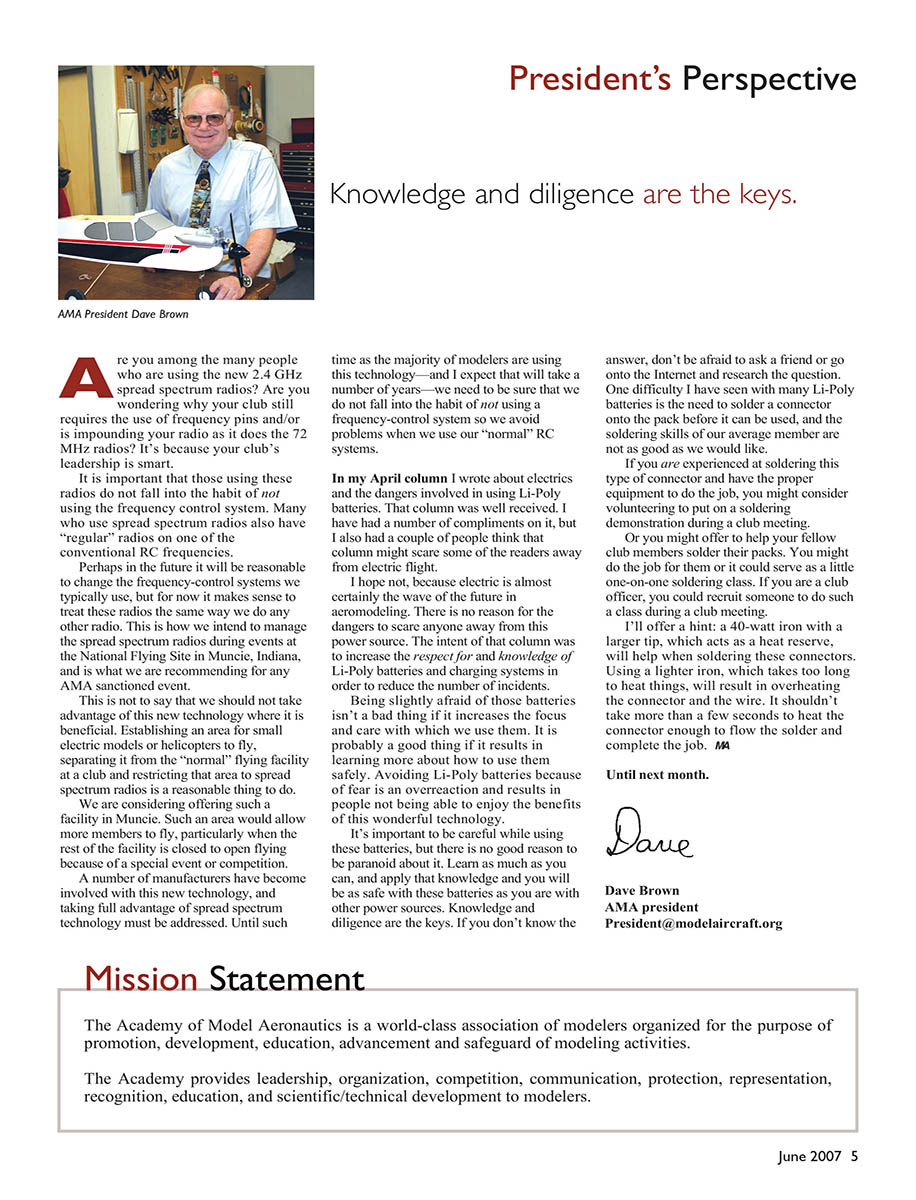
President’s Perspective - 2007/06
Knowledge and diligence are the keys.
Are you among the many people who are using the new 2.4 GHz spread-spectrum radios? Are you wondering why your club still requires the use of frequency pins and/or is impounding your radio as it does the 72 MHz radios? It’s because your club’s leadership is smart.
It is important that those using these radios do not fall into the habit of not using the frequency-control system. Many who use spread-spectrum radios also have "regular" radios on one of the conventional RC frequencies.
Perhaps in the future it will be reasonable to change the frequency-control systems we typically use, but for now it makes sense to treat these radios the same way we do any other radio. This is how we intend to manage the spread-spectrum radios during events at the National Flying Site in Muncie, Indiana, and is what we are recommending for any AMA-sanctioned event.
This is not to say that we should not take advantage of this new technology where it is beneficial. Establishing an area for small electric models or helicopters to fly, separating it from the "normal" flying facility at a club and restricting that area to spread-spectrum radios, is a reasonable thing to do. We are considering offering such a facility in Muncie. Such an area would allow more members to fly, particularly when the rest of the facility is closed to open flying because of a special event or competition.
A number of manufacturers have become involved with this new technology, and taking full advantage of spread-spectrum technology must be addressed. Until such time as the majority of modelers are using this technology—and I expect that will take a number of years—we need to be sure that we do not fall into the habit of not using a frequency-control system so we avoid problems when we use our "normal" RC systems.
In my April column I wrote about electrics and the dangers involved in using Li-Poly batteries. That column was well received. I have had a number of compliments on it, but I also had a couple of people think that column might scare some of the readers away from electric flight.
I hope not, because electric is almost certainly the wave of the future in aeromodeling. There is no reason for the dangers to scare anyone away from this power source. The intent of that column was to increase the respect for and knowledge of Li-Poly batteries and charging systems in order to reduce the number of incidents. Being slightly afraid of those batteries isn’t a bad thing if it increases the focus and care with which we use them. It is probably a good thing if it results in learning more about how to use them safely. Avoiding Li-Poly batteries because of fear is an overreaction and results in people not being able to enjoy the benefits of this wonderful technology.
It’s important to be careful while using these batteries, but there is no good reason to be paranoid about it. Learn as much as you can, and apply that knowledge and you will be as safe with these batteries as you are with other power sources. Knowledge and diligence are the keys. If you don’t know the answer, don’t be afraid to ask a friend or go onto the Internet and research the question.
One difficulty I have seen with many Li-Poly batteries is the need to solder a connector onto the pack before it can be used, and the soldering skills of our average member are not as good as we would like.
If you are experienced at soldering this type of connector and have the proper equipment to do the job, you might consider volunteering to help others in one of these ways:
- Put on a soldering demonstration during a club meeting.
- Offer to help club members solder their packs, either by doing the job or as a one-on-one soldering lesson.
- If you are a club officer, recruit someone to give such a class during a meeting.
Here’s a hint: a 40-watt iron with a larger tip, which acts as a heat reservoir, will help when soldering these connectors. Using a lighter iron, which takes too long to heat things, will result in overheating the connector and the wire. It shouldn’t take more than a few seconds to heat the connector enough to flow the solder and complete the job.
Until next month.
Dave Brown AMA President [email protected]
Transcribed from original scans by AI. Minor OCR errors may remain.

