
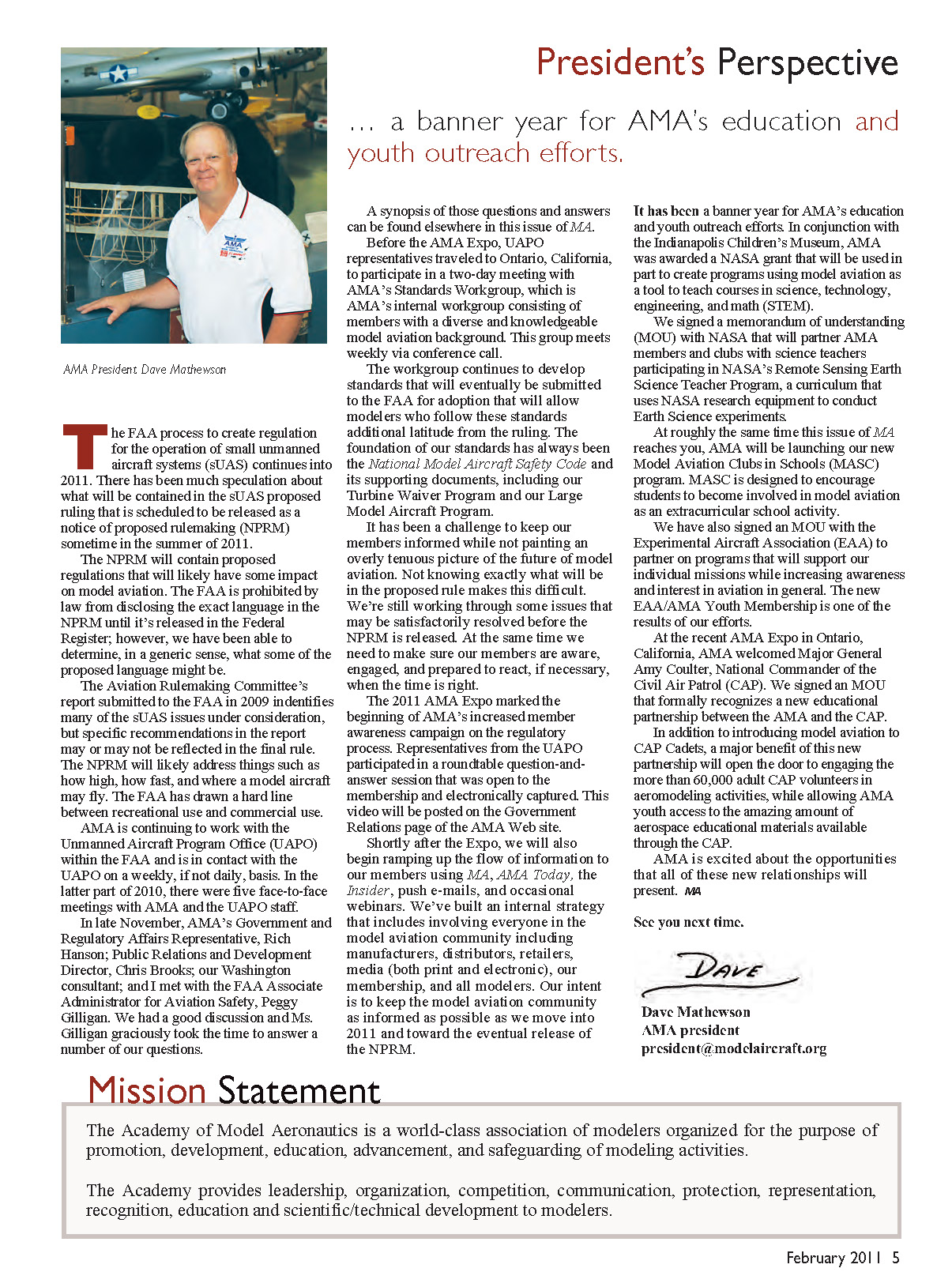
President’s Perspective - 2011/02
FAA sUAS rulemaking
The FAA process to create regulation for the operation of small unmanned aircraft systems (sUAS) continues into 2011. There has been much speculation about what will be contained in the sUAS proposed ruling that is scheduled to be released as a notice of proposed rulemaking (NPRM) sometime in the summer of 2011.
The NPRM will contain proposed regulations that will likely have some impact on model aviation. The FAA is prohibited by law from disclosing the exact language in the NPRM until it's released in the Federal Register; however, we have been able to determine, in a generic sense, what some of the proposed language might be.
The Aviation Rulemaking Committee's report submitted to the FAA in 2009 identifies many of the sUAS issues under consideration, but specific recommendations in the report may or may not be reflected in the final rule. The NPRM will likely address things such as how high, how fast, and where a model aircraft may fly. The FAA has drawn a hard line between recreational use and commercial use.
AMA engagement with the FAA
AMA is continuing to work with the Unmanned Aircraft Program Office (UAPO) within the FAA and is in contact with the UAPO on a weekly, if not daily, basis. In the latter part of 2010, there were five face-to-face meetings with AMA and the UAPO staff.
In late November, AMA's Government and Regulatory Affairs Representative Rich Hanson; Public Relations and Development Director Chris Brooks; our Washington consultant; and I met with the FAA Associate Administrator for Aviation Safety, Peggy Gilligan. We had a good discussion and Ms. Gilligan graciously took the time to answer a number of our questions.
A synopsis of those questions and answers can be found elsewhere in this issue of Model Aviation.
Before the AMA Expo, UAPO representatives traveled to Ontario, California, to participate in a two-day meeting with AMA's Standards Workgroup, AMA's internal workgroup consisting of members with a diverse and knowledgeable model aviation background. This group meets weekly via conference call.
The workgroup continues to develop standards that will eventually be submitted to the FAA for adoption that will allow modelers who follow these standards additional latitude from the ruling. The foundation of our standards has always been the National Model Aircraft Safety Code and its supporting documents, including our Turbine Waiver Program and our Large Model Aircraft Program.
Member communication and preparedness
It has been a challenge to keep our members informed while not painting an overly tenuous picture of the future of model aviation. Not knowing exactly what will be in the proposed rule makes this difficult. We're still working through some issues that may be satisfactorily resolved before the NPRM is released. At the same time we need to make sure our members are aware, engaged, and prepared to react, if necessary, when the time is right.
The 2011 AMA Expo marked the beginning of AMA's increased member awareness campaign on the regulatory process. Representatives from the UAPO participated in a roundtable question-and-answer session that was open to the membership and electronically captured. This video will be posted on the Government Relations page of the AMA website.
Shortly after the Expo, we will also begin ramping up the flow of information to our members using Model Aviation, AMA Today, the Insider, push e-mails, and occasional webinars. We've built an internal strategy that includes involving everyone in the model aviation community including manufacturers, distributors, retailers, media (both print and electronic), our membership, and all modelers. Our intent is to keep the model aviation community as informed as possible as we move into 2011 and toward the eventual release of the NPRM.
Education and youth outreach
It has been a banner year for AMA's education and youth outreach efforts. In conjunction with the Indianapolis Children's Museum, AMA was awarded a NASA grant that will be used in part to create programs using model aviation as a tool to teach courses in science, technology, engineering, and math (STEM).
We signed a memorandum of understanding (MOU) with NASA that will partner AMA members and clubs with science teachers participating in NASA's Remote Sensing Earth Science Teacher Program, a curriculum that uses NASA research equipment to conduct Earth Science experiments.
At roughly the same time this issue of Model Aviation reaches you, AMA will be launching our new Model Aviation Clubs in Schools (MASC) program. MASC is designed to encourage students to become involved in model aviation as an extracurricular school activity.
Partnerships
We have also signed an MOU with the Experimental Aircraft Association (EAA) to partner on programs that will support our individual missions while increasing awareness and interest in aviation in general. The new EAA/AMA Youth Membership is one of the results of our efforts.
At the recent AMA Expo in Ontario, California, AMA welcomed Major General Amy Coulter, National Commander of the Civil Air Patrol (CAP). We signed an MOU that formally recognizes a new educational partnership between the AMA and the CAP.
In addition to introducing model aviation to CAP cadets, a major benefit of this new partnership will be opening the door to engaging the more than 60,000 adult CAP volunteers in aeromodeling activities, while allowing AMA youth access to the aerospace educational materials available through the CAP.
AMA is excited about the opportunities that all of these new relationships will present.
See you next time.
Dave Mathewson AMA president [email protected]
Transcribed from original scans by AI. Minor OCR errors may remain.

