
President's Perspective — 2012/11
Bob Brown [email protected]
The value of noncompetitive events
As I am writing this in September, much of my focus has been on a long-awaited meeting between James Williams, manager of the Unmanned Aircraft Systems (UAS) Integration Office (the restructured Unmanned Aircraft Program Office), Bill Crozier, other FAA officials, AMA Executive Director Dave Mathewson, our Government and Regulatory Affairs Representative Rich Hanson, and me to discuss Public Law 112-95, the proposed Notice of Proposed Rulemaking, and its consequences for model aviation.
AMA’s position is that Public Law 112-95, passed by Congress and signed into law by President Barack Obama in February 2012, exempts model aircraft from regulation provided certain safety criteria are met and the activity is conducted within the auspices of a community-based safety program.
We provided the FAA representatives with a copy of the AMA Safety Program and asked that it be recognized as complying with congressional intent. We suggested that a Memorandum of Understanding (MOU) to identify AMA as a community-based organization as described in the law again be considered. The intent of this document would be to define the criteria for enacting the model aviation provision and create a liaison between the AMA and the FAA aimed at maintaining safe aeromodeling operations within the National Airspace System (NAS).
Staff members from the UAS Integration Office voiced concern regarding Congress’s approach, stating conformity with federal law requires a regulatory approach to maintaining the safety of the NAS. They expressed their belief that management of model aircraft activity should be handled through a set of consensus-based standards accepted, adopted, and established through an FAA-published Notice of Applicability. Ultimately, the FAA representatives agreed to review the AMA Safety Program and to consider establishing an MOU. Nothing definitive was decided, but the FAA committed to replying to the issues in 30 to 45 days.
The Association for Unmanned Vehicle Systems International (AUVSI) is the representative organization for the commercial global unmanned systems and robotics community. While in Washington, Rich Hanson and I met with representatives of the organization to develop a basic understanding of each other’s programs. Although the AUVSI represents a slightly different community of unmanned aviation, it is obvious that we should look into coordinating our efforts.
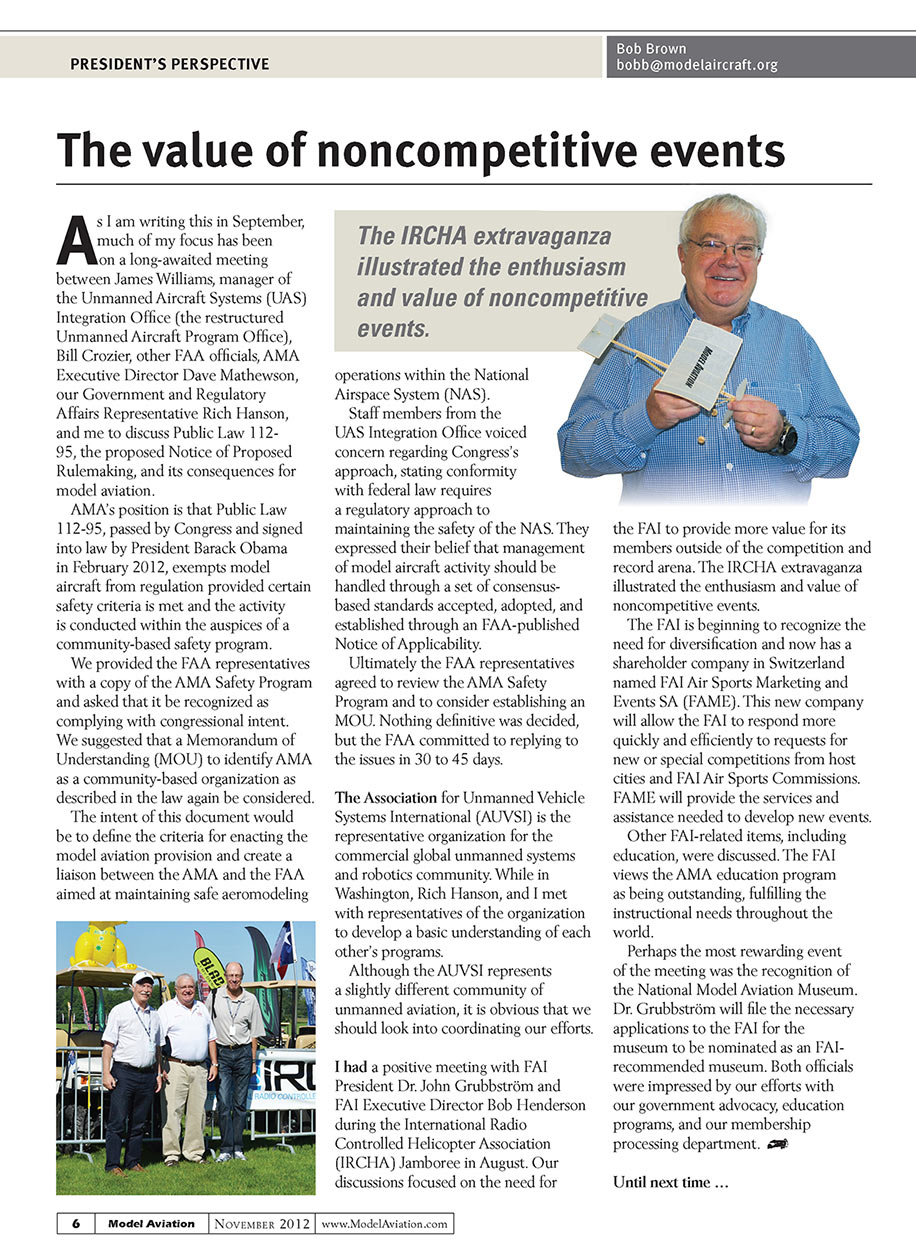
I had a positive meeting with FAI President Dr. John Grubbström and FAI Executive Director Bob Henderson during the International Radio Controlled Helicopter Association (IRCHA) Jamboree in August. Our discussions focused on the need for the FAI to provide more value for its members outside of the competition and record arena. The IRCHA extravaganza illustrated the enthusiasm and value of noncompetitive events.
The FAI is beginning to recognize the need for diversification and now has a shareholder company in Switzerland named FAI Air Sports Marketing and Events SA (FAME). This new company will allow the FAI to respond more quickly and efficiently to requests for new or special competitions from host cities and FAI Air Sports Commissions. FAME will provide the services and assistance needed to develop new events.
Other FAI-related items, including education, were discussed. The FAI views the AMA education program as outstanding, fulfilling instructional needs throughout the world.
Perhaps the most rewarding part of the meeting was the recognition of the National Model Aviation Museum. Dr. Grubbström will file the necessary applications to the FAI for the museum to be nominated as an FAI-recommended museum. Both officials were impressed by our efforts with government advocacy, education programs, and our membership processing department.
Until next time …
Transcribed from original scans by AI. Minor OCR errors may remain.

