
President's Perspective
Dave Brown AMA president
It will probably involve some more rules ...
RULES, RULES, RULES! All we seem to do is deal with rules. I hate rules. I hate thinking about them, I hate learning them, and I hate being subject to them. There simply isn't much about rules that I like — particularly those that apply to me. I actually like those rules that keep the other guy from doing something I think jeopardizes my fun, but those rules are different!
Have you ever heard this from a modeler? I'd bet you have. I think we have all expressed some version of this at one time or another, usually in the frustration of being subjected to a rule that gets in the way of our fun.
Most of those rules are ridiculous, and common sense would make them unnecessary, but common sense may be an oxymoron. If we could only abide by the Golden Rule, most rules wouldn't be necessary, but it's tough to have a competition under that rule.
Rules are not the most effective way to regulate our sport; peer pressure is a much more powerful force, and rules are used as guidance for that peer pressure.
Another force that applies — and it could be argued that it is the most significant — is conscience. I suspect most of us feel guilty if we have violated a rule, even if we are alone.
Rules established by AMA are intended to improve the sport. Some are made to make it safer, some make it possible to have fair competition, and some are made to ensure the survival of the sport by reducing the need for "outsiders" to make rules to regulate us.
Often those rules are the toughest to swallow. They may seem to contradict AMA's dedication to the advancement of model aviation, and to a certain degree I can see this point. On the other hand, if we fail to control our own activities, it will not be long before someone else regulates them for us.
In a couple of instances this has raised the ire of a few AMA members, and it isn't an easy subject to address. The first case involves the definition that separates an Unmanned Aerial Vehicle (UAV) from a model airplane. I addressed this issue in a previous column, and it raised quite a ruckus among those with an interest in this field.
Many misread what I wrote and felt I was advocating that the Federal Aviation Administration (FAA) step in and regulate UAVs. I wasn't advocating any such regulation, and I don't know of anyone in AMA who has made any such plea to the FAA.
What I do believe — and that column reflected — is the inevitability of that regulation. Anyone who thinks the FAA can ignore UAVs flying "missions" that extend far beyond the pilot's line of sight, without some form of regulation, is kidding himself. My acceptance of this as inevitable would not drive me to approach the FAA to suggest it.
What I do think we should do is establish a recognized definition that separates UAVs from model airplanes to avoid model airplanes becoming regulated. Many rules might be appropriate for UAVs but would be devastating if applied to model airplanes.
The second instance relates to "full-contact" Radio Control (RC) Combat. The AMA Safety Committee recommended a ban on such events, and the proverbial fertilizer hit the rotary distribution device almost immediately. In most instances the vast majority of this activity is perfectly reasonable and carried out so that there is minimal risk of creating a liability problem. The problem is that a few modelers simply do not get it, and they run events that are inherently unsafe. I even had a person try to prove the relative safety of "his" activity by the "rule" that the only person you could intentionally hit was the pilot of an opposing airplane — and hitting him yielded points! Hello?
That forces us to reconsider our policy of "letting anything go" guide our activities and rely on common sense as the principal control. The result? The entire subject of full-contact Combat will be referred to the Radio Control Combat Association (RCCA), which is the Special Interest Group dedicated to RC Combat. It has been tasked to come up with — are you ready for this? — rules to govern this type of activity. Aaaaaaaaaarggghhh!
The 2002 National Aeromodeling Championships (Nats) is over, and although it started a little slowly with low attendance for the Scale events, it finished with a big event: Free Flight! Along the way, the staff dealt with every variation of problems imaginable and, in most cases, did so with style and grace.
Congratulations to the winners and all who took part.
The Nats is now approaching a month and a half in length, and the event covers nearly every type of model conceivable.
I want to take this opportunity to congratulate the International Miniature Aerobatic Club (IMAC) crowd, which dug in after last year's noise complaint and made the models much quieter. I'm not aware of a single noise complaint this year. Well done, folks.
We continue to have problems with Free Flight models retrieving their aircraft off-site and creating "trespassing" complaints. We need to work on this one. (It will probably involve some more rules ...)
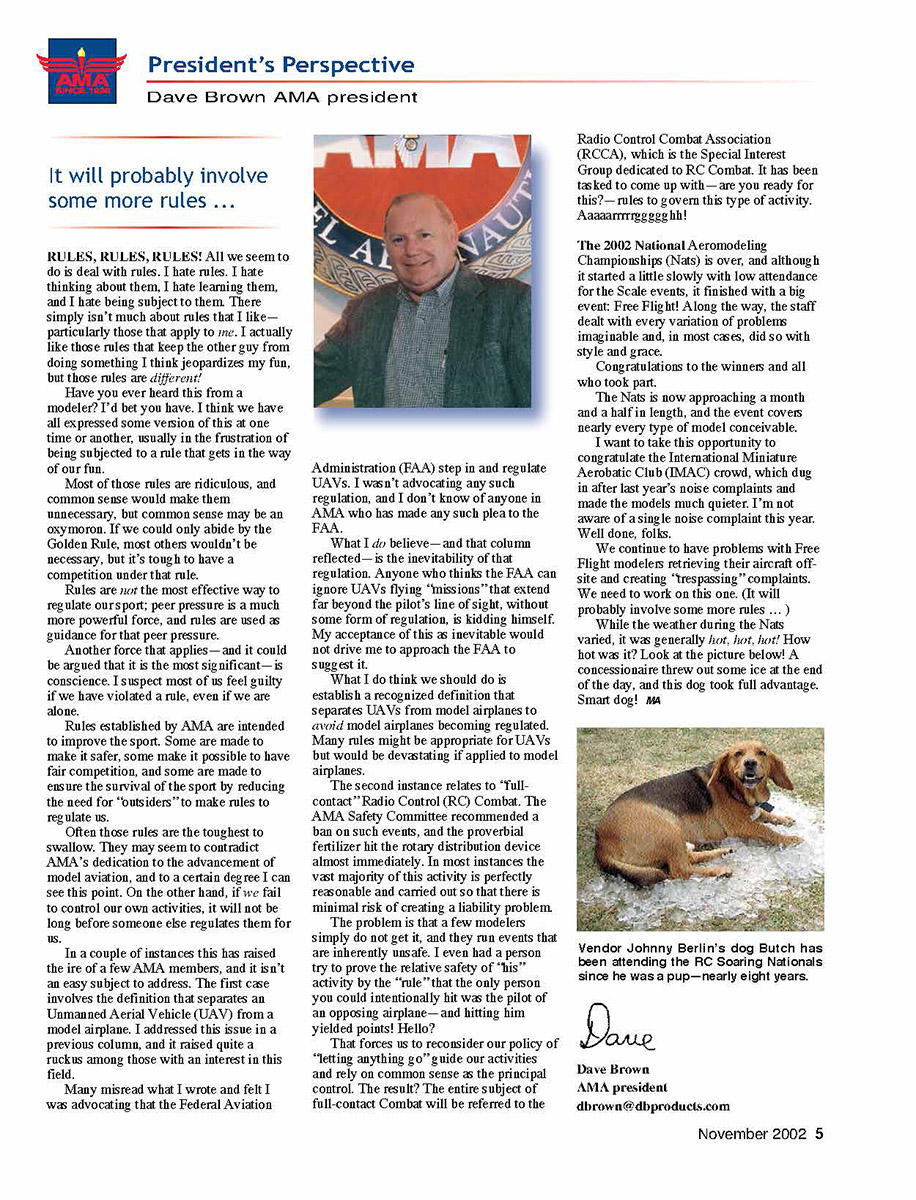
While the weather during the Nats varied, it was generally hot, hot, hot! How hot was it? Look at the picture below! A concessionaire threw out some ice at the end of the day, and this dog took full advantage. Smart dog! MA
Dave Brown AMA president <REDACTED>
Transcribed from original scans by AI. Minor OCR errors may remain.

