
Product Review
409 Sixth St., Phillipsburg NJ 08865
Castle Creations Electronic Speed Controls
Pros:
- Large variety of products in line to satisfy almost any application
- Consistency of instruction manuals from product to product
- Twelve-inch-long servo lead on most units allows ESC to be located as far as possible from receiver—essential to good operation in high-current applications. In low-current applications, shorter leads provided reduce unnecessary weight.
Cons:
- Slightly longer power and battery leads would have been nice.
- Folded instruction booklet is difficult to fit into binder for reference.
- Heat sink for each design is arbitrarily sized to correspond to maximum dimensions of the circuit board rather than to dissipation requirements provided by FET manufacturers.
- BEC chip employed is limited in number of servos it will drive, but those limitations are not clearly spelled out in manuals. Many radio systems (especially those with poor linkages, digital servos, or in high-speed aircraft) can easily draw much more, leading to possible loss of control of the model. Utility and need for BEC diminish greatly as more powerful systems are employed, so it was not a desired feature in 40+-amp units.
CERTAIN PRODUCTS can be difficult to review for any number of reasons; sometimes the company has a long-standing reputation for quality, sometimes the product is known and loved, and sometimes the volume of work for a comprehensive review seems daunting. With the Castle Creations Electronic Speed Control (ESC) family, all those factors apply. Nevertheless, I will review six of the brushed-motor ESCs, ranging from the tiny Pixie-7P to the Griffin-55.
As an electronics engineer, my first approach to reviewing the products was to compare the features list of each with the data provided by the chip manufacturers. As much as possible, the components were identified and specifications were compared to those published by Castle Creations.
Next I analyzed the firmware performance in several aspects — most notably in similarity of user interface and similarity to the rest of the industry.
Finally, all ESCs would find a home in a model of suitable performance for the recommended unit. This would allow a subjective interpretation of how the ESC "felt" in the application.
The quick review: everything worked as advertised, feel was consistent with other brands, most parts were reasonably utilized, and all the "magic smoke" stayed inside.
Common features: All Castle controls except the Pixie-7P are similar in their operation and features; the big difference (other than size and weight) is the current capacity. The Pixie-7P will be discussed separately, so the word "all" in the following paragraphs means all except the Pixie-7P.
All controllers are microprocessor-controlled units using the popular Microchip PIC12C508 — a part found in many of the ESCs from a variety of vendors.
All products include a Battery Eliminator Circuit (BEC) to eliminate the need for a separate receiver battery. The BEC puts out 5.0 volts nominally, and that went down to roughly 4.0 volts before the low-voltage motor-cutoff (LVC) feature shutdown the motor.
All units were advertised with a fixed 4.7-volt LVC. When measured, the LVC never disconnected at 4.7 volts; 4.2 volts was far more common but is within approximately a 10% range and therefore acceptable. The LVC function prevents flies from completely draining a battery pack and losing control of the aircraft.
When the motor power starts dropping, you should be on final if not on the ground.
All products employ a thin (0.032 inch) piece of aluminum plate to serve as a heat sink for the field-effect transistors (FETs). None of them utilized any heat sink compound (a special type of grease which conducts heat well) to enhance the function of the heatsink, but it would help on the hotter-running units to reduce the possibility of failure.
The controllers' 35A and higher employed power leads marked 18AWG (American Wire Gauge) for the motor and battery. Although the leads were a bit short (approximately five inches on average), they were certainly adequate. For the miniature controllers 16AWG wire was employed, and the smallest control used unmarked wire I would estimate at 20 or 22AWG. Wire sizes are appropriate for the specified application.
All Castle Creations ESCs used the same color coding for the leads; give the man an A+ for consistency. The leads to the motor were white and red, and the leads to the battery pack were red and black, matching the common colors for battery packs.
All the controls were ready to run (except connectors) right out of the box. This allows a pilot to easily be able to use all those controls intuitively interchangeably.
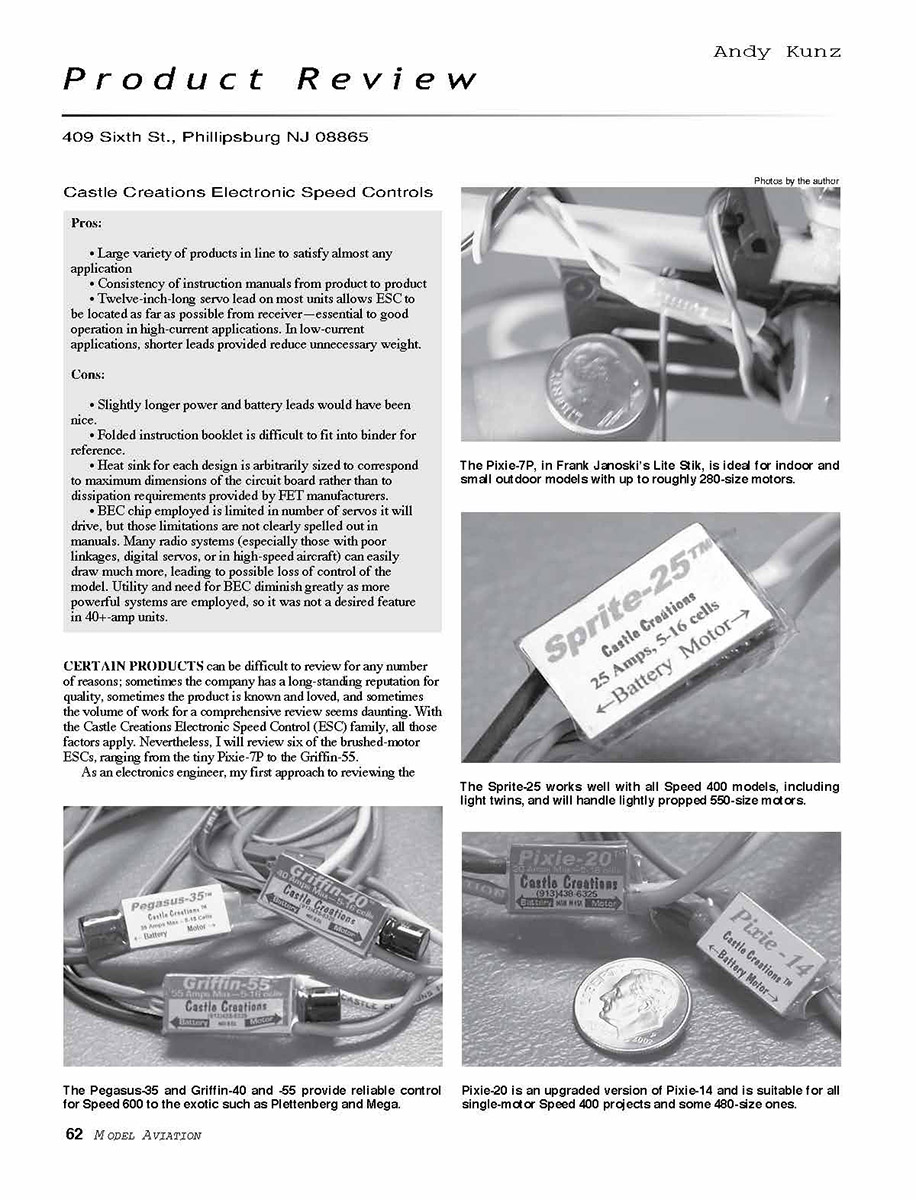
Pixie-7P: When I first looked at the 7P in the review package, I was slightly shocked it was tiny — roughly the same size as the two-amp controls at the hobby shop. After disassembly to identify components, I asked my friend Frank Janacki to try this tiny controller in his Lite Stik. He was kind enough to give us his views on the subject.
"I found the Pixie-7P very easy to set up and program. I started by soldering on my battery and motor connectors so it would easily fit the existing wiring on my GWS Lite Stik. After connecting the motor and powering up the controller I was ready to begin."
"The Safe Power On" feature of the Pixie ensures that setup proceeds with no unpleasant surprises. This provides a very welcome safety precaution especially where you consider that most of us tend to neglect preparation when an opportunity arises to get out on the field and go flying. This is why many of my readers have used Castle Creations units for safe operation of their models.
Castle Creations provides a simple set of instructions with the speed control. You are free to download an electronic version in Adobe Acrobat® format located on the Pixie-7P product page on their Website. Since my setup involved a lithium battery for extended flying times I wanted to be sure to set the Auto Motor Cut-Off at 4.7V and enable the Hard Cutoff option in order to avoid damage to the cells.
"The whole process of programming the speed control is a breeze. You simply use your transmitter's throttle stick at three distinct positions, full open, full closed, and half-throttle, to indicate your selections. The Pixie guides you through a very intuitive sequence of steps in order to confirm each setting. I found the manual very informative and completed the programming in no time."
"Flying is always lots of fun and I can honestly say that this little speed control has yet to let me down on the flying field. Aside from the other benefits, Castle Creations has built in a low torque Soft Start feature to help prevent excessive wear on gearboxes and bellcranks.
"The speed control can be set to automatically calibrate itself to the throttle range of your transmitter and has a built-in Smooth Reverse Exponential Throttle feature to make control as pleasant as possible."
"The Pixie performed extremely well time and time again as I repeatedly slowed the motor down to a glide and then popped the throttle to gain altitude.
One final feature worth mentioning is the Auto Shut-Down due to signal loss. With all the fun of flying, I'm sure this feature will come in handy. It's comforting to know that the next time I start daydreaming on the stick and wander outside of the range of my receiver I won't have to worry about my airplane flying off into the sunset.
I am very satisfied with the overall performance of this little controller. With its size and weight, programmability, exhaustive feature set, and proven reliability this unit finds its place as a welcome addition to my growing arsenal of slow fly electronics components.
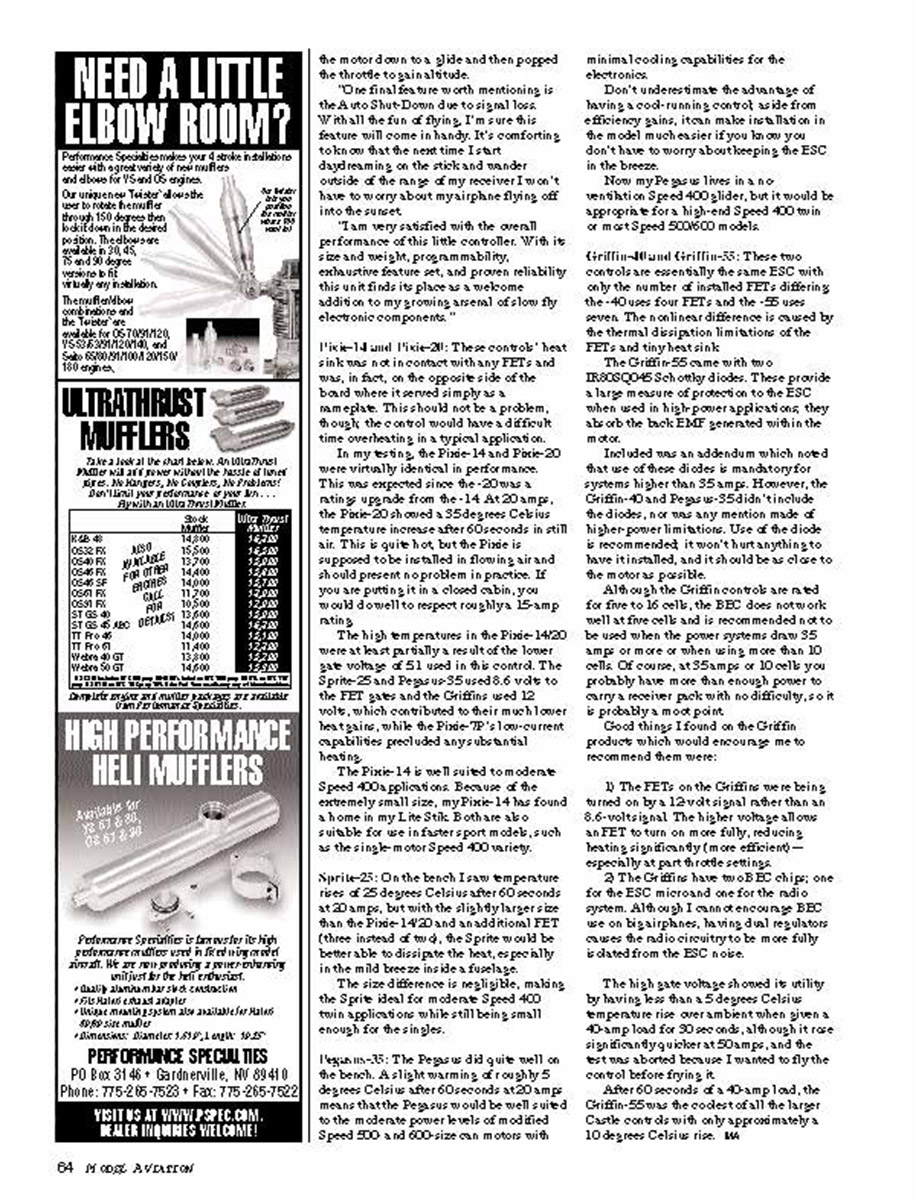
Pixie-14 and Pixie-24: These controls' heat sinks was not in contact with any FETs and was, in fact, on the opposite side of the board where it served simply as a nameplate. This should not be a problem, though; the control would have a difficult time overheating in a typical application.
In my testing, the Pixie-14 and Pixie-20 were virtually identical in performance. This was expected since the -20 was a rating upgrade from the -14. At 20 amps, the Pixie-20 showed a 35 degree Celsius temperature increase after 60 seconds in still air. This is quite hot, but the Pixie is supposed to be installed in flowing air and should present no problem in practice. If you are putting it in a closed cabin, you could double to respect your cabin 15 amp rating.
The high temperatures in the Pixie-14/20 were at least partially a result of the lower gate voltage of 5.1 used in this control. The Sprite-25 and Pegasus-35 used 8.6 volts to the FET gates and the Griffins used 12 volts, which contributed to their much lower heat rise, while the Pixie's low-current capabilities precluded any substantial heating.
The Pixie-14 is well suited to moderate Speed 400 applications. Because of the extremely small size, my Pixie-14 was found a home in my Lite Stik. Both are also suitable for use in faster sport models, such as the single-motor Speed 400 variety.
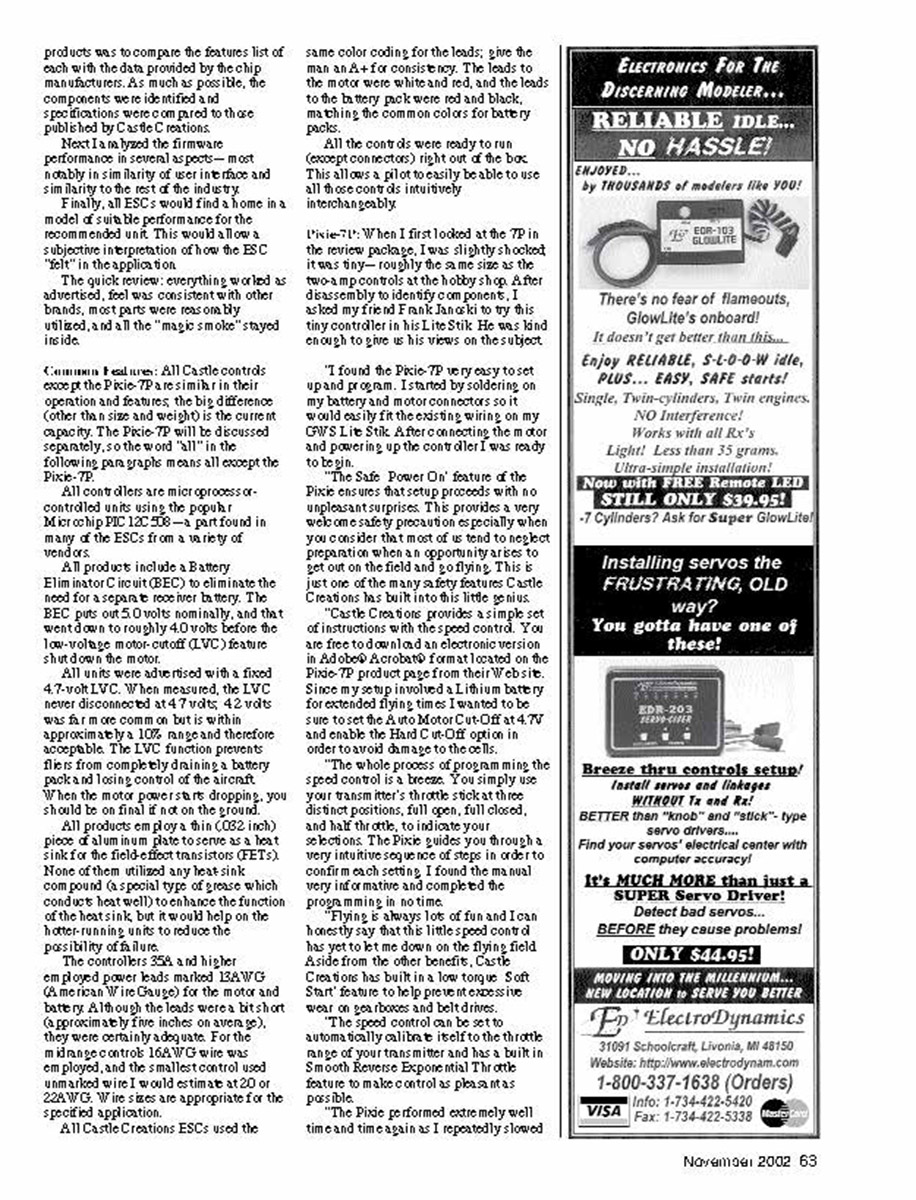
Sprite-25: On the bench I saw temperature rises of 25 degrees Celsius after 60 seconds at 20 amps, but with the slightly larger size than the Pixie-14/20 and an additional FET (three instead of two), the Sprite would be better able to dissipate the heat, especially in the mild breeze inside a fuselage.
The size difference is negligible, making the Sprite ideal for moderate Speed 400 twin applications while still being small enough for the singles.
Pegasus-35: The Pegasus did quite well on the bench. A slight warming of roughly 5 degrees Celsius after 60 seconds at 20 amps means that the Pegasus would be well suited to the moderate power levels of modified Speed 500 and 600-size can motors with minimal cooling capability for the electronics.
Don't underestimate the advantage of having a cool-running control aside from efficiency gains; it can make installation in the model much easier if you know you don't have to worry about keeping the ESC in the breeze.
Now my Pegasus lives in a no-ventilation Speed 400 glider, but it would be appropriate for a high-end Speed 400 twin or most Speed 500/600 models.
Griffin-55 and Griffin-75: These two controls are essentially the same ESC with only the number of installed FETs differing — the -40 uses four FETs and the -55 uses seven. The cooling performance is governed by the thermal dissipation limitations of the FETs and tiny heatsink.
The Griffin-55 came with two IRF3205/6305 Schottky diodes. These provide a large measure of protection to the ESC when used in high power applications; they absorb the back EMF generated within the motor.
I noted was an addendum which noted that use of these diodes is mandatory for systems higher than 35 amps. However, the Griffin-40 and Pegasus-35 did include the diodes, so no reason exists to make an a priori FET number limitation. Use of the diodes is recommended; it won't hurt anything to have them installed, and it should be as close to the motor as possible.
Although the Griffin controls are rated for 75 to 16 cells, the BEC does not work well with nine or ten cells and is recommended not to be used when the power systems draw 35 amps or more even if using more than 10 cells. Of course, at 35 amps or 10 cells you probably have more than enough power to carry a receiver pack with no difficulty, so it is probably a moot point.
Good things I found on the Griffin products which would encourage me to recommend them were:
- The FETs on the Griffins are being run on by a 12 volt signal rather than an 8.6-volt signal. The higher voltage allows an FET to turn on more fully, reducing heating significantly (more efficient), especially at part throttle settings.
- The Griffin drives have one BEC chip; one for the ESC microcode and one for the radio. Although I cannot encourage BEC use on airplanes, having dual regulators would make the radio circuitry more fully isolated from the ESC noise.
The high gate voltage showed its utility by having less than a 5 degree Celsius temperature rise over ambient when driven at 40 amps for 30 seconds, although it ran significantly quicker at 50 amps and the heatsink became too hot to handle, a not uncommon condition before flying the motor before flying it.
After 60 seconds at 40 amps load, the Griffin-55 was the coolest of all the larger Castle controls with only approximately a 10 degree Celsius rise.
Transcribed from original scans by AI. Minor OCR errors may remain.

