
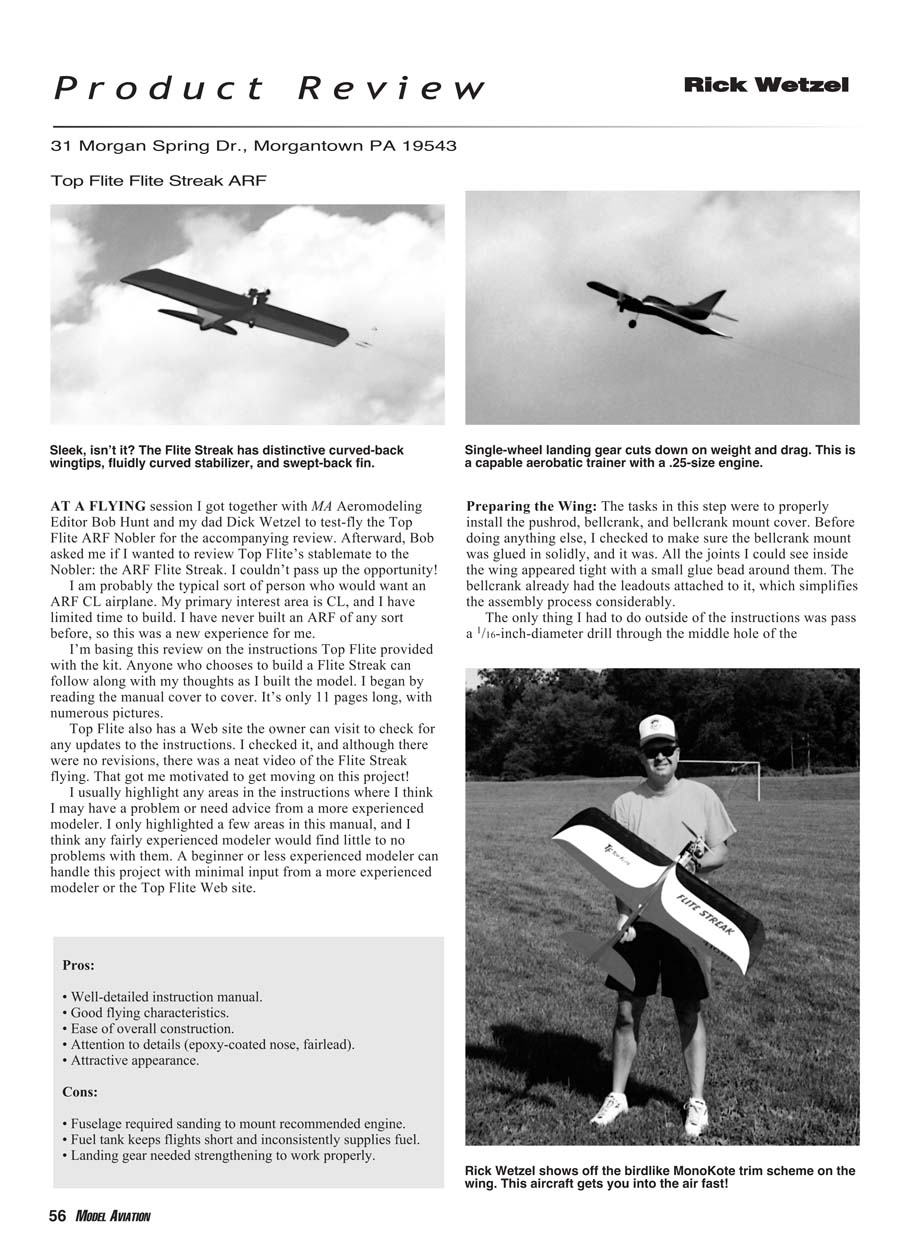
Product Review
Rick Wetzel
31 Morgan Spring Dr., Morgantown PA 19543
Top Flite Flite Streak ARF
AT A FLYING session I got together with MA Aeromodeling Editor Bob Hunt and my dad Dick Wetzel to test-fly the Top Flite ARF Nobler for the accompanying review. Afterward, Bob asked me if I wanted to review Top Flite’s stablemate to the Nobler: the ARF Flite Streak. I couldn’t pass up the opportunity!
I am probably the typical sort of person who would want an ARF CI airplane. My primary interest area is CL, and I have limited time to build. I have never built an ARF of any sort before, so this was a new experience for me.
I’m basing this review on the instructions Top Flite provided with the kit. Anyone who chooses to build a Flite Streak can follow along with my thoughts as I built the model. I began by reading the manual cover to cover. It’s only 11 pages long, with numerous pictures.
Top Flite also has a Web site the owner can visit to check for any updates to the instructions. I checked it, and although there were no revisions, there was a neat video of the Flite Streak flying. That got me motivated to get moving on this project!
I usually highlight any areas in the instructions where I think I may have a problem or need advice from a more experienced modeler. I only highlighted a few areas in this manual, and I think any fairly experienced modeler would find little to no problems with them. A beginner or less experienced modeler can handle this project with minimal input from a more experienced modeler or the Top Flite Web site.
Preparing the Wing: The tasks in this step were to properly install the pushrod, bellcrank, and bellcrank mount cover. Before doing anything else, I checked to make sure the bellcrank mount was glued in solidly, and it was. All the joints I could see inside the wing appeared tight with a small glue bead around them. The bellcrank already had the leadouts attached to it, which simplifies the assembly process considerably.
The only thing I had to do outside of the instructions was pass a 1/16-inch-diameter drill through the middle hole of the
Pros:
- Well-detailed instruction manual.
- Good flying characteristics.
- Ease of overall construction.
- Attention to details (epoxy-coated nose, fairlead).
- Attractive appearance.
Cons:
- Fuselage required sanding to mount recommended engine.
- Fuel tank keeps flights short and inconsistently supplies fuel.
- Landing gear needed strengthening to work properly.
Transcribed from original scans by AI. Minor OCR errors may remain.

