
Product Review
Steve Kaluf
When Bob Hunt, Model Aviation's aeromodeling editor, called to tell me he had a helicopter for me to review, I was excited! I hadn't done a product review in several years, and I like doing them. Bob proceeded to tell me it was a small, hardwired indoor helicopter—not what I expected, but intriguing. I figured this machine would probably be along the lines of a toy. Boy was I pleasantly surprised!
Packaging and Contents The box arrived a couple of days later at the office. I was determined to wait until I got home to open it, but lunchtime rolled around and it was too cold to go anywhere, so I could not resist taking a look.
I was happy to see that this little machine was a scale representation of a full-scale Lama (the helicopter—not the animal) and was manufactured by Hirobo, a respected maker of RC helicopters and other fine equipment. Hirobo is well known in the Fédération Aéronautique Internationale competition circuit.
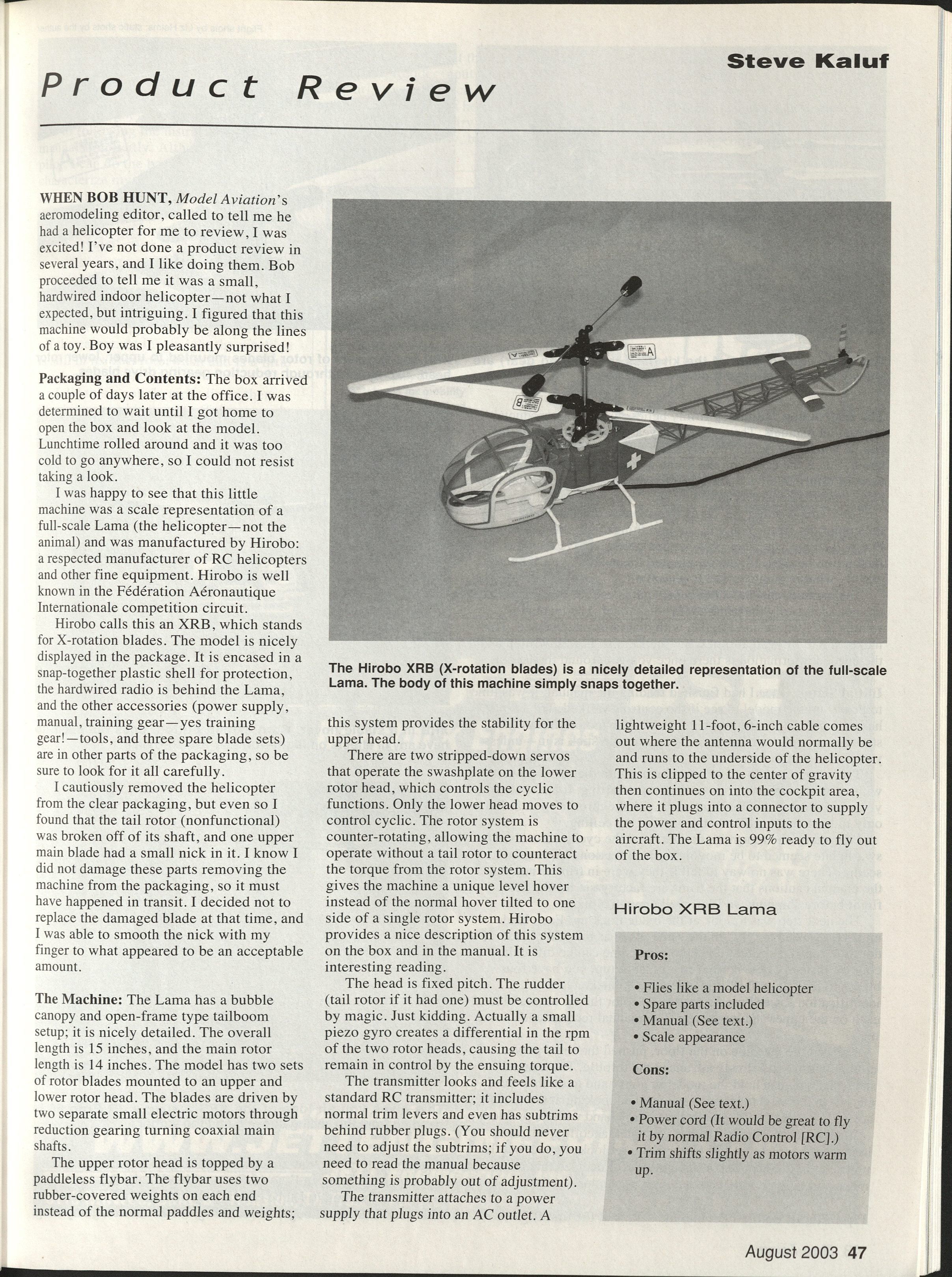
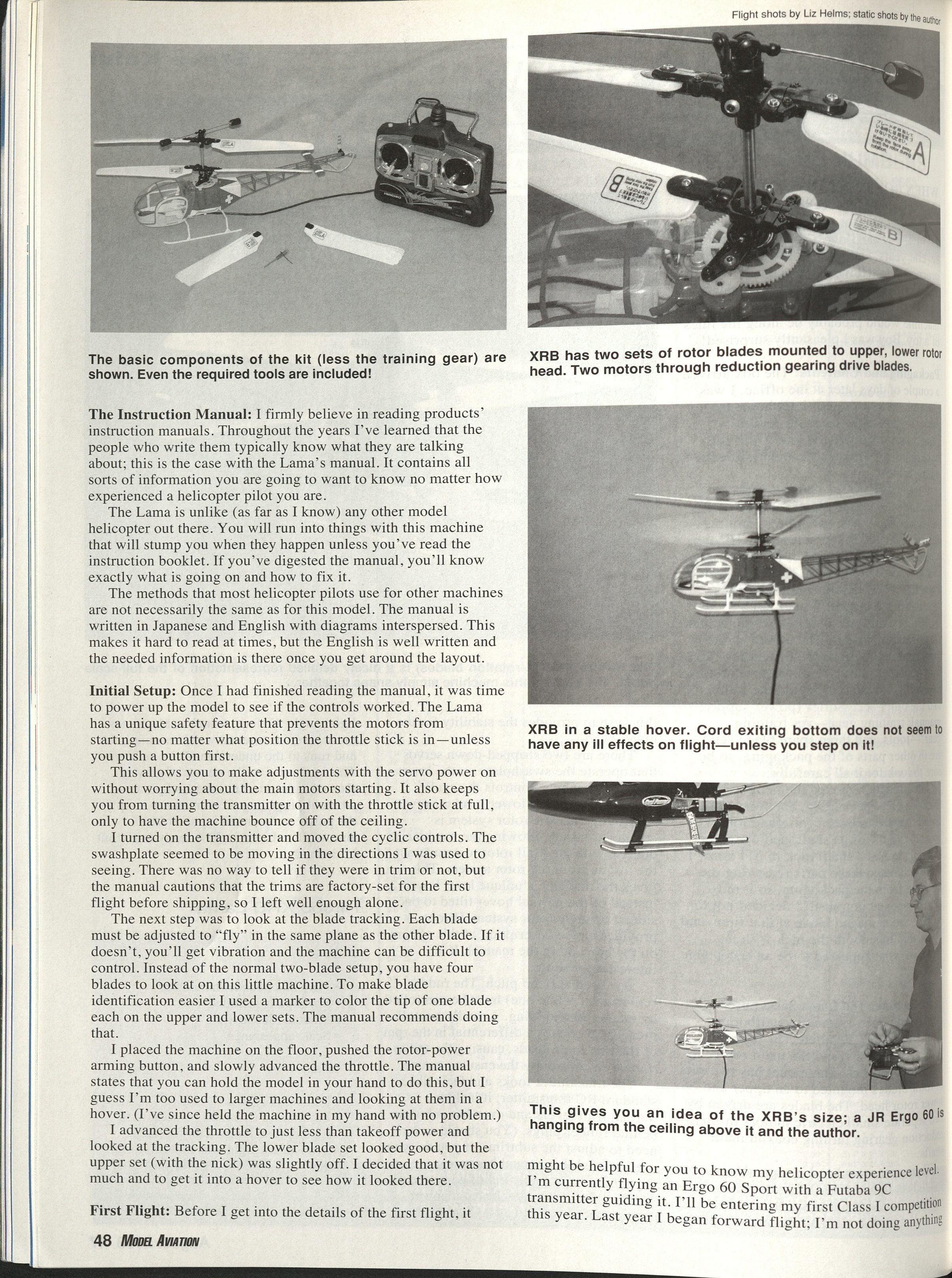
Hirobo calls this an XRB, which stands for X-rotation blades. The model is nicely displayed in the package and is encased in a snap-together plastic shell for protection. The hardwired radio is behind the Lama, and the other accessories (power supply, manual, training gear—yes, training gear!—tools, and three spare blade sets) are in other parts of the packaging, so be sure to look for everything carefully.
I cautiously removed the helicopter from the clear packaging and found that the tail rotor (nonfunctional) was broken off its shaft and one upper main blade had a small nick. I know I did not damage these parts removing the machine from the packaging, so it must have happened in transit. I decided not to replace the damaged blade at that time and was able to smooth the nick with my finger to an acceptable amount.
The Machine
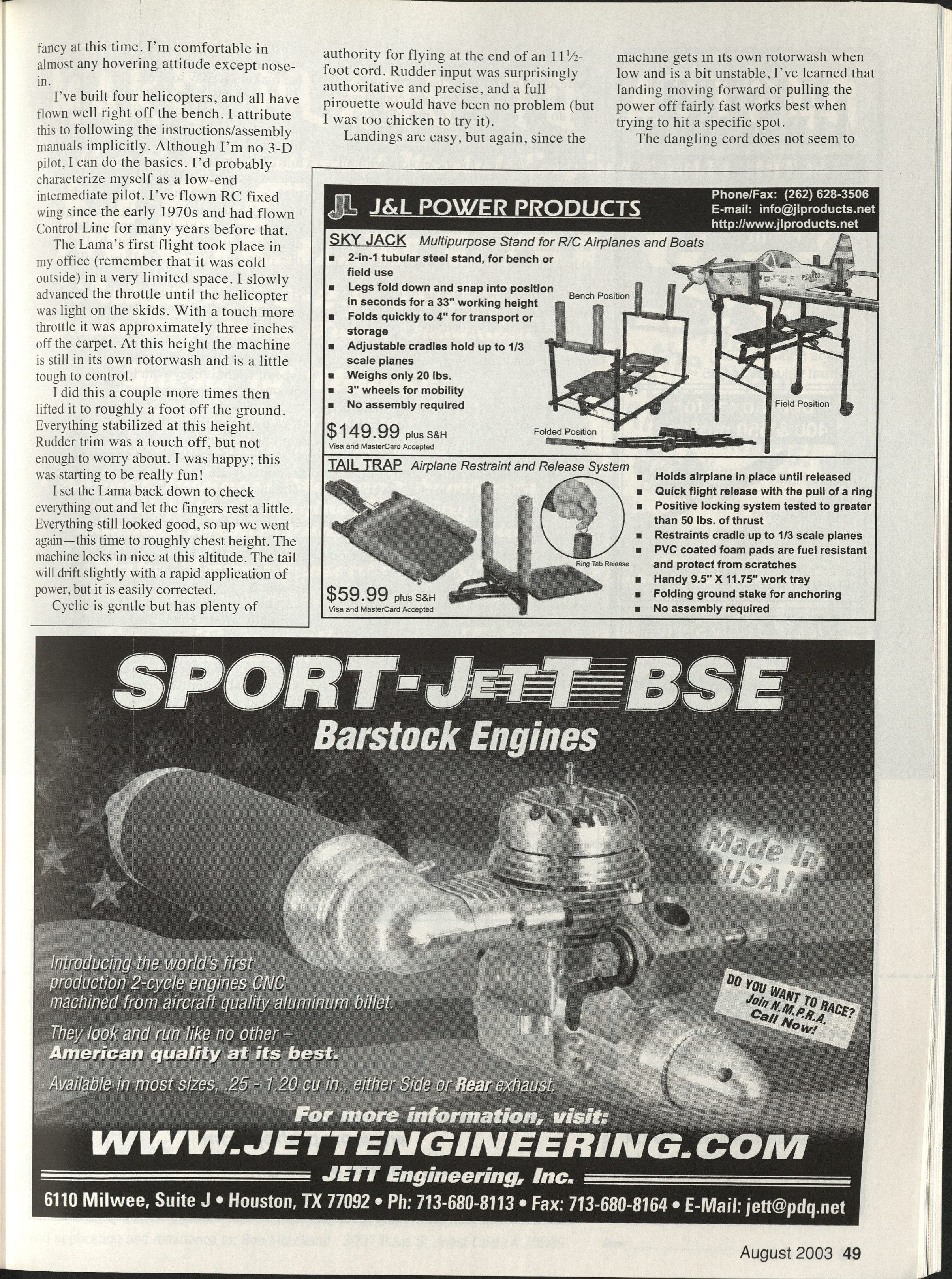
The Lama has a bubble canopy and an open-frame tailboom setup; it is nicely detailed. Overall length is 15 inches, and the main rotor diameter is 14 inches. The model has two sets of rotor blades mounted to an upper and lower rotor head. The blades are driven by two separate small electric motors through reduction gearing turning coaxial main shafts.
The upper rotor head is topped by a paddleless flybar. The flybar uses two rubber-covered weights on each end instead of the normal paddles and weights; this system provides stability for the upper head.
There are two stripped-down servos that operate the swashplate on the lower rotor head, which controls the cyclic functions. Only the lower head moves to control cyclic. The rotor system is counter-rotating, allowing the machine to operate without a tail rotor to counteract torque from the rotor system. This gives the machine a unique level hover instead of the normal hover tilted to one side as in a single-rotor system. Hirobo provides a nice description of this system on the box and in the manual; it is interesting reading.
The head is fixed-pitch. The rudder (tail rotor if it had one) must be controlled by magic. Just kidding. A small piezo gyro creates a differential in the rpm of the two rotor heads, causing the tail to remain under control by the ensuing torque.
The transmitter looks and feels like a standard RC transmitter; it includes normal trim levers and even has subtrims behind rubber plugs. (You should never need to adjust the subtrims; if you do, read the manual because something is probably out of adjustment.)
The transmitter attaches to a power supply that plugs into an AC outlet. A lightweight 11-foot, 6-inch cable comes out where the antenna would normally be and runs to the underside of the helicopter. This is clipped to the center of gravity and then continues into the cockpit area, where it plugs into a connector to supply power and control inputs to the aircraft. The Lama is 99% ready to fly out of the box.
Hirobo XRB Lama
Pros:
- Flies like a model helicopter
- Spare parts included
- Manual (see text)
- Scale appearance
Cons:
- Manual (see text)
- Power cord (it would be great to fly it by normal radio control)
- Trim shifts slightly as motors warm up
The Instruction Manual
I firmly believe in reading instruction manuals. Over the years I've learned that the people who write them typically know what they're talking about; this is the case with the Lama's manual. It contains all sorts of information you will want to know no matter how experienced a helicopter pilot you are.
The Lama is unlike (as far as I know) any other model helicopter out there. You will run into things with this machine that will stump you when they happen unless you've read the instruction booklet. If you've digested the manual, you'll know exactly what is going on and how to fix it.
The methods most helicopter pilots use for other machines are not necessarily the same as for this model. The manual is written in Japanese and English with diagrams interspersed. This makes the layout a little awkward at times, but the English is well written and the needed information is there once you get around the layout.
Initial Setup
Once I had finished reading the manual, it was time to power up the model to see if the controls worked. The Lama has a unique safety feature that prevents the motors from starting—no matter what position the throttle stick is in—unless you push a button first.
This allows you to make adjustments with the servo power on without worrying about the main motors starting. It also keeps you from turning the transmitter on with the throttle stick at full, only to have the machine bounce off the ceiling.
I turned on the transmitter and moved the cyclic controls. The swashplate seemed to be moving in the directions I was used to seeing. There was no way to tell if they were in trim or not, but the manual cautions that the trims are factory-set for the first flight before shipping, so I left well enough alone.
The next step was to look at the blade tracking. Each blade must be adjusted to "fly" in the same plane as the other blade. If it doesn't, you'll get vibration and the machine can be difficult to control. Instead of the normal two-blade setup, you have four blades to look at on this little machine. To make blade identification easier I used a marker to color the tip of one blade on the upper and lower sets. The manual recommends doing that.
I placed the machine on the floor, pushed the rotor-power arming button, and slowly advanced the throttle. The manual states that you can hold the model in your hand to do this; I guess I'm too used to larger machines and looking at them in a hover. (I've since held the machine in my hand with no problem.)
I advanced the throttle to just less than takeoff power and looked at the tracking. The lower blade set looked good, but the upper set (with the nick) was slightly off. I decided it was not much and got it into a hover to see how it looked there.
First Flight
Before I get into the details of the first flight, a bit about my helicopter experience level: I'm currently flying an Ergo 60 Sport with a Futaba 9C transmitter. I'll be entering my first Class I competition this year. Last year I began forward flight; I'm not doing anything fancy at this time. I'm comfortable in almost any hovering attitude except nose-in.
I've built four helicopters, and all have flown well right off the bench. I attribute this to following instructions and assembly manuals implicitly. Although I'm no 3-D pilot, I can do the basics. I'd characterize myself as a low-end intermediate pilot. I've flown RC fixed wing since the early 1970s and had flown control line for many years before that.
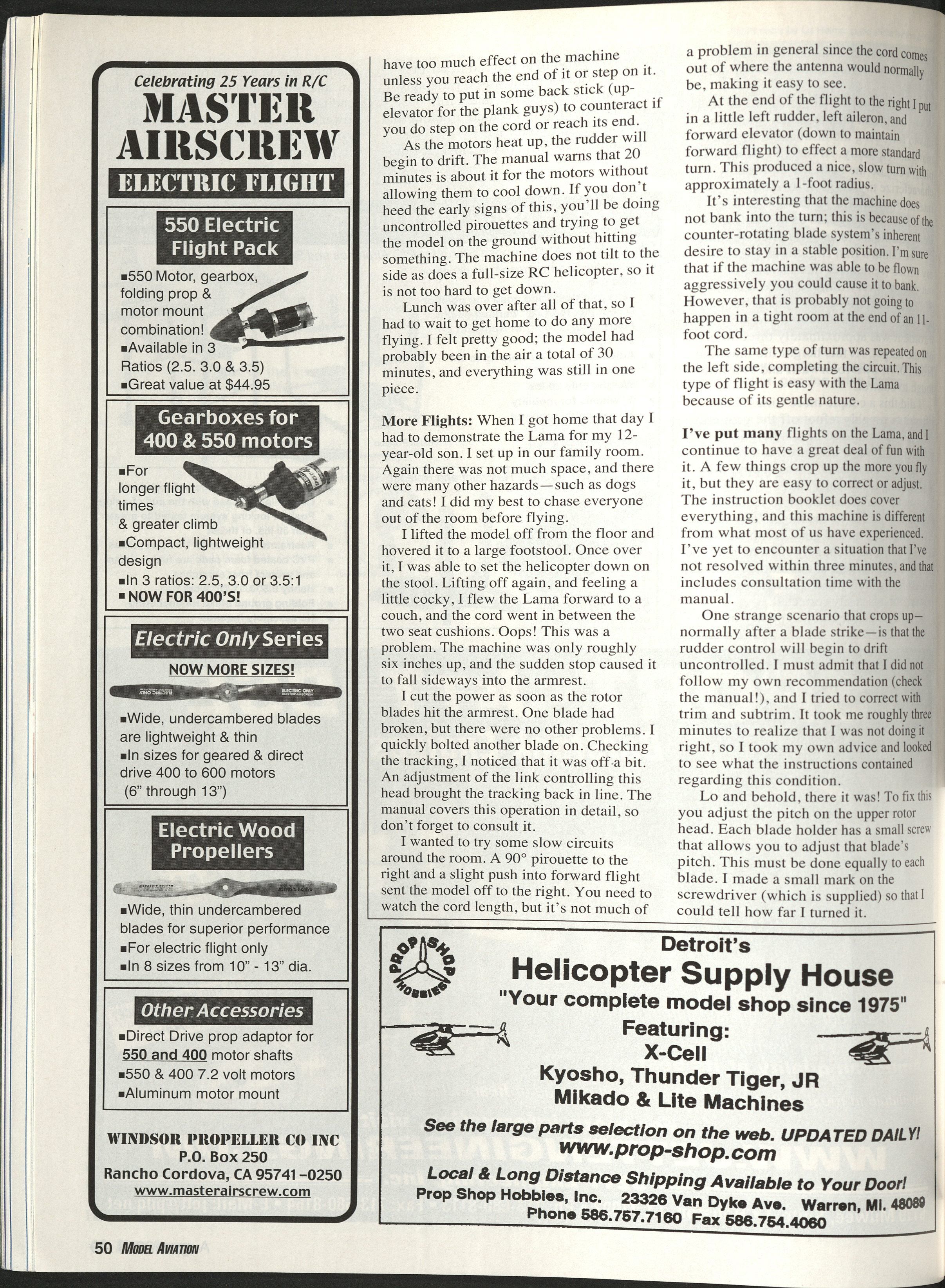
The Lama's first flight took place in my office (remember that it was cold outside) in very limited space. I slowly advanced the throttle until the helicopter was light on the skids. With a touch more throttle it was approximately three inches off the carpet. At this height the machine is still in its own rotorwash and is a little tough to control.
I did this a couple more times then lifted it to roughly a foot off the ground. Everything stabilized at this height. Rudder trim was a touch off, but not enough to worry about. I was happy; this was starting to be really fun!
I set the Lama back down to check everything out and let my fingers rest a little. Everything still looked good, so up we went again—this time to roughly chest height. The machine locks in nicely at this altitude. The tail will drift slightly with a rapid application of power, but it is easily corrected.
Cyclic is gentle but has plenty of authority for flying at the end of an 11½-foot cord. Rudder input was surprisingly authoritative and precise, and a full pirouette would have been no problem (but I was too chicken to try it).
Landings are easy, but since the machine gets in its own rotorwash when low and is a bit unstable, I've learned that landing while moving forward or pulling the power off fairly quickly works best when trying to hit a specific spot.
The dangling cord does not seem to have much effect on the machine unless you reach the end of it or step on it. Be ready to put in some back stick (up-elevator for the plank guys) to counteract it if you do step on the cord or reach its end.
As the motors heat up, the rudder will begin to drift. The manual warns that about 20 minutes is about it for the motors without allowing them to cool down. If you don't heed the early signs of this, you'll be doing uncontrolled pirouettes and trying to get the model on the ground without hitting something. The machine does not tilt to the side as a full-size RC helicopter does, so it is not too hard to get down.
Lunch was over after all of that, so I had to wait to get home to do any more flying. I felt pretty good; the model had probably been in the air a total of 30 minutes, and everything was still in one piece.
More Flights When I got home that day I had to demonstrate the Lama for my 12-year-old son. I set up in our family room. Again there was not much space, and there were many other hazards—such as dogs and cats! I did my best to chase everyone out of the room before flying.
I lifted the model from the floor and hovered it to a large footstool. Once over it, I was able to set the helicopter down on the stool. Lifting off again, and feeling a little cocky, I flew the Lama forward to a couch, and the cord went between the two seat cushions. Oops! The sudden stop caused it to fall sideways into the armrest.
I cut the power as soon as the rotor blades hit the armrest. One blade had broken, but there were no other problems. I quickly bolted another blade on. Checking the tracking, I noticed it was off a bit. An adjustment of the link controlling this head brought the tracking back in line. The manual covers this operation in detail, so consult it.
I wanted to try some slow circuits around the room. A 90° pirouette to the right and a slight push into forward flight sent the model off to the right. You need to watch the cord length, but it's not much of a problem in general since the cord comes out where the antenna would normally be, making it easy to see.
At the end of the flight to the right I put in a little left rudder, left aileron, and forward elevator (down to maintain forward flight) to effect a more standard turn. This produced a nice, slow turn with approximately a 1-foot radius.
It's interesting that the machine does not bank into the turn; this is because the counter-rotating blade system inherently desires to stay in a stable position. I'm sure that if the machine were flown aggressively you could cause it to bank, but that is probably not going to happen in a tight room at the end of an 11-foot cord.
The same type of turn was repeated on the left side, completing the circuit. This type of flight is easy with the Lama because of its gentle nature.
I've put many flights on the Lama, and I continue to have a great deal of fun with it. A few things crop up the more you fly it, but they are easy to correct or adjust. The instruction booklet covers everything, and this machine is different from what most of us have experienced. I've yet to encounter a situation I haven't resolved within three minutes, including consultation with the manual.
One strange scenario that crops up—normally after a blade strike—is that the rudder control will begin to drift uncontrolled. I must admit I did not follow my own recommendation (check the manual!), and I tried to correct with trim and subtrim. It took me roughly three minutes to realize I was not doing it right, so I looked to see what the instructions contained regarding this condition.
Lo and behold, there it was. To fix this you adjust the pitch on the upper rotor head. Each blade holder has a small screw that allows you to adjust that blade's pitch. This must be done equally to each blade. I made a small mark on the screwdriver (which is supplied) so I could tell how far I turned it.
You must remember to check this adjustment while the motors are running. It is pretty easy once you get the hang of it. Also, be careful where you make this adjustment; small changes are all that are needed.
I have come to accept that there is little you can do to make the Lama do aerobatics. It is not built for them. What it does do is provide a fun, easy-to-fly indoor helicopter that is very scale in appearance and behavior. It's great for teaching a new pilot the basics of helicopter control without the intimidation factor of a full-size model.
The manual recommends changing the pitch a half turn at a time. I ended up turning the screws approximately one-and-a-half turns (a half turn at a time) to correct the trim. If you think about this adjustment, it is logical: the two sets of blades must be set to the same pitch to maintain the same rpm. So when one is out of adjustment, you get an out-of-trim situation with the rudder.
The blades used on the Lama are constructed from lightweight foam; as a result, they are safe but fairly fragile. The model is supplied with three complete sets. Eventually you will hit a blade or two. I've run the model into a couch, a desk, and a fabric-covered wing, and no damage was done to anything I hit—not even a mark. The blade broke, but nothing else did. I suspect it would hurt if you put a hand in the blades, but I doubt any real damage would be done.
You can increase control sensitivity by changing the linkage on the top rotor head from one side to the other. This gives more control authority, but it is not overly sensitive and it's still smooth. I've heard of others taking the flybar weights off to really up the control authority, but I haven't tried that yet.
The Hirobo XRB Lama is a great little helicopter. This machine is no more a toy than a full-size RC helicopter; it does take some skill to fly it. However, by the same token it is not hard to fly.
The best thing about the Lama is that it really flies like a model helicopter. Its fixed pitch is so stable that you'll think you have collective pitch. There is none of the "throttle jockeying" normally associated with trying to hold a fixed-pitch machine at a constant altitude.
The damage done, in even the most severe crash, is next to nothing. This means the "pucker factor" of trying to fly a helicopter or attempting maneuvers or flight attitudes such as a nose-in hover is low. The machine's inherent stability makes it easy to fly. In many ways it replaces the simulator time many of us use to try such things as a nose-in hover. Certainly you won't be trying 3-D flight with this model.
The Lama also fulfills a need for those of us in cold climates; with it we can fly anytime we want. I love to hover, and this helicopter is really good at that. My next step will be to allow my 12-year-old son some stick time and see how he progresses with it. (I'll stock up on blades first!)
The Hirobo XRB Lama sells for approximately $300 and is distributed in the U.S. by Altech Marketing, which is a division of Model Rectifier Corporation. I've seen this helicopter listed between $270 and slightly more than $300. It is a super little machine that I feel anyone interested in helicopters (regardless of skill level) will enjoy.
(Editor's note: Altech Marketing has asked us to include the following maintenance advice. For long-term preventive care of the XRB Lama, oil the exposed motor bushing before flying for the day or if you get a sudden drifting after extended periods of time. If the helicopter does not sound as smooth as it did at first, oil the motors as well.)
Distributor
Model Rectifier Corporation Box 6312 Edison, NJ 08837 (732) 225-2100 www.modelrectifier.com
Transcribed from original scans by AI. Minor OCR errors may remain.

